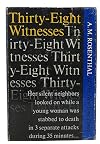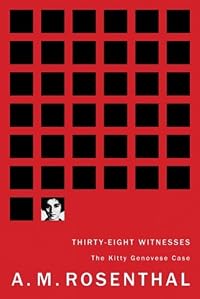
Thirty-Eight Witnesses: The Kitty Genovese Case
by A. M. Rosenthal
On This Page
Description
"In a decade scarred by national tragedy, March 13, 1964, stands apart. Not because of the identity of the victim - whose name was not Kennedy, King, or Malcolm - but because of the circumstances. Kitty Genovese was a 28-year-old middle-class woman from Kew Gardens, Queens, whose murder was distinguished by the presence of thirty-eight witnesses, not one of whom did a thing to stop the series of attacks that would claim her life." "First published over thirty years ago, Thirty-Eight show more Witnesses remains an important social document. As related by one of the best-known and most controversial newspaper professionals in the country, it is part memoir, part investigative journalism, and part public service. In a new introduction, A.M. Rosenthal examines why the murder of Kitty Genovese still has the power to shock an otherwise jaded world."--Jacket. show lessTags
Recommendations





















Member Reviews
I received this book from the publisher in exchange for a review. This did not effect my opinions of the book, or the review itself.
I distinctly remember being shocked and horrified by this case when I first learned about in my Social Psychology class in college. As I began to read more and more true crime, I sought out books on Kitty Genovese (two of which have recently been published, only one of which I have so far read).
This is the original book on the subject, reissued for a new generation of readers hungry to understand just what happened. Rosenthal was a newspaper editor who not only sent his reporters out on the case, but was the first to break the story of the thirty-eight witnesses and their famous "apathy".
Though the book show more originally came out over 40 years ago, it still feels relevant today. Rosenthal forces his readers to examine the hard-hitting questions no one truly likes to think about:
What would I myself have done if I was one of those thirty-eight?
Would I have acted any differently?
Do I act any differently in my everyday life?
Am I just the same as those thirty-eight infamous witnesses? show less
I distinctly remember being shocked and horrified by this case when I first learned about in my Social Psychology class in college. As I began to read more and more true crime, I sought out books on Kitty Genovese (two of which have recently been published, only one of which I have so far read).
This is the original book on the subject, reissued for a new generation of readers hungry to understand just what happened. Rosenthal was a newspaper editor who not only sent his reporters out on the case, but was the first to break the story of the thirty-eight witnesses and their famous "apathy".
Though the book show more originally came out over 40 years ago, it still feels relevant today. Rosenthal forces his readers to examine the hard-hitting questions no one truly likes to think about:
What would I myself have done if I was one of those thirty-eight?
Would I have acted any differently?
Do I act any differently in my everyday life?
Am I just the same as those thirty-eight infamous witnesses? show less
This book is a short reflection on Kitty Genovese by the then Metropolitan Editor at the New York Times, discussing the origins of the news story and case, his involvement both professionally and personally, and the overreaching implications of the Kitty Genovese Murder.
For those not in the know, Kitty Genevose was stabbed to death on a residential city street at 3AM in 1964 - stabbed three different times over a half-hour period - while thirty-eight witnesses to the crime neglected to call police for a variety of unacceptable reasons.
The only person to call the police explained that he had called the police after much deliberation. He had phoned a friend in Nassau County for advice and then he had crossed the roof of the building to show more the apartment of the elderly woman to get her to make the call more than ten minutes after Kitty Genovese had been fatally stabbed a third, separate time.
Kitty Genovese's murder evoked outrage - often inappropriately directed - and instigated a lengthy discussion about societal roles, human apathy, and raises more questions without answers. Rosenthal's short volume on the subject examines many of the different angles of the Genovese murder, from societal responsibilities to New York's problems inherent in its relationship with the NYPD, striving to find meaning while maintaining the detailed observations of a newspaper reporter.
There are no easy answers at the end of Rosenthal's book, as he admits himself, but he handles the complexity of this crime and its aftermath with a level of professionalism that never betrays his humanity or attachment to it.
NOTE: Interestingly, if only to me, the author details that the true scope of the Kitty Genovese murder revealed itself to him when having lunch with the New York Police Commissioner on March (3) Twenty-Third (23). 23 Skidoo. show less
For those not in the know, Kitty Genevose was stabbed to death on a residential city street at 3AM in 1964 - stabbed three different times over a half-hour period - while thirty-eight witnesses to the crime neglected to call police for a variety of unacceptable reasons.
The only person to call the police explained that he had called the police after much deliberation. He had phoned a friend in Nassau County for advice and then he had crossed the roof of the building to show more the apartment of the elderly woman to get her to make the call more than ten minutes after Kitty Genovese had been fatally stabbed a third, separate time.
Kitty Genovese's murder evoked outrage - often inappropriately directed - and instigated a lengthy discussion about societal roles, human apathy, and raises more questions without answers. Rosenthal's short volume on the subject examines many of the different angles of the Genovese murder, from societal responsibilities to New York's problems inherent in its relationship with the NYPD, striving to find meaning while maintaining the detailed observations of a newspaper reporter.
There are no easy answers at the end of Rosenthal's book, as he admits himself, but he handles the complexity of this crime and its aftermath with a level of professionalism that never betrays his humanity or attachment to it.
NOTE: Interestingly, if only to me, the author details that the true scope of the Kitty Genovese murder revealed itself to him when having lunch with the New York Police Commissioner on March (3) Twenty-Third (23). 23 Skidoo. show less
This account of the murder of a young woman in New York back in 1964 is very thought provoking. No less than 38 people witnessed - either visually or aurally - the murder, and yet not one of them summoned the police or any other form of help. Much has be written since this case as to why people would behave like this, what it says about our society, what it says about human beings. This book is a re-print of an piece written at the time by a Pulitzer prize winning journalist. Since reading it I have found myself pondering about the issues he raises.
This case has always intrigued me, it’s about a young woman, Kitty Genovese who was murdered in 1964. She was coming home after closing a bar that she managed to her safe, neighborhood in Queens. She is being followed by a man who randomly follows women home who are driving alone at night to kill them. While she’s parking her car she notices the man is approaching her so she tries to get to a police call box to call for help. He's on her before she can get there and stabs her in the stomach, she cries out for help, several times. The lights are being turned on in the building of her home and several windows were opened and some people are shouting out for the man to leave her alone, they are more irritated by being woken up at 3:00 show more AM than hearing a woman fight for her life.
The assailant runs from the scene after the first attack which gives Kitty time to try to make it to the door of her home. He's come back to finish what he started while she's still screaming out for help. He finally stabs her in the throat to stop her from screaming. All the while thirty-eight people are watching. Anyone of them could have picked up their phone and dialed "0" to get help if they didn't want to physically get involved. It didn't seem to take much to scare the man off since they had already done it once. One man calls the police but it was too late, he calls from a neighbor's phone after he calls his friend for advice. It's unbelievable.
This is a short book that was written from a famous newspaper editor’s point of view, he is so torn as to why no one bothered to call the police sooner and what stopped them. He sends a reporter out there to interview some of the witnesses and also get the feel of the neighborhood. The excuses he gets are just awful, it's like they didn't care. They didn't want to get involved that's the bottom line. Some would have the nerve to blame the police, from past bad experiences that they had when talking to them.
It’s was interesting to read how archaic police communications were back then. This crime did prompt a change in police communications in New York city. Even though if they would have been called while the first attack was waking was taking place, Kitty's life would have been saved.
I was disappointed in the fact that the book didn't focus more on the crime and the investigation itself. It was a bit dry in places when the author would make comparisons regarding what he saw while he was a foreign correspondent in third world countries and what happened that night in Queens, it's was almost like he was wrestling with his own conscience.
This book was mainly from a journalistic point of view. I felt I reading a personal journal of the author's account of his feelings regarding this incident.
I would like to thank Open Road Media and NetGalley for providing me a copy of this e-galley to read and give my honest opinion. show less
The assailant runs from the scene after the first attack which gives Kitty time to try to make it to the door of her home. He's come back to finish what he started while she's still screaming out for help. He finally stabs her in the throat to stop her from screaming. All the while thirty-eight people are watching. Anyone of them could have picked up their phone and dialed "0" to get help if they didn't want to physically get involved. It didn't seem to take much to scare the man off since they had already done it once. One man calls the police but it was too late, he calls from a neighbor's phone after he calls his friend for advice. It's unbelievable.
This is a short book that was written from a famous newspaper editor’s point of view, he is so torn as to why no one bothered to call the police sooner and what stopped them. He sends a reporter out there to interview some of the witnesses and also get the feel of the neighborhood. The excuses he gets are just awful, it's like they didn't care. They didn't want to get involved that's the bottom line. Some would have the nerve to blame the police, from past bad experiences that they had when talking to them.
It’s was interesting to read how archaic police communications were back then. This crime did prompt a change in police communications in New York city. Even though if they would have been called while the first attack was waking was taking place, Kitty's life would have been saved.
I was disappointed in the fact that the book didn't focus more on the crime and the investigation itself. It was a bit dry in places when the author would make comparisons regarding what he saw while he was a foreign correspondent in third world countries and what happened that night in Queens, it's was almost like he was wrestling with his own conscience.
This book was mainly from a journalistic point of view. I felt I reading a personal journal of the author's account of his feelings regarding this incident.
I would like to thank Open Road Media and NetGalley for providing me a copy of this e-galley to read and give my honest opinion. show less
Ratings
Members
- Recently Added By
Lists

The Great Courses: The Great Ideas of Psychology
61 works; 1 member
Author Information
16+ Works 1,045 Members
Common Knowledge
- Canonical title
- Thirty-Eight Witnesses: The Kitty Genovese Case
- Original publication date
- 1964
- First words
- This small book is about a woman I never met but who touched my life as she did the lives of many other people—some tens of thousands, I think. I know very little about her except her name, which was Catherine Genovese, and... (show all) her age, which was twenty-eight, and the manner of her dying.
- Last words
- (Click to show. Warning: May contain spoilers.)There are, it seems to me, only two logical ways to look at the story of the murder of Catherine Genovese. One is the way of the neighbor on Austin Street—“Let’s forget the whole thing.”
The other is to recognize that the bell tolls even on each man’s individual island, to recognize that every man must fear the witness in himself who whispers to close the window.
Classifications
- Genres
- Nonfiction, Sociology, General Nonfiction, Politics and Government, History, Philosophy
- DDC/MDS
- 364.15 — Society, government, & culture Social problems and social services Crime Criminal offenses Offenses against the person
- LCC
- HV6534 .N5 .R65 — Social sciences Social pathology. Social and public welfare. Criminology Social pathology. Social and public welfare. Criminology Crimes and offenses
- BISAC
Statistics
- Members
- 74
- Popularity
- 426,391
- Reviews
- 4
- Rating
- (3.56)
- Languages
- English, Japanese
- Media
- Paper, Ebook
- ISBNs
- 7
- ASINs
- 4