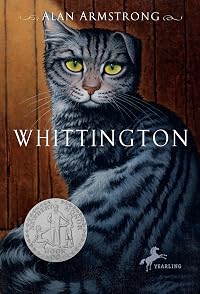
Whittington
by Alan W. Armstrong
On This Page
Description
Whittington, a feline descendant of Dick Whittington's famous cat of English folklore, appears at a rundown barnyard plagued by rats and restores harmony while telling his ancestor's story.Tags
Recommendations







Member Recommendations
Member Reviews
Bernie keeps a barn full of animals the rest of the world has no use for - two retired trotters, a rooster, some banty hens, and a Muscovy duck with clipped wings who calls herself The Lady. The Lady is pretty much the Law, and so, when the cat called Whittington shows up one day, it is to the Lady that he makes an appeal to secure a place in the barn. "Why don't you just take it?" she asks him. From the looks of him, he's one tough customer. "Because," the cat explains, "I want to be part of the talking."
Bernie's orphaned grandkids, Abby and Ben, come to the barn to help feed the animals. Eight-year-old Ben, Abby says with "the worry of love," is not reading well. Whittington and the Lady decide that Abby should give Ben lessons in the show more barn.
It is a balm for Ben when, having toughed out the daily reading tutorial, Whittington comes to tell, in tantalizing installments, the story handed down to him from his nameless forebear, Dick Whittington's cat. It is the legend of the lad born into poverty in rural England during the Black Death, who runs away to London, where he has heard the streets are paved with gold. In London he discovers a world of excitement and opportunity and, of course, the cat who brings him fortune and riches beyond his wildest imaginings.
Alan Armstrong's narrative weaves back and forth hypnotically between the domestic details of the barn and the rousing and exotic adventures of Dick Whittington and his cat as he becomes a trader in "fine silks, brocades and satins, glowing velvets and flashing taffetas," traveling the ancient spice routes to the Far East.
Crafted by a master storyteller, this is an unforgettable tale about how learning to read saves one young boy. show less
Bernie's orphaned grandkids, Abby and Ben, come to the barn to help feed the animals. Eight-year-old Ben, Abby says with "the worry of love," is not reading well. Whittington and the Lady decide that Abby should give Ben lessons in the show more barn.
It is a balm for Ben when, having toughed out the daily reading tutorial, Whittington comes to tell, in tantalizing installments, the story handed down to him from his nameless forebear, Dick Whittington's cat. It is the legend of the lad born into poverty in rural England during the Black Death, who runs away to London, where he has heard the streets are paved with gold. In London he discovers a world of excitement and opportunity and, of course, the cat who brings him fortune and riches beyond his wildest imaginings.
Alan Armstrong's narrative weaves back and forth hypnotically between the domestic details of the barn and the rousing and exotic adventures of Dick Whittington and his cat as he becomes a trader in "fine silks, brocades and satins, glowing velvets and flashing taffetas," traveling the ancient spice routes to the Far East.
Crafted by a master storyteller, this is an unforgettable tale about how learning to read saves one young boy. show less
A battle-scarred tomcat named Whittington moves into a barn full of rescued farm animals. The barn belongs to an old filling-station owner and his wife, who are raising their two grandchildren; the children's mother is dead and their father absent and uninvolved. Moreover, the boy is dyslexic and angry about it and almost everything else. The cat, meanwhile, claims to be a descendant of the famous Dick Whittington's cat, and he begins to tell Whittington's story to the assembled animals and the children.
So, a barn full of talking animals,children with modern problems, and a legendary story from medieval England. Who would think such disparate elements could be combined into such a good book?
Armstrong doesn't sugarcoat the animals just show more because he makes them capable of speech. Cats get in fights, killing rats and even other cats; predators attack the farm animals; a neighboring cat in heat attracts Whittington's attentions. In short, the animals behave like animals. The human characters, as well, are realistically drawn and not too good to be true. Through much research, detailed in a note at the end, Armstrong has fleshed out the story of Dick Whittington into a tale that held my interest, as well as that of the book's characters.
I think any middle-grade reader would like this book, and it would be useful in sensitizing children to the problems of dyslexia without being overly didactic. show less
So, a barn full of talking animals,children with modern problems, and a legendary story from medieval England. Who would think such disparate elements could be combined into such a good book?
Armstrong doesn't sugarcoat the animals just show more because he makes them capable of speech. Cats get in fights, killing rats and even other cats; predators attack the farm animals; a neighboring cat in heat attracts Whittington's attentions. In short, the animals behave like animals. The human characters, as well, are realistically drawn and not too good to be true. Through much research, detailed in a note at the end, Armstrong has fleshed out the story of Dick Whittington into a tale that held my interest, as well as that of the book's characters.
I think any middle-grade reader would like this book, and it would be useful in sensitizing children to the problems of dyslexia without being overly didactic. show less
This winning tale introduces Whittington, a roughneck Tom who arrives one day at a barn full of rescued animals and asks for a place there. He spins for the animals—as well as for Ben and Abby, the kids whose grandfather does the rescuing—a yarn about his ancestor, the nameless cat who brought Dick Whittington to the heights of wealth and power in 16th-century England. This is an unforgettable tale about the healing, transcendent power of storytelling, and how learning to read saves one little boy.
This is a story about a stray cat named Whittington who joins several other animals which society has no use for in Grandfather Bernie's barn. He appeals to Lady the duck in charge who has her wings clipped, but wants to fly. He wants to be part of "the talking" with the other animals in the barn. Meanwhile, Bernie's two orphaned grandchildren, Abby and Ben are also adopted by big hearted Bernie. They all care for the animals. The children are fortunate to hear Whittington's tales of the story (which is told like an English folktale) handed down to him by his nameless forebear, Dick Whittington's cat. This is a story of a boy who goes from rags to riches by traveling from London to exotic places on a ship. The storytelling of show more Whittington the cat acts as a reward and a healing process for Ben who is having trouble learning how to read. I loved this book. I think that kids will like the fact that learning to read saves a boy from anger and humiliation. They will also like the wonderful animal characters who can talk to each other. Equally fascinating is the story of Dick Whittington which takes place in rural, England, London, and other far off lands. show less
At first it reminded me of a simpler version of Charlotte's Web. But it gets more interesting in a different direction, as it explores, for example, the desire of all the animals to help the young brother learn to read. Author is clearly an historian, and in that respect the book reminds me of yet another Newbery, [b:Adam of the Road|164255|Adam of the Road|Elizabeth Janet Gray|https://i.gr-assets.com/images/S/compressed.photo.goodreads.com/books/1348558311l/164255._SX50_.jpg|452487], which I loved as a child. I think I would have loved this then, too.
I loved the details. The exploration of the reading disability. Learning that silver makes a bell sound prettier (hence, I suppose, the Christmas song) and that London was full of bells show more announcing all sorts of thing, back in the day (hence the nursery rhyme with the line 'said the bells of St. Swithin's.' I also like the version of the fable of the Lion and the Mouse told here, which has a rat instead of a mouse, so that the last line can be "'Tit for tat,' said the rat."
Includes back matter. show less
I loved the details. The exploration of the reading disability. Learning that silver makes a bell sound prettier (hence, I suppose, the Christmas song) and that London was full of bells show more announcing all sorts of thing, back in the day (hence the nursery rhyme with the line 'said the bells of St. Swithin's.' I also like the version of the fable of the Lion and the Mouse told here, which has a rat instead of a mouse, so that the last line can be "'Tit for tat,' said the rat."
Includes back matter. show less
There are two parallel stories here: one is about a stray cat who finds a new home in the barn of a kindly farmer, and how the cat and the other animals help the farmer's grandson learn how to read. The other is a story-within-a-story, told by the cat about his ancestor, who was the pet of Dick Whittington, the famous London trader.
Both tales are well told and complement each other nicely, and all the characters are the root-for-from-the-start sort. Recommended.
Both tales are well told and complement each other nicely, and all the characters are the root-for-from-the-start sort. Recommended.
The first several chapters of this book were quite good. I loved the details of Whittington's arrival at the barn and the manner in which he proved himself to the other animals, but the book seemed to lose some of that charm as it went along. The switch between the parallel stories was often clumsy (for example, the transitions between chapters included a lot about eating and horses stretching their legs, which just felt tacked on to me) and just tedious.
It didn't help that neither of the stories was particularly compelling in the long run. The Dick Whittington thread in particular just kind of petered out. I also found it annoying that the beginning of the book suggested that his success would have something to do with the plague, but show more in the end, any connection to the plague was tangential at best.
It may have helped if I'd been able to buy that a cat---even a very exceptional cat like Whittington---would know quite that much about human culture and English history. My kids both liked the book okay, but they were happy to get back to the Chronicles of Prydain again when we'd finished Whittington (and so was I). show less
It didn't help that neither of the stories was particularly compelling in the long run. The Dick Whittington thread in particular just kind of petered out. I also found it annoying that the beginning of the book suggested that his success would have something to do with the plague, but show more in the end, any connection to the plague was tangential at best.
It may have helped if I'd been able to buy that a cat---even a very exceptional cat like Whittington---would know quite that much about human culture and English history. My kids both liked the book okay, but they were happy to get back to the Chronicles of Prydain again when we'd finished Whittington (and so was I). show less
Members
- Recently Added By
Lists

Newbery Honor Books By year - II - 1981-2035
143 works; 4 members

Books Read in 2022
5,226 works; 115 members
Talk Discussions
Past Discussions
Whittington, Alan Armstrong in World Reading Circle (January 2013)
Author Information
7 Works 1,341 Members
All Editions
Some Editions
Awards and Honors
Awards
Distinctions
Common Knowledge
- Canonical title
- Whittington
- Original publication date
- 2005
- People/Characters
- Whittington aka Bent Ear (Cat); Lady aka Muscovy (Duck); Dick Whittington; Hugh Fitzwarren; Louis Green, Sir Lewis; Bernie (grandfather) (show all 8); Abby (granddaughter); Ben (grandson)
- Important places
- London, England, UK
- Epigraph
- Be not forgetful to entertain strangers: for thereby some have entertained angels unawares. -Hebrews 13:2
- Dedication
- For Carol and Ernie, Al, the barn folks, and Ben and Abby.
- First words
- She was the ugliest duck he'd ever seen, purplish black with splotches of white on her wings, red wart skin around the neck, a pink bill.
- Last words
- (Click to show. Warning: May contain spoilers.)It was.
Classifications
Statistics
- Members
- 1,095
- Popularity
- 23,333
- Reviews
- 28
- Rating
- (3.56)
- Languages
- English
- Media
- Paper, Audiobook, Ebook
- ISBNs
- 18
- ASINs
- 2
