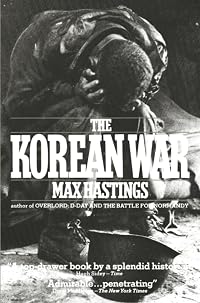
The Korean War
by Max Hastings
On This Page
Description
It was the first war we could not win. At no other time since World War II have two superpowers met in battle. In this extensive history, preeminent military historian Max Hastings takes us back to the bloody, bitter struggle to restore South Korean independence after the Communist invasion of June 1950. Using personal accounts from interviews with more than two hundred vets-including the Chinese-Hastings follows real officers and soldiers through the battles. He brilliantly captures the show more Cold War crisis at home-the strategies and politics of Truman, Acheson, Marshall, MacArthur, Ridgway, and Bradley-and shows what we should have learned in the war that was the prelude to Vietnam. show lessTags
Recommendations











Member Reviews
I freely admit that I probably wouldn’t have read ‘The Korean War’ if it hadn’t been lent to me. Moreover, it took me a little while to get into. I'm very glad to have given it a chance, though, and 80 pages in I was hooked. The Korean War is an often overlooked conflict; I knew practically nothing about it before reading this book. It is overshadowed by WWII on one side and Vietnam on the other, yet was of immense global significance. Hastings tells the story in a clear, readable, and informative style, without getting too journalistic. The book was originally published in 1987, which dates the conclusions at the end interestingly. When the USSR and communism were still considered global superpowers and threats to the West, it show more must have been easier to see the Korean war as a just conflict that merited its cost in lives and money. These days, it is notable that the only insular communist dictatorship still to exist is North Korea with, as I understand it, the same boundaries as were agreed in the 1953 armistice. This is hardly a positive legacy for the Korean War. In the 21st century, we can ask with hindsight why it was worth fighting proxy wars against communism when its superpowers would peacefully collapse (USSR) or smoothly shift into a state capitalist oligarchy (China) a few decades later. At the time of the Cold War, such developments could hardly be foreseen. Hastings ends by saying that the war saved South Korea from an awful fate. On the other hand, who’s to say that it hasn’t prolonged the terrible fate of the North? Since 1987 American has stacked up several more catastrophic military interventions, tempting the rest of the world to suppose that they only ever make things worse.
The actual narrative of the war, by contrast, has not dated discernibly. The inevitable temptation to compare wars to each other led me to consider the similarities of the Korean War and the trenches of WWI. The former began with unprovoked invasion of South Korea by the North, which the South Korean army could do little to repulse. The USA, which was occupying Japan at the time, mustered up a vaguely worded UN resolution to resist North Korea’s aggression, partly from the belief that it was backed by the USSR. American forces, with fairly tokenistic allied support, proceeded to repulse the North Korean army and drive it back close to the Northern border with China. Whereupon Chinese forces entered the war and threw back the American troops into South Korea, nearly creating a rout. After the initial shock had worn off and General MacArthur had been replaced, the Americans pulled themselves together and turned back the Chinese advance. All this occurred within the first year of the war, which then dragged on for a further three or so years, during which time both sides dug in and the lines moved very little. Any small gains were achieved at the cost of heavy casualties. That certainly seems to me a lot more like WWI’s Western Front than any particular phase of WWII. I don’t know much about the Vietnam War, but Hastings certainly confirmed my impression that the US completely failed to apply any useful lessons from Korea to that later, similar conflict.
In fact, my strongest impression of the whole war is that it was a tragic fiasco and narrowly escaped becoming a nuclear one. The US forces were by all accounts in a terrible state when the war began, their technological superiority barely making up for failures of leadership, training, and morale. The South Korean regime was a corrupt dictatorship with a totally ineffectual army. The North Korean communist regime was ruthlessly oppressive. Bad decisions were made on all sides, millions of lives were thrown away, and both North and South Korea were devastated. China’s military made perhaps the most creditable showing, as they were able to use very recent experience of guerrilla conflict in the Chinese civil war to compensate for a severe lack of equipment. On the other hand, the surprising success of the Chinese forces was premised on a complete disregard for the value of human life. Hastings is only able to provide vague estimates for Chinese and Korean casualties, which run to the millions: an order of magnitude greater than US losses.
The loss of life in the Korean War would nonetheless have been much greater if nuclear weapons had been used. Hastings suggests that the US came disturbingly close to this. In the early 1950s, only the US had the bomb and MacArthur argued both before and after his removal from command that tactical nuclear strikes on China were necessary to contain communism. All America’s allies were opposed to this, on the totally reasonable grounds of not wanting another world war. It appears, though, that at the time nuclear weapons did not have the doomsday aura they later acquired and the American military viewed them as only quantitatively different from conventional arms. Hastings puts it like this:
All very chilling. Not surprisingly, most of the voices in the narrative are American or others on the UN side, but Hastings does take care to include Korean and Chinese accounts. He also makes no secret of the atrocities on all sides and the pervasive racism of the US soldiers. In addition to following the front lines, the book includes chapters on intelligence (scant and badly organised), the war in the air (US-dominated), prisoners of war, and how peace was negotiated. The latter includes extraordinary accounts of how the island of Koje-do, where the UN forces kept their POWs, became in effect a second front in the war. North Korean and Chinese POWs took control of the camps where they were imprisoned, thanks to deliberate communist infiltration and remarkably slapdash US management. In May 1952, one camp of North Koreans actually took their American commandant hostage, precipitating a siege.
Overall, I recommend Hastings’ account as an eye-opening account of the Korean War that neatly balances military details with wider analysis. 29 years after its publication, it would be fascinating to read a complementary account drawing on USSR and Chinese archives that may have subsequently become available. What has not changed, sadly, in the apparent inability of the US to learn foreign policy lessons. Hastings quotes Colonel John Michaelis as follows:
One need only change Korea to Iraq or Afghanistan. Back then the stated aim was to create bulwarks against communism, now apparently it's to create bulwarks against Islamic fundamentalism. I'm no expert, but the tactics seem equally counterproductive in each case. Same shit, different century. show less
The actual narrative of the war, by contrast, has not dated discernibly. The inevitable temptation to compare wars to each other led me to consider the similarities of the Korean War and the trenches of WWI. The former began with unprovoked invasion of South Korea by the North, which the South Korean army could do little to repulse. The USA, which was occupying Japan at the time, mustered up a vaguely worded UN resolution to resist North Korea’s aggression, partly from the belief that it was backed by the USSR. American forces, with fairly tokenistic allied support, proceeded to repulse the North Korean army and drive it back close to the Northern border with China. Whereupon Chinese forces entered the war and threw back the American troops into South Korea, nearly creating a rout. After the initial shock had worn off and General MacArthur had been replaced, the Americans pulled themselves together and turned back the Chinese advance. All this occurred within the first year of the war, which then dragged on for a further three or so years, during which time both sides dug in and the lines moved very little. Any small gains were achieved at the cost of heavy casualties. That certainly seems to me a lot more like WWI’s Western Front than any particular phase of WWII. I don’t know much about the Vietnam War, but Hastings certainly confirmed my impression that the US completely failed to apply any useful lessons from Korea to that later, similar conflict.
In fact, my strongest impression of the whole war is that it was a tragic fiasco and narrowly escaped becoming a nuclear one. The US forces were by all accounts in a terrible state when the war began, their technological superiority barely making up for failures of leadership, training, and morale. The South Korean regime was a corrupt dictatorship with a totally ineffectual army. The North Korean communist regime was ruthlessly oppressive. Bad decisions were made on all sides, millions of lives were thrown away, and both North and South Korea were devastated. China’s military made perhaps the most creditable showing, as they were able to use very recent experience of guerrilla conflict in the Chinese civil war to compensate for a severe lack of equipment. On the other hand, the surprising success of the Chinese forces was premised on a complete disregard for the value of human life. Hastings is only able to provide vague estimates for Chinese and Korean casualties, which run to the millions: an order of magnitude greater than US losses.
The loss of life in the Korean War would nonetheless have been much greater if nuclear weapons had been used. Hastings suggests that the US came disturbingly close to this. In the early 1950s, only the US had the bomb and MacArthur argued both before and after his removal from command that tactical nuclear strikes on China were necessary to contain communism. All America’s allies were opposed to this, on the totally reasonable grounds of not wanting another world war. It appears, though, that at the time nuclear weapons did not have the doomsday aura they later acquired and the American military viewed them as only quantitatively different from conventional arms. Hastings puts it like this:
How close did the United States come, in the winter of 1950, to employing nuclear bombs against the Chinese? Much closer, the answer must be, than her allies cared to believe at the time. If Truman and the fellow-members of his Administration recoiled from bearing the responsibility for so terrible an act, America’s leading military men, from the Joint Chiefs downwards, were far more equivocal, and seemed far less disturbed by the prospect. [...] Had the Chinese proved able to convert the defeat of the UN forces into their destruction, had Eighth Army been unable to check its retreat, and been driven headlong into the coastal ports with massive casualties, it is impossible to declare with certainty that Truman would have resisted demands for an atomic demonstration against China.
All very chilling. Not surprisingly, most of the voices in the narrative are American or others on the UN side, but Hastings does take care to include Korean and Chinese accounts. He also makes no secret of the atrocities on all sides and the pervasive racism of the US soldiers. In addition to following the front lines, the book includes chapters on intelligence (scant and badly organised), the war in the air (US-dominated), prisoners of war, and how peace was negotiated. The latter includes extraordinary accounts of how the island of Koje-do, where the UN forces kept their POWs, became in effect a second front in the war. North Korean and Chinese POWs took control of the camps where they were imprisoned, thanks to deliberate communist infiltration and remarkably slapdash US management. In May 1952, one camp of North Koreans actually took their American commandant hostage, precipitating a siege.
Overall, I recommend Hastings’ account as an eye-opening account of the Korean War that neatly balances military details with wider analysis. 29 years after its publication, it would be fascinating to read a complementary account drawing on USSR and Chinese archives that may have subsequently become available. What has not changed, sadly, in the apparent inability of the US to learn foreign policy lessons. Hastings quotes Colonel John Michaelis as follows:
“I don’t think that, as an army or a nation, we ever learn from our mistakes, from history. We didn’t learn from the Civil War, we didn’t learn from World War I. The US Army has still not accepted the simple fact that its performance in Korea was lousy.”
One need only change Korea to Iraq or Afghanistan. Back then the stated aim was to create bulwarks against communism, now apparently it's to create bulwarks against Islamic fundamentalism. I'm no expert, but the tactics seem equally counterproductive in each case. Same shit, different century. show less
Hastings hopes to remedy the neglect with which historians have treated the Korean War. He contends that, "above all, perhaps, Korea merits close consideration as a military rehearsal for the subsequent disaster in Vietnam." Indeed, in his detailed history of the conflict, he draws many parallels to the ill-fated war in Indochina. (Especially poignant: the reference to "the ferocious struggles that cost thousands of men on both sides their lives in pursuit of hill numbers or map references.") The book is well-written and stays interesting; his minute-by-minute eyewitness recollections from the front are as riveting as they are grim.
The Korean War was accompanied by some critically important side-dramas: Truman versus MacArthur, the show more Allies' fears of both McArthur and McCarthy, China versus the Soviet Union, the questionable fate of Formosa, and the decision to use -or not to use - atomic weapons in tactical maneuvers. All of these issues are given illuminating coverage by Hastings. Among his sobering conclusions was the observation that in spite of many examples of personal bravery, the performance of the U.S. Army - at least in the first year of fighting - "ranged between moderate and deplorable." Behavior of Army prisoners of war was not much better. Furthermore, many Americans exhibited arrogance, insensitivity, and paternalism in their treatment of Koreans. In fact, he suggests, Americans had much more respect for the Chinese, whose infantrymen were considered to be excellent fighters.
Hastings is scrupulously fair in his assessment of both U.S. and Chinese motives for fighting in Korea. Although he tries to convey fully the frustration Americans felt by having political limits placed on their military power, he does not hesitate to express his own gratitude that nuclear weapons were not used. He deplores the behavior of Syngman Rhee and his support by the U.S., but declares him and his regime "infinitely better than anything attainable under Kim Il Sung." One minor quibble would be that the scanty maps are inadequate. A recommended companion piece while reading this very good book is the Oxford Atlas of American Military History.
(JAF) show less
The Korean War was accompanied by some critically important side-dramas: Truman versus MacArthur, the show more Allies' fears of both McArthur and McCarthy, China versus the Soviet Union, the questionable fate of Formosa, and the decision to use -or not to use - atomic weapons in tactical maneuvers. All of these issues are given illuminating coverage by Hastings. Among his sobering conclusions was the observation that in spite of many examples of personal bravery, the performance of the U.S. Army - at least in the first year of fighting - "ranged between moderate and deplorable." Behavior of Army prisoners of war was not much better. Furthermore, many Americans exhibited arrogance, insensitivity, and paternalism in their treatment of Koreans. In fact, he suggests, Americans had much more respect for the Chinese, whose infantrymen were considered to be excellent fighters.
Hastings is scrupulously fair in his assessment of both U.S. and Chinese motives for fighting in Korea. Although he tries to convey fully the frustration Americans felt by having political limits placed on their military power, he does not hesitate to express his own gratitude that nuclear weapons were not used. He deplores the behavior of Syngman Rhee and his support by the U.S., but declares him and his regime "infinitely better than anything attainable under Kim Il Sung." One minor quibble would be that the scanty maps are inadequate. A recommended companion piece while reading this very good book is the Oxford Atlas of American Military History.
(JAF) show less
What I’ve come to expect from Hastings: well-written and gripping with a somewhat conservative lean (a tendency that I’ve only found to be a negative in his book on Vietnam). A solid in-depth history that I’d recommend to any level of reader.
I read a broad assortment of genre, from science fiction, to biography to literary fiction. One of my favorites is history and military history in particular. In reviewing my library, I noted a couple of works by Max Hastings and noted that I had rated them very highly.
His book, Retribution, was an outstanding treatment of the final year of the World War II Pacific theater. Vietnam, an Epic Tragedy, was equally as well done. That being the case, I purchased a couple of other Hastings works, including this treatment of the Korean War.
Sadly, this was nowhere near quality of the two books cited above. Consider, Retribution, which deals with only the final year in the Pacific theater, clocks in at a hardcover 688 pages. His book on the show more Vietnam War extends for almost 900 hardcover pages. This book on the Korean War is a paperback 389 pages. Simply too short and cursory a treatment for such an important event.
It is not a terrible book, but would serve as more of a beginner’s guide to the conflict. It gives you all the important events and personalities, but little of the detail that made the earlier two books so outstanding. show less
His book, Retribution, was an outstanding treatment of the final year of the World War II Pacific theater. Vietnam, an Epic Tragedy, was equally as well done. That being the case, I purchased a couple of other Hastings works, including this treatment of the Korean War.
Sadly, this was nowhere near quality of the two books cited above. Consider, Retribution, which deals with only the final year in the Pacific theater, clocks in at a hardcover 688 pages. His book on the show more Vietnam War extends for almost 900 hardcover pages. This book on the Korean War is a paperback 389 pages. Simply too short and cursory a treatment for such an important event.
It is not a terrible book, but would serve as more of a beginner’s guide to the conflict. It gives you all the important events and personalities, but little of the detail that made the earlier two books so outstanding. show less
Max Hastings is a very good writer. In this book, he writes about the experiences of those involved in the Korean war. Talking about on-the-ground experiences is something this author does so well, really bringing the feel of the battle to the reader. He provides just enough background for the general reader about the reasons for and consequences of the war, but does not provide this in great depth.
Excellent narrative history of the Korean War. The author uses "first-hand" accounts of those who fought in that conflict on both sides to arrive at a re-assessment of this war. He naturally "highlights" some actions of British troops including the stand of the" Gloucesters" on the Imjin in 1951. He is full of praise for the fighting retreat of the US Marines from the Chosin reservoir ,while scathing of the actions of the 8th Army leadership in failing to comprehend the Chinese threat of "intervention" in the conflict. A good read.
The author reviews many aspects of the Korean War. Good explanation of what happened and how we (US) conducted the war on behalf of the UN. It has been 30 years since the book was written and some of his observations/biases become glaringly apparent. In the forward he pretty much established his opinion of how he saw the war. I would rather he had stated facts, first hand observations, and any relevant information and let the reader make that assessment - at least until the concluding chapter.
Members
- Recently Added By
Lists

Best Military History Books
123 works; 21 members

Books bought at library sales
98 works; 4 members

Books Read in 2023
5,638 works; 147 members

THE WAR ROOM
813 works; 24 members
Author Information

78+ Works 14,474 Members
British journalist, editor, and historian Max Hastings was born on December 28, 1945. He was a foreign correspondent for BBC television and London's Evening Standard, for which he later served as editor from 1996 to 2001. Hastings also worked as editor and editor-in-chief of The Daily Telegraph. In addition to presenting BBC historical show more documentaries and writing numerous books of military history, Hastings has contributed to publications including the Daily Mail, The Guardian, and the New York Review of Books. He received the nonfiction Somerset Maugham Award for Bomber Command, as well as the Yorkshire Post Book of the Year Prize for both Overlord and The Battle for the Falklands. His title Catastrophe 1914: Europe Goes to War made The New York Times Best Seller List in 2013. The Secret War: Spies, Ciphers, and Guerrillas, 1939-1945 was published in 2016 and is also on the New York Times Bestsellers List. Hastings was knighted in 2002, is a Fellow of the Royal Society of Literature, and from 2002-2007 was President of the Campaign to Protect Rural England. (Bowker Author Biography) show less
Some Editions
Series
Belongs to Publisher Series
Common Knowledge
- Original publication date
- 1987
- Important places
- Korea; South Korea; North Korea
- Important events
- Korean War (1950 | 1953)
- Original language
- English
Classifications
Statistics
- Members
- 962
- Popularity
- 27,570
- Reviews
- 12
- Rating
- (3.86)
- Languages
- Danish, Dutch, English, Italian
- Media
- Paper, Audiobook, Ebook
- ISBNs
- 30
- ASINs
- 13