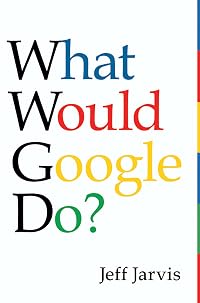
What Would Google Do?
by Jeff Jarvis
On This Page
Description
A manual for survival and success that asks the most important question today's leaders, in any industry, can ask themselves: What would Google do? To demonstrate how to emulate Google, Jarvis lays out his laws of what he calls "the new Google century," including such insights as: Think distributed; Become a platform; Join the post-scarcity, open-source, gift economy; The middleman has died; Your worst customers are your best friends and your best customers are your partners; Do what you do show more best and link to the rest; Get out of the way; Make mistakes well; and more. He applies these principles not just to emerging technologies and the Internet, but to other industries--telecommunications, airlines, television, government, healthcare, education, journalism, and, yes, book publishing--showing ultimately what the world would look like if Google ran it. The result will change the way readers ask questions and solve problems.--From publisher description. show lessTags
Recommendations




























Member Reviews
It's difficult to remember the Internet before Google. In just over ten years, the little company begun in a Menlo Park, California garage has grown into a globally-known giant. Its name has become a common verb. Its search engine is the world's primary link to exploring the Web. Some of its freely-shared tools have replaced resources that seemed indispensable a short time ago, and its other applications may be destined to do the same: Google Maps, Google Earth, Google documents, Chrome, G-Mail, Google Scholar, Picasa, and on and on. Google tools are certainly part of my daily life.
What made Google an unrivaled success in such a short time? How can other companies survive in a Google world? Media writer and blogger Jeff Jarvis thinks show more the best way to adapt to this tumultuous new world is to emulate the giant. In whichever industry, business, or organization you might be involved, Jarvis suggests you ask yourself the same question: "What would Google do? How might Google founders Larry Page and Sergey Brin approach your circumstance?
In What Would Google Do?, Jarvis presents his case in two parts. In the first half of the book, he describes the Google model as a means of explaining its success. Google seeks simplicity and effective results. It gives its products away, knowing well-used tools will keep people coming back for more. In many ways, Google offers itself as a platform for other people's creativity, realizing that people prefer controlling, manipulating, and tweaking the tools they use. Its corporate culture has been cited as a model for nurturing ideas, research (backed up by arguably the best data crunching on earth), and deployment. Even Google's apparent contradictions (e.g., a corporate giant with a start-up's metality, tight-lipped projects with a freeware face) add to its success.
With the Google approach described in the first half, Jarvis runs down a checklist of specific industries in the second half. He applies the Google philosophy to each. It's harsh at times, but the approach seems appropriate in the competitive business world. I found it intriguing, for example, each time he urged companies to step back and ask themselves what business they are in. Take newspapers. Are they in business to sell newspapers? Seems obvious, right? Are they stuck with newspaper or might they be in business to sell news -- regardless the medium? Perhaps they do best selling advertisements? How can they best supply an audience to their advertisers? Another example: airlines. Do airlines fly airplanes ... or move people? Companies should take a hard look at their defining product focus its resources there. If serving people is crucial to its bottom line, then it jolly well better offer quality customer service.
Jarvis also suggested being open to change and, if necessary, radical change. If a company's future lies in completely ripping apart and restructuring its product, it must do so. Hesitation could doom the company. Why? Because if there's a better way to do something, someone will eventually do it. Better you than a competitor, don't you think?
Jarvis gets wobbly with some of the industries. He's not equally familiar with all of them, but nevertheless tries to apply Google principles with mixed results.
The tumultuous changes he predicts/advocates was making me a bit wobbly by the end of the book, in fact. Every revolution he discussed could be imagined at the ground level as uprooted careers and job displacements for many people. Millions of them. I'm not saying Jarvis is wrong. He may be quite right. I just hope the ride into the Googlification of all business isn't as devastating to as many people as it seems. This was a provocative book.
Find more of my reviews at Mostly NF. show less
What made Google an unrivaled success in such a short time? How can other companies survive in a Google world? Media writer and blogger Jeff Jarvis thinks show more the best way to adapt to this tumultuous new world is to emulate the giant. In whichever industry, business, or organization you might be involved, Jarvis suggests you ask yourself the same question: "What would Google do? How might Google founders Larry Page and Sergey Brin approach your circumstance?
In What Would Google Do?, Jarvis presents his case in two parts. In the first half of the book, he describes the Google model as a means of explaining its success. Google seeks simplicity and effective results. It gives its products away, knowing well-used tools will keep people coming back for more. In many ways, Google offers itself as a platform for other people's creativity, realizing that people prefer controlling, manipulating, and tweaking the tools they use. Its corporate culture has been cited as a model for nurturing ideas, research (backed up by arguably the best data crunching on earth), and deployment. Even Google's apparent contradictions (e.g., a corporate giant with a start-up's metality, tight-lipped projects with a freeware face) add to its success.
With the Google approach described in the first half, Jarvis runs down a checklist of specific industries in the second half. He applies the Google philosophy to each. It's harsh at times, but the approach seems appropriate in the competitive business world. I found it intriguing, for example, each time he urged companies to step back and ask themselves what business they are in. Take newspapers. Are they in business to sell newspapers? Seems obvious, right? Are they stuck with newspaper or might they be in business to sell news -- regardless the medium? Perhaps they do best selling advertisements? How can they best supply an audience to their advertisers? Another example: airlines. Do airlines fly airplanes ... or move people? Companies should take a hard look at their defining product focus its resources there. If serving people is crucial to its bottom line, then it jolly well better offer quality customer service.
Jarvis also suggested being open to change and, if necessary, radical change. If a company's future lies in completely ripping apart and restructuring its product, it must do so. Hesitation could doom the company. Why? Because if there's a better way to do something, someone will eventually do it. Better you than a competitor, don't you think?
Jarvis gets wobbly with some of the industries. He's not equally familiar with all of them, but nevertheless tries to apply Google principles with mixed results.
The tumultuous changes he predicts/advocates was making me a bit wobbly by the end of the book, in fact. Every revolution he discussed could be imagined at the ground level as uprooted careers and job displacements for many people. Millions of them. I'm not saying Jarvis is wrong. He may be quite right. I just hope the ride into the Googlification of all business isn't as devastating to as many people as it seems. This was a provocative book.
Find more of my reviews at Mostly NF. show less
Jeff Jarvis' What Would Google Do? is more of an exploration of innovative business and leadership practices than it is an examination of Google. My worry had been that Jarvis' book might spend too much time fawning over Google, but for the most part, he avoids that and even manages to briefly discuss such warts as the whole China issue.
Jarvis discusses how the world is becoming "googlier" in terms of becoming more networked, interactive, diffuse and innovative. The world of the future will be much more open to experimentation and even to acknowledged failure. In the future, we will need to listen to feedback much more closely than we have in the past and will also have to respond more agilely to these problems than we have in the show more past.
Jarvis also offers suggestions for how other industries can get their googliness on. He looks at banking, health care, education, government, restaurants, and the like.
The world he predicts will, from my perspective of education, be incredibly challenging. Schools tend to be rather traditionalist and authoritarian in their approach. Teachers have tended to act autonomously with little input from colleagues, students, or parents sought or expected. Teachers have been the source of all knowledge and authority. But as people come to expect different interactions with authorities, schools will be challenged.
I don't quite know how we'll respond to these trends. I don't know that most schools are thinking about them except as remote intellectual thought-exercises. But as I read about the decline of the publishing industry, the movie industry, newspapers, music, and the like, I think we're avoiding something we can't really avoid.
What Would Google Do? doesn't provide much in terms of specific answers, but it asks the right questions and provides some guideposts that we ignore at our own risk. show less
Jarvis discusses how the world is becoming "googlier" in terms of becoming more networked, interactive, diffuse and innovative. The world of the future will be much more open to experimentation and even to acknowledged failure. In the future, we will need to listen to feedback much more closely than we have in the past and will also have to respond more agilely to these problems than we have in the show more past.
Jarvis also offers suggestions for how other industries can get their googliness on. He looks at banking, health care, education, government, restaurants, and the like.
The world he predicts will, from my perspective of education, be incredibly challenging. Schools tend to be rather traditionalist and authoritarian in their approach. Teachers have tended to act autonomously with little input from colleagues, students, or parents sought or expected. Teachers have been the source of all knowledge and authority. But as people come to expect different interactions with authorities, schools will be challenged.
I don't quite know how we'll respond to these trends. I don't know that most schools are thinking about them except as remote intellectual thought-exercises. But as I read about the decline of the publishing industry, the movie industry, newspapers, music, and the like, I think we're avoiding something we can't really avoid.
What Would Google Do? doesn't provide much in terms of specific answers, but it asks the right questions and provides some guideposts that we ignore at our own risk. show less
Overall: 3.5 (out of 5)
In a nutshell: How to apply the rules of the digital economy to any organization.
What's best about it: Many examples that help explain his point.
What could be better: I read it on my iPad. Hyperlinks would have been nice.
Who should read this: Any CEO, SVP, executive director, board chair or aspiring manager that wants their organization to maintain its relevancy.
Further comments:
While Jarvis can be a bit preachy, this book is a terrific mind-bending exercise for any leader of any type of organization. The book isn't so much about "what would Google do" but the new rules of our digital society and how they apply. What Would Google Do is for leaders who want to start thinking about how to thrive in the 21st show more century as technology and digital life lays waste to the old ways of operating.
Among the interesting issues discussed by Jeff Jarvis:
1) "Free" really is a profitable business model. The how, what, when and why. "Free" doesn't mean you give everything away. In fact companies -- like Google -- give away quite a bit, but get much more in return.
2) Technology and relationships: the rapid rise of digital businesses is explained through the interaction of technology and relationships. Those businesses that just deploy technology eventually fall flat (Yahoo). Those that deploy technology to find new relationships and enhance existing relationships soar (Facebook).
3) The role of networks and growth: organizations that establish new networks and extract minimum value from participants will grow and prosper. Example: LinkedIn (free), Flickr, WordPress/blogger.
4) The impact of Google: technology is requiring all companies and organizations to answer the question: "what business am I really in?" and where do I add value. As a Organizations need to focus on that specialty. Otherwise once technology eviscerates middlemen, you may be out business. Example 1: are doctor's sickness companies or health organizations? If it's the latter, isn't it possible that they could be outsourced and made irrelevant. If the latter, that's less likely to occur. Example 2: Kodak. If it had realized that it was in the "memory and images business", it might have beaten Yahoo! and purchased Flickr. What business are you really in?
5) The more you control, the less you will be trusted. The less you control.... Does the Apple way of operating contradict this?
Definitely worth reading.
Question, comments? ken@karpaydiem.com www.karpaydiem.com show less
In a nutshell: How to apply the rules of the digital economy to any organization.
What's best about it: Many examples that help explain his point.
What could be better: I read it on my iPad. Hyperlinks would have been nice.
Who should read this: Any CEO, SVP, executive director, board chair or aspiring manager that wants their organization to maintain its relevancy.
Further comments:
While Jarvis can be a bit preachy, this book is a terrific mind-bending exercise for any leader of any type of organization. The book isn't so much about "what would Google do" but the new rules of our digital society and how they apply. What Would Google Do is for leaders who want to start thinking about how to thrive in the 21st show more century as technology and digital life lays waste to the old ways of operating.
Among the interesting issues discussed by Jeff Jarvis:
1) "Free" really is a profitable business model. The how, what, when and why. "Free" doesn't mean you give everything away. In fact companies -- like Google -- give away quite a bit, but get much more in return.
2) Technology and relationships: the rapid rise of digital businesses is explained through the interaction of technology and relationships. Those businesses that just deploy technology eventually fall flat (Yahoo). Those that deploy technology to find new relationships and enhance existing relationships soar (Facebook).
3) The role of networks and growth: organizations that establish new networks and extract minimum value from participants will grow and prosper. Example: LinkedIn (free), Flickr, WordPress/blogger.
4) The impact of Google: technology is requiring all companies and organizations to answer the question: "what business am I really in?" and where do I add value. As a Organizations need to focus on that specialty. Otherwise once technology eviscerates middlemen, you may be out business. Example 1: are doctor's sickness companies or health organizations? If it's the latter, isn't it possible that they could be outsourced and made irrelevant. If the latter, that's less likely to occur. Example 2: Kodak. If it had realized that it was in the "memory and images business", it might have beaten Yahoo! and purchased Flickr. What business are you really in?
5) The more you control, the less you will be trusted. The less you control.... Does the Apple way of operating contradict this?
Definitely worth reading.
Question, comments? ken@karpaydiem.com www.karpaydiem.com show less
If in the land of the blind, the one-eyed man is king, Jeff Jarvis contends Google jumped into the blind, half-realized world of Web 1.0 full-sighted and fully aware of the possibilities. Jarvis writes about the impact and power of Google the way a disciple follows a prophet - he's a smart, perceptive, at times skeptical disciple, but a disciple non-the-less.
Jeff Jarvis, a blogger, describes Google's groundbreaking business model - a business model based on fundamental changes in customer expectations and organization, the architecture of the internet, openness, ethics and economy. Jarvis doesn't write a history of Google, he writes a journalistic analysis of its culture from the outsider's perspective, a choice that hurt this books show more credibility. While Jarvis knows his Google: how Google rankings work, the widespread and at times pointed power of blogs, the mass of niche marketing - I wish Jarvis had a quarterly report. I wish he could point me to a webpage or newspaper article or Google PR report to explain those things. I don't require Jarvis to follow an academic's footnoted thesis, I just like to know where he got the knowledge. A book is a still a book, Jarvis, and it's not searchable or linkable, you said so yourself.
Jarvis spends the last half of his book re-imagining certain industries into Google-esque, internet-based free-markets. Jarvis is an unapologetic proponent of open-source anything, be it wine lists or GM-car design, and interconnecting as much of our lives into the computing cloud as possible. Jervis envisions restaurants where the customers affect the menu, peer-to-peer loans ala Kiva.org for banks, and a nebulous online-aggregated university process. His ideas strike a ring of truth, and sometimes a ring of fear - the old order slips away, the center of today's world will not hold. Jarvis has already found his battlecry: Long Live Google! Long Live the King!
Other Reviews & Original Words: http://motorcyclesshotguns.blogspot.com/ show less
Jeff Jarvis, a blogger, describes Google's groundbreaking business model - a business model based on fundamental changes in customer expectations and organization, the architecture of the internet, openness, ethics and economy. Jarvis doesn't write a history of Google, he writes a journalistic analysis of its culture from the outsider's perspective, a choice that hurt this books show more credibility. While Jarvis knows his Google: how Google rankings work, the widespread and at times pointed power of blogs, the mass of niche marketing - I wish Jarvis had a quarterly report. I wish he could point me to a webpage or newspaper article or Google PR report to explain those things. I don't require Jarvis to follow an academic's footnoted thesis, I just like to know where he got the knowledge. A book is a still a book, Jarvis, and it's not searchable or linkable, you said so yourself.
Jarvis spends the last half of his book re-imagining certain industries into Google-esque, internet-based free-markets. Jarvis is an unapologetic proponent of open-source anything, be it wine lists or GM-car design, and interconnecting as much of our lives into the computing cloud as possible. Jervis envisions restaurants where the customers affect the menu, peer-to-peer loans ala Kiva.org for banks, and a nebulous online-aggregated university process. His ideas strike a ring of truth, and sometimes a ring of fear - the old order slips away, the center of today's world will not hold. Jarvis has already found his battlecry: Long Live Google! Long Live the King!
Other Reviews & Original Words: http://motorcyclesshotguns.blogspot.com/ show less
It should be 3.5 stars out of 5 (or somewhere between 3-4 stars).
In this book, author Jeff Harvis of BuzzMachine.com, discusses the concept of "Googlethink". He takes Google and studies what made today's huge company, an enormously successful organization and how that success can be transferred to other industries.
The book is divided into 2 parts. The first of which is the answer to "What/Why?" as in "What/Why is Google successful?". Jeff discusses the concepts of "Googlethink" and "Googlejuice". He also suggests that Google is a platform for success. Being a "platform" for other people to improve on and adopting the collaborative open-source mindset is what got it to be where it is today. He also explains and touches on his personal show more first rule which shows the relationship between Control and Trust. A few other ideas are also explored.
In the second part, Jeff provides some examples of the various services/products in our world that can truly benefit from the Googlethink way of doing things. Airlines, cola companies, hospitals, restaurants, media, etc. can all adopt the Google mindset of openness and collaboration which will ultimately transform these services into platforms of success by keeping customers and users involved. Although some ideas seem far-fetched. It's the idea that counts.
An enjoyable read, especially the second part of the book which answers the title's question. show less
In this book, author Jeff Harvis of BuzzMachine.com, discusses the concept of "Googlethink". He takes Google and studies what made today's huge company, an enormously successful organization and how that success can be transferred to other industries.
The book is divided into 2 parts. The first of which is the answer to "What/Why?" as in "What/Why is Google successful?". Jeff discusses the concepts of "Googlethink" and "Googlejuice". He also suggests that Google is a platform for success. Being a "platform" for other people to improve on and adopting the collaborative open-source mindset is what got it to be where it is today. He also explains and touches on his personal show more first rule which shows the relationship between Control and Trust. A few other ideas are also explored.
In the second part, Jeff provides some examples of the various services/products in our world that can truly benefit from the Googlethink way of doing things. Airlines, cola companies, hospitals, restaurants, media, etc. can all adopt the Google mindset of openness and collaboration which will ultimately transform these services into platforms of success by keeping customers and users involved. Although some ideas seem far-fetched. It's the idea that counts.
An enjoyable read, especially the second part of the book which answers the title's question. show less
This was an interesting audiobook, and Jeff Jarvis, the author, did a good job as narrator. I enjoyed hearing about things through "Google lenses," since Google has grown by leaps and bounds. One point especially interesing to me was how Google's search page is so simple, but can take you to so many places, while Yahoo's home page is so crowded. Who's the market leader here?
While Jarvis' insights were interesting, they weren't interesting enough to get me to finish the book.
I think the problem for me was that the book was targeted more at the business community than at the casual observer.
I'm conflicted. I suspect the book is very good, but it just didn't interest me enough. Ergo, the 4 star rating. 5 stars for probable content and 3 stars for average personal interest average out to 4 stars.
I think the problem for me was that the book was targeted more at the business community than at the casual observer.
I'm conflicted. I suspect the book is very good, but it just didn't interest me enough. Ergo, the 4 star rating. 5 stars for probable content and 3 stars for average personal interest average out to 4 stars.
Members
- Recently Added By
Author Information

8+ Works 1,099 Members
Awards and Honors
Common Knowledge
- Original title
- What Would Google Do?
- Original publication date
- 2009
- Dedication*
- Für Tammy, Jake und Julia
- First words*
- Kein Manager, kein Unternehmen, keine Institution scheint wirklich zu wissen, wie man im Zeitalter des Internets überlebt und wächst. Außer Google.
*Some information comes from Common Knowledge in other languages. Click "Edit" for more information.
Classifications
- Genres
- Business, Technology, Nonfiction, General Nonfiction
- DDC/MDS
- 658.4012 — Applied science & technology Management & public relations General management Executive Planning, control, strategy Strategy
- LCC
- HD30.2 .J375 — Social sciences Industries. Land use. Labor Industries. Land use. Labor Management. Industrial management
- BISAC
Statistics
- Members
- 768
- Popularity
- 36,475
- Reviews
- 25
- Rating
- (3.56)
- Languages
- 9 — Danish, Dutch, English, French, German, Norwegian (Bokmål), Norwegian, Portuguese, Spanish
- Media
- Paper, Audiobook, Ebook
- ISBNs
- 25
- ASINs
- 5