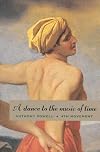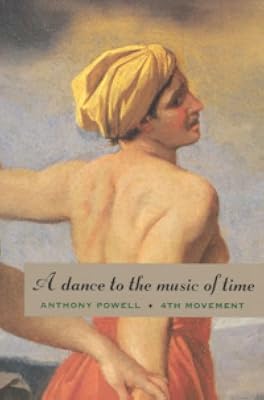
A Dance to the Music of Time: Fourth Movement, Winter
by Anthony Powell
A Dance to the Music of Time (Collections and Selections — 10-12)
On This Page
Description
Anthony Powell's brilliant twelve novel sequence chronicles the lives of over three hundred characters, and is a unique evocation of life in twentieth-century England. It is unrivalled for its scope, its humour and the enormous pleasure it has given to generations. Volume 4 contains the last three novels in the sequence: Books do Furnish a Room; Temporary Kings; Hearing Secret Harmonies.Tags
Recommendations



















Member Recommendations


Member Reviews
"By many deeds of shame / We learn that love grows cold", as the hymn writer put it.
I don't entirely know what happened here, but it's a crying shame. Anthony Powell commenced his mammoth 12-book series in 1950, uncertain at the time exactly how many volumes it would run, but determined to capture society's change and the ravages of Time. The first three volumes are youthful works, not always great literature but consistently engaging. Titles four through nine increase in power as our protagonists go from young well-heeled flappers in their 20s to middle-aged survivors of an horrific War. Here, we're on the other side and, as the author nears seventy, he seems unsure of his intentions.
Is it that Powell killed off or retired so many of show more our beloved characters that his new ones would always seem inferior by comparison? That the decision to give over much of books ten and eleven to the post-war literary world renders them even more niche, even more historically antiquated than the volumes set in uproarious pre-war England? That the author almost entirely dispenses with historical details, meaning that we no longer "feel" like we are in any particular time period? Perhaps we are at fault for being mundane: where once the deliberate emptiness of our protagonist Nick and his wife Isobel was a charming quirk of the series, allowing us to see the other characters through neutral eyes, we are now frustrated by the occasional mention to their child or children (we're never sure even how many they have, let alone what their names are) and the obscure explanation of why we should care about Isobel's (literally and figuratively) entitled family. Perhaps the beautifully-composed gargoyle named Widmerpool so overwhelms the volumes that Powell's confounding decision to leave him mostly in shadow even as he commits extraordinary acts leaves us grasping at the edges of something resembling a plot. (The lack of plot wouldn't be a problem if it were deliberate, but the lack of historical ambience makes me think we are supposed to be focused on the narrative.) Perhaps twelve novels is just too long for a book where most characters are revealed to be symbols rather than people. The return of a much-loved figure from the past is lessened when we realise that they stand for one of Powell's bugbears, be it sexualised women or people who are - in the author's eyes - excessively political (whether left- or right-wing).
Reluctant as I am to ever suggest that an aging author might be past their peak, I might instead posit that the structure of the sequence ultimately became its own worst enemy. The narrative voice compelling but always temporally unfixed - was Jenkins telling this narrative as we went along, or was this entirely retrospective? The answer seemed to be "whichever Powell needed in the moment", leaving us with a much less-engaging tone than that of Proust, whose great work is often compared to this one, and where we are constantly enjoying the battle between the older narrator's knowledge and his younger self's naivete. Additionally, in terms of structural flaws, the eternal recurrences of certain characters has robbed them of their power. If Nick had met Le Bas or Mrs Erdleigh merely once after their initial experience, or perhaps twice, we would have felt great power. Instead, the author seems to indicate - if unintentionally - that his world is one of ever decreasing circles, and reappearances become cause for a mere raised eyebrow rather than dropping one's lorgnette and spilling the Ovaltine.
The ten-year gap between each of the books in this volume does little to help, either. One might have assumed Powell was working towards a reflection on age but instead he seems almost put out by the passage of time. Characters who must be ancient are forced to survive until late in the piece because he needs them for his denouement, and the final volume leaves us with no grand reflections on age except perhaps an increased willingness on Nick Jenkins' part to pass judgment on young people he perceives as overly sexualised. (Or, perhaps more accurately, young people, especially women, who show it in their bearing and dress; after all, he can hardly complain about the mere act.) Perhaps the only positive thing that emerges from these volumes - and it may be the only time anyone can call her "positive" - is the character of Pamela Flitton, who demands the reader's attention at every turn, and whose dark psychology creates the perfect opponent to Widermpool's sickly, self-absorbed nature.
And no reviewer could be honest if they not dismiss the final volume, Hearing Secret Harmonies, almost entirely. Let's abandon any pretence at the existing characters and storyline, and instead allow the elderly writer to discourse at length about cult leaders and hippies and other things young people apparently do. Oh, sure, there's some further expansion on the character of X. Trapnel, the beatnik author who was an hilarious caricature in Books Do Furnish a Room but who - as Powell mega-fan Barbara Pym believed - came to unreasonably overwhelm the later novels in the series. What was Powell doing with the final volume? Why did he think this was a fitting way to end a landmark series that had run for three decades of his life? Hilary Spurling's biography of Powell tactfully avoids the question, so perhaps I will never know.
The biggest disappointment for me, however, is that Powell toys in these volumes with a narrative technique that one feels could have been the defining feature of these books - perhaps even made the series into great literature, rather than an effete and highbrow read for those of us who enjoy such things, - namely the question of second- and third-hand narrative. It does appear on occasion in the early volumes, but most of the time Nick is present at major occurrences even when it seems completely illogical. Take Books Do Furnish a Room in which he witnesses most every major incident in the love triangle of Widmerpool-Pamela-Trapnel, no matter how unlikely. By the middle book, Temporary Kings, Powell introduces a concept of other characters telling Nick what they witnessed, sometimes even multiple characters often different views, or reporting stories they heard from someone else. He takes up this mantle in a more determined manner in Hearing Secret Harmonies. Widmerpool, aka the Frog Footman, has had an astonishing decade since the previous book, and takes place in a subsequent series of remarkable events, yet he himself is kept either "offscreen" or across a crowded room for the bulk of the volume. Instead, his rise, fall, re-rise, and re-fall are chronicled to us primarily by a series of messengers. It's an interesting technique, to be sure, but it feels underutilised - perhaps even clumsy - in the hands of an author past his prime, and rather disappointing in its belated introduction to the cycle.
I am reminded again of a sagacious New York Times review from 1973 which notes that, despite the series still being enjoyable for longtime fans, "one goes on reading the Dance, feeling rather like a guest enjoying himself at a party after the band has left and the hosts have gone".
Well, quite. show less
I don't entirely know what happened here, but it's a crying shame. Anthony Powell commenced his mammoth 12-book series in 1950, uncertain at the time exactly how many volumes it would run, but determined to capture society's change and the ravages of Time. The first three volumes are youthful works, not always great literature but consistently engaging. Titles four through nine increase in power as our protagonists go from young well-heeled flappers in their 20s to middle-aged survivors of an horrific War. Here, we're on the other side and, as the author nears seventy, he seems unsure of his intentions.
Is it that Powell killed off or retired so many of show more our beloved characters that his new ones would always seem inferior by comparison? That the decision to give over much of books ten and eleven to the post-war literary world renders them even more niche, even more historically antiquated than the volumes set in uproarious pre-war England? That the author almost entirely dispenses with historical details, meaning that we no longer "feel" like we are in any particular time period? Perhaps we are at fault for being mundane: where once the deliberate emptiness of our protagonist Nick and his wife Isobel was a charming quirk of the series, allowing us to see the other characters through neutral eyes, we are now frustrated by the occasional mention to their child or children (we're never sure even how many they have, let alone what their names are) and the obscure explanation of why we should care about Isobel's (literally and figuratively) entitled family. Perhaps the beautifully-composed gargoyle named Widmerpool so overwhelms the volumes that Powell's confounding decision to leave him mostly in shadow even as he commits extraordinary acts leaves us grasping at the edges of something resembling a plot. (The lack of plot wouldn't be a problem if it were deliberate, but the lack of historical ambience makes me think we are supposed to be focused on the narrative.) Perhaps twelve novels is just too long for a book where most characters are revealed to be symbols rather than people. The return of a much-loved figure from the past is lessened when we realise that they stand for one of Powell's bugbears, be it sexualised women or people who are - in the author's eyes - excessively political (whether left- or right-wing).
Reluctant as I am to ever suggest that an aging author might be past their peak, I might instead posit that the structure of the sequence ultimately became its own worst enemy. The narrative voice compelling but always temporally unfixed - was Jenkins telling this narrative as we went along, or was this entirely retrospective? The answer seemed to be "whichever Powell needed in the moment", leaving us with a much less-engaging tone than that of Proust, whose great work is often compared to this one, and where we are constantly enjoying the battle between the older narrator's knowledge and his younger self's naivete. Additionally, in terms of structural flaws, the eternal recurrences of certain characters has robbed them of their power. If Nick had met Le Bas or Mrs Erdleigh merely once after their initial experience, or perhaps twice, we would have felt great power. Instead, the author seems to indicate - if unintentionally - that his world is one of ever decreasing circles, and reappearances become cause for a mere raised eyebrow rather than dropping one's lorgnette and spilling the Ovaltine.
The ten-year gap between each of the books in this volume does little to help, either. One might have assumed Powell was working towards a reflection on age but instead he seems almost put out by the passage of time. Characters who must be ancient are forced to survive until late in the piece because he needs them for his denouement, and the final volume leaves us with no grand reflections on age except perhaps an increased willingness on Nick Jenkins' part to pass judgment on young people he perceives as overly sexualised. (Or, perhaps more accurately, young people, especially women, who show it in their bearing and dress; after all, he can hardly complain about the mere act.) Perhaps the only positive thing that emerges from these volumes - and it may be the only time anyone can call her "positive" - is the character of Pamela Flitton, who demands the reader's attention at every turn, and whose dark psychology creates the perfect opponent to Widermpool's sickly, self-absorbed nature.
And no reviewer could be honest if they not dismiss the final volume, Hearing Secret Harmonies, almost entirely. Let's abandon any pretence at the existing characters and storyline, and instead allow the elderly writer to discourse at length about cult leaders and hippies and other things young people apparently do. Oh, sure, there's some further expansion on the character of X. Trapnel, the beatnik author who was an hilarious caricature in Books Do Furnish a Room but who - as Powell mega-fan Barbara Pym believed - came to unreasonably overwhelm the later novels in the series. What was Powell doing with the final volume? Why did he think this was a fitting way to end a landmark series that had run for three decades of his life? Hilary Spurling's biography of Powell tactfully avoids the question, so perhaps I will never know.
The biggest disappointment for me, however, is that Powell toys in these volumes with a narrative technique that one feels could have been the defining feature of these books - perhaps even made the series into great literature, rather than an effete and highbrow read for those of us who enjoy such things, - namely the question of second- and third-hand narrative. It does appear on occasion in the early volumes, but most of the time Nick is present at major occurrences even when it seems completely illogical. Take Books Do Furnish a Room in which he witnesses most every major incident in the love triangle of Widmerpool-Pamela-Trapnel, no matter how unlikely. By the middle book, Temporary Kings, Powell introduces a concept of other characters telling Nick what they witnessed, sometimes even multiple characters often different views, or reporting stories they heard from someone else. He takes up this mantle in a more determined manner in Hearing Secret Harmonies. Widmerpool, aka the Frog Footman, has had an astonishing decade since the previous book, and takes place in a subsequent series of remarkable events, yet he himself is kept either "offscreen" or across a crowded room for the bulk of the volume. Instead, his rise, fall, re-rise, and re-fall are chronicled to us primarily by a series of messengers. It's an interesting technique, to be sure, but it feels underutilised - perhaps even clumsy - in the hands of an author past his prime, and rather disappointing in its belated introduction to the cycle.
I am reminded again of a sagacious New York Times review from 1973 which notes that, despite the series still being enjoyable for longtime fans, "one goes on reading the Dance, feeling rather like a guest enjoying himself at a party after the band has left and the hosts have gone".
Well, quite. show less
It took me all of 2019, but I finally finished A Dance... It was incredible. Though this fourth and final volume was my least favorite (by comparison with the previous three), it was still so phenomenal and well written. In the three books making up the Fourth Movement, we see the bizarre horror show that is the Widmerpools' marriage, leave England for a literary conference in Venice, and witness the late sixties through the introduction of a sinister hippy/Manson-like cult (a countercultural continuation of the pre-WWI occult group first mentioned in, I think, book 2, whose characters have cropped up now and then throughout the series).
I think I read this series at about the right time in my life--about to be 40. I have a different show more perspective on things that seemed important or pressing when I was very young. I recognize that my life is about half over. I'm not so near my end that the sense of mortality suffusing this final volume feels upsetting or imminent (yet).
Probably the most moving and successful meditation on a life in long slow-motion that I can conceive of. show less
I think I read this series at about the right time in my life--about to be 40. I have a different show more perspective on things that seemed important or pressing when I was very young. I recognize that my life is about half over. I'm not so near my end that the sense of mortality suffusing this final volume feels upsetting or imminent (yet).
Probably the most moving and successful meditation on a life in long slow-motion that I can conceive of. show less
I approached the fourth movement of A Dance to the Music of Time with mixed emotions. Having thoroughly enjoyed the first three volumes (rating each 4-5 stars), I was ready for more of the same. But I was also a bit sad to be coming to the end of the series, knowing I would have to leave Nick Jenkins and many, many other interesting characters behind. And things started off pretty well. The first novella, Books do Furnish a Room, was set in the post-war period, with Nick entering his forties. On a return visit to his university, he realizes:
The probability was that even without cosmic upheaval some kind of reshuffle has to take place halfway through life, a proposition borne out by the autobiographies arriving thick and fast -- three or show more four at a time at regular intervals -- for my review in one of the weeklies. ... their narrative supporting, on the whole, evidence already noticeably piling up, that friends, if required at all in the manner of the past, must largely be reassembled at about this milestone. The changeover might improve consistency, even quality, but certainly lost in intimacy; anyway that peculiar kind of intimacy that is consoling when you are young, though probably too vulnerable to withstand the ever increasing self-regard of later years. (p. 3)
Reading these opening pages prompted reflection on the past decade of my life, having just left my forties this year. I found I could relate to Nick in a different way than before. Books do Furnish a Room brought new characters into the dance, along with familiar faces like Kenneth Widmerpool, who was introduced in the very first novella and has reappeared in unusual situations, usually when you would least expect it.
Unfortunately, Anthony Powell wrote two more novellas after Books do Furnish a Room. I found them a slog. Reading Temporary Kings and Hearing Secret Harmonies was a lot like watching a favorite television series that has gone past its prime. The dance metaphor failed to work as well, mostly because so many important characters were lost in the war. Powell brought in new characters Nick supposedly knew twenty years before, but being unknown to the reader these encounters lacked spark. In addition, Powell's writing was strongest in the earlier books, which covered the 1920s through 1940s. In Hearing Secret Harmonies, published in 1975 and set in the 1960s, Powell comes across as a crotchety old man who couldn't understand what those crazy hippie kids were up to. The plot became outlandish, I lost interest, and the last book became a forced march to the finish.
However, when I step back and think about the twelve novellas in their entirety, this is an amazing body of work depicting a specific slice of England in an enormously readable and enjoyable way. show less
The probability was that even without cosmic upheaval some kind of reshuffle has to take place halfway through life, a proposition borne out by the autobiographies arriving thick and fast -- three or show more four at a time at regular intervals -- for my review in one of the weeklies. ... their narrative supporting, on the whole, evidence already noticeably piling up, that friends, if required at all in the manner of the past, must largely be reassembled at about this milestone. The changeover might improve consistency, even quality, but certainly lost in intimacy; anyway that peculiar kind of intimacy that is consoling when you are young, though probably too vulnerable to withstand the ever increasing self-regard of later years. (p. 3)
Reading these opening pages prompted reflection on the past decade of my life, having just left my forties this year. I found I could relate to Nick in a different way than before. Books do Furnish a Room brought new characters into the dance, along with familiar faces like Kenneth Widmerpool, who was introduced in the very first novella and has reappeared in unusual situations, usually when you would least expect it.
Unfortunately, Anthony Powell wrote two more novellas after Books do Furnish a Room. I found them a slog. Reading Temporary Kings and Hearing Secret Harmonies was a lot like watching a favorite television series that has gone past its prime. The dance metaphor failed to work as well, mostly because so many important characters were lost in the war. Powell brought in new characters Nick supposedly knew twenty years before, but being unknown to the reader these encounters lacked spark. In addition, Powell's writing was strongest in the earlier books, which covered the 1920s through 1940s. In Hearing Secret Harmonies, published in 1975 and set in the 1960s, Powell comes across as a crotchety old man who couldn't understand what those crazy hippie kids were up to. The plot became outlandish, I lost interest, and the last book became a forced march to the finish.
However, when I step back and think about the twelve novellas in their entirety, this is an amazing body of work depicting a specific slice of England in an enormously readable and enjoyable way. show less
(26) The last of this collection of novellas, I guess you could say. The 4th 'movement' of the Dance for me was the weakest link. I was beginning to enjoy them more in the second and third movement as I got used to the author's verbose style full of allusions and complex sentences. I actually expected this one to be the best as I felt it would take an ironic and profound look at growing old and the the 'winter' of life. Perhaps the novels did just that, but if they did it was lost on me with all the nonsense about the silly cult. Widmerpool's whole ending was unlikely given the character we thought we knew and it just felt wrong and forced. The only novella of the three I enjoyed some was 'Temporary Kings,' at the literary conference in show more Venice.
I felt the loss of the old friends Stringham and Templar, that had been easily replaced by the military friends. Trapnel, Gwinnett, and the weird cult boy never interested me. It also was disappointing that Powell did not focus much on the Tolland nieces and nephews (never mind Isobel and Nick's children!) As your life moves on, you become very involved in the younger generation through your children, right? I understand Nick's role as a foil, but this complete neglect of his own children's lives was not believable. Also, the weird almost lack of grief when people died. So matter of fact - after awhile, I felt as if this played false as well. In general, due to things feeling incongruous, eventually the book began to feel like what it was - long and ponderous.
I am glad I read the whole collection given my Anglophile literary tastes. My reading life would have been incomplete without it, but on the whole it was a bit tedious. Poor Widmerpool - he deserved a better ending. Not a sympathetic one, mind you - just better. show less
I felt the loss of the old friends Stringham and Templar, that had been easily replaced by the military friends. Trapnel, Gwinnett, and the weird cult boy never interested me. It also was disappointing that Powell did not focus much on the Tolland nieces and nephews (never mind Isobel and Nick's children!) As your life moves on, you become very involved in the younger generation through your children, right? I understand Nick's role as a foil, but this complete neglect of his own children's lives was not believable. Also, the weird almost lack of grief when people died. So matter of fact - after awhile, I felt as if this played false as well. In general, due to things feeling incongruous, eventually the book began to feel like what it was - long and ponderous.
I am glad I read the whole collection given my Anglophile literary tastes. My reading life would have been incomplete without it, but on the whole it was a bit tedious. Poor Widmerpool - he deserved a better ending. Not a sympathetic one, mind you - just better. show less
I loved the wrap up to this series. Outrageous characters and events keep on coming. X Trapnel in Books Do Furnish a Room, Russell Gwinett in Temporary Kings and Scorpio Murtlock in Hearing Secret Harmonies. Events become increasingly unusual, and these 3 books are far more fun. The wrap up of the Widmerpool story in pretty incredible, and the set pieces are fantastic. It does become somewhat confusing who is with who by the end as there has been so much shifting around of partners. I can see this series will reward re-reading.
I burnt my fingers. Typing is hard. So is thinking. These deserve a bit better than what they're going to get, but at least Adam Roberts has already made the joke about multi-volume fantasy novels versus mutli-volume literary novels so I don't have to. I noted that the narrator is the one character who seems to actively take an interest in others, particularly their inner lives, and an empathy even with the unsympathetic seems to be the key, if nothing else, at least to being a writer.
And now: ouchie.
And now: ouchie.
Some respond most to literature, some to music, some to painting, sculpture or movies. Even for the centathlete and others less enraptured by the visual arts, there is joy in simply regarding from a distance our books on shelves, in cases.
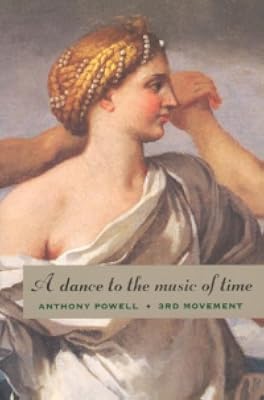
The spines of the four volumes of Anthony Powell’s A Dance to the Music of Time, aligned vertically and sequentially, display the Four Seasons suspended in motion and joined in a ring, excerpted from the painting of the same name by the 17th century French artist, Nicolas Poussin. Kudos to the University of Chicago Press for the handsome and appropriate covers.
Poussin’s masterpiece inspired the 20th century British author to publish from 1951 to 1975 a series of 12 novels, divided into four show more volumes according to the seasons, comprising one “duodecalogy.” The nature of this work is singular enough that searching the term itself yields primarily references to Dance.
Books Do Furnish a Room is the title of the tenth installment, incidentally supporting the centathlete’s aforementioned aesthetic satisfaction in looking at his bookcase next to his faulty, formerly high-fidelity stereo, underneath framed photos he took of a Montana roadside vista, a Costa Rican cloud forest, and the Haleakala crater atop Maui. Without delineating the current symbolic month or season of his own life, as Powell’s series proceeds to do for its narrator, Nicholas Jenkins (and thus for the author and his generation), the centathlete plods along his route, briefly pausing to reflect on Dance, a marvelous, weighty piece of furniture, so to speak, to be displayed and treated respectfully.
Dance presents a collection of Brits who, through and after the two world wars, engage articulately in high-minded colloquies on Art, Nostalgia, Personal Myth and other Topics That Should Be Capitalized; love affairs; dissolution; internecine entanglement; and dubious or emotionally fraught activities. Auberon Waugh, deceased, bilious son of deceased, bilious Top 100 author Evelyn Waugh, dismissed Dance as an “upmarket soap opera,” but the centathlete refuses to be a likeminded player hater. The pleasure in reading these novels was by no means guilty.
In addition to being Quite English, Powell’s characters are essentially aristocratic or loftily bohemian; Dance is replete with peers by legacy or appointment, generals, artists, writers, composers and critics. Eton and Oxford also loom large. Joe Sixpack might be put off by this preoccupation with the elite and the near-total exclusion of the working man and woman. In fact, Powell is ready for this objection. Jenkins asks one American about another’s family history and is met with a laugh:
“‘Why do the British always ask that?’
‘One of our foibles.’
‘That’s not what Americans do.’
‘But we’re not Americans. You must humour our straying from the norm in that respect.’”
The centathlete doubts that most Brits, their Royals aside, share Jenkins’s and Powell’s obsession with genealogy and titles. Nobility literally occupied the author’s bed and visited his study: he was married to Lady Violet Pakenham and he himself declined knighthood in his later years. A social man and a prolific book reviewer, Powell was no doubt aware of a certain assessment of snobbery, as seen in Jenkins’s exchange with one of the few grungy personages of Dance:
“‘Why are you so stuck up?’ she asked, truculently.
‘I’m just made that way.’
‘You ought to fight it.’
‘I can’t see why.’”
If you find humor, albeit dry, mannerly and English, in the above two passages, then you will appreciate the main appeal of Dance. Imagine bumping into an old friend, as Jenkins does, who says, “You must inspect my future wife,” instead of, “Meet Peggy.”
Powell further spices his tea by saddling his characters with tragicomic flaws and idiosyncrasies. They combat alcoholism, licentiousness, cynicism and melancholy. The effect is a view of the second tier of England’s Finest, making the rich brew easier on the tongue.
Many of the dozens of significant characters in Dance were modeled partly or wholly on real people. Only two such historical figures would be familiar to Joe Sixpack: George Orwell and Aleister Crowley. The former, two years older than Powell, attended Eton College with him, and they were friendly for years despite divergent political beliefs. Interestingly, one Orwell expert (if not, one wonders at times, a self-styled psychic Orwell channeler), the formidable, indefatigable polemicist Christopher Hitchens, did not see the resemblance of Orwell in the character of Erridge Tolland—as do members of the Anthony Powell Society—in his essay on Dance. A qualified admirer of the saga, Hitchens critiqued Powell’s conservatism for the way it omitted dramatization of key historical realities such as British fascism.
For an American there can be a smug and hypocritical tendency to simplify a foreigner’s politics, even more so when the subject is dead. In this line we boil down Powell as a Tory and therefore “reactionary,” “pro-establishment,” and “upper-crust-clinging.” The centathlete, conscious of his own limitations and detachment, notes an author’s political perspective only as it aids textual digestion and regurgitation. With cud in cheek, he recalls that North America’s first great literary humorist, Thomas Chandler Haliburton, “…was a Tory of an old and rigorous school—a school so completely overwhelmed by the subsequent triumphs of labour and democratic thought as to be almost a museum-piece now.” That appraisal comes courtesy of Robert McDougall’s afterword to Haliburton’s 1836 uproarious satire, The Clockmaker which the centathlete purchased at the worth-visiting Haliburton house in Windsor, Nova Scotia, a town known as “the birthplace of hockey.”
Haliburton was a Canadian, a judge, and, ultimately a Tory Member of the House of Commons in England. He is considered “the most frequently quoted author in America” on account of aphorisms such as “Death and taxes are inevitable” and others.
Seeking to strike a Tory-Labour balance, the centathlete thinks of Martin Amis, a one-time crony of Hitchens, and his left-ish but acerbic take on writers and their affiliations in his 1995 novel, The Information:
“‘Novelist and politician are both concerned with human potential.’
‘This would be Labour, of course.’”
The bitter protagonist, also an author, goes on to observe:
“All writers, all book people, were Labour, which was one of the reasons they got on so well, why they didn’t keep suing each other and beating each other up.”
Amis’s sarcasm notwithstanding, the centathlete recognizes the political tension and bias in literary criticism and appreciation, especially when he dimly recalls his own undergraduate classes…
Returning to the Dance floor, Aleister Crowley, the second referenced real-life model, will be known to headbangers via Ozzy Osbourne’s “Mr. Crowley,” a message to the English occultist. That song features the six-string sorcery of the late Randy Rhoads, a trailblazer in “hammering,” the technique of fingertapping up on a guitar’s fretboard as a keyboard player might, now a requirement for any heavy metal axman. In jazz, Stanley Jordan almost exclusively plays in this manner. Listening to his 1985 recording debut, “Magic Touch,” you can’t help but enjoy the elegant adventurism. His web site discusses his current participation in Music Therapy. The centathlete happily conjectures that the practice of this alternative anodyne would have surfaced in a more current version of Dance.
The work’s engine is the perpetual cycle of themes, motifs and situations, as the characters or their proxies meet again and again as they age. These encounters occur by design through balls, chateau weekends and other society gatherings, or, more dramatically and seemingly as frequently, through coincidence. After questioning the likelihood of this recurrent serendipity, the centathlete will defer to Hitchens, who writes, “…it is very far from improbable that a small and highly stratified island society should find its more educated and leisured members running into each other at successive conjunctures.”
The centathlete also grants that half of Americans live within 50 miles of their birthplace. However, it his experience that many, if not the large majority of, friends from childhood and young adulthood and even later, move apart and lose touch. Geographic dislocation, suburban traffic and twelve-hour workdays hinder the will to suspend disbelief on this subject and therefore Dance seems accordingly alien and antiquated.
Jenkins, the stand-in for Powell, naturally participates in most of these meetings. His ubiquity and his retention of names, faces and more, would make a Society Page editor envious. He knows Everybody, which ultimately turns absurd, as in the final novel when he meets a mature woman at a wedding and it is prompted that he knew intimately and independently her brother, her first lover, her deceased daughter, the daughter’s widower, and many of the daughter’s lovers including the man present at her death.
Powell’s style is belletristic (apparently there’s a new, aggressive kind of belletrism), formal and elongated. Like Haliburton, Powell astutely generalizes on aspects of human experience, but he usually shuns the brevity required for an “aphorism.” For example,
“When it comes to recapitulation of what is known of a dead friend, for the benefit of a third party (whether or not writing a biography), remnants transmissible in a form at once lucid, unimpeded by subjective considerations, are astonishingly meagre.”
With regard to grammar, he perplexingly employs colons, rather than commas or semicolons, in a series (ex. “The Stourwater passages had by now acquired the smell common to all schools: furniture polish: disinfectant: fumes of unambitious cooking.”). This usage appears throughout Dance and, if elsewhere in modern literature, the centathlete has not yet encountered it. Then there is “rôle,” which Powell insists on adorning with a circumflex; the symbol serves as a synecdoche for the author’s overarching traditionalism. Think of an older gent who wears a cravat at an office where no one has worn a tie for years.
The narration also carries a curious degree of circumspection. Jenkins introduces us to hundreds of people, typically with intricate description and incisive development. Yet he won’t tell us what his own wife looks like, and she is allowed only infrequent, terse statements in concordance with his own sensibility. We vicariously attend weddings and other ceremonies, but not his own. His parents figure in a flashback and recede offstage. Even allowing for tact or loyalty to authorial “objectivity” (apparently achievable only when discussing those outside the immediate family), the centathlete wished for a modest, if subjective, airing of the Jenkins household.
In Dance classical and renaissance images and themes are sounded, considered, and then played out. Other relics—passages from centuries-old texts, song fragments, cars, buildings—resonate for the honestly aging Jenkins, who comments, “The other mild advantage [of growing old] endorses a keener perception for the authenticities of mythology, not only of the traditional sort, but—when such are any good—the latterday mythologies of poetry and the novel.”
Cultivated retrospection—into personal history and beyond— brings resonance to a life. Throughout Dance Jenkins admires artistic creators or mystical aspirants, tortured as they might be, provided they are building on foundations of well-considered tradition. What was written about Poussin seems to hold for Powell, “For him, the one thing that truly sustained creation was the inseminating authority of the past.”
The evocation of Time in the title of the duodecalogy calls attention to the daunting amount needed to read this complete work, the longest leg of the centathlon, an engrossing, erudite, tasteful yet occasionally racy, comedy. Now, the attractive volumes stand, Seasons outward. Looking back at them again, the centathlete is gratefully edified that he had the legs and the time to place them there. show less
The spines of the four volumes of Anthony Powell’s A Dance to the Music of Time, aligned vertically and sequentially, display the Four Seasons suspended in motion and joined in a ring, excerpted from the painting of the same name by the 17th century French artist, Nicolas Poussin. Kudos to the University of Chicago Press for the handsome and appropriate covers.
Poussin’s masterpiece inspired the 20th century British author to publish from 1951 to 1975 a series of 12 novels, divided into four show more volumes according to the seasons, comprising one “duodecalogy.” The nature of this work is singular enough that searching the term itself yields primarily references to Dance.
Books Do Furnish a Room is the title of the tenth installment, incidentally supporting the centathlete’s aforementioned aesthetic satisfaction in looking at his bookcase next to his faulty, formerly high-fidelity stereo, underneath framed photos he took of a Montana roadside vista, a Costa Rican cloud forest, and the Haleakala crater atop Maui. Without delineating the current symbolic month or season of his own life, as Powell’s series proceeds to do for its narrator, Nicholas Jenkins (and thus for the author and his generation), the centathlete plods along his route, briefly pausing to reflect on Dance, a marvelous, weighty piece of furniture, so to speak, to be displayed and treated respectfully.
Dance presents a collection of Brits who, through and after the two world wars, engage articulately in high-minded colloquies on Art, Nostalgia, Personal Myth and other Topics That Should Be Capitalized; love affairs; dissolution; internecine entanglement; and dubious or emotionally fraught activities. Auberon Waugh, deceased, bilious son of deceased, bilious Top 100 author Evelyn Waugh, dismissed Dance as an “upmarket soap opera,” but the centathlete refuses to be a likeminded player hater. The pleasure in reading these novels was by no means guilty.
In addition to being Quite English, Powell’s characters are essentially aristocratic or loftily bohemian; Dance is replete with peers by legacy or appointment, generals, artists, writers, composers and critics. Eton and Oxford also loom large. Joe Sixpack might be put off by this preoccupation with the elite and the near-total exclusion of the working man and woman. In fact, Powell is ready for this objection. Jenkins asks one American about another’s family history and is met with a laugh:
“‘Why do the British always ask that?’
‘One of our foibles.’
‘That’s not what Americans do.’
‘But we’re not Americans. You must humour our straying from the norm in that respect.’”
The centathlete doubts that most Brits, their Royals aside, share Jenkins’s and Powell’s obsession with genealogy and titles. Nobility literally occupied the author’s bed and visited his study: he was married to Lady Violet Pakenham and he himself declined knighthood in his later years. A social man and a prolific book reviewer, Powell was no doubt aware of a certain assessment of snobbery, as seen in Jenkins’s exchange with one of the few grungy personages of Dance:
“‘Why are you so stuck up?’ she asked, truculently.
‘I’m just made that way.’
‘You ought to fight it.’
‘I can’t see why.’”
If you find humor, albeit dry, mannerly and English, in the above two passages, then you will appreciate the main appeal of Dance. Imagine bumping into an old friend, as Jenkins does, who says, “You must inspect my future wife,” instead of, “Meet Peggy.”
Powell further spices his tea by saddling his characters with tragicomic flaws and idiosyncrasies. They combat alcoholism, licentiousness, cynicism and melancholy. The effect is a view of the second tier of England’s Finest, making the rich brew easier on the tongue.
Many of the dozens of significant characters in Dance were modeled partly or wholly on real people. Only two such historical figures would be familiar to Joe Sixpack: George Orwell and Aleister Crowley. The former, two years older than Powell, attended Eton College with him, and they were friendly for years despite divergent political beliefs. Interestingly, one Orwell expert (if not, one wonders at times, a self-styled psychic Orwell channeler), the formidable, indefatigable polemicist Christopher Hitchens, did not see the resemblance of Orwell in the character of Erridge Tolland—as do members of the Anthony Powell Society—in his essay on Dance. A qualified admirer of the saga, Hitchens critiqued Powell’s conservatism for the way it omitted dramatization of key historical realities such as British fascism.
For an American there can be a smug and hypocritical tendency to simplify a foreigner’s politics, even more so when the subject is dead. In this line we boil down Powell as a Tory and therefore “reactionary,” “pro-establishment,” and “upper-crust-clinging.” The centathlete, conscious of his own limitations and detachment, notes an author’s political perspective only as it aids textual digestion and regurgitation. With cud in cheek, he recalls that North America’s first great literary humorist, Thomas Chandler Haliburton, “…was a Tory of an old and rigorous school—a school so completely overwhelmed by the subsequent triumphs of labour and democratic thought as to be almost a museum-piece now.” That appraisal comes courtesy of Robert McDougall’s afterword to Haliburton’s 1836 uproarious satire, The Clockmaker which the centathlete purchased at the worth-visiting Haliburton house in Windsor, Nova Scotia, a town known as “the birthplace of hockey.”
Haliburton was a Canadian, a judge, and, ultimately a Tory Member of the House of Commons in England. He is considered “the most frequently quoted author in America” on account of aphorisms such as “Death and taxes are inevitable” and others.
Seeking to strike a Tory-Labour balance, the centathlete thinks of Martin Amis, a one-time crony of Hitchens, and his left-ish but acerbic take on writers and their affiliations in his 1995 novel, The Information:
“‘Novelist and politician are both concerned with human potential.’
‘This would be Labour, of course.’”
The bitter protagonist, also an author, goes on to observe:
“All writers, all book people, were Labour, which was one of the reasons they got on so well, why they didn’t keep suing each other and beating each other up.”
Amis’s sarcasm notwithstanding, the centathlete recognizes the political tension and bias in literary criticism and appreciation, especially when he dimly recalls his own undergraduate classes…
Returning to the Dance floor, Aleister Crowley, the second referenced real-life model, will be known to headbangers via Ozzy Osbourne’s “Mr. Crowley,” a message to the English occultist. That song features the six-string sorcery of the late Randy Rhoads, a trailblazer in “hammering,” the technique of fingertapping up on a guitar’s fretboard as a keyboard player might, now a requirement for any heavy metal axman. In jazz, Stanley Jordan almost exclusively plays in this manner. Listening to his 1985 recording debut, “Magic Touch,” you can’t help but enjoy the elegant adventurism. His web site discusses his current participation in Music Therapy. The centathlete happily conjectures that the practice of this alternative anodyne would have surfaced in a more current version of Dance.
The work’s engine is the perpetual cycle of themes, motifs and situations, as the characters or their proxies meet again and again as they age. These encounters occur by design through balls, chateau weekends and other society gatherings, or, more dramatically and seemingly as frequently, through coincidence. After questioning the likelihood of this recurrent serendipity, the centathlete will defer to Hitchens, who writes, “…it is very far from improbable that a small and highly stratified island society should find its more educated and leisured members running into each other at successive conjunctures.”
The centathlete also grants that half of Americans live within 50 miles of their birthplace. However, it his experience that many, if not the large majority of, friends from childhood and young adulthood and even later, move apart and lose touch. Geographic dislocation, suburban traffic and twelve-hour workdays hinder the will to suspend disbelief on this subject and therefore Dance seems accordingly alien and antiquated.
Jenkins, the stand-in for Powell, naturally participates in most of these meetings. His ubiquity and his retention of names, faces and more, would make a Society Page editor envious. He knows Everybody, which ultimately turns absurd, as in the final novel when he meets a mature woman at a wedding and it is prompted that he knew intimately and independently her brother, her first lover, her deceased daughter, the daughter’s widower, and many of the daughter’s lovers including the man present at her death.
Powell’s style is belletristic (apparently there’s a new, aggressive kind of belletrism), formal and elongated. Like Haliburton, Powell astutely generalizes on aspects of human experience, but he usually shuns the brevity required for an “aphorism.” For example,
“When it comes to recapitulation of what is known of a dead friend, for the benefit of a third party (whether or not writing a biography), remnants transmissible in a form at once lucid, unimpeded by subjective considerations, are astonishingly meagre.”
With regard to grammar, he perplexingly employs colons, rather than commas or semicolons, in a series (ex. “The Stourwater passages had by now acquired the smell common to all schools: furniture polish: disinfectant: fumes of unambitious cooking.”). This usage appears throughout Dance and, if elsewhere in modern literature, the centathlete has not yet encountered it. Then there is “rôle,” which Powell insists on adorning with a circumflex; the symbol serves as a synecdoche for the author’s overarching traditionalism. Think of an older gent who wears a cravat at an office where no one has worn a tie for years.
The narration also carries a curious degree of circumspection. Jenkins introduces us to hundreds of people, typically with intricate description and incisive development. Yet he won’t tell us what his own wife looks like, and she is allowed only infrequent, terse statements in concordance with his own sensibility. We vicariously attend weddings and other ceremonies, but not his own. His parents figure in a flashback and recede offstage. Even allowing for tact or loyalty to authorial “objectivity” (apparently achievable only when discussing those outside the immediate family), the centathlete wished for a modest, if subjective, airing of the Jenkins household.
In Dance classical and renaissance images and themes are sounded, considered, and then played out. Other relics—passages from centuries-old texts, song fragments, cars, buildings—resonate for the honestly aging Jenkins, who comments, “The other mild advantage [of growing old] endorses a keener perception for the authenticities of mythology, not only of the traditional sort, but—when such are any good—the latterday mythologies of poetry and the novel.”
Cultivated retrospection—into personal history and beyond— brings resonance to a life. Throughout Dance Jenkins admires artistic creators or mystical aspirants, tortured as they might be, provided they are building on foundations of well-considered tradition. What was written about Poussin seems to hold for Powell, “For him, the one thing that truly sustained creation was the inseminating authority of the past.”
The evocation of Time in the title of the duodecalogy calls attention to the daunting amount needed to read this complete work, the longest leg of the centathlon, an engrossing, erudite, tasteful yet occasionally racy, comedy. Now, the attractive volumes stand, Seasons outward. Looking back at them again, the centathlete is gratefully edified that he had the legs and the time to place them there. show less
Members
- Recently Added By
Lists

Books Read in 2021
5,361 works; 113 members
Author Information

61+ Works 13,440 Members
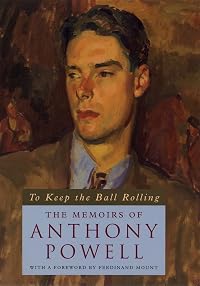
Anthony Powell was born on December 21, 1905 in Westminster, England and was educated at Eton College and Balliol College, Oxford. In 1926 he became an editor at Duckworth & Co. and later moved on to be a scriptwriter for Warner Brothers. By 1937 he was a regular contributor to The Spectator and the Daily Telegraph. From 1953-1959 Powell was the show more Literary Editor of Punch. His first book, The Barnard Letter, was published in 1928 and his first novel, Afternoon Men, was published in 1931. In 1951 Powell published A Question of Upbringing, which was the first of the 12-novel sequence A Dance to the Music of Time. In 1975 he published Hearing Secret Harmonies, which was the last novel of the sequence. Powell wrote Infants of the Spring, which is part of To Keep the Ball Rolling, his memoirs. He also published The Fisher King in 1986. Anthony Powell died peacefully at his home, The Chantry, aged 94 on March 28, 2000. (Bowker Author Biography) show less
All Editions
Some Editions
Awards and Honors
Series

Work Relationships
Contains
Is abridged in
Has as a reference guide/companion
Common Knowledge
- Canonical title
- A Dance to the Music of Time: Fourth Movement, Winter
- Original publication date
- 1976-10
- People/Characters
- Nicholas Jenkins
- Important places
- London, England, UK
- Dedication
- For Rupert
- First words
- Reverting to the University at forty, one immediately recaptured all the crushing melancholy of the undergraduate condition.
- Last words
- (Click to show. Warning: May contain spoilers.)Even the formal measure of the Seasons seemed suspended in the wintry silence.
- Disambiguation notice
- Omnibus volume of:
10 -- Books Do Furnish a Room;
11 -- Temporary Kings; and
12 -- Hearing Secret Harmonies.
NOTE: The Simon Vance audiobook, combined here, is unabridged.
Omnibus edition of:
10. Books do furnish a room (1971)
11. Temporary kings (1973)
12. Hearing secret harmonies (1975)
Classifications
Statistics
- Members
- 957
- Popularity
- 27,626
- Reviews
- 16
- Rating
- (4.18)
- Languages
- English, Spanish
- Media
- Paper, Audiobook, Ebook
- ISBNs
- 9
- ASINs
- 12