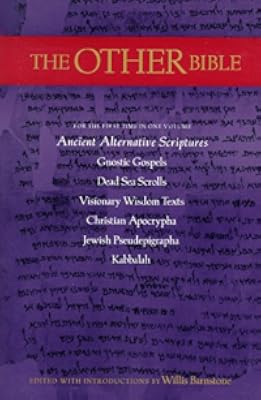
The Other Bible
by Willis Barnstone (Editor)
On This Page
Description
A collection of ancient, esteric texts from Judeo-Christian traditions, excluded from the official canon of the Old and New Testaments.Tags
Recommendations






Member Reviews
A good and clear translation of a great variety of texts from different times, religious movements, and places and the best sampler of what an alternate history Bible might have looked like (if Christianity had never existed, or a more Jewish form had won out, or a more Gnostic one etc.) Contains Dead Sea Scrolls, Jewish mysticism, Christian literature, Gnostic works, poems and much more.
Full of a splendid assortment of wonders (and a helpful selection of rarities like the Odes of Solomon) grouped by type of book. (Read the Acts of the Apostles and wondering what the deed-books of other disciples read like? Read on. Read the Book of Revelation and wondering what other books of its ilk read like -- they were a genre. Read on.) Nearly show more every work I would wish to give a reader to show the variety and splendor of non-Biblical literature is here, a thoughtfully chosen anthology.
Best read in small doses for its sheer strangeness and variety, but warmly recommended.
-Kushana show less
Full of a splendid assortment of wonders (and a helpful selection of rarities like the Odes of Solomon) grouped by type of book. (Read the Acts of the Apostles and wondering what the deed-books of other disciples read like? Read on. Read the Book of Revelation and wondering what other books of its ilk read like -- they were a genre. Read on.) Nearly show more every work I would wish to give a reader to show the variety and splendor of non-Biblical literature is here, a thoughtfully chosen anthology.
Best read in small doses for its sheer strangeness and variety, but warmly recommended.
-Kushana show less
Excellent collection of Early Christian era texts. Contains Gnostic, Dead Sea Scroll, Apocrypha and Jewish texts. Pretty obvious why most of these didn't make it into the Christian Bible. But these are valuable texts that rival the bible in importance when we consider the evolution of religious thought in the formative period of the Christian Church. The Gnostics are the most heavily represented. Several branchs of Gnostic texts are included here. It would be nice to see the Nag Hammadi books represented a little better however. While the texts of the christian authors are interesting, the introductory matter to each of the individual texts makes this Bible well worth buying. Barnstones introductions help bring this disparate group of show more Christian thinkers into perspective. show less
Excellent book to use to teach how the canon was formed. However, even they leave out texts like the Gospel of Mary.
A collection of ancient esoteric texts
07/14/2009: read 'THE GOSPEL OF NICODEMUS,' a text once considered part of the canon and wildly popular during Medieval times. '...a passion gospel purporting to be an official report of the trial, crucifixion, and resurrection of Jesus.... one of the most dramatic and moving documents of early Christianity. Argumentative rather than spiritual, it reads like an exciting eyewitness report of murder, miracle, and resurrection.... a fabricated record of the third or fourth century written specifically as a pious counterblast to Pagan statements concerning Jesus.... Faith or disbelief makes one person's miracles another's sorcery.... In keeping with other works of the period, the Gospel is virulently anti-Jewish. It attempts editorially to show more dissociate Jesus as well as early biblical figures from Jewish identity.... the term 'Jews' becomes a stereotyping device to condemn a rival alien people.' (359-360)
From the first part, 'Acts of Pilate': Medieval romance writers invented the Holy Grail from legends about Joseph of Arimathaea, who claimed the body of Jesus and placed it in the tomb. Before that happened, though, Jewish leaders advocating for Jesus' death imprisoned Joseph. He is rescued by divine intervention. Joseph describes how, 'at midnight as I stood and prayed, the house where you shut me in was raised up the four corners, and I saw as it were a lightning flash in my eyes. Full of fear, I fell to the ground. And someone took me by the hand and raised me up from the place where I had fallen, and something moist like water flowed from my head to my feet, and the smell of fragrant oil reached my nostrils.' (372)
From the second part, 'Christ's Descent into Hell': Hades is the personification of death, a being who devours the dead and holds them in his gut. He and Satan are fearful that Jesus will steal all the dead from them and bring the dead up to heaven.
'Then Hades said to his demons: 'Make fast well and strongly the gates of brass and the bars of iron, and hold my locks, and stand upright and watch every point. For if he [the crucified Jesus] comes in, woe will seize us.'' (376)
Of course, Jesus breaks through all the brass and iron and redeems those lost souls who died before His coming. Then Hades and Satan squabble about who is to blame.
'And Hades took Satan and said to him: 'O Beelzebub, heir of fire and torment, enemy of the saints, through what necessity did you contrive that the King of glory should be crucified, so that he should come here and strip us naked? Turn and see that not one dead man is left in me, but that all which you gained through the Tree of Knowledge you have lost through the tree of the cross.' (377)
10/14/2008: read the 'Infancy Gospels' -- of James, Matthew, Thomas, as well as the Latin & Arabic ones -- researching Mariology; also dipped into the 'Apocalypses.' show less
From the first part, 'Acts of Pilate': Medieval romance writers invented the Holy Grail from legends about Joseph of Arimathaea, who claimed the body of Jesus and placed it in the tomb. Before that happened, though, Jewish leaders advocating for Jesus' death imprisoned Joseph. He is rescued by divine intervention. Joseph describes how, 'at midnight as I stood and prayed, the house where you shut me in was raised up the four corners, and I saw as it were a lightning flash in my eyes. Full of fear, I fell to the ground. And someone took me by the hand and raised me up from the place where I had fallen, and something moist like water flowed from my head to my feet, and the smell of fragrant oil reached my nostrils.' (372)
From the second part, 'Christ's Descent into Hell': Hades is the personification of death, a being who devours the dead and holds them in his gut. He and Satan are fearful that Jesus will steal all the dead from them and bring the dead up to heaven.
'Then Hades said to his demons: 'Make fast well and strongly the gates of brass and the bars of iron, and hold my locks, and stand upright and watch every point. For if he [the crucified Jesus] comes in, woe will seize us.'' (376)
Of course, Jesus breaks through all the brass and iron and redeems those lost souls who died before His coming. Then Hades and Satan squabble about who is to blame.
'And Hades took Satan and said to him: 'O Beelzebub, heir of fire and torment, enemy of the saints, through what necessity did you contrive that the King of glory should be crucified, so that he should come here and strip us naked? Turn and see that not one dead man is left in me, but that all which you gained through the Tree of Knowledge you have lost through the tree of the cross.' (377)
10/14/2008: read the 'Infancy Gospels' -- of James, Matthew, Thomas, as well as the Latin & Arabic ones -- researching Mariology; also dipped into the 'Apocalypses.' show less
NO OF PAGES: 742 SUB CAT I: Apocrypha SUB CAT II: SUB CAT III: DESCRIPTION: Excerpted ancient holy texts from Judeo-Christian traditions that were excluded from the official cannon of the Old and New Testaments. Selections from Jewish Pseudepigrapha, early Kabbalah, Haggadah, Midrash, Christian Apocrypha, and Gnostic scriptures.NOTES: SUBTITLE: Ancient Alternative Scriptures
Ratings
Members
- Recently Added By
Author Information

Willis Barnstone was born in Lewiston, Maine. He attended Bowdoin, Columbia, and Yale, earning his doctorate. Barnstone taught in Greece from 1949 to 1951, and in Buenos Aires during the Dirty War. He went to China during the Cultural Revolution, where he was later a Fulbright Professor of American Literature at Beijing Foreign Studies University show more from 1984 to 1985. Barnstone has authored more than forty books, poetry collections, poetry translations, philosophical and religious texts. He is a former O'Connor Professor of Greek at Colgate University, is a Distinguished Professor of Comparative Literature and is in the Institute of Biblical and Literary Studies at Indiana University. He has received numerous awards for his work, among them the Emily Dickinson Award, the W. H. Auden Award, and a PEN/Book-of-the-Month-Club Special Citation for translation. Barnstone was also a Guggenheim Fellow and Pulitzer Prize finalist in poetry. His titles include The Complete Poems of Sappho,, Translated with an Introduction, Ancient Greek Lyrics, Love Poems, and Café de l'Aube à Paris, Dawn Café in Paris: Poems Composed in French and Their Translation in English. (Bowker Author Biography) show less
Common Knowledge
- Canonical title
- The Other Bible
- Original publication date
- 1984
- Epigraph
- Had Alexandria triumphed and not Rome,
the extravagant and muddled stories that I have summarized here would be coherent, majestic, and perfectly ordinary.
—Jorge Luis Borges (on the Gnostics) - Dedication
- For Marija Dionisia Maddock
- First words
- INTRODUCTION
William Blake's wife, Catherine Boucher, once complained that she had little of Mr. Blake's company for he was always in Paradise.
Classifications
- Genres
- Religion & Spirituality, Nonfiction, History
- DDC/MDS
- 229.052 — Religion The Bible Apocrypha, pseudepigrapha, intertestamental works Apocrypha Modern versions and translations
- LCC
- BS1695 .O87 — Philosophy, Psychology and Religion The Bible The Bible Old Testament Special parts of the Old Testament
- BISAC
Statistics
- Members
- 1,158
- Popularity
- 21,659
- Reviews
- 6
- Rating
- (4.02)
- Languages
- English
- Media
- Paper
- ISBNs
- 4
- ASINs
- 7