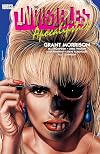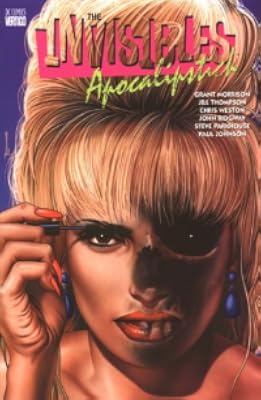
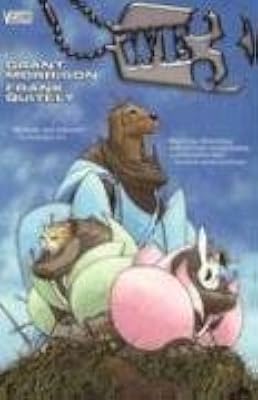
The Invisibles, Vol. 2: Apocalipstick
by Grant Morrison
The Invisibles Vol.1 (Collections and Selections — 9-16), The Invisibles (Collections and Selections — TPB Vol 1 issues 09-16)
On This Page
Description
In the second volume of this series of action and intrigue, the Invisibles, including new recruit Dane McGowan, try to prepare as the Conspiracy's shock troops launch their greatest direct attack on them ever. And as this hidden war between authority and anarchy continues, the origin of Lord Fanny, the transvestite shaman who can call down the Earth's most ancient and terrifying magic, is finally revealed. But as conspiracies and hidden truths create a labyrinth of deception and distrust, show more even the power of this she-man shaman may not be enough to keep the Invisibles alive to fight another day. show lessTags
Recommendations





Member Reviews
My Invisibles re-read continues. The second volume moves the focus to Lord Fanny, who I'm pretty sure was the first trans main character I came across as a teenager. The reader learns how she became a witch, while Dane flees the Invisibles and King Mob consults an old friend. Although the plot is very compelling, the most haunting sequences are side interludes following employees of the evil conspiracy. I think each of these is an entire issue, one following a domestic servant and the other a guard. The former feeds human corpses to an eldritch monster born to the royal family. Naturally he ends up fed to the monster himself. The latter gets a sympathetic biography, which ends abruptly when he is killed by King Mob. Both of these side show more stories are striking examinations of class and inequality, demonstrating how ordinary people can end up doing evil things because they're 'just following orders'. A brilliant contrast to the main characters and a welcome change from making all enemy minions faceless and disposable.
The Tory antagonists have aged depressingly well. The Invisibles was written towards the end of the Thatcher and Major era; its politics feel remarkably contemporary after years of austerity under Cameron, May, and Johnson. Once again, Britain is a bleak and fatalistic country ground down by wealth inequality, aristocratic privilege, and incompetent Conservative governments. Also pandemic and Brexit, these days. The discussion of Princess Diana is a blast from the past, though:
[b:The Invisibles, Vol. 2: Apocalipstick|22357|The Invisibles, Vol. 2 Apocalipstick|Grant Morrison|https://i.gr-assets.com/images/S/compressed.photo.goodreads.com/books/1429233908l/22357._SY75_.jpg|1040171] introduces lots more magical weirdness and Jim Crow, rapper and voodoo priest. It continues to be remarkably well-paced and exciting for a narrative so dense with references and allusions. The art is vivid and atmospheric, especially during Lord Fanny's flashbacks. This series is really rewarding to re-read. show less
The Tory antagonists have aged depressingly well. The Invisibles was written towards the end of the Thatcher and Major era; its politics feel remarkably contemporary after years of austerity under Cameron, May, and Johnson. Once again, Britain is a bleak and fatalistic country ground down by wealth inequality, aristocratic privilege, and incompetent Conservative governments. Also pandemic and Brexit, these days. The discussion of Princess Diana is a blast from the past, though:
"She was supposed to represent the mythical Diana, you see, the moon goddess, the virgin huntress, but the very concept seemed beyond her comprehension. Her firstborn was to have been the moon-child, the incarnate shadow-king of a new England, the terrible messiah of the dark millennium."
"A privilege for any woman, Miles!"
[b:The Invisibles, Vol. 2: Apocalipstick|22357|The Invisibles, Vol. 2 Apocalipstick|Grant Morrison|https://i.gr-assets.com/images/S/compressed.photo.goodreads.com/books/1429233908l/22357._SY75_.jpg|1040171] introduces lots more magical weirdness and Jim Crow, rapper and voodoo priest. It continues to be remarkably well-paced and exciting for a narrative so dense with references and allusions. The art is vivid and atmospheric, especially during Lord Fanny's flashbacks. This series is really rewarding to re-read. show less
This second volume of The Invisibles does create some sympathy for its protagonists that I found lacking in the first. In particular, much of it is constructed around the origin myth of Lord Fanny, and the new character Jim Crow (an Invisibles avatar of Papa Guedhe) is quite engaging. While reading, it struck me that Grant Morrison's comic was not quite so innovative as it has been made out to be. Steve Englehart's Coyote actually covered a lot of this ground at the end of the Cold War, before the seeming monopolarity of the millenium threw popular esotercism into the insurgent mode (later called jihad by Hakim Bey). Still, I have to hand it to Morrison for his ability to introject dead baby jokes and the occasional shocking profundity, show more such as the placenta as ur-Christ (46)! As a symptom of its occult charge, The Invisibles: Apocalypstick manifested several synchronicities with my life experience in the context of reading it. show less
Much like the previous volume, so much of this is inventive and compassionate and wonderful, and then Morrison just dumps a lot of obscenity on us, by which I mean ugliness and sadness and torture and death for no plot-related purpose. The heroes here are nuanced and interesting, the villains are evil cartoons, and the things they do are made just about as awful as they could be just to get a rise out of you, and it left me feeling unhappy and a little sick, and I don't need that--I'm a 36-year-old man with a beautiful little happy boy (who Grant Morrison would love to torture and kill were he only a fictional little boy; more, he'd love to write me as the slavering killer; it's just no good the things he does) and a difficult show more relationship with his mother and increasingly what I want from books is either nuanced psychology or rollicking adventures or sharp analysis or simple peace, and I have outgrown The Invisibles, goodbye. show less
This really starts to hit its stride. It's shed its debt to Sandman from the first volume (which I was slightly surprised at). For the most part it's becoming less verbose too (although there are still fairly long passages of Morrisson's (pseudo?) automatic writing schtick). It's pretty scatter-shot, with different characters suddenly taking prominence, but there is a coherent arc.
Generally, there seems to be a certain attention to craft displayed here that Morrisson apparently decided was unnecessary at some point later in his career, and the whole thing - madcap, psychedelic, self-indulgent nonsense that it is - reads surprisingly well.
Generally, there seems to be a certain attention to craft displayed here that Morrisson apparently decided was unnecessary at some point later in his career, and the whole thing - madcap, psychedelic, self-indulgent nonsense that it is - reads surprisingly well.
This book takes you deep into the depravity of the people in power, which demonstrates the importance of the war the Invisibles are fighting.
The center of the story arc is the origin story of Lord Fanny, and I found her vision quest as a child to be quite fascinating. That being said, I'm uncomfortable how marginalized a character she is, and that her sexuality is portrayed in way that is almost freakish (forced into it, prostitution, heavy drugs).
This volume ends on a cliffhanger, and so I was compelled to pick up the next volume.
The center of the story arc is the origin story of Lord Fanny, and I found her vision quest as a child to be quite fascinating. That being said, I'm uncomfortable how marginalized a character she is, and that her sexuality is portrayed in way that is almost freakish (forced into it, prostitution, heavy drugs).
This volume ends on a cliffhanger, and so I was compelled to pick up the next volume.
The degree by which the wonderment and invention in this book increases, flourishes and spills over relative to the first one is exactly equal to the degree to which enjoyment decreases due to familiarity with the world and MO and resultant lessened novelty. What I'm saying is that Grant Morrison is a proven master of dodecadimensional drug math. Also, I'd expected Lord Fanny to be my least favourite, and instead she is my favourite! Drug math strikes again!
I quite enjoyed this volume overall. The twisting of time in the tale of Lord Fanny was rather fascinating to me, and eventually began to make sense. It tied in beautifully with the tale of 'what turns someone evil' if you will. I found the attention paid to class issues rather interesting, as I've been reading rather extensively about the Mod movement and how it was essentially built out of class distinctions.
The Invisibles, as a whole, is proving to be a quite titillating read. I'd be interested in reading it through with the annotations from the early usenet groups, but at this point I feel that would be cheating a wee bit. I'd prefer to be surprised this time around, and in future rereads (which I feel may inevitably happen) see it show more with the fresh eyes of those who have obsessively read it.
I'd also be quite interested in seeing whether or not anyone has put together a reading list for the comics based upon all the books that [a:Grant Morrison|12732|Grant Morrison|http://photo.goodreads.com/authors/1311378308p2/12732.jpg] referenced in the letter columns and the intro portions of some issues. The Monster of Glamis reference alone makes me want to keep reading. :) show less
The Invisibles, as a whole, is proving to be a quite titillating read. I'd be interested in reading it through with the annotations from the early usenet groups, but at this point I feel that would be cheating a wee bit. I'd prefer to be surprised this time around, and in future rereads (which I feel may inevitably happen) see it show more with the fresh eyes of those who have obsessively read it.
I'd also be quite interested in seeing whether or not anyone has put together a reading list for the comics based upon all the books that [a:Grant Morrison|12732|Grant Morrison|http://photo.goodreads.com/authors/1311378308p2/12732.jpg] referenced in the letter columns and the intro portions of some issues. The Monster of Glamis reference alone makes me want to keep reading. :) show less
Members
- Recently Added By
Lists

Slipstream or Interstitial Fiction
160 works; 19 members

Drawn Out: The 50 Best Non-Superhero Graphic Novels
175 works; 8 members
Author Information

All Editions
Series

The Invisibles Vol.1
25 works (Collections and Selections — 9-16)

The Invisibles
65 works (Collections and Selections — TPB Vol 1 issues 09-16)
Belongs to Publisher Series
Work Relationships
Contains
Has as a study
Common Knowledge
- Canonical title
- The Invisibles, Vol. 2: Apocalipstick
- Original title
- The Invisibles, Vol. 2: Apocalipstick
- Alternate titles
- The Invisibles: Apocalipstick
- People/Characters
- King Mob; Ragged Robin; Lord Fanny; Jack Frost; Boy; Baron Samedi (show all 8); Tlazolteotl (Diety); Brody Lewis
- Important places
- Brazil; London, England, UK; Pennsylvania, USA; Philadelphia, Pennsylvania, USA; Rio de Janeiro, Rio de Janeiro, Brasil
- First words
- Nice. They crucified a toad.
Classifications
- Genre
- Graphic Novels & Comics
- DDC/MDS
- 741.5973 — Arts & recreation Drawing & decorative arts Drawing Comic books, graphic novels, fotonovelas, cartoons, caricatures, comic strips History, geographic treatment, biography North American United States (General)
- LCC
- PN6728 .I58 .M66 — Language and Literature Literature (General) Literature (General) Collections of general literature Comic books, strips, etc.
- BISAC
Statistics
- Members
- 747
- Popularity
- 37,595
- Reviews
- 9
- Rating
- (4.07)
- Languages
- English, German, Portuguese (Brazil), Spanish
- Media
- Paper, Ebook
- ISBNs
- 4
- ASINs
- 2