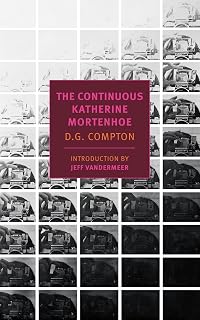
On This Page
Description
"Katherine Mortenhoe's world looks very similar to our own, except that in this near future medical science has found the cure for death--or eliminated nearly every cause for it other than old age. So when Katherine is diagnosed with a terminal brain disease caused by an inability to process an ever-increasing volume of sensory input, she immediately becomes a celebrity to the "pain-starved public." But Katherine will not agree to be the star of the TV show Human Destiny, her last days will show more not be recorded by any cameras. She doesn't realize that from the moment of her diagnosis, she's been watched, not only by television producers but by a new kind of reporter, one with no visible camera, who is always recording behind his never-blinking eye"-- show lessTags
Recommendations























Member Reviews
First something I must get off my chest: I heartily dislike the new goodreads homepage. It’s far too busy, I much preferred the less cluttered old version. Secondly, this is a short novel and only took me three days to read because it is, pardon my French, grim as fuck. A bitterer, more cynical sci-fi novel I have rarely come across. The conceit is as follows: Katherine Mortenhoe is diagnosed with a terminal illness that will kill her in mere weeks. As such illnesses are vanishingly rare, she immediately becomes a celebrity and is hounded by the media. A man with TV cameras in his eyes follows her around, trying to make a reality TV show about her. Although there is a dark humour about all this, it’s a nasty, angry sort of humour show more that isn’t really funny. The writing is at times witty, yet never in a light-hearted fashion. For example this moment when Katherine has just been diagnosed and phones a church.
This novel (which has also been published under the name [b:The Unsleeping Eye|676077|The Unsleeping Eye|D.G. Compton|https://images.gr-assets.com/books/1403632836s/676077.jpg|4465059]) first came out in 1974 and reads as unsettlingly prescient. The voyeuristic media obsession with unusual categories of suffering and the pervasiveness of reality TV are foreseen very clearly. Many background details of world-building seem entirely too convincing: tokenistic privacy laws, rampant inequality, and constant protest marches that are ignored and disregarded. The book has aged pretty well as the focus is on social change, not technological. It’s a particularly cynical analysis of social and individual psychology. Despite the proximity of Katherine to the reader - the point of view is split between her and the cameraman - it’s hard to sympathise with her as a person. The narrative places you in such a similar position to those watching her dying on TV that reading about her becomes uncomfortable. Knowing how she feels seems voyeuristic, a clever effect to pull off in a novel.
I should also add that to me the most horrible incident in the book doesn’t involve Katherine at all. At one point when Rod the cameraman is driving, he comes across a protest blocking the road. Impatient, he tries to get through line of marchers by slipping after another vehicle. In the process he runs over two people, killing one. The callous atmosphere surrounding this murder (manslaughter?) is absolutely chilling and Rod recounts the episode with an air of self-justification, mixed with disbelief that his actions could have such serious consequences. The police pick him up then assure him there will be no charges and no-one will care. The dead woman and injured man are nameless, faceless, disregarded. I think this scene (which had no plot purpose that I could discern) demonstrated both the dangerous mindset that driving can breed and that media voyeurism is as much about what is not shown as what is splashed everywhere. Whereas Katherine’s illness apparently justifies a huge amount of media time and money, deaths in road ‘accidents’ and on untelegenic protests create no interest whatsoever. Plus ça change.
‘The Continuous Katherine Mortenhoe’ is a smart book, albeit one shot through with both petty and grand cruelties and seemingly determined to undermine the reader’s faith in humanity. It is a powerful and memorable piece of fiction, but not at all pleasant to read. It was no surprise to find the ending just as depressing as the rest. Thus I can only give it three stars. show less
"Vicar Pemberton speaking."
So then it was too late for her to change her mind. "I’m going to die," she said.
"You wouldn’t have rung me if you really believed that. What have you taken?"
"I’ve taken umbrage."
This novel (which has also been published under the name [b:The Unsleeping Eye|676077|The Unsleeping Eye|D.G. Compton|https://images.gr-assets.com/books/1403632836s/676077.jpg|4465059]) first came out in 1974 and reads as unsettlingly prescient. The voyeuristic media obsession with unusual categories of suffering and the pervasiveness of reality TV are foreseen very clearly. Many background details of world-building seem entirely too convincing: tokenistic privacy laws, rampant inequality, and constant protest marches that are ignored and disregarded. The book has aged pretty well as the focus is on social change, not technological. It’s a particularly cynical analysis of social and individual psychology. Despite the proximity of Katherine to the reader - the point of view is split between her and the cameraman - it’s hard to sympathise with her as a person. The narrative places you in such a similar position to those watching her dying on TV that reading about her becomes uncomfortable. Knowing how she feels seems voyeuristic, a clever effect to pull off in a novel.
‘The Continuous Katherine Mortenhoe’ is a smart book, albeit one shot through with both petty and grand cruelties and seemingly determined to undermine the reader’s faith in humanity. It is a powerful and memorable piece of fiction, but not at all pleasant to read. It was no surprise to find the ending just as depressing as the rest. Thus I can only give it three stars. show less
What an odd novel this is. I do not mean that in any way negatively. I have never read anything quite like it. The story as such, is told from two perspectives, those of the two main characters. One is dying, the other is watching her die in ways she cannot suspect. Human love, human kindness, help one make it to the end of the story, but my no means does love triumph. The exploitation of a person who is dying, making them into a reality TV star in effect, constantly grounds one in the sordidness of our society. Normally I find the endings of novels their weakest points. Not in this case. Both characters meet their futures, better for their experiences together. Strongly recommended.
Ugh. What a slog. I gave up more than 50% of the way through because, fundamentally, I was not enjoying this book (and, at more than 50% of the way through, I felt it still had not begun, quite ... if it were a 600 page opus, that might be acceptable for the same page count (100ish pages of set-up) but not in a 200 page book.
On the front flap, in an effort to drum up interest in the book, it describes plot events that still have not happened, despite my being more than 50% of the way through. No, just no.
I love the title (when am I going to learn that books only sometimes live up to their title!) but the characters were dull and uninteresting, the plot was dull and uninteresting, the future setting was scarcely described and show more unevocative, and I imagine, if it weren't for the "reality tv" aspect of it (basically unexplored, at least to the point I got to in the book, and with every indication that they were never going to explore it) I'm sure this would be a dusty forgotten tome.
I will be reading Jack Vance's Lyonesse next instead! Life's too short, and (if I live to my father's age) I only have another 26 years of reading left, and (at current rates, though I hope to pick up speed in retirement) that's only about 3,000 books. They better all be good ones!
(Note: 5 stars = amazing, wonderful, 4 = very good book, 3 = decent read, 2 = disappointing, 1 = awful, just awful. I'm fairly good at picking for myself so end up with a lot of 4s). show less
On the front flap, in an effort to drum up interest in the book, it describes plot events that still have not happened, despite my being more than 50% of the way through. No, just no.
I love the title (when am I going to learn that books only sometimes live up to their title!) but the characters were dull and uninteresting, the plot was dull and uninteresting, the future setting was scarcely described and show more unevocative, and I imagine, if it weren't for the "reality tv" aspect of it (basically unexplored, at least to the point I got to in the book, and with every indication that they were never going to explore it) I'm sure this would be a dusty forgotten tome.
I will be reading Jack Vance's Lyonesse next instead! Life's too short, and (if I live to my father's age) I only have another 26 years of reading left, and (at current rates, though I hope to pick up speed in retirement) that's only about 3,000 books. They better all be good ones!
(Note: 5 stars = amazing, wonderful, 4 = very good book, 3 = decent read, 2 = disappointing, 1 = awful, just awful. I'm fairly good at picking for myself so end up with a lot of 4s). show less
D.G. Compton’s 1974 novel, also known as The Unsleeping Eye, is both eerily prophetic and very dated. It presents a world where medicine has advanced to such a degree that old age and accidents are virtually the only cause of death. When Katherine Mortenhoe, a workaholic editor in her forties, is told by her doctor that she’s one of the rare few to have developed a terminal condition, her imminent death makes her a celebrity. The vulpine TV producer Vincent Ferriman knows that Katherine’s situation will make her perfect for his show Human Destiny, in which the tragedies of the few are played out for the edification (and salivation) of the comfortable masses. Her husband Harry is game to sign the lucrative contract; but Katherine show more herself won’t so easily be made a victim. Yet she hasn’t reckoned with Vincent’s masterstroke, in the form of very special reporter Roddie Patterson. The high concept, which foreshadows our own age of reality TV shows and constant status updates, is intriguing, but Compton’s novel is dragged down by the fact that his future still looks, and feels, an awful lot like the 1970s...
For the full review, please see my blog:
https://theidlewoman.net/2019/07/27/the-continuous-katherine-mortenhoe-d-g-compt... show less
For the full review, please see my blog:
https://theidlewoman.net/2019/07/27/the-continuous-katherine-mortenhoe-d-g-compt... show less
Story: 5 / 10
Characters: 5
Setting: 5
Prose: 3
A strong concept, but with a poorly balanced plot. Half the book was spent setting up the story, leaving little space for a proper pace. In the end, the concept is the only thing to take away from this one...
Memory triggers: TV eyes, eternal public protests, reality TV
Characters: 5
Setting: 5
Prose: 3
A strong concept, but with a poorly balanced plot. Half the book was spent setting up the story, leaving little space for a proper pace. In the end, the concept is the only thing to take away from this one...
Memory triggers: TV eyes, eternal public protests, reality TV
Ratings
Members
- Recently Added By
Lists

S.F. Masterworks (Complete)
229 works; 15 members

Books Read in 2014
2,343 works; 89 members

Christmas Haul 2014
9 works; 1 member

SF Masterworks
193 works; 8 members
Author Information

39+ Works 1,418 Members
Some Editions
Awards and Honors
Series

Belongs to Publisher Series
Common Knowledge
- Canonical title
- The Continuous Katherine Mortenhoe
- Alternate titles
- The Unsleeping Eye (1973) (1973); Death Watch; The Continuous Katherine Mortenhoe (1974, UK) (1974, UK)
- Original publication date
- 1973
- Related movies
- Death Watch (1980 | IMDb)
- Dedication
- For my dear wife carol.
A celebration, of her and us - First words
- Katherine Mortenhoe . . . So now I had a name to work on, and a case history. I also had NTV's background report. The last two would be of little help.
Sometimes a novel is so complex it's simple. (Introduction) - Last words
- (Click to show. Warning: May contain spoilers.)She was very close to me, and spoke softly.
"You've come back," she said.
I hadn't, of course. Such things aren't that easy. But I'd made a decent start. I was on my way.
(Click to show. Warning: May contain spoilers.)There will always be an inner world that no one can see and that cannot be expressed except through the medium of words. (Introduction) - Blurbers
- Lethem, Jonathan
Classifications
Statistics
- Members
- 438
- Popularity
- 70,291
- Reviews
- 6
- Rating
- (3.46)
- Languages
- English, French, German
- Media
- Paper, Ebook
- ISBNs
- 12
- ASINs
- 7