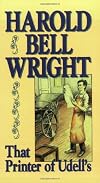
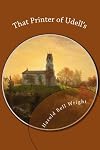
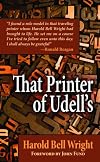
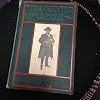
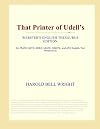
That Printer of Udell's
by Harold Bell Wright
On This Page
Description
As a boy, Dick Falkner ran away from abject poverty and an abusive alcoholic father. Sixteen years later, he finds himself hungry of body and empty of spirit in a Midwestern town. Although he finds no help in this so-called Christian town, he is eventually taken in by George Udell, a local publisher and kindhearted man. Through hard work and Christian morals, this man, who becomes known as "that printer of Udell's," rises above his past to a new, inspiring life with God.Tags
Recommendations














Member Reviews
I only know of That Printer of Udell's because of its mention in several biographies of Ronald Reagan. Reagan read the book and joined his mother's church through baptism, and tried to live by its precepts. It was minister-turned-author Harold Bell Wright's first book, first published in 1903. Wright was a major, best-selling author of the pre-World War II era, though he is mostly forgotten now and ignored or derided by the literati and academe.
That Printer of Udell's drips with 1903 Progressivism and Social Gospel ideas. Christianity in the book is less about saving souls than "doing something" to make society better. To address homelessness, joblessness, and vice. Social Gospel because, by God, shouldn't we try to make earth like show more heaven; Progressivism because, by Govt., shouldn't we, with the right ideas and the power of the state, solve society's ills. Otherwise, it reads like light, early-1900s narrative fiction. Omniscient narrator, corny dialogue, coincidences in characters and events that break your suspension of disbelief, et cetera. It's not a bad book, but, but it isn't earth-shattering literature either. And, a lot of the guff it my get is because it is so black-and-white moral: good guys win, bad guys lose, vice is bad, grit and determination will win the day. All the stuff the glitterati, literati, and academerati deride as childish, bunkish, hokum. Not really bad stuff, but they hate it. It is literature of a moral and edifying tone, Horatio Alger type stuff, that the aforementioned folks hate and deride. Which makes me like it even more. Just to spite 'em. In the end, though, it's not a bad story. Though naïve in its political program, I still wanted the good guys to win, and I found the story engaging enough. It was a pleasant, though not life-changing read. As a historian it illustrates the period, and offers insight into the mind and soul of Ronald Reagan, for whom it was a touchstone. All-in-all, I am happy I read That Printer of Udell's. show less
That Printer of Udell's drips with 1903 Progressivism and Social Gospel ideas. Christianity in the book is less about saving souls than "doing something" to make society better. To address homelessness, joblessness, and vice. Social Gospel because, by God, shouldn't we try to make earth like show more heaven; Progressivism because, by Govt., shouldn't we, with the right ideas and the power of the state, solve society's ills. Otherwise, it reads like light, early-1900s narrative fiction. Omniscient narrator, corny dialogue, coincidences in characters and events that break your suspension of disbelief, et cetera. It's not a bad book, but, but it isn't earth-shattering literature either. And, a lot of the guff it my get is because it is so black-and-white moral: good guys win, bad guys lose, vice is bad, grit and determination will win the day. All the stuff the glitterati, literati, and academerati deride as childish, bunkish, hokum. Not really bad stuff, but they hate it. It is literature of a moral and edifying tone, Horatio Alger type stuff, that the aforementioned folks hate and deride. Which makes me like it even more. Just to spite 'em. In the end, though, it's not a bad story. Though naïve in its political program, I still wanted the good guys to win, and I found the story engaging enough. It was a pleasant, though not life-changing read. As a historian it illustrates the period, and offers insight into the mind and soul of Ronald Reagan, for whom it was a touchstone. All-in-all, I am happy I read That Printer of Udell's. show less
When I learned in Paul Kengor's book, God and Ronald Reagan, that Reagan read this book when he was eleven years old and cherished it throughout his life, I felt a need to find it and read it for myself.
The author was a minister of a Disciples of Christ church in Kansas when he wrote the book. It was first printed as a serial in the Christian Century, at the time, a Disciples of Christ journal. It was his first book.
The story is about a young man, son of a drunkard, who after his mother died, wound up living in a middle western city. He found work as a printer, secretly fell in love with a beautiful rich girl, and became an active Christian versus just a church member. Because of his poor background he was looked down upon by the show more religious elite (including the parents of the girl he loved). His natural talents boosted him into leadership positions in the town and because of his faith in Christ and belief in its practical application he prevailed over all sorts of opposition and evil.
I was reminded of John Sheldon's book, In His Steps, as I read That Printer of Udell's.
The book would not be considered politically correct in this day because of its depiction of African Americans, although this is but a small portion of the book. It would also likely be panned for being too simple in its understanding and presentation of the Christian faith. Yet I am glad to have found and read this book, and am happy to recommend it, particularly to those who want to learn more of the literature that influenced Ronald Reagan. show less
The author was a minister of a Disciples of Christ church in Kansas when he wrote the book. It was first printed as a serial in the Christian Century, at the time, a Disciples of Christ journal. It was his first book.
The story is about a young man, son of a drunkard, who after his mother died, wound up living in a middle western city. He found work as a printer, secretly fell in love with a beautiful rich girl, and became an active Christian versus just a church member. Because of his poor background he was looked down upon by the show more religious elite (including the parents of the girl he loved). His natural talents boosted him into leadership positions in the town and because of his faith in Christ and belief in its practical application he prevailed over all sorts of opposition and evil.
I was reminded of John Sheldon's book, In His Steps, as I read That Printer of Udell's.
The book would not be considered politically correct in this day because of its depiction of African Americans, although this is but a small portion of the book. It would also likely be panned for being too simple in its understanding and presentation of the Christian faith. Yet I am glad to have found and read this book, and am happy to recommend it, particularly to those who want to learn more of the literature that influenced Ronald Reagan. show less
Great story even if the writing left a bit to be desired. Worth the read.
A bit scattered, and too preachy.
Wright's First book, a set of sermons. This book began Wright's writing career and set up the style, themes and even traditions of illustration that continued through the 1920's. Wright was asked to write this because of the dramatic and picturesque nature of his sermons. This is the Burt printing of the 1903 1st edition.Wright went on to be one of the most prolific and best-seller writers of the early 1900's, living in Tucson and writing in the Catalina's. See Mine with the Iron door for his Oracle connection.
Ratings
Members
- Recently Added By
Author Information

36+ Works 3,217 Members
Harold Bell Wright was born in Rome, New York on May 4, 1872. Before becoming a full-time author, he was a preacher. Between 1902 and 1942 he wrote 19 books, several stage plays, and numerous magazine articles. His books include That Printer of Udell's; The Shepherd of the Hills; The Calling of Dan Matthews; The Winning of Barbara Worth; and To My show more Sons. He died of bronchial pneumonia on May 24, 1944. (Bowker Author Biography) show less
Some Editions
Common Knowledge
- Epigraph
- And the King shall answer and say unto them, Verily I say unto you, Inasmuch as ye did it unto one of these my brethren, even these least, ye did it unto me.
- Dedication
- To that friend whose life has taught me many beautiful thruths; whose words have strenthened and encouraged me to live more true to my God, my fellows and myself; who hoped for me when others lost hope; who believed in me ... (show all)when others cold not; who saw good when others looked for evil; to that friend, whoever he is, wherever he is, wherever he may be, I affectionately dedicate this story.
- First words
- O God, take ker o' Dick!
- Last words
- (Click to show. Warning: May contain spoilers.)Inasmuch as ye have done it unto one of the least of these, my brethren, ye have done it unto Me.
Classifications
- Genres
- Fiction and Literature, Christian Fiction
- DDC/MDS
- 813.4 — Literature & rhetoric American literature in English American fiction in English Later 19th Century 1861-1900
- LCC
- PZ3 .W9324 — Language and Literature Fiction and juvenile belles lettres Fiction and juvenile belles lettres Fiction in English
- BISAC
Statistics
- Members
- 324
- Popularity
- 97,814
- Reviews
- 5
- Rating
- (3.88)
- Languages
- English, German
- Media
- Paper, Audiobook, Ebook
- ISBNs
- 43
- ASINs
- 20