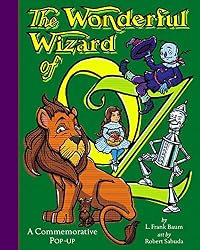
The Wonderful Wizard of Oz: A Commemorative Pop-up
by Robert Sabuda (Paper engineer), L. Frank Baum
Classic Collectible Pop-ups
On This Page
Description
A pop-up version of the classic story with a shorter version of the text.Tags
Recommendations





Member Reviews
I had the pleasure of reading this book again to some little ones recently. In general I’m not a huge fan of “pop up” books but this one really takes the concept to the next level, and for a classic story. The first thing you notice is the book is quite thick and upon opening the cover, you’re greeted with a tornado that springs up about ten inches. The book only has seven major pages but each is impressive, and the text of the story is then included on smaller sub-pages which open as insets, and which include smaller pop-ups and illustrations. Kids love the detail level and fingering things, putting on the small green film glasses when the Emerald City is entered, and spinning the hot air balloon which is one of the later show more pop-ups. They also love pointing out the small discrepancies between the film and the book which stem from the book being true to the Baum’s original, which I think is cool.
In an age with so much other content for kids, it’s nice to see this story is not “dead”, there are so many nice elements and messages to it beyond the imagination Baum clearly showed: being brave in a world that is sometimes evil and scary, being confident and understanding that you may already have within you something that you perceive as a shortcoming, being smart enough to see through charades such as the one the “Great and Terrible” Oz perpetuates until this motley crew comes along, and lastly, of course, the universal sentiment of trying to go home. If you’re looking for a very nice way of reading this story to kids, this “queen mother” of pop up books would be a great choice. show less
In an age with so much other content for kids, it’s nice to see this story is not “dead”, there are so many nice elements and messages to it beyond the imagination Baum clearly showed: being brave in a world that is sometimes evil and scary, being confident and understanding that you may already have within you something that you perceive as a shortcoming, being smart enough to see through charades such as the one the “Great and Terrible” Oz perpetuates until this motley crew comes along, and lastly, of course, the universal sentiment of trying to go home. If you’re looking for a very nice way of reading this story to kids, this “queen mother” of pop up books would be a great choice. show less
Sabuda's version of The Wonderful Wizard of Oz is such a gorgeous book. Sabuda is the master of paper crafting. His two page pop-up spreads are amazing. They are detailed, brilliant in color, and capture a whimsical feel perfectly suited to the subject. Most impressive of all, though, is the ingenuity of his constructions that emerge from the page. One set up features the wizard taking off in his hot air balloon; a hot air balloon is suppressed between two flat pages until its turn arrives, and then jumps up and gracefully swings back and forth, with the wizard in his basket hanging below. That in itself should be enough to recommend this book to everyone. Nonetheless, some of the other spreads display a glorious Emerald City castle, a show more creepy witch's castle, a twisting tornado, the Munchkin village, a field of poppies, and a final scene. In addition to these big glories, each page has smaller pages with their own miniature fold-out people and objects. These smaller pages are where Sabuda includes the text, and he encloses a ridiculously large amount in tiny spaces. I suppose that should not be surprising, for a writer who specializes in the creative folding and hiding of paper. The narrative is easy to read, and true to the original. Well, guilty confession: I have never read the original Wizard of Oz series. It has been on my to-read pile for a long time. Yet, what I know from the movie and my background information about the books shows me that he at least captures the right spirit in his writing. I love this book, and hope to procure more in Sabuda's commemorative series. show less
I'm somewhat torn between including and excluding this in my classroom. On the one hand, I recognize that my students would absolutely love the pop-ups. However, given how fragile they are, I know that they'd get some extreme wear-and-tear very quickly. Also, given the complexity of the pop-ups, I don't think my students would actually be reading the book. That said, I do think that I would use this for a read aloud. That way my students would get to see the beautiful pop-ups and hear the actual writing on the page. Plus my book would survive more than just one school year.
This pop-up book does The Wonderful Wizard of OZ justice and really captures the fantasy aspect of the story. My favorite two pages are the one with the giant emerald castle and then the hot-air balloon that spins! I believe children of all ages will enjoy this timeless adventure with its breathtaking illustrations.
I really loved this book. I loved this book for two reasons. Reason number one being that it has pop up pictures and it is interactive. Each page has the main object that is being talked about as the pop-up picture. It also has the writing in little pop-up books inside the actual book. For example the first page talks about the cyclone that is hitting the land and the pop up picture is of the cyclone. Another example would be the page they’re talking about the land of Oz, the pop-up picture is Oz’s castle. Another reason I liked this book is because of the use of colors. Each page has one main color and then different shades of the main color throughout the whole page. For example Oz’s castle page is made of the color green with show more different green undertones for the rest of the page. I think the big idea of this book is to be yourself and be accepting of others. show less
This book is illustrated beautifully and uniquely. It stands out against other books because it brings its readers into the book with interactive pull outs and pop-up visuals. It tells the tale of the Wizard of Oz with visuals and a storyline that stand out against the classic story we know so well.
This book is a beautiful book illustrated with watercolor and pop-up pieces. It was translated from Chinese so some of the wording is awkward but over all the narrative and the text it self is very well written. This is the traditional story of the four friends who go on a journey for one thing but end up finding so much more. The illustrations combined with the pop-up elements really bring the story to life and give it something a little different than the original. This book is great for children ages two through third grade. This book would be great in a classroom to:
-show children a very creative way to tell a story
-read aloud to the children
-have the children work with the pictures only
-examine the different characters and their show more personalities show less
-show children a very creative way to tell a story
-read aloud to the children
-have the children work with the pictures only
-examine the different characters and their show more personalities show less
Members
- Recently Added By
Lists

Carole's List
445 works; 13 members
Author Information

Sabuda was born in Pinckney, Michigan on March 8, 1965. He was skilled as an artist from a very young age, and he attended the Pratt Institute in New York City. His specific interest in 3-D paper engineering---pop-up books---was sparked by a book he received as a gift. Since 1994 Sabuda has published at least one pop-up book annually. These books show more are typically childrens' classics like The Twelve Days of Christmas, Mother Goose, The Wizard of Oz, Alice's Adventures in Wonderland, The Night Before Christmas and, most recently, Beauty and the Beast. Sabuda works from his studio in New York City. His 2010 title Beauty and The Beast made The New York Times BestSeller List for 2010. (Bowker Author Biography) show less

609+ Works 72,272 Members
Best known as the author of the Wizard of Oz series, Lyman Frank Baum was born on May 15, 1856, in New York. When Baum was a young man, his father, who had made a fortune in oil, gave him several theaters in New York and Pennsylvania to manage. Eventually, Baum had his first taste of success as a writer when he staged The Maid of Arran, a show more melodrama he had written and scored. Married in 1882 to Maud Gage, whose mother was an influential suffragette, the two had four sons. Baum often entertained his children with nursery rhymes and in 1897 published a compilation titled Mother Goose in Prose, which was illustrated by Maxfield Parrish. The project was followed by three other picture books of rhymes, illustrated by William Wallace Denslow. The success of the nursery rhymes persuaded Baum to craft a novel out of one of the stories, which he titled The Wonderful Wizard of Oz. Some critics have suggested that Baum modeled the character of the Wizard on himself. Other books for children followed the original Oz book, and Baum continued to produce the popular Oz books until his death in 1919. The series was so popular that after Baum's death and by special arrangement, Oz books continued to be written for the series by other authors. Glinda of Oz, the last Oz book that Baum wrote, was published in 1920. (Bowker Author Biography) show less
Awards and Honors
Awards
Distinctions
Notable Lists
Series

Work Relationships
Is an adaptation of
Common Knowledge
- Original publication date
- 2001
- People/Characters
- Dorothy; Toto; Scarecrow [Oz]; Tin Woodman; Cowardly Lion; Wicked Witch of the West (show all 7); Wizard of Oz
- Important places
- Emerald City; Yellow Brick Road
- First words
- Dorothy lived in the middle of the great Kansas prairies with Uncle Henry, who was a farmer, and Aunt Em, who was the farmer's wife.
- Last words
- (Click to show. Warning: May contain spoilers.)From the Land of Oz said Dorothy. And oh, Aunt Em! I'm so glad to be at home again.
Classifications
Statistics
- Members
- 1,006
- Popularity
- 25,745
- Reviews
- 21
- Rating
- (4.33)
- Languages
- English, French, Italian, Portuguese
- Media
- Paper
- ISBNs
- 7