On This Page
Description
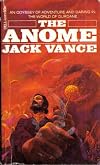
The minstrel Gastel Etzwane lives in Shant -- a country of cantons, each independently dictating its own law and customs. The enforcement of law is simple, quick, and inevitable: death by decapitation, from an explosive torc clamped around each citizen's neck by authority of a single man -- the Anome. For millennia Anomes have ruled Shant, dealing death as they see fit -- and none dares defy them, until Gastel Etzwane risks his head to expose the Anome's identity -- and end the tyranny of show more these faceless men forever. - Jack KingOn the fringes of the Gaean Reach, the cantons of Shant on the planet Durdane are ruled by the reclusive Anome -- who coerces the population using explosive rings around the neck of every adult citizen. The Durdane trilogy (The Anome, The Brave Free Men, and The Asutra) follows the life of Gastel Etzwane, who grows from childhood in the dust of Rhododendron Way to become a musician of renown, and almost against his will, a man of action. When remote cantons are brutalized by the depredations of inhuman Roguskhoi, Etzwane goes before the Anome with a case for response. The Anome proves oddly reluctant to act, and Etzwane must stage a coup to turn Shant against the hordes. Eventually he discovers the sinister fact that the Roguskhoi tribes are pawns of the Asutra, alien elements who seek to bend all of humanity to a disturbing end. The Durdane trilogy traces the rise, struggles and ultimate triumph of Gastel Etzwane-and through him, of humanity itself-over alien subjugation. - Joel HedlundThe Anome, originally published as The Faceless Man, is Book I of the Durdane trilogy, and Volume 43 of the Spatterlight Press Signature Series.Released in the centenary of the author's birth, this handsome new collectionis based upon the prestigious Vance Integral Edition. Select volumes enjoyup-to-date maps, and many are graced with freshly-written forewords contributedby a distinguished group of authors. Each book bears a facsimile of theauthor's signature and a previously-unpublished photograph, chosen from family archives for the period the book was written. These uniquefeatures will be appreciated by all, from seasoned Vance collector to new reader sampling the spectrum of this author's influential work forthe first time. - John Vance II show lessTags
Recommendations













Member Reviews
I haven't read a Jack Vance story for quite a few years. Since he just passed away near the end of May I felt I owed myself a look at some of what I have missed over the years. "The Faceless Man", first published in the February and March 1971 issues of The Magazine of Fantasy and Science Fiction, and the first book in a trilogy was handy and looked interesting. Reading it reminded me of why I once liked Vance so much. The writing is smart, the world building is quick and good and we have little difficulty immersing ourselves in it and identifying with our young protagonist, Mur, who is about to rebel against a very harsh and unfair totalitarian community. The world of the story is a distinctly devolved group of xenophobic societies in show more the far future on another planet. Women in particular are not in a happy place. This is also partly a coming of age tale. When boys reach the age of 12 they go through a purification ceremony to become "Pure boys" and take on a new name. They must thereafter avoid the taint of women which they have just been cleansed of. Mur follows the letter of the law, but apparently not the spirit according to the religious leaders by being too close to his mother. This becomes the catalyst for Mur to break away from his birthplace.
This is as much a generic fantasy as science fiction. I liked it "OK", but my liking distinctly lessened for a time once the boy escaped and was out in the world. In fact I set it aside to read something else, but I came back to it since it kept hanging there in the back of my mind. It has some exciting moments, but it is also quite bland at times and, being part of a trilogy, a little unfinished. I enjoyed it, but it is fair to say I appreciated the story more in hindsight when I had a bigger picture of things and thought back on it. I will probably read the followup novels "The Brave Free Men" and "The Asutra" before too long.
This is by no means a great work, and since it is over 40 years old it can't help but seem a little dated. I thought it was a lot more readable than some of the experimental stuff from that era, however. Vance does not disappoint. show less
This is as much a generic fantasy as science fiction. I liked it "OK", but my liking distinctly lessened for a time once the boy escaped and was out in the world. In fact I set it aside to read something else, but I came back to it since it kept hanging there in the back of my mind. It has some exciting moments, but it is also quite bland at times and, being part of a trilogy, a little unfinished. I enjoyed it, but it is fair to say I appreciated the story more in hindsight when I had a bigger picture of things and thought back on it. I will probably read the followup novels "The Brave Free Men" and "The Asutra" before too long.
This is by no means a great work, and since it is over 40 years old it can't help but seem a little dated. I thought it was a lot more readable than some of the experimental stuff from that era, however. Vance does not disappoint. show less
Mur (later renamed Etzwane) is from a female-phobic religious community from which he escapes. He then becomes a musician and later learns of a threat to his country in the form of ravaging mutant creatures. For some reason, the Faceless Man, the mysterious supreme authority that rules here, refuses to act against them and minimizes the threat they pose. Etzwane seeks out the Faceless man to discover why and to try to get him to take action.
This first book of the Durdane trilogy was originally published in paperback in 1971 as The Anome. It is currently available for Kindle under the original title. It is a short book by modern standards, with 224 pages and very wide margins. I found the limited 1983 hardcover editions of this trilogy show more at my local library and later learned that any print versions are now difficult to come by. I don’t know why. This first installment is quite interesting. The world-building is top notch, with enough detail to bring it to life. The imaginative setting has the feel of fantasy/steampunk, but in my estimation, the book qualifies as science fiction. The details of the story tie back to known science without resort to supernatural or mystical contrivances. It is set in the distant future, on a planet with multiple suns, colonized by humans many generations before and largely forgotten by those on Earth.
The protagonist is likeable, and he is smart and brave enough to pull up stakes and move on when he finds himself in a bad situation. I followed his exploits with interest.
As the first book of a series, many questions remain at the end. I hope they will be resolved. I’ll be reading the rest of the series, so I’ll let you know if they are. show less
This first book of the Durdane trilogy was originally published in paperback in 1971 as The Anome. It is currently available for Kindle under the original title. It is a short book by modern standards, with 224 pages and very wide margins. I found the limited 1983 hardcover editions of this trilogy show more at my local library and later learned that any print versions are now difficult to come by. I don’t know why. This first installment is quite interesting. The world-building is top notch, with enough detail to bring it to life. The imaginative setting has the feel of fantasy/steampunk, but in my estimation, the book qualifies as science fiction. The details of the story tie back to known science without resort to supernatural or mystical contrivances. It is set in the distant future, on a planet with multiple suns, colonized by humans many generations before and largely forgotten by those on Earth.
The protagonist is likeable, and he is smart and brave enough to pull up stakes and move on when he finds himself in a bad situation. I followed his exploits with interest.
As the first book of a series, many questions remain at the end. I hope they will be resolved. I’ll be reading the rest of the series, so I’ll let you know if they are. show less
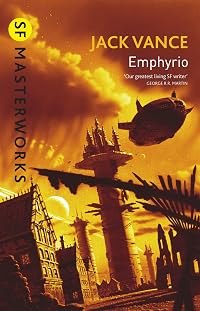
Less scintillating than Jack Vance of old, in the proceeding trilogy he takes three volumes to do more or less what he did in "Emphyrio".
Remarkably uncompelling for a Vance novel, and even as things got rolling about 150 pages in, there wasn't much reason to pick it up again except to finish the damn thing.
Which is a shame, I originally tracked this one down because I've had the two sequels stalled on the to-read stack for decades.
Which is a shame, I originally tracked this one down because I've had the two sequels stalled on the to-read stack for decades.
The following is a review of the Durdane Chronicles as a whole (without spoilers):
http://speculiction.blogspot.co.uk/2014/05/review-of-durdane-chronicles-by-jack....
http://speculiction.blogspot.co.uk/2014/05/review-of-durdane-chronicles-by-jack....
Pleasant enough, but not outstanding. The ending tails off in a lacklustre fashion. Feels like a potboiler.
Dec 17, 2024 (Edited)English (UK)
Ratings
Members
- Recently Added By
Author Information

375+ Works 34,905 Members
John Holbrook Vance (August 28, 1916 - May 26, 2013) was an American mystery, fantasy and science fiction writer. Most of his work was published under the name Jack Vance. He also wrote 11 mystery novels as John Holbrook Vance and three as Ellery Queen, and once each used pseudonyms Alan Wade, Peter Held, John van See, and Jay Kavanse. Vance won show more the World Fantasy Award for Life Achievement in 1984. The Science Fiction Hall of Fame inducted him in 2001. Among his awards for particular works were: Hugo Awards, in 1963 for The Dragon Masters, in 1967 for The Last Castle, and in 2010 for his memoir This is Me, Jack Vance!; a Nebula Award in 1966, also for The Last Castle; the Jupiter Award in 1975; the World Fantasy Award in 1990 for Lyonesse: Madouc. He also won an Edgar (the mystery equivalent of the Nebula) for the best first mystery novel in 1961 for The Man in the Cage. He died at his home in Oakland, California, on May 26, 2013, aged 96. (Bowker Author Biography) show less
Some Editions
Series

Belongs to Publisher Series
Work Relationships
Is contained in
Common Knowledge
- Canonical title
- The Faceless Man
- Original title
- The Faceless Man
- Alternate titles
- The Anome
- Original publication date
- 1971
- People/Characters
- Gastel Etzwane (AKA Mur)
- Important places*
- Durdane
- First words
- At the age of nine Mur heard a man in his mother's rest cottage call out a jocular curse in the name of the Faceless Man.
- Last words
- (Click to show. Warning: May contain spoilers.)We'll start with that Morningshore trifle Birds in the Surf ..."
- Original language*
- Inglés
- Disambiguation notice
- Originally serialized in: The magazine of fantasy and science fiction (Feb.-March 1971) under title: The Faceless Man
*Some information comes from Common Knowledge in other languages. Click "Edit" for more information.
Classifications
Statistics
- Members
- 527
- Popularity
- 57,017
- Reviews
- 6
- Rating
- (3.64)
- Languages
- 7 — Dutch, English, French, German, Italian, Portuguese, Spanish
- Media
- Paper, Ebook
- ISBNs
- 15
- ASINs
- 11