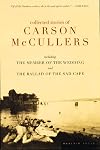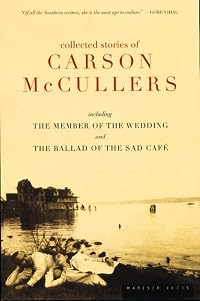
Collected Stories of Carson McCullers
by Carson McCullers 
On This Page
Description
Carson McCullers--novelist, dramatist, poet--was at the peak of her powers as a writer of short fiction. Here are nineteen stories that explore her signature themes: wounded adolescence, loneliness in marriage, and the tragicomedy of life in the South. Here too are two novellas that Tennessee Williams judged to be "assuredly among the masterpieces of our language."--Publisher description.Tags
Recommendations
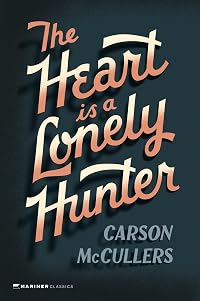









Member Reviews
I read much of this collection at the cabin of some friends in the mountains of western North Carolina. We ate fried green tomatoes and grits and listened to the rush and gurgle of the stream below. When not frolicking outside, I buried myself in this book and it was like spending time with a different kind of old friend. I'd read The Heart Is A Lonely Hunter in my youth, years before I lived in the South, and felt drawn into that world. My own darkness melded with the darkness of the novel and it felt right. Later I moved to the South, where I lived in various states over the next 10 years, and this also felt right. I embraced the melancholic decay I found there for I knew it as my familiar. I slipped that shroud on as if coming home show more to a place where I finally felt I belonged. The desperate summer heat, the slow talking natives, buttery grits, scuttling of giant roaches in the underbrush (and also regrettably in my toaster), kudzu jungles along the roadways: it all made a weird sort of sense. It felt desperate and crazy but so did I, and so it seemed normal.
I purchased this particular copy of the Collected Stories of Carson McCullers as a gift for my sister one year. Oddly enough I had not read it, nor did I read it until just now, many years later, when during a book purge she asked me if I'd like it back. From the very first story, I began slyly falling back in love with Ms. McCullers. By the time I'd reached The Member of the Wedding my passion had reached a fever pitch. There I was in the South, sweating hot in a cabin in the woods, and I could not pull myself away from her words. It was as if she were sprawled out on the plank floor next to me, tall and haunted, whispering these stories in my burning ear.
Coming-of-age tales remain among my favorite types of literature. In the past, I devoured them with insatiable hunger. But never in all my reading have I seen the loss of childhood described with such painstaking devastation as in The Member of the Wedding. McCullers lays out F. Jasmine's agonies before the reader in exquisite detail, many of them poured forth in molasses-stretched moments as F. Jasmine huddles around the kitchen table in the fading twilight with her cohorts Berenice and John Henry, both of whom she loves and loathes, in that special moody way of early adolescence.
Reading The Member of the Wedding made me physically ill at some points. It was as if I were reliving the shattering of my own youthful innocence under the merciless hammers we never see coming when we are young. The excruciation burned particularly hard while watching in my mind as F. Jasmine walked through the Blue Moon upstairs to that room. With my faith in humanity as it is, always resting on a twitchy teeter-totter, wavering between none and some, this scene slammed down hard on the none side, sending the hard wooden plank rushing up to collide with my chin. As I rubbed my throbbing jaw, I thought about how hard it is to grow up in this world, to remain unmarred by some flawed adult's selfish motives.
Though McCullers drags F. Jasmine through tragic circles, she leaves her in a tentative upswing at the end. This surprised me a little, and yet when I think about the last passages, I see more heartbreak and frustration ahead for her. For though she weathered a few brutal storms, she still lives very much in her own head. And I know what trouble that can bring, far into the years to come. show less
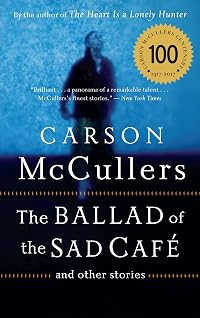
So I am one of those who loved The Heart Is A Lonely Hunter, although to this day I struggle to explain why. The characters are almost alien as to prevent my connection with them, but their struggles, desires and needs are absolutely something I can feel and understand. I found the novel The Ballad of the Sad Café to be very similar. The characters seemed to be designed to come across as foreign in many ways, but the motivations of Miss Amelia, Cousin Lymon and Marvin Macy make them real. It is almost as if their strange exteriors bring greater focus to their interiors. I found the short stories that went along with this short novel very good as well. I especially enjoyed Wunderkind, The Jockey and Madame Zilensky and the King of show more England as they left me, upon completion, mulling over what they were about, the various possibilities. The other short stories, while quite good, provided me with too obvious of an answer, for my tastes, as to what I was supposed to understand or learn. show less
McCullers is at her best when her stories are about adolescents (almost always motherless, often gender-bending, and with a father who's a jeweler) on the cusp of change. But I loved immersing myself in her world in every story.
This collection of short pieces culminates with MEMBER OF THE WEDDING; but I've read that very recently, so it wasn't time for a re-read. For me it culminated with BALLAD OF THE SAD CAFE. This is a very sad piece (as the title warns) featuring a grotesque cast of characters and a miserable ending. It is not "my thing"; but it was still a story to grab me by the throat, and it provided all of the collection's best quotes.
"It is known that if a message is written with lemon juice on a clean sheet of paper there show more will be no sign of it. But if the paper is held for a moment to the fire then the letters turn brown and the meaning becomes clear. Imagine that the whiskey is fire and that the message is that which is known only in the soul of a man - then the worth of Miss Amelia's liquor can be understood."
"The atmosphere of a proper cafe implies these qualities: fellowship, the satisfactions of the belly, and a certain gaiety and grace of behavior." That should be put on a sign and sold to cafe owners everywhere.
"In order to come into the cafe you did not have to buy the dinner, or a portion of liquor. There were cold bottled drinks for a nickel. And if you could not even afford that, Miss Amelia had a drink called Cherry Juice which sold for a penny a glass... There, for a few hours at least, the deep bitter knowing that you are not worth much in this world could be laid low." show less
This collection of short pieces culminates with MEMBER OF THE WEDDING; but I've read that very recently, so it wasn't time for a re-read. For me it culminated with BALLAD OF THE SAD CAFE. This is a very sad piece (as the title warns) featuring a grotesque cast of characters and a miserable ending. It is not "my thing"; but it was still a story to grab me by the throat, and it provided all of the collection's best quotes.
"It is known that if a message is written with lemon juice on a clean sheet of paper there show more will be no sign of it. But if the paper is held for a moment to the fire then the letters turn brown and the meaning becomes clear. Imagine that the whiskey is fire and that the message is that which is known only in the soul of a man - then the worth of Miss Amelia's liquor can be understood."
"The atmosphere of a proper cafe implies these qualities: fellowship, the satisfactions of the belly, and a certain gaiety and grace of behavior." That should be put on a sign and sold to cafe owners everywhere.
"In order to come into the cafe you did not have to buy the dinner, or a portion of liquor. There were cold bottled drinks for a nickel. And if you could not even afford that, Miss Amelia had a drink called Cherry Juice which sold for a penny a glass... There, for a few hours at least, the deep bitter knowing that you are not worth much in this world could be laid low." show less
"First of all, love is a joint experience between two persons--but the fact that it is a joint experience does not mean that it is a similar experience to the two people involved. There are the lover and the beloved, but these two come from different countries. Often the beloved is only a stimulus for all the stored-up love which has lain quiet within the lover for a long time hitherto. And somehow every lover knows this. He feels in his soul that his love is a solitary thing. He comes to know a new, strange loneliness and it is this knowledge which makes him suffer. So there is only one thing for the lover to do. He must house his love within himself as best he can; he must create for himself a whole new inward world--a world intense show more and strange, complete in himself. Let it be added here that this lover about whom we speak need not necessarily be a young man saving for a wedding ring--this lover can be a man, woman, child, or indeed any human creature on this earth.
"Now, the beloved can also be of any description. The most outlandish people can be the stimulus for love. A man may be a doddering great-grandfather and still love only a strange girl he saw in the streets of Cheehaw one afternoon two decades past. The preacher may love a fallen woman. The beloved may be treacherous, greasy-headed, and given to evil habits. Yes, and the lover may see this as clearly as anyone else--but that does not affect the evolution of his love one whit. A most mediocre person can be the object of a love which is wild, extravagant, and beautiful as the poison lilies of the swamp. A good man may be the stimulus for a love both violent and debased, or a jabbering madman may bring about in the soul of someone a tender and simple idyll. Therefore, the value and quality of any love is determined solely by the lover himself.
"It is for this reason that most of us would rather love than be loved. Almost everyone wants to be the lover. And the curt truth is that, in a deep secret way, the state of being beloved is intolerable to many. The beloved fears and hates the lover, and with the best of reasons. For the lover is forever trying to strip bare his beloved. The lover craves any possible relation with the beloved, even if this experience can cause him only pain." - Carson McCullers, from "The Ballad of the Sad Cafe"
McCullers effortlessly provokes within me a beautiful and ineffable sense of homesickness. show less
"Now, the beloved can also be of any description. The most outlandish people can be the stimulus for love. A man may be a doddering great-grandfather and still love only a strange girl he saw in the streets of Cheehaw one afternoon two decades past. The preacher may love a fallen woman. The beloved may be treacherous, greasy-headed, and given to evil habits. Yes, and the lover may see this as clearly as anyone else--but that does not affect the evolution of his love one whit. A most mediocre person can be the object of a love which is wild, extravagant, and beautiful as the poison lilies of the swamp. A good man may be the stimulus for a love both violent and debased, or a jabbering madman may bring about in the soul of someone a tender and simple idyll. Therefore, the value and quality of any love is determined solely by the lover himself.
"It is for this reason that most of us would rather love than be loved. Almost everyone wants to be the lover. And the curt truth is that, in a deep secret way, the state of being beloved is intolerable to many. The beloved fears and hates the lover, and with the best of reasons. For the lover is forever trying to strip bare his beloved. The lover craves any possible relation with the beloved, even if this experience can cause him only pain." - Carson McCullers, from "The Ballad of the Sad Cafe"
McCullers effortlessly provokes within me a beautiful and ineffable sense of homesickness. show less
To me the novella The Ballad of the Sad Cafe, with its theme of love as a dark and grotesque compulsion, is the standout in this collection. The accompanying short stories are so similar in tone that they come across more as sketches or character studies than completed works. And The Member of the Wedding I just don't know what to make of - is it coming of age, coming out, or the surrender/discovery of self?
I'd recommend going with the paper version of this book. My copy is the nook edition which has scanning typos like you'd see in a bad pdf and it looks like the kindle ebook has the same problem. The nook TOC is interactive at least, unlike the kindle.
I'd recommend going with the paper version of this book. My copy is the nook edition which has scanning typos like you'd see in a bad pdf and it looks like the kindle ebook has the same problem. The nook TOC is interactive at least, unlike the kindle.
I married a man from the South almost 20 years ago, but his family and culture remain utterly opaque to me. I thought perhaps literature by a Southern woman writer could help me grasp why they are the way they are. The stories contained here seemed dreary and dull and I couldn't figure out what the point was supposed to be.
(Previous attempts to read Eudora Welty also failed to please, but I have enjoyed one book by Adriana Trigiani.)
(Previous attempts to read Eudora Welty also failed to please, but I have enjoyed one book by Adriana Trigiani.)
Though I enjoy much of McCuller's writing, I prefer her novels more and consider them far-surpassing her shorter works. I felt I was running out of time and therefore had to abandon what still remains in this book for me unread.
Members
- Recently Added By
Author Information

98+ Works 22,730 Members
Carson McCullers was born in Columbus, Georgia, on February 19, 1917. She died at age fifty in Nyack, New York, on September 29, 1967. A promising pianist, she had hoped to enroll at the Juilliard School of Music when she was seventeen, but when she arrived in New York, she attended writing classes at Columbia University instead. In December 1936 show more her first story, "Wunderkind," was published in "Story" magazine. That winter she began work on "The Mute," which would become her enduring masterpiece, "The Heart Is a Lonely Hunter." (Publisher Provided) Carson McCullers was born Lula Carson Smith on February 19, 1917 in Columbus, Georgia. At the age of seventeen, desiring to become a famous concert pianist, she went to New York City to attend the Julliard School of Music. Her family sacrificed and raised money for her tuition to go to Julliard, but she lost all of her money when she left her pocketbook on the subway. Unable to tell her family what had happened, she took writing classes at Columbia University and New York University from 1935-1936. Her first novel, The Heart Is a Lonely Hunter, was published in 1940. Her other novels included Reflections in a Golden Eye, The Ballad of the Sad Café, The Member of the Wedding, and Clock Without Hands. With the help of Tennessee Williams, The Member of the Wedding was adapted into a play, which won the New York Drama Critics Circle Award in 1950. She died from a stroke and subsequent brain hemorrhage on September 29, 1967at the age of 50. (Bowker Author Biography) show less
Carson McCullers has a Legacy Library. Legacy libraries are the personal libraries of famous readers, entered by LibraryThing members from the Legacy Libraries group.
Some Editions
Work Relationships
Contains
Common Knowledge
- Canonical title
- Collected Stories of Carson McCullers
- Original title
- Collected Stories of Carson McCullers, including The Member of the Wedding and The Ballad of the Sad Café
- Original publication date
- 1987
- People/Characters
- Carson McCullers
Classifications
Statistics
- Members
- 691
- Popularity
- 41,470
- Reviews
- 9
- Rating
- (4.15)
- Languages
- English, German
- Media
- Paper, Ebook
- ISBNs
- 8
- UPCs
- 2
- ASINs
- 5