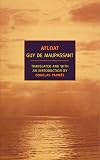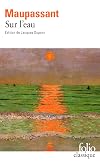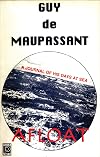
Afloat
by Guy de Maupassant
On This Page
Description
General Books publication date: 2009 Original publication date: 1889 Original Publisher: G. Routledge and sons Notes: This is an OCR reprint. There may be typos or missing text. There are no illustrations or an index. When you buy the General Books edition of this book you get free trial access to Million-Books.com where you can select from more than a million books for free. You can also preview the book there.Tags
Recommendations















































Member Reviews
A marvellous work, an account of a voyage GDM made on his yacht along the coast of the South of France with his two hired sailors. His most personal work, in which the author comes closest to the reader, perhaps because it's plotless, and the narrator gives himself time to dream, to rant, and reflect. It contains matchless descriptions of the sea and the South of France, and amazing confessional stuff, in which Mauppassant comes across as a precursor to all the modern confessional writing of French lit: the Celines, the Cendrars. It contains Maupassant's famous rant against militarism and war, his reaction to the sack of Paris by the Germans in the 1870-71 Franco Prussian war. Here's a snippet:
Men of war are the scourge of humanity. We show more fight against nature, against ignorance, against all sorts of obstacles to mitigate the evils of our miserable existence. There are men, philanthropists, learned men, who spend their whole lives toiling to discover how to help, support, relieve their brother mortals... then along comes a war, and in six months, the generals have destroyed the work of twenty years of patient effort...
An incredible work, one to turn to again and again. show less
Men of war are the scourge of humanity. We show more fight against nature, against ignorance, against all sorts of obstacles to mitigate the evils of our miserable existence. There are men, philanthropists, learned men, who spend their whole lives toiling to discover how to help, support, relieve their brother mortals... then along comes a war, and in six months, the generals have destroyed the work of twenty years of patient effort...
An incredible work, one to turn to again and again. show less
de Maupassant's book afloat is presented as a journal of the author's eight day cruise along the French Cote d' Azur. Each chapter is dated, more than a few even mention a location; Nice, Cannes, Agay, Saint-Raphaël, Saint-Tropez...
Most of the pages however are covered by de Maupassant's musings on war, society, women, humanity's ordeal and quite a few outburst of his Spleen. The pages relating to the actual sailing are very sparesely distributed through the book.
Belying its structure, the book is not a journal of a sailing expedition. The volume is actually a collection of earlier writings, articles, essais and monographs, brought together and structurally organised over a narrative framework of a sailing trip. Each separate piece show more pops up as an impression, a flow of thought that is loosely triggered by an event of the trip.
Despite the beautiful writing ( was Maupassant not Flaubert's protégé ? ) and an amusing chauvinistic resume of French history in a few "bons mots", Maupassant's ramblings will hardly capture the imagination today. Wrestling with his narcisistic Spleen and "dégout" of the Modern world, his opinions, however true, have acquired a naive gloss. Maupassant lived after all a 150 years ago. His disgust for instance with the French politics that lead to the war of 1870 bleakens with what we know has yet to come in the next century.
Still the few pages that do relate about the sailing are exquisite. They conjure a charming account of a vanished unspoiled world. There is no mass tourism yet; no crowded marinas; the Sailboats still have no auxilliairy engines and anchor in the harbours; the weather forecast is still predicted by the experienced old Sailor; the Yachts and sailing vessels catch the early land breeze to leave port and out at sea depend on the incoming sea breeze to bring them back to port.
These few scattered sailing pieces are the true attraction of this book, but are unfortunately too few to recommend the volume as a whole. show less
Most of the pages however are covered by de Maupassant's musings on war, society, women, humanity's ordeal and quite a few outburst of his Spleen. The pages relating to the actual sailing are very sparesely distributed through the book.
Belying its structure, the book is not a journal of a sailing expedition. The volume is actually a collection of earlier writings, articles, essais and monographs, brought together and structurally organised over a narrative framework of a sailing trip. Each separate piece show more pops up as an impression, a flow of thought that is loosely triggered by an event of the trip.
Despite the beautiful writing ( was Maupassant not Flaubert's protégé ? ) and an amusing chauvinistic resume of French history in a few "bons mots", Maupassant's ramblings will hardly capture the imagination today. Wrestling with his narcisistic Spleen and "dégout" of the Modern world, his opinions, however true, have acquired a naive gloss. Maupassant lived after all a 150 years ago. His disgust for instance with the French politics that lead to the war of 1870 bleakens with what we know has yet to come in the next century.
Still the few pages that do relate about the sailing are exquisite. They conjure a charming account of a vanished unspoiled world. There is no mass tourism yet; no crowded marinas; the Sailboats still have no auxilliairy engines and anchor in the harbours; the weather forecast is still predicted by the experienced old Sailor; the Yachts and sailing vessels catch the early land breeze to leave port and out at sea depend on the incoming sea breeze to bring them back to port.
These few scattered sailing pieces are the true attraction of this book, but are unfortunately too few to recommend the volume as a whole. show less
A quasi-fictional travelogue? Regardless of what's true or not Maupassant's writing and observational skills are as impressive as ever here. It's probably only recommended for dedicated fans of the author, but such people will find some very nice passages here. A short read and definitely worth it.
Sur l’eau n’est pas le livre le plus connu de Maupassant, mais il bénéficie d’un certain succès d’estime. Et pour être du Maupassant, c’est du Maupassant ! Un immense soin apporté aux mots et de magnifiques descriptions. C’est ce que j’ai préféré dans ce livre, en partie parce que c’était ce que j’étais venue y chercher.
Mais entre ces descriptions, il y a toute la misanthropie dont Maupassant peut faire preuve quand il trempe sa plume dans le vitriol. Il n’est pas tendre avec le genre humain, il est prompt à exposer la bêtise humaine, encore plus quand l’homme est en troupeau. Mais ce sont aussi toutes les contradictions de l’écrivain qui ressortent, lorsque tantôt il se place au-dessus de la show more mêlée tantôt il admet qu’il n’est pas mieux que les autres. Et cela fait passer la pilule.
Un condensé de Maupassant, donc, avec le récit de ces quelques jours de navigation à bord du Bel Ami (pas difficile de deviner d’où viennent les fonds qui lui ont permis cet achat…) : un regard acéré sur le genre humain, une santé déjà chancelante, et surtout un superbe style et des phrases qu’on ne se lasse pas de relire pour en apprécier le polissage parfait et l’éclat sans pareil. show less
Mais entre ces descriptions, il y a toute la misanthropie dont Maupassant peut faire preuve quand il trempe sa plume dans le vitriol. Il n’est pas tendre avec le genre humain, il est prompt à exposer la bêtise humaine, encore plus quand l’homme est en troupeau. Mais ce sont aussi toutes les contradictions de l’écrivain qui ressortent, lorsque tantôt il se place au-dessus de la show more mêlée tantôt il admet qu’il n’est pas mieux que les autres. Et cela fait passer la pilule.
Un condensé de Maupassant, donc, avec le récit de ces quelques jours de navigation à bord du Bel Ami (pas difficile de deviner d’où viennent les fonds qui lui ont permis cet achat…) : un regard acéré sur le genre humain, une santé déjà chancelante, et surtout un superbe style et des phrases qu’on ne se lasse pas de relire pour en apprécier le polissage parfait et l’éclat sans pareil. show less
Aug 6, 2022French
Ratings
Members
- Recently Added By
Lists

French Fiction of the 18th and 19th Centuries in English Translation
169 works; 3 members
Author Information

Henry-René-Albert-Guy de Maupassant was born on August 5, 1850 in France. He was schooled at a seminary in Yvetot and Le Harve. He fought in the Franco-German War, then held civil service posts with the Ministry of the Navy and the Ministry of Public Instruction. He also worked with Gustave Flaubert, who helped him develop his writing talent and show more introduced him to many literary greats. During his lifetime, he wrote six novels, three travel books, one book of verse, and over 300 short stories. He is considered one of the fathers of the modern short story. His works include The Necklace, A Piece of String, Mademoiselle Fifi, Miss Harriet, My Uncle Jules, Found on a Drowned Man, and The Wreck. He suffered from mental illness in his later years and attempted suicide on January 2, 1892. He was committed to a private asylum in Paris, where he died on July 6, 1893. (Bowker Author Biography) show less
Some Editions
Awards and Honors
Series
Belongs to Publisher Series
Work Relationships
Common Knowledge
- Canonical title
- Afloat
- Original title
- Sur l'eau
- Original publication date
- 1888
- Important places
- French Riviera
- First words
- ANTIBES, APRIL 6
Fast asleep when my skipper Bernard flung a handful of gravel at my bedroom window. I opened it and my face, lungs and even my soul were refreshed by the deliciously cool night air.
Classifications
- Genres
- Fiction and Literature, General Fiction
- DDC/MDS
- 848.803 — Literature & rhetoric French Literature French miscellaneous writings Later 19th century 1848–1900 Diaries, journals, notebooks, reminiscences
- LCC
- PQ2350 .S713 — Language and Literature French, Italian, Spanish and Portuguese literatures French literature Modern literature 19th century
- BISAC
Statistics
- Members
- 185
- Popularity
- 176,863
- Reviews
- 4
- Rating
- (3.98)
- Languages
- English, French, German
- Media
- Paper, Ebook
- ISBNs
- 21
- ASINs
- 8