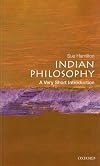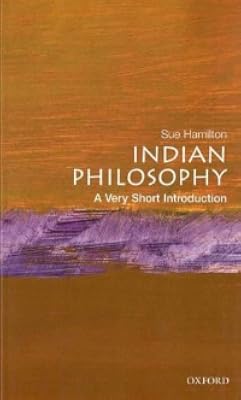
Indian Philosophy: A Very Short Introduction
by Sue Hamilton
On This Page
Description
This text emphasizes the diversity of Indian thought, and is structured around six schools which have achieved classic status.Tags
Recommendations








Member Reviews
This is an especially dense Very Short Introduction, compressing its vast field into a 35,000-word neutron star of information. I found I had to take it slowly, despite the fact that the writing is clear and well-ordered.
Hamilton takes the decision to leave most key terminology untranslated, a decision I approve of, but it does leave the novice facing some pretty daunting discussions on things like svabhāva, or jñāna-kāṇḍa. Where other introductory books might write that ‘matter is seen as being less important than the underlying soul or consciousness’, Hamilton instead writes that ‘prakṛti is qualitatively inferior to puruṣa, and the sense of self imparted by the I-maker deluded’. This is ultimately better, but for show more a beginner like me it required some slow and careful reading.
I've shelved it under religion as well as philosophy; one of the things this books does especially well is make the point that the distinction between the two is a uniquely Western (and post-Kantian) one. Most of the thought systems here are, at least in some sense, soteriological, in that they have mokṣa or release from reincarnation as their more-or-less ultimate objective. To me with my feeble knowledge of Western philosophy a lot of it felt vaguely Pythagorean, or at any rate Pre-Socratic. Hamilton suggests near the end that those Indian philosophers who have become known in the West have done so by jettisoning the wider religious context of their arguments, and she looks forward to a time when a more authentically Indian milieu can be incorporated into these discussions. That seems to me to be a very fruitful and sensible position.
There is quite a lot here that I still don't understand (as you'd expect) – the intricacies of some of the Buddhist schools in particular are clearly far deeper than can be explored in this format – but what I am left with is a decent sense of the (impressively long) chronology and an idea of some of the key recurring themes. A focus on the power and meaning of language comes up a lot, as it does in Western thought, and that I found fascinating in the context of Sanskrit (except where it veers into epistemology, something I'm afraid I have always found totally uninteresting).
But most of the discussion, in this book at least, is metaphysical. The questions revolve around the nature of reality – whether or not there is some underlying nature separate from what we experience through our senses, and whether everything is ultimately the same one fundamental substance or rather made of a plurality of essences. You can see I've forgotten most of the proper terms already, but you get the idea.
Overall it's a very clear outline of what is obviously a big, complex field. It made me very aware of my ignorance in this area – but, as books like this need to, it also offers an excellent Further Reading section to help address the deficit. show less
Hamilton takes the decision to leave most key terminology untranslated, a decision I approve of, but it does leave the novice facing some pretty daunting discussions on things like svabhāva, or jñāna-kāṇḍa. Where other introductory books might write that ‘matter is seen as being less important than the underlying soul or consciousness’, Hamilton instead writes that ‘prakṛti is qualitatively inferior to puruṣa, and the sense of self imparted by the I-maker deluded’. This is ultimately better, but for show more a beginner like me it required some slow and careful reading.
I've shelved it under religion as well as philosophy; one of the things this books does especially well is make the point that the distinction between the two is a uniquely Western (and post-Kantian) one. Most of the thought systems here are, at least in some sense, soteriological, in that they have mokṣa or release from reincarnation as their more-or-less ultimate objective. To me with my feeble knowledge of Western philosophy a lot of it felt vaguely Pythagorean, or at any rate Pre-Socratic. Hamilton suggests near the end that those Indian philosophers who have become known in the West have done so by jettisoning the wider religious context of their arguments, and she looks forward to a time when a more authentically Indian milieu can be incorporated into these discussions. That seems to me to be a very fruitful and sensible position.
There is quite a lot here that I still don't understand (as you'd expect) – the intricacies of some of the Buddhist schools in particular are clearly far deeper than can be explored in this format – but what I am left with is a decent sense of the (impressively long) chronology and an idea of some of the key recurring themes. A focus on the power and meaning of language comes up a lot, as it does in Western thought, and that I found fascinating in the context of Sanskrit (except where it veers into epistemology, something I'm afraid I have always found totally uninteresting).
But most of the discussion, in this book at least, is metaphysical. The questions revolve around the nature of reality – whether or not there is some underlying nature separate from what we experience through our senses, and whether everything is ultimately the same one fundamental substance or rather made of a plurality of essences. You can see I've forgotten most of the proper terms already, but you get the idea.
Overall it's a very clear outline of what is obviously a big, complex field. It made me very aware of my ignorance in this area – but, as books like this need to, it also offers an excellent Further Reading section to help address the deficit. show less
To explain the complexities of Indian Philosophy over two thousand years or so in one of the Very Short Introduction series from Oxford is asking for trouble but, within the series' constraints, Sue Hamilton does as good a job as might be possible under the circumstances.
On the positive side, she provides a framework for further study and helps us to understand both the developmental processes and sophistication of Indian thought. This was not burdened by the necessity to take into account an Abrahamanic variant of God.
It is difficult to separate philosophy from religion in the cases of Christian Europe, Judaism and Islam but these latter were able to construct a philosophical approach despite God. Indian philosophy can justly be show more regarded as a different and great thinking tradition, one that still allowed for 'God'.
Hamilton takes us from early Brahminical practice and thought through the multiplying and interweaving branches of Hindu and Buddhist investigations of reality and language. This leads us to the inevitable negative side of the book. There is just too much happening here over too long a period.
This is not Hamilton's fault. Her subject is complex. Over-simplification would mislead the serious reader. Her prose is clear but the need to cover so much ground means that this cannot be more than a framework. It is perhaps best to treat it as a useful way station than a terminus. show less
On the positive side, she provides a framework for further study and helps us to understand both the developmental processes and sophistication of Indian thought. This was not burdened by the necessity to take into account an Abrahamanic variant of God.
It is difficult to separate philosophy from religion in the cases of Christian Europe, Judaism and Islam but these latter were able to construct a philosophical approach despite God. Indian philosophy can justly be show more regarded as a different and great thinking tradition, one that still allowed for 'God'.
Hamilton takes us from early Brahminical practice and thought through the multiplying and interweaving branches of Hindu and Buddhist investigations of reality and language. This leads us to the inevitable negative side of the book. There is just too much happening here over too long a period.
This is not Hamilton's fault. Her subject is complex. Over-simplification would mislead the serious reader. Her prose is clear but the need to cover so much ground means that this cannot be more than a framework. It is perhaps best to treat it as a useful way station than a terminus. show less
I’ve recently finished a book on Hinduism which is really pretty much about Indian Philosophy so I was interested to read this book which promised a more general overview of Indian thinking. Admittedly, both books were "Very short introductions" which limits what can be transmitted. Alas, it was pretty much the same and what I found missing from both books was some sort of critical analysis of both the history (as transmitted) and the actual ideas. It seems to me that there is less emphasis in the Indian Philosophy on divine revelation. That the sages were regarded as simply wise people (they all seem to be male). But they were not claiming (as in the Western tradition) that they were getting their message direct from God and show more therefore it had universal and irrevocable application. But I should mention here that I’ve only read this book in the Blinkist summary version, so, inevitably, have missed the detail and nuances that would be covered in the full book. Nevertheless, I’ve found these summaries to be pretty good and have no reason to doubt that, in the current case, that the Blinkist team have done a good job in extracting the essence. Anyway, I’ve extracted a few nuggets below which help capture what the book says.
“Mapping the universe:....The sages of the Upanishads and later thinkers like Nagarjuna pursued knowledge with a clear goal in mind: to transform their destiny and achieve liberation from the endless cycle of rebirth......it's a sophisticated understanding of how actions create consequences.
By the 5th century BCE, this understanding evolved to encompass all actions, with their effects potentially spanning multiple lifetimes.....The Buddha would later revolutionize this concept by teaching that intention, not just action, was the key to karmic consequences.
They created an incredible system of knowledge written in sacred texts called the Vedas. Their world centred on sacrifice–detailed ceremonies they believed maintained the harmony of the cosmos.
The brahmins maintained their position at the top of society because people believed their ritual purity kept these cosmic-maintaining ceremonies effective.....Some brahmins focused on performing ceremonies, others turned their attention inward......These inner-focused thinkers developed the teachings found in the Upanishads.....These texts introduced a revolutionary idea: your deepest self or atman shares its nature with the universal essence or Brahman.......Whether through precise ritual actions or deep insights into the nature of things, these thinkers aimed for practical results–breaking free from the cycle of rebirth and knowing the highest truth.
Buddha's revolutionary path to awakening:...Around 485 BCE, Siddhartha Gotama was born to a wealthy family in what we now call Nepal.....This young prince would eventually become known as the Buddha, the Awakened One......He shared what he called the Four Noble Truths, but took a completely different path than the brahmin priests.....The Buddha's most striking teachings centred on two ideas: how everything connects, and how nothing stays the same......He created a balanced approach between extreme self-denial and complex rituals.
This practical focus, would go on to influence not just Buddhist thought but the entire landscape of Indian philosophy.......These ideas spread rapidly across northern India, challenging the established order.
The brahmins began their response by looking deeply at language itself......From this focus on language grew new ways of proving what we can truly know. [Almost the same as the linguistic schools that grew up in British Philosophy around Bertrand Russell and Witgenstein]. As these ideas about knowledge grew, another school called Taisheshika mapped out everything that exists. They found several basic building blocks of reality: substance, quality, action universality, particularity, inherence, and absence....From these intellectual foundations grew many branches of Indian thought. Some focused on understanding the nature of knowledge......Others turned toward exploring consciousness itself. As these ideas flowed through Indian society, they sparked something revolutionary-whole new ways of understanding the human mind and its potential.
Two systems in particular-Yoga and Vedanta-created bridges between philosophical theory and spiritual practice that people still walk today......Yoga's origins stretch back to India's earliest spiritual seekers,....By the time these practices were systematized in Patanjali's Yoga Sutras around the 3rd century CE, they had evolved far beyond physical exercises.
techniques to still what they called the modifications of the mind.....Yoga points to something deeper-a pure awareness that watches it all happen. This watching presence, called purusha, stands apart from everything it observes-the world of prakriti.
Another tradition called Samkhya built a complete map of how this works. They saw reality as having two distinct sides-pure awareness on one hand, and everything else on the other.
Then came Shankara, a brilliant thinker who turned everything upside down. His tradition, Advaita Vedanta, said reality isn't split in two-it's all one thing, pure consciousness-existence called Brahman.......Shankara said the whole world works like this. It's real, but not in the way we usually think.
Other Vedantic philosophers like Ramanuja suggested a middle way........They saw reality as one fabric woven from many threads. Yes, everything connects in one great unity, but the distinctions we see still matter.......Each tradition offered a different map to freedom, a distinct way of seeing yourself and your place in the universe.
Walk into any major university, and you'll find students studying ancient Indian texts right alongside Plato and Kant [Well that didn’t appear to be happening at the Australian National University when I studied Philosophy there. But there was certainly a strong school studying Sanscrit. I just didn’t see much or any overlap with the scholars studying Plato and Kant.] .........When Western scholars first began learning Sanskrit and reading India's ancient texts in the 1800s, something unexpected happened.....Indians themselves began looking at their philosophical heritage with fresh eyes.....Today, Indian philosophy travels two paths. In universities, scholars use modern tools to study these ancient ideas, showing they're every bit as rigorous as Western philosophy. [I’d really be interested in finding out about these studies but they don’t see to get much attention in the West....I must do a bit of research. My initial forays into critical analysis of ancient Indian teaching has not been very illuminating....there seems to be a lot of work in how they transmitted the message ...like pedogogy rather than analysis of the ideas]. Meanwhile, traditional schools in India keep teaching these ideas the old way, focusing on how they can transform your life.
But here's the thing-this split between thinking and practice is new.....As we mentioned earlier, the original Indian philosophers saw no gap between careful reasoning and the search for spiritual freedom......These studies speak powerfully to modern questions. Their careful studies of meditation, how we perceive things, and the nature of awareness offer fresh angles on age-old mysteries: What watches your thoughts? How does your consciousness connect to the world?”
So what’s my overall take on the book? Well, I think it’s generally pretty good except I would have liked a little more about modern Indian Philosophy. What are the scientists and scholars in the Maths departments and Engineering faculties and the Philosophy faculties thinking and teaching these days. My take-away from reading this book is that they are pretty much stuck with traditional Indian Philosophy but there is that throw-away line about Indian Philosophers using modern tools to analyse the ancient texts. So what is different? We are not given any clues. So three stars from me. show less
“Mapping the universe:....The sages of the Upanishads and later thinkers like Nagarjuna pursued knowledge with a clear goal in mind: to transform their destiny and achieve liberation from the endless cycle of rebirth......it's a sophisticated understanding of how actions create consequences.
By the 5th century BCE, this understanding evolved to encompass all actions, with their effects potentially spanning multiple lifetimes.....The Buddha would later revolutionize this concept by teaching that intention, not just action, was the key to karmic consequences.
They created an incredible system of knowledge written in sacred texts called the Vedas. Their world centred on sacrifice–detailed ceremonies they believed maintained the harmony of the cosmos.
The brahmins maintained their position at the top of society because people believed their ritual purity kept these cosmic-maintaining ceremonies effective.....Some brahmins focused on performing ceremonies, others turned their attention inward......These inner-focused thinkers developed the teachings found in the Upanishads.....These texts introduced a revolutionary idea: your deepest self or atman shares its nature with the universal essence or Brahman.......Whether through precise ritual actions or deep insights into the nature of things, these thinkers aimed for practical results–breaking free from the cycle of rebirth and knowing the highest truth.
Buddha's revolutionary path to awakening:...Around 485 BCE, Siddhartha Gotama was born to a wealthy family in what we now call Nepal.....This young prince would eventually become known as the Buddha, the Awakened One......He shared what he called the Four Noble Truths, but took a completely different path than the brahmin priests.....The Buddha's most striking teachings centred on two ideas: how everything connects, and how nothing stays the same......He created a balanced approach between extreme self-denial and complex rituals.
This practical focus, would go on to influence not just Buddhist thought but the entire landscape of Indian philosophy.......These ideas spread rapidly across northern India, challenging the established order.
The brahmins began their response by looking deeply at language itself......From this focus on language grew new ways of proving what we can truly know. [Almost the same as the linguistic schools that grew up in British Philosophy around Bertrand Russell and Witgenstein]. As these ideas about knowledge grew, another school called Taisheshika mapped out everything that exists. They found several basic building blocks of reality: substance, quality, action universality, particularity, inherence, and absence....From these intellectual foundations grew many branches of Indian thought. Some focused on understanding the nature of knowledge......Others turned toward exploring consciousness itself. As these ideas flowed through Indian society, they sparked something revolutionary-whole new ways of understanding the human mind and its potential.
Two systems in particular-Yoga and Vedanta-created bridges between philosophical theory and spiritual practice that people still walk today......Yoga's origins stretch back to India's earliest spiritual seekers,....By the time these practices were systematized in Patanjali's Yoga Sutras around the 3rd century CE, they had evolved far beyond physical exercises.
techniques to still what they called the modifications of the mind.....Yoga points to something deeper-a pure awareness that watches it all happen. This watching presence, called purusha, stands apart from everything it observes-the world of prakriti.
Another tradition called Samkhya built a complete map of how this works. They saw reality as having two distinct sides-pure awareness on one hand, and everything else on the other.
Then came Shankara, a brilliant thinker who turned everything upside down. His tradition, Advaita Vedanta, said reality isn't split in two-it's all one thing, pure consciousness-existence called Brahman.......Shankara said the whole world works like this. It's real, but not in the way we usually think.
Other Vedantic philosophers like Ramanuja suggested a middle way........They saw reality as one fabric woven from many threads. Yes, everything connects in one great unity, but the distinctions we see still matter.......Each tradition offered a different map to freedom, a distinct way of seeing yourself and your place in the universe.
Walk into any major university, and you'll find students studying ancient Indian texts right alongside Plato and Kant [Well that didn’t appear to be happening at the Australian National University when I studied Philosophy there. But there was certainly a strong school studying Sanscrit. I just didn’t see much or any overlap with the scholars studying Plato and Kant.] .........When Western scholars first began learning Sanskrit and reading India's ancient texts in the 1800s, something unexpected happened.....Indians themselves began looking at their philosophical heritage with fresh eyes.....Today, Indian philosophy travels two paths. In universities, scholars use modern tools to study these ancient ideas, showing they're every bit as rigorous as Western philosophy. [I’d really be interested in finding out about these studies but they don’t see to get much attention in the West....I must do a bit of research. My initial forays into critical analysis of ancient Indian teaching has not been very illuminating....there seems to be a lot of work in how they transmitted the message ...like pedogogy rather than analysis of the ideas]. Meanwhile, traditional schools in India keep teaching these ideas the old way, focusing on how they can transform your life.
But here's the thing-this split between thinking and practice is new.....As we mentioned earlier, the original Indian philosophers saw no gap between careful reasoning and the search for spiritual freedom......These studies speak powerfully to modern questions. Their careful studies of meditation, how we perceive things, and the nature of awareness offer fresh angles on age-old mysteries: What watches your thoughts? How does your consciousness connect to the world?”
So what’s my overall take on the book? Well, I think it’s generally pretty good except I would have liked a little more about modern Indian Philosophy. What are the scientists and scholars in the Maths departments and Engineering faculties and the Philosophy faculties thinking and teaching these days. My take-away from reading this book is that they are pretty much stuck with traditional Indian Philosophy but there is that throw-away line about Indian Philosophers using modern tools to analyse the ancient texts. So what is different? We are not given any clues. So three stars from me. show less
Finished this at work today on my breaks. It definitely lives up to its name "A very short Introduction".... which isn't necessarily a bad thing, and in this case, for the most part it isn't. It definitely breezes through a lot of topics, some of which obviously doesn't get enough time to allow for full grasping of it. Which in some ways is a good thing; it forces one to read the primary sources or other texts (either way it requires further reading) but on the other hand, its a bad thing because its not simplistic enough for a laymen or for someone hoping to get caught up on a topic (especially one as vague and large such as this).
This does make me interested in the other books/topics of this series (with albeit different authors, one show more of whom is Simon Critchley, who I've read some of his works before). show less
This does make me interested in the other books/topics of this series (with albeit different authors, one show more of whom is Simon Critchley, who I've read some of his works before). show less
Very well done VSI; since it's a ridiculously broad topic to cover in such a short format, Hamilton has to be selective, but she is rationally selective, and tries to make everything fit together in a narrative and in comparisons. It's dense, and hard, because the philosophy is dense and hard, not because Hamilton does a bad job.
A wonderful and compelling introduction to India's engaging and sophisticated philosophical beliefs. While typically thought of by Westerners as 'mystical' rather than 'rational', Hamilton's well-written overview of these ancient thoughts characterize a highly developed system of logics applied to further understanding of existence and the beyond, in which no clear distinction separates religion from philosophy, where philosophy was a deeply personal and sometimes spiritual quest for meaning in life. Very highly recommended to all interested in philosophy or Indian thought!
The materials covered are primarily related to prominent classical schools of philosophy and the persons responsible for their creation (when known), ranging from Pāṇini to Gotama Buddha to Śaṅkara. Reference to gods and political/social conditions that caused those ideas to flourish or die out were minimal. The ideas were presented in fairly chronological order, from ca. 2000 BCE to the 11th century CE, and the relationships between successive ideologies were explained.
While I've read a few things in this area in the past, my approach as a reader was certainly not that of a scholar. As a layperson, I was pleased with how clear and well organized this was. It really is a very short introduction to the topic, and as such the show more material presented was very condensed, but it is still quite readable, provides a helpful overview of the topic, and includes a nice selection of further readings for each school of thought.
One thing that I'm still confused about is the use of the word Hinduism. According to the author that is a misleading and anachronistic term, but I'm still not sure what an appropriate substitute (or substitutes) would be. show less
While I've read a few things in this area in the past, my approach as a reader was certainly not that of a scholar. As a layperson, I was pleased with how clear and well organized this was. It really is a very short introduction to the topic, and as such the show more material presented was very condensed, but it is still quite readable, provides a helpful overview of the topic, and includes a nice selection of further readings for each school of thought.
One thing that I'm still confused about is the use of the word Hinduism. According to the author that is a misleading and anachronistic term, but I'm still not sure what an appropriate substitute (or substitutes) would be. show less
Members
- Recently Added By
Author Information
3 Works 294 Members
Series
Belongs to Publisher Series
Common Knowledge
- Canonical title
- Indian Philosophy: A Very Short Introduction
- Original title
- Indian Philosophy: A Very Short Introduction
- Original publication date
- 2001
- First words
- India has a long, rich, and diverse tradition of philosophical thought, spanning some two and a half millennia and encompassing several major religious traditions.
- Last words
- (Click to show. Warning: May contain spoilers.)With its fundamental focus on the nature of reality itself, much more profound than this was the worldview of classical India.
- Original language
- English
Classifications
Statistics
- Members
- 282
- Popularity
- 113,709
- Reviews
- 8
- Rating
- (3.58)
- Languages
- English
- Media
- Paper, Audiobook, Ebook
- ISBNs
- 6
- ASINs
- 4