The Lower Depths
by Maxim Gorky
On This Page
Description
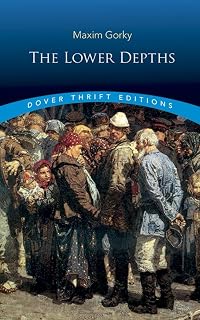
Set amongst the whores, alcoholics, cynics and doss house dreamers of a Russia on the brink of revolution, The Lower Depths is a harrowing, violent and uncompromising portrayal of the human spirit at its lowest ebb, with destitution and death an ever present spectre.Tags
Recommendations



















Member Recommendations
CurrerBell The Lower Depths (Maxim Gorky, 1902) seems to have been an influence on The Iceman Cometh (Eugene O'Neill, 1939).
Member Reviews
Though this is technically still socialist realism, it's early enough that the term hadn't yet hist the heights of self-parodying, straitjacketing genre description that it — and Gorky himself — would reach in post-Revolution Russia.
Decent, though a lot of the newness of the ideas are now long since old hat. The relentless pessimism particularly with regards to the ending, for example, now seems like what you'd expect from a student just out of art school rather than an established writer.
Decent, though a lot of the newness of the ideas are now long since old hat. The relentless pessimism particularly with regards to the ending, for example, now seems like what you'd expect from a student just out of art school rather than an established writer.
Of interest for its apparent influence on The Iceman Cometh, but this translation might not be of the best. Additionally, note that this is an inexpensive Kindle edition and is not text-digitized; instead, the pages are simply scanned images.
Still, 3½*** considering that this doesn't seem to be an easy title to find in translation and that it's important for its association with Eugene O'Neill.
Still, 3½*** considering that this doesn't seem to be an easy title to find in translation and that it's important for its association with Eugene O'Neill.
Well worth reading.
Das Nachtasyl" - die Welt der Underdogs, der Gescheiterten, Arbeits- und Obdachlosen. Jeder der Asylbewohner bewahrt bei Gorki in der Tristesse eines ausweglosen Alltags seine unverwechselbare Persönlichkeit und klammert sich mit dem Rest des verbliebenen Lebenswillens an die Hoffnung auf ein Entrinnen aus dem erniedrigenden Dasein. Gezeigt wird, wie jeder auf seine Art und Weise zu überleben sucht. In eindringlichen Bildern beschreibt das Stück jene, die am Tiefpunkt ihrer Existenz angelangt sind, die mit dem Leben nicht mehr fertig werden und ihre Angst, ihre Einsamkeit, Hoffnung und Depression durch nervenaufreibende Streitereien, Haarspaltereien und Lügen nur notdürfig verdeckt.
Quelle: Amazon.de
Quelle: Amazon.de
Jan 9, 2011German
Ratings
Members
- Recently Added By
Lists

1900s (Decade, not century)
73 works; 17 members

Favourite Books
1,819 works; 309 members

20th Century Literature
1,161 works; 55 members

Books Read in 2019
4,052 works; 110 members

20230107
18 works; 1 member

Philip Ward's Lifetime Reading Plan
592 works; 22 members

My Play Collection
769 works; 3 members
Author Information

929+ Works 8,246 Members
Alexei Maximovich Peshkov, better known as Maxim (Maksim) Gorky, was born on March 28th, 1968. Until the recent collapse of the Soviet state, Gorky was officially viewed as the greatest Russian writer of the twentieth century---an evaluation far above the true measure of his nevertheless considerable talent. Proclaimed the founder of socialist show more realism, he significantly influenced many Soviet writers, as well as others in Europe and in the developing world, and his works were for decades part of the Soviet school curriculum. His formal education was minimal. From the age of 11, he fended for himself with a variety of jobs. Self-taught, he published his first story, "Makar Chudra," in 1892. His first collection, Sketches and Stories (1898), is a romantic celebration of society's strong outcasts---the hobos and the drifters---and helped to popularize such literary protagonists. Foma Gordeyev (1899), Gorky's first novel, depicts generational conflict within the Russian bourgeoisie. A popular public figure on the left, Gorky was often in trouble with the tsarist government. During the 1900s, he was the central figure in the Znanie publishing house, which produced realist prose with a social conscience. Some of his own works were extremely successful. The play The Lower Depths (1902), set in a poorhouse and a strong indictment of social injustice, was not only a staple of Soviet theater but also influential in the United States. Eugene O'Neill's The Iceman Cometh was influenced by it. The propagandistic, extraordinarily influential novel Mother (1906) presents an iconic working-class woman who is transformed into a saint of the Revolution; its optimism in the ultimate triumph of the cause made it a prototype of socialist-realist fiction. During the years prior to 1917, Gorky published a number of autobiographical stories: All Over Russia (1912--18) (also Through Russia) and his memoirs; My Childhood (1913--14), My Apprenticeship (1915--16), and My Universities (1923). This trilogy shows his art at its best and includes some very lively reminiscences of such writers as Tolstoy and Chekhov. Although a Bolshevik party member since 1905, Gorky strongly criticized the new regime after the October Revolution: His collected articles from 1917-18, Untimely Thoughts, remained unpublished in the Soviet Union until recently. A cultural activist, he helped to save the lives of many writers, artists, and scholars during the cold and hungry years of the civil war. In 1921 he left Russia for Italy but returned permanently a decade later, recognized as the grand old man of Soviet literature. He then worked for Stalin's economic policies and presided over the institutionalization of socialist realism. At his death, he left unfinished a major novel of considerable interest, The Life of Klim Samgin, which he had been working on since 1925. (Bowker Author Biography) show less
Awards and Honors
Series
Belongs to Publisher Series
Work Relationships
Is contained in
Has the adaptation
Has as a student's study guide
Common Knowledge
- Canonical title
- The Lower Depths
- Alternate titles
- A Night's Lodging; At the Bottom
- Original publication date
- 1902
- Related movies
- The Lower Depths (1957 | IMDb); The Lower Depths (1936 | IMDb); Ye dian (1947 | IMDb)
- Quotations
- When work is a pleasure, life is good. When work is duty, life is slavery.
- Original language
- Russian
- Disambiguation notice
- This entry represents works containing only "The Lower Depths." Please do not combine with editions that also contain other works.
Classifications
- Genre
- Fiction and Literature
- DDC/MDS
- 891.723 — Literature & rhetoric Literatures of other languages East Indo-European and Celtic literatures Russian and East Slavic languages Russian drama 1800–1917
- LCC
- PG3463 .N2 .C6 — Language and Literature Slavic languages and literatures. Baltic languages. Albanian language Slavic. Baltic. Albanian Russian literature Individual authors and works 1870-1917 Gorky
- BISAC
Statistics
- Members
- 314
- Popularity
- 101,771
- Reviews
- 5
- Rating
- (3.61)
- Languages
- 12 — Czech, Danish, English, French, German, Italian, Norwegian (Bokmål), Portuguese, Russian, Croatian, Spanish, Swedish
- Media
- Paper, Audiobook, Ebook
- ISBNs
- 40
- UPCs
- 1
- ASINs
- 10