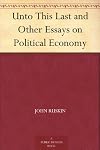
Unto This Last
by John Ruskin
On This Page
Description
Unto This Last is an essay on economy by John Ruskin, critical of the 18th and 19th century capitalist economists. When first published as four magazine articles in 1860 they were, in the words of Ruskin himself, "very violently criticized" and the publisher was forced to halt publication. But Ruskin persevered and released the four articles in this book form in 1862. Gandhi read Unto This Last in 1904 and it had a huge impact on his social and economic philosophy, with Gandhi making an show more immediate decision to live according to Ruskin's teachings.. show less
Tags
Recommendations




















Member Reviews
In his inimitable style, Ruskin takes in his powerful grip the trunk of the trunk of the tree of modern economic thought and shakes the entire growth. Rejected by early readers as "absolute nonsense" and "total absurdity," the ideas of this book have continued for a century and a half to exert a significant influence on social thought, deeply affecting figures like Gandhi as well as (via Bernard Leach) Yanagi Soetsu, a key figure in the Japanese peasant art movements of the Taisho period (1912-1926).
I didn't read this edition, I actually just got the text off the internet, but I imagine it's the same. It is a surprisingly readable critique of political economic philosophy, particularly going to town on one Mr. J.S. Mill. Overall, it is pretty utopian; I can agree with him about the way the economy should be run and that happiness should be the highest priority, but what does writing about that really accomplish? He ignores the foundation of production and capitalism, which is that it always tends toward more production/growth/expansion of capital and so-forth. It is not compatible with human happiness. My favorite quote:
For, truly, the man who does not know when to die, does not know how to live.
Ruskin, again, came across to me as an opinionated bigot who was very pleased with himself and whom I would not have liked at all. Yes, he wrote and lectured some 150 years ago, and our social mores have changed considerably, but he annoyed me. Perhaps I might have enjoyed him as a lecturer, but the way these essays were presented (presumably "as Written") I very quickly got so disturbed that I could not follow his points. His continued use of phrases and clauses in apposition ruined any flow of information. They made the essays virtually unreadable. Even the book's editor added 28 pages of notes to explain what Ruskin was saying. The "Brief Sketch of the Author's Life" include was somewhat illuminating. The added commentary "Ruskin as show more Economist" was needed - to explain why Sir Arthur Quiller-Couch added the collection of essays to his Kings Treasuries of Literature. show less
Ratings
Members
- Recently Added By
Lists

Harold Bloom - The Western Canon: C. The Democratic Age
336 works; 15 members
Author Information

493+ Works 8,993 Members
Ruskin was one of the most influential man of letters of the nineteenth century. An only child, Ruskin was born in Surrey. He attended Christ Church, Oxford, from 1839 to 1842. His ties to his parents, especially his mother, were very strong, and she stayed with him at Oxford until 1840, when, showing ominous signs of consumption, he left for a show more long tour of Switzerland and the Rhineland with both parents. His journeys to France, Germany, and, especially, Italy formed a great portion of his education. Not only did these trips give him firsthand exposure to the art and architecture that would be the focus of much of his long career; they also helped shape what he felt was his main interest, the study of nature. Around this time Ruskin met the landscape artist J. M. W. Turner, for whose work he had developed a deep admiration and whom he lauded in his Modern Painters (1843). In 1848 Ruskin married Euphemia (Effie) Gray, a distant cousin 10 years his junior. This relationship has been the focus of much scholarship, for six years later the marriage was annulled on the grounds of nonconsummation, and in 1855 Effie married John Everett Millais, the Pre-Raphaelite painter and an acquaintance of Ruskin. During the years 1849--52, Ruskin lived in Venice, where he pursued a course of architectural studies, publishing The Seven Lamps of Architecture (1849) and where he began The Stones of Venice (1851--53). It was also during this period that Ruskin's evangelicalism weakened, leading finally to his "unconversion" at Turin in 1858. His subsequent interest in political economy was clearly stated when, echoing his "hero," Carlyle, Ruskin remarked in the last volume of Modern Painters that greed is the deadly principle that guides English life. In a series of essays in Cornhill Magazine attacking the "pseudo-science" of political economists like J. S. Mill, David Ricardo, and Thomas Malthus, Ruskin argues that England should base its "political economy" on a paternalistic, Christian-based doctrine instead of on competition. The essays were not well received, and the series was canceled short of completion, but Ruskin published the collected essays in 1862 as Unto This Last. At the same time, he renewed his attacks on the political economists in Fraser's Magazine, later publishing these essays as Munera Pulveris (1872). From about 1862 until his death, Ruskin unsuccessfully fought depression. He was in love with Rose La Touche, whom he met when she was 11 and he 41. When she turned 18, Ruskin proposed, but the her parents opposed the marriage, and religious differences (she was devout; Ruskin was at this time a freethinker) kept them from ever marrying. La Touche died in 1875, insane, and three years later Ruskin experienced the first of seven attacks of madness that would plague him over the next 10 years. By 1869 Ruskin had accepted the first Slade Professorship of Fine Art at Oxford, begun his serial Fors Clavigera, been sued and found guilty of libel for his attack on Whistler in Fors Clavigera (he was fined a farthing), and resigned his professorship. Ruskin's work was instrumental in the formation of art history as a modern discipline. A capable artist, he complemented his technical understanding of art with insightful analysis and passionately held social ideals. His social writings are of interest today primarily as artifacts of the age, but his art criticism still holds an important place, especially in his appreciation of Turner. There is a vast number of works on Ruskin. From a literary standpoint, John Rosenberg's study, although dated because of many of its assumptions, is still an outstanding book. Jay Fellows's work is interesting and has caused much controversy among Ruskin scholars. (Bowker Author Biography) show less
Series
Belongs to Publisher Series
Work Relationships
Is contained in
The Works of John Ruskin: "A Joy Forever" (and Its Price in the Market) being the substance (with additions) of two lectures on the political economy of art, delivered at Manchester, July 10th and 18th, 1857/Munera Pulveris: Six Essays on the Elements of Political Economy/The Two Paths, being Lectures on Art and Its Application to Decoration and Manufacture/"Unto This Last": Four Essays on the First Principles of Political Economy/The Storm Cloud of the Nineteenth Century: Two Lectures Delivered at the by John Ruskin
Classifications
Statistics
- Members
- 169
- Popularity
- 192,828
- Reviews
- 3
- Rating
- (3.79)
- Languages
- Chinese, English, French, Italian
- Media
- Paper, Ebook
- ISBNs
- 33
- ASINs
- 11