On This Page
Description
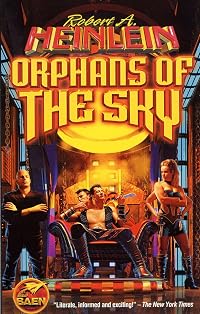
Lost in SpaceHugh had been taught that, according to the ancient sacred writings, the Ship was on a voyage to faraway Centaurus. But he also understood this was just allegory for a voyage to spiritual perfection. Indeed, how could the Ship move, since its miles and miles of metal corridors were all there was of creation? Science knew that the Ship was all the universe, and as long as the sacred Converter was fed, the lights would continue to glow, the air would flow, and the Creator's Plan show more would be fulfilled. Of course, there were the muties, grotesquely deformed parodies of humans, who lurked in the upper reaches of the Ship, where gravity was weaker. Were they evil incarnate, or merely a divine check on the population, keeping humanity from expanding past the capacity of the Ship to support? Then Hugh was captured by the muties and met their leader (or leaders)-Joe-Jim, with two heads on one body-and learned the true nature of the Ship and its mission between the stars. But could he make his people believe him before it was too late? Could he make them believe that he must be allowed to fly the Ship? show lessTags
Recommendations

















Member Recommendations

The Modern Scholar: From Here to Infinity ~An Exploration of Science Fiction Literature~ (14 Lectures on 7 Audiocassettes) by Michael D. C. Drout
themulhern This awful work by Heinlein pretty much refutes everything positive that Drout has to say about Heinlein in his discussion of his work in this quite interesting lecture series.
jigarpatel "Non-Stop" (1958) is a well-developed successor to Heinlein's fix-up "Orphans of the Sky" (whose components were first published 1941). I recommend "Non-Stop" for plot and characterization, "Orphans of the Sky" for those interested in the history of science fiction. Both are excellent.
Member Reviews
The women exist only so that they can be beaten by their menfolk. They have faces so that they can be broken, and teeth so that they can be knocked out. It seems like the Ship has no draft animals to abuse, so women must fill that void. I assume that they are unnecessary to procreation, though, because taking them along on the great escape was a definite afterthought. Babies must come from the mass converter.
If this book plopped by accident into an Ursula LeGuin universe the moon colonized by the escapees would be well known to the Hainish as a tragic awful mess and dire warning. However, I think Heinlein expect us to consider the ending a victory. LeGuin's Ship would have been a lot stranger and more interesting, too.
If this book plopped by accident into an Ursula LeGuin universe the moon colonized by the escapees would be well known to the Hainish as a tragic awful mess and dire warning. However, I think Heinlein expect us to consider the ending a victory. LeGuin's Ship would have been a lot stranger and more interesting, too.
Compiles two seminal 1941 novellas: Universe and Common Sense.
The Ship, a massive, five-mile-long colony vessel, was launched centuries ago with the goal of colonizing a planet orbiting Proxima Centauri. Following a devastating mutiny that killed the original officers, successive generations lost all scientific knowledge. The descendants no longer know what a spaceship is. To them, the Ship is the entire universe, and space simply does not exist.
The surviving population lives in a post-technological, agrarian society. The Ship's original science has degraded into dogmatic, superstitious rituals. The Scientists act as the priestly class, managing the ship's basic maintenance without actually understanding how the technology works. In the show more upper, irradiated decks live the muties, mutated outcasts, and descendants of the mutineers who have become physically deformed but often retain a clearer, practical understanding of the Ship's machinery.
Hugh Hoyland, a young man training to become a Scientist, is captured by a group of muties led by a highly intelligent, two-headed mutant named Joe-Jim. Joe-Jim shows Hugh a forgotten control room with viewing ports. For the first time, Hugh witnesses the vastness of space and realizes the Ship is moving toward a destination.
When Hugh attempts to share this truth with the rest of the crew, he is deemed a heretic and imprisoned. He must navigate deadly political and religious factions and ally with the muties to overthrow the oppressive leadership.
In the end, while Hugh fails to educate the entire civilization about the reality of the universe, he and a small group of followers take a shuttle from the main ship. They successfully land on a habitable moon, becoming the first humans to see a real sky and begin colonizing their new home show less
The Ship, a massive, five-mile-long colony vessel, was launched centuries ago with the goal of colonizing a planet orbiting Proxima Centauri. Following a devastating mutiny that killed the original officers, successive generations lost all scientific knowledge. The descendants no longer know what a spaceship is. To them, the Ship is the entire universe, and space simply does not exist.
The surviving population lives in a post-technological, agrarian society. The Ship's original science has degraded into dogmatic, superstitious rituals. The Scientists act as the priestly class, managing the ship's basic maintenance without actually understanding how the technology works. In the show more upper, irradiated decks live the muties, mutated outcasts, and descendants of the mutineers who have become physically deformed but often retain a clearer, practical understanding of the Ship's machinery.
Hugh Hoyland, a young man training to become a Scientist, is captured by a group of muties led by a highly intelligent, two-headed mutant named Joe-Jim. Joe-Jim shows Hugh a forgotten control room with viewing ports. For the first time, Hugh witnesses the vastness of space and realizes the Ship is moving toward a destination.
When Hugh attempts to share this truth with the rest of the crew, he is deemed a heretic and imprisoned. He must navigate deadly political and religious factions and ally with the muties to overthrow the oppressive leadership.
In the end, while Hugh fails to educate the entire civilization about the reality of the universe, he and a small group of followers take a shuttle from the main ship. They successfully land on a habitable moon, becoming the first humans to see a real sky and begin colonizing their new home show less
Considered to be the classic generation starship story, I enjoyed this novel a lot. It takes a concept from physics - that one cannot move faster than the speed of light - and applies it to travel. If one wanted to travel to another star, it would take many human lifetimes. One way to bridge that distance is the generation starship. There's just one problem - after a period of time, people would forget Earth and any experience of living on a planet.
Heinlein wonderfully explores the rediscovery of scientific concepts in a neo-feudal society. I also enjoyed how he created a new greeting - "Good eating!" - that everyone uses to greet each other. The story is also a wonderful exploration of the conflict between dogma and true scientific show more curiosity.
Heinlein's one major weakness here is his female characters. There is only one female character I recall with any meaningful agency. Other female characters are treated with disregard. show less
Heinlein wonderfully explores the rediscovery of scientific concepts in a neo-feudal society. I also enjoyed how he created a new greeting - "Good eating!" - that everyone uses to greet each other. The story is also a wonderful exploration of the conflict between dogma and true scientific show more curiosity.
Heinlein's one major weakness here is his female characters. There is only one female character I recall with any meaningful agency. Other female characters are treated with disregard. show less
This may not be the first generation starship tale, but it's probably the first where the passengers have forgotten that they're in a ship and that its corridors and rooms are not the universe.
This novel combines the story of Galileo with political intrigue and military conquest, all aboard a starship that has lapsed into feudalism after a mutiny in the crew long ago. After the mutiny, people forgot not only their mission to travel to Far Centaurus but that there was a universe outside the ship's hull. Books are still around, but physics and astronomy are treated like elaborate allegories by the "scientists" and not realities. Barbaric muties roam the upper decks, and cannibalism is not unknown, infantcide a common practice.
Scientist show more novitiate Hugh Hoyland plays the Galileo role. He is captured by two-headed mutant Joe-Jim and, when he's not playing checkers with either of the twins, has the run of their library and the benefit of their intellects. It's from that unlikely source that Hoyland learns the truth about the ship and the world outside.
And he begins to form a plan to complete the mission.
First published in 1941 as two short stories, "Universe" and "Common Sense", this story still entertains with its heroism, intrigue, and action. They are, chronologically, also the last short stories in Heinlein's Future History. show less
This novel combines the story of Galileo with political intrigue and military conquest, all aboard a starship that has lapsed into feudalism after a mutiny in the crew long ago. After the mutiny, people forgot not only their mission to travel to Far Centaurus but that there was a universe outside the ship's hull. Books are still around, but physics and astronomy are treated like elaborate allegories by the "scientists" and not realities. Barbaric muties roam the upper decks, and cannibalism is not unknown, infantcide a common practice.
Scientist show more novitiate Hugh Hoyland plays the Galileo role. He is captured by two-headed mutant Joe-Jim and, when he's not playing checkers with either of the twins, has the run of their library and the benefit of their intellects. It's from that unlikely source that Hoyland learns the truth about the ship and the world outside.
And he begins to form a plan to complete the mission.
First published in 1941 as two short stories, "Universe" and "Common Sense", this story still entertains with its heroism, intrigue, and action. They are, chronologically, also the last short stories in Heinlein's Future History. show less
First Impressions:
The book reads rather rapidly and well for a young adult novel, originally appearing in Astounding Science Fiction back in the 1940s. Heinlein's writing and plotting had improved since those days, but there's something fun and unique about his early writings such as Space Cadet, or Starship Troopers, contemporary stories that involved a strong lead character and lots of plot points.
Plots:
I may be wrong but this may be one of the first stories of a multi-generational ship that had some kind of catastrophe where everyone forgot they lived on a ship and thought the Ship was all there was! I've seen this idea played out in the original Star Trek episode "For the World is Hollow and I Have Touched the Sky" and the show more television series "Star Lost."
The main character Hugh Hoyland lives on a Ship where scientists are reverred as holy and the Captain of the ship is near godhood. There are farms going on, and a Converter that is used to create energy from mass (and occasionally from dead bodies). There is an internal struggle with mutants in the upper levels. It's very dictatorial and people know their places. To question is to court death.
But Hugh questions. And he ends up with the mutants, a two headed guy called Joe-Jim and his sidekick Bobo. This small unassuming trio are the vanguard of a major change where the Ship is headed for a star -- but the inhabitants don't even know what space is.
Fascinating scenario, but not enough time is spent on the whole religious aspect of the scientists. They do mention a few scientific facts but have decided its all allegory and ancient myths -- such as the law of gravity!
The part where we move into rebellion, assassination and betrayal towards the end of the book is really fascinating. The end is a bit rushed, but Heinlein acknowledges that as a string of amazing coincidences! Ha!
Overall a great read and highly recommended to fans of early Heinlein. show less
The book reads rather rapidly and well for a young adult novel, originally appearing in Astounding Science Fiction back in the 1940s. Heinlein's writing and plotting had improved since those days, but there's something fun and unique about his early writings such as Space Cadet, or Starship Troopers, contemporary stories that involved a strong lead character and lots of plot points.
Plots:
I may be wrong but this may be one of the first stories of a multi-generational ship that had some kind of catastrophe where everyone forgot they lived on a ship and thought the Ship was all there was! I've seen this idea played out in the original Star Trek episode "For the World is Hollow and I Have Touched the Sky" and the show more television series "Star Lost."
The main character Hugh Hoyland lives on a Ship where scientists are reverred as holy and the Captain of the ship is near godhood. There are farms going on, and a Converter that is used to create energy from mass (and occasionally from dead bodies). There is an internal struggle with mutants in the upper levels. It's very dictatorial and people know their places. To question is to court death.
But Hugh questions. And he ends up with the mutants, a two headed guy called Joe-Jim and his sidekick Bobo. This small unassuming trio are the vanguard of a major change where the Ship is headed for a star -- but the inhabitants don't even know what space is.
Fascinating scenario, but not enough time is spent on the whole religious aspect of the scientists. They do mention a few scientific facts but have decided its all allegory and ancient myths -- such as the law of gravity!
The part where we move into rebellion, assassination and betrayal towards the end of the book is really fascinating. The end is a bit rushed, but Heinlein acknowledges that as a string of amazing coincidences! Ha!
Overall a great read and highly recommended to fans of early Heinlein. show less
This novel is about a generation ship traveling to another star--one where they've forgotten they're even on a ship. Due to an early mutiny, the ship is divided, with barbarian mutants still rampaging centuries later. Scientist Hugh Hoyland rediscovers the truth and sets out to restore the original mission--helped byJoe-Jim the two-headed mutant, also a memorable character. Yes, this was written in 1941, and social aspects date this even more than the scientific--how Heinlein treated women characters for instance. But if you can ignore that, the book is a quick, absorbing read, fast-paced, action packed and witty. And not just action-packed. This is basically a generation-ship retelling of Galileo and the Copernican Revolution, and the show more battle between orthodoxy and science, told in an entertaining and thought-provoking way. show less
This early Heinlein tale of a generation ship is quite interesting given that it was published in 1941. The ship has suffered a disaster as a result of a mutiny many generations ago. The mutiny resulted in death of 90% of the ship's population. The subsequent struggle for survival has produced a bifurcated population. The first group is an illiterate peasant society with barely literate technocrats maintaining the crucial power systems and sages keeping a very distorted history alive. Parts of the history that are not understandable have morphed into a sort of religion. The population seems to have become mentally degenerate with some of the peasants barely able to speak. The second population group consists of mutated humans who dwell show more in the upper levels of the ship and are feared and hunted by the first group.
This story is very harsh with lots of weapons, violence and betrayals. There is cannabalism and infanticide. But it also features the awe on the part of the protagonist at seeing the stars for the first time and beginning to understand that there is something outside of the Ship and the the Trip is an actually journey to a destination and not a metaphor for the end of life.
The rating would have been much higher had it not been for how Heinlein treats the women in this story. Only three women are mentioned, only two of those three are given names and none of them have any dialogue or agency. The women are treated as chattel and brutalized by the men. That treatment makes this book one that I will not read again. show less
This story is very harsh with lots of weapons, violence and betrayals. There is cannabalism and infanticide. But it also features the awe on the part of the protagonist at seeing the stars for the first time and beginning to understand that there is something outside of the Ship and the the Trip is an actually journey to a destination and not a metaphor for the end of life.
The rating would have been much higher had it not been for how Heinlein treats the women in this story. Only three women are mentioned, only two of those three are given names and none of them have any dialogue or agency. The women are treated as chattel and brutalized by the men. That treatment makes this book one that I will not read again. show less
Members
- Recently Added By
Lists

Best Science Fiction Novels
816 works; 426 members

Generation Ship
28 works; 7 members

Speculative Fiction to Read
706 works; 32 members

Favorite Childhood Books
1,651 works; 519 members

Books Read in 2021
5,361 works; 114 members

Books Read in 2014
2,344 works; 89 members

Books Cited in Blueprint by Nicholas Christakis
261 works; 1 member
Author Information

459+ Works 174,625 Members
Robert Anson Heinlein was born on July 7, 1907 in Butler, Mo. The son of Rex Ivar and Bam Lyle Heinlein, Robert Heinlein had two older brothers, one younger brother, and three younger sisters. Moving to Kansas City, Mo., at a young age, Heinlein graduated from Central High School in 1924 and attended one year of college at Kansas City Community show more College. Following in his older brother's footsteps, Heinlein entered the Navel Academy in 1925. After contracting pulmonary tuberculosis, of which he was later cured, Heinlein retired from the Navy and married Leslyn MacDonald. Heinlein was said to have held jobs in real estate and photography, before he began working as a staff writer for Upton Sinclair's EPIC News in 1938. Still needing money desperately, Heinlein entered a writing contest sponsored by the science fiction magazine Thrilling Wonder Stories. Heinlein wrote and submitted the story "Life-Line," which went on to win the contest. This guaranteed Heinlein a future in writing. Using his real name and the pen names Caleb Saunders, Anson MacDonald, Lyle Monroe, John Riverside, and Simon York, Heinlein wrote numerous novels including For Us the Living, Methuselah's Children, and Starship Troopers, which was adapted into a big-budget film for Tri-Star Pictures in 1997. The Science Fiction Writers of America named Heinlein its first Grand Master in 1974, presented 1975. Officers and past presidents of the Association select a living writer for lifetime achievement. Also, the Science Fiction and Fantasy Hall of Fame inducted Heinlein in 1998. Heinlein died in 1988 from emphysema and other related health problems. Heinlein's remains were scattered from the stern of a Navy warship off the coast of California. (Bowker Author Biography) show less
Some Editions
Awards and Honors
Notable Lists
Series

Belongs to Publisher Series
Feza Dizisi (2)
Work Relationships
Is contained in
Common Knowledge
- Canonical title
- Orphans of the Sky
- Original title
- Orphans of the Sky
- Original publication date
- 1963; 1941 (Common Sense) (Common Sense); 1941 (Universe) (Universe)
- People/Characters
- Hugh Hoyland; Joe-Jim Gregory; Bobo
- Epigraph
- "The Proxima Centauri Expedition, sponsored by the Jordan Foundation in 2119, was the first recorded attempt to reach the nearer stars fo this galaxy. Whatever its unhappy fate we can only conjecture...' - Quoted from The Ro... (show all)mance of Modern Astrography, by Franklin Buck, published by Lux Transcriptions, Ltd., 3.50 cr.
- First words
- "There's a mutie! Look out!"
- Last words
- (Click to show. Warning: May contain spoilers.)"Yes," he agreed. "Good eating. From now on, Alan, always Good Eating."
- Original language
- English
- Disambiguation notice
- Note that the Italian translation is titled 'Universo' (isfdb), so these entries should not be separated out and combined with the novella ... (show all)'Universe'.
This novel was first published in Astounding Science Fiction in May and October of 1941 as two separate novelettes: "Universe" and its sequel "Common Sense". "Universe" was reprinted by itself in book form in 1951. The two were combined to form this work in 1963.
Classifications
Statistics
- Members
- 2,644
- Popularity
- 7,126
- Reviews
- 44
- Rating
- (3.47)
- Languages
- 10 — Czech, Dutch, English, Estonian, French, German, Italian, Japanese, Russian, Swedish
- Media
- Paper, Audiobook, Ebook
- ISBNs
- 40
- UPCs
- 1
- ASINs
- 50