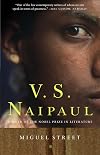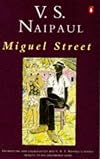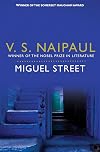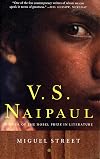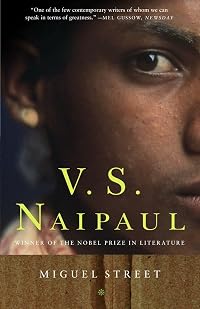
Miguel Street
by V. S. Naipaul
On This Page
Description
"A stranger could drive through Miguel Street and just say 'Slum!' because he could see no more." But to its residents this derelict corner of Trinidad's capital is a complete world, where everybody is quite different from everybody else. There's Popo the carpenter, who neglects his livelihood to build "the thing without a name." There's Man-man, who goes from running for public office to staging his own crucifixion, and the dreaded Big Foot, the bully with glass tear ducts. There's the show more lovely Mrs. Hereira, in thrall to her monstrous husband. In this tender, funny early novel, V. S. Naipaul renders their lives (and the legends their neighbors construct around them) with Dickensian verve and Chekhovian compassion.Set during World War II and narrated by an unnamed-but precociously observant-neighborhood boy, Miguel Street is a work of mercurial mood shifts, by turns sweetly melancholy and anarchically funny. It overflows with life on every page. show lessTags
Recommendations























Member Reviews
Never has the description on the back of a book left me so ill prepared for what I actually took away from a novel. With words like tender, funny, and compassion I was expecting a nice light hearted read about life in a small town Trinidad during the 1930ies. At times it was all that. But, what I was not prepared for was the rampant, repeated descriptions of wife beating. What makes this really frightening is that the novel is told from the point of view of a young child. This, perfectly acceptable, actually encouraged, wife beating is just part of every day life for the boy. And wait, it gets worse. He has no father, and a mother who routinely beats him. One of the most profound examples of "the circle of violence system" I have ever show more come across in a novel. show less
I have difficulty coming to terms with my enjoyment of Naipaul's fiction and his odious character. He is a self-professed physical abuser, a misogynist, a colonial apologist, and if not a full-blown racist, very close to a racist.
I first read Naipaul's A House for Mr. Biswas after seeing it on Barack Obama's list of summer reads. It was an excellent book about a man modeled on Naipaul's own father. In Miguel Street, Naipaul describes with fictitious invention the characters on the street where he grew up.
Naipaul ran with a mostly innocent gang of older boys. I believe most of them are of Indian descent but a few may be of Black Caribbean descent. He is a gifted student, but the people on his street are not. There is a push-cart show more worker, an amateur mechanic, a pimp, a carpenter, a poet, and several housewives who suffer under the fists of their husbands, though in Naipaul's telling the beatings are a rite of passage for women.
The character sketches are light-hearted, despite describing a world of poverty. The characters are constantly dirty and fighting. Each chapter focuses on one of them, going through a quick story about one part of their life, such as how working with the American military changed one of them, how the purchase of a car made a man obsessive, and how another man tried to move away from the street.
Despite his awful personal beliefs, Naipaul is a talented writer with a keen eye for male characters. show less
I first read Naipaul's A House for Mr. Biswas after seeing it on Barack Obama's list of summer reads. It was an excellent book about a man modeled on Naipaul's own father. In Miguel Street, Naipaul describes with fictitious invention the characters on the street where he grew up.
Naipaul ran with a mostly innocent gang of older boys. I believe most of them are of Indian descent but a few may be of Black Caribbean descent. He is a gifted student, but the people on his street are not. There is a push-cart show more worker, an amateur mechanic, a pimp, a carpenter, a poet, and several housewives who suffer under the fists of their husbands, though in Naipaul's telling the beatings are a rite of passage for women.
The character sketches are light-hearted, despite describing a world of poverty. The characters are constantly dirty and fighting. Each chapter focuses on one of them, going through a quick story about one part of their life, such as how working with the American military changed one of them, how the purchase of a car made a man obsessive, and how another man tried to move away from the street.
Despite his awful personal beliefs, Naipaul is a talented writer with a keen eye for male characters. show less
The street in Port of Spain, Trinidad, is viewed by a fatherless boy who looks up to all the eccentric men on the street where he lives, although some are not much more than boys themselves. The book is generally viewed as witty but I found many of the stories to be quite sad. Somehow, by learning more of his background, this has put other books I've read by Naipaul, as well as his parsimonious ways, in better perspective.
'A galaxy of characters',, December 7, 2014
By
sally tarbox
This review is from: Miguel Street (Paperback)
The narrator looks back at his youth on a street in 1940s Port of Spain, Trinidad.
"A stranger could drive through Miguel Street and just say 'Slum!' because he could see no more. But we, who lived there, saw our street as a world, where everybody was quite different from everybody else."
Some of the characters have a strong presence throughout (some are even carried over from another of Naipaul's works, 'The Mystic Masseur'), whereas others only feature in 'their' chapter - thus this feels rather like a set of short stories.
The characters are quite memorable: Bhakcu, 'the mechanical genius', who wrecks every car he tries to fix; a show more beaten wife; a poet; a woman who has eight children by seven fathers - while the narrator and his friends observe and discuss the world around them in Trinidadian English. Thus discussing schoolwork:
" 'Is the English and litritcher that does beat me'.
In Elias's mouth litritcher was the most beautiful word I heard. it sounded like something to eat, something rich like chocolate.
Hat said, 'You mean you have to read a lot of poultry and thing?' "
I didn't enjoy this book as much as Naipaul's superb 'A House for Mr Biswas', and found some of the stories less compelling than others, but overall quite a good read show less
By
sally tarbox
This review is from: Miguel Street (Paperback)
The narrator looks back at his youth on a street in 1940s Port of Spain, Trinidad.
"A stranger could drive through Miguel Street and just say 'Slum!' because he could see no more. But we, who lived there, saw our street as a world, where everybody was quite different from everybody else."
Some of the characters have a strong presence throughout (some are even carried over from another of Naipaul's works, 'The Mystic Masseur'), whereas others only feature in 'their' chapter - thus this feels rather like a set of short stories.
The characters are quite memorable: Bhakcu, 'the mechanical genius', who wrecks every car he tries to fix; a show more beaten wife; a poet; a woman who has eight children by seven fathers - while the narrator and his friends observe and discuss the world around them in Trinidadian English. Thus discussing schoolwork:
" 'Is the English and litritcher that does beat me'.
In Elias's mouth litritcher was the most beautiful word I heard. it sounded like something to eat, something rich like chocolate.
Hat said, 'You mean you have to read a lot of poultry and thing?' "
I didn't enjoy this book as much as Naipaul's superb 'A House for Mr Biswas', and found some of the stories less compelling than others, but overall quite a good read show less
I know it's not very wise to compare books, but this time I must.
I read Mahfouz's Arabian Nights and Days a week ago, and didn't like it. I thought it was not diverse, not impressionable, not deep. But I realized on reading Miguel Street, that Naipaul tried to use the technique Mahfouz didn't quite ace. Naipaul introduced a few characters briefly and spent the rest of the time delving into their character traits, their life stories etc in a very enchanting way. I liked the little touches of culture: the way in which the Trinidadians speak, the use of calypsos that fossilize and somewhat laugh at scandals. There was extensive though subtle social commentary on the plight of Trinidadians, on their complexes towards America, and their show more impressions of the rest of the world. You could also see the poor, their comparisons with the middle-class, their daily struggles with bearing children, raising them, domestic violence, war, madness, laughter, education etc.
Yes, generally I like deeper books, but for what it's worth, if I compare him with all my recent reads: Anita Desai, Ngugi, Mahfouz of course, I think he stands out. show less
I read Mahfouz's Arabian Nights and Days a week ago, and didn't like it. I thought it was not diverse, not impressionable, not deep. But I realized on reading Miguel Street, that Naipaul tried to use the technique Mahfouz didn't quite ace. Naipaul introduced a few characters briefly and spent the rest of the time delving into their character traits, their life stories etc in a very enchanting way. I liked the little touches of culture: the way in which the Trinidadians speak, the use of calypsos that fossilize and somewhat laugh at scandals. There was extensive though subtle social commentary on the plight of Trinidadians, on their complexes towards America, and their show more impressions of the rest of the world. You could also see the poor, their comparisons with the middle-class, their daily struggles with bearing children, raising them, domestic violence, war, madness, laughter, education etc.
Yes, generally I like deeper books, but for what it's worth, if I compare him with all my recent reads: Anita Desai, Ngugi, Mahfouz of course, I think he stands out. show less
This novel is almost connected short stories--there is one narrator, a boy/teen who grows up as the book goes on. Each chapter is his description of someone who lives on Miguel Street. A few characters—his own mother and Hat and his two nephews Eddoes and Boyee— appear in many of the chapters.
I liked this book and enjoyed the different characters--most of whom are men--but I also wondered what Naipaul was trying to say about this neighborhood. It is WWII, Miguel Street is in or on the edge of the slum. And he does not portray these characters kindly. There are men who think they are very smart but clearly are not, men who don't work or skip work when they feel like it, violent men and women, a women with 8 kids by 7 men (who is not show more named as a prostitute, but maybe is?). There are also kind people, especially Hat, who took in his nephews. People move in and out, share fresh mangoes, generally look out for each other. In the end, the narrator does leave Miguel Street when he gets a chance to go to school in England. show less
I liked this book and enjoyed the different characters--most of whom are men--but I also wondered what Naipaul was trying to say about this neighborhood. It is WWII, Miguel Street is in or on the edge of the slum. And he does not portray these characters kindly. There are men who think they are very smart but clearly are not, men who don't work or skip work when they feel like it, violent men and women, a women with 8 kids by 7 men (who is not show more named as a prostitute, but maybe is?). There are also kind people, especially Hat, who took in his nephews. People move in and out, share fresh mangoes, generally look out for each other. In the end, the narrator does leave Miguel Street when he gets a chance to go to school in England. show less
It's unique--and unique in Naipaul's work, of which I've read a dozen, my favorites including House for Mr Biswas, The Loss of El Dorado, and Among the Believers. Used to teach Miguel street in community college Freshman English--maybe fifteen years, often twice a year. It never got old to me. My "teaching" was largely aloudreading, including my class who were fearful of the accent. Once in awhile a student had been there, would try to recreate some. I find it a comic achievement of the highest order, rather like (and unlike) Faulkner's As I LAy Dying. Man-Man's dog is a wonderful creation, roughly equal to Shakespeare's Crab, the clown's dog in Two Gentlemen of Verona.
I wonder if a film of it is even possible, maybe by a Brazilian show more film-maker? The humor would be tough to represent visually. The dog-do on the bar, funny to hear, would not be so funny to see. The brand-new truck "repaired" by the compulsive tinkerer--lovely. I would use the book as the first of five in my course, others including a Shakespeare play, a poetry collection, and a memoir or non-fiction. It really got the class off to a great start. Of course, Naipaul grew into a bit of a zero--dissing women authors, whoring, etc. But if we can forgive politicians, why not geniuses? show less
I wonder if a film of it is even possible, maybe by a Brazilian show more film-maker? The humor would be tough to represent visually. The dog-do on the bar, funny to hear, would not be so funny to see. The brand-new truck "repaired" by the compulsive tinkerer--lovely. I would use the book as the first of five in my course, others including a Shakespeare play, a poetry collection, and a memoir or non-fiction. It really got the class off to a great start. Of course, Naipaul grew into a bit of a zero--dissing women authors, whoring, etc. But if we can forgive politicians, why not geniuses? show less
Members
- Recently Added By
Author Information

96+ Works 25,749 Members
Vidiadhar Surajprasad Naipaul was born of Indian ancestry in Chaguanas, Trinidad on August 17, 1932. He was educated at University College, Oxford and lived in Great Britain since 1950. From 1954 to 1956, he edited a radio program on literature for the British Broadcasting Corporation's Caribbean Service. His first novel, The Mystic Masseur, was show more published in 1957. His other novels included A House for Mr. Biswas, A Bend in the River, Guerrillas, and Half a Life. In a Free State won the Booker Prize in 1971. He started writing nonfiction in the 1960s. His first nonfiction book, The Middle Passage, was published in 1962. His other nonfiction works included An Area of Darkness, Among the Believers, Beyond Belief, and A Turn in the South. He was knighted in 1990 and received the Nobel Prize in Literature in 2001. He died on August 11, 2018 at the age of 85. (Bowker Author Biography) show less
Some Editions
Awards and Honors
Series
Belongs to Publisher Series
Work Relationships
Common Knowledge
- Original title
- Miguel Street
- Original publication date
- 1959
- People/Characters
- Hat; Eddoes; Bhakcu; Boyee; Mrs Hereira; Titus Hoyt (show all 9); Laura; Big Foot; Man Man
- Important places
- Trinidad; Caribbean Region
- Dedication
- For my mother and Kamla
- First words
- Every morning when he got up Hat would sit on the banister of his back verandah and shout across, 'What happening there, Bogart?'
- Last words
- (Click to show. Warning: May contain spoilers.)I left them all and walked briskly towards the aeroplane, not looking back,looking only at my shadow before me, a dancing dwarf on the tarmac.
Classifications
Statistics
- Members
- 851
- Popularity
- 32,044
- Reviews
- 17
- Rating
- (3.80)
- Languages
- 10 — Dutch, English, Finnish, French, German, Hebrew, Italian, Portuguese, Spanish, Turkish
- Media
- Paper, Audiobook, Ebook
- ISBNs
- 39
- ASINs
- 12