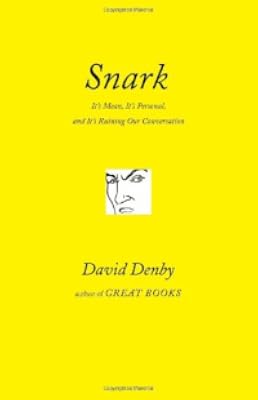
Snark
by David Denby
On This Page
Description
What is snark? You recognize it when you see it-a tone of teasing, snide, undermining abuse, nasty and knowing, that is spreading like pinkeye through the media and threatening to take over how Americans converse with each other and what they can count on as true. Snark attempts to steal someone's mojo, erase her cool, annihilate her effectiveness. In this sharp and witty polemic, New Yorker critic and bestselling author David Denby takes on the snarkers, naming the nine principles of show more snark-the standard techniques its practitioners use to poison their arrows. Snarkers like to think they are deploying wit, but mostly they are exposing the seethe and snarl of an unhappy country, releasing bad feeling but little laughter.In this highly entertaining book, Denby traces the history of snark through the ages, starting with its invention as personal insult in the drinking clubs of ancient Athens, tracking its development all the way to the age of the Internet, where it has become the sole purpose and style of many media, political, and celebrity Web sites. Snark releases the anguish of the dispossessed, envious, and frightened; it flows when a dying class of the powerful struggles to keep the barbarians outside the gates, or, alternately, when those outsiders want to take over the halls of the powerful and expel the office-holders. Snark was behind the London-based magazine Private Eye, launched amid the dying embers of the British empire in 1961; it was also central to the career-hungry, New York–based magazine Spy. It has flourished over the years in the works of everyone from the startling Roman poet Juvenal to Alexander Pope to Tom Wolfe to a million commenters snarling at other people behind handles. Thanks to the grand dame of snark, it has a prominent place twice a week on the opinion page of the New York Times.Denby has fun snarking the snarkers, expelling the bums and promoting the true wits, but he is also making a serious point: the Internet has put snark on steroids. In politics, snark means the lowest, most insinuating and insulting side can win. For the young, a savage piece of gossip could ruin a reputation and possibly a future career. And for all of us, snark just sucks the humor out of life. Denby defends the right of any of us to be cruel but shows us how the real pros pull it off. Snark, he says, is for the amateurs. show lessTags
Recommendations









Member Recommendations

Member Reviews
“Say not thou, What is the cause that the former days were better than these? for thou dost not enquire wisely concerning this.”
That’s a quote from Ecclesiastes. That means people have been going on and on about the good old days for thousands of years. They’ve been doing it for so long that God had to tell them to cut it out, already. (It didn’t work, but I appreciate Him trying.)
Snark is a decent book, but in my eyes it’s marred by frequent laments about how much nicer people used to be. Laments written by a solidly middle class American white man of a certain age. Hmm.
Also – okay, let me preface this complaint by pointing out that because I’m weird, I grew up reading Lewis Carroll’s poem The Hunting of the Snark. We show more had an illustrated copy around, and as a kid I read it incessantly. I have whole stretches of it memorized, and let me tell you, that’s exactly the kind of thing that will get you not invited to the really good birthday parties.
I’m a fan, is what I’m saying. So when I also say that David Denby’s references to this strange poem are strained and disruptive, he’d best listen. I’m his potential fan base, and he’s alienating me.
This book sets out to explain why snark is dangerous and destructive. To do that, Denby has to define what snark is.
“Snark,” he explains early on, “is a teasing, rug-pulling form of insult that attempts to steal someone’s mojo, erase her cool, annihilate her effectiveness, and it appeals to a knowing audience that shares the contempt of the snarker and therefore understands whatever references he makes.”
Fair enough, and nicely put. Snark also, Denby says, has a certain “whatever” quality. It “attacks without reason,” because the snarker doesn’t care about anything and has no larger point to make. Snarking is kneejerk sneering.
Good point. Definitely something to think about.
But that doesn’t take a whole book to say. And this is a short book that still feels longer than it needs to be, because this should have been an essay. I found myself growing restless long before the end, and this book is only 128 pages including acknowledgements and a reference list.
Also, Denby includes a paragraph of his own New Yorker writing that he was surprised to hear accused of snarkiness, and it’s the snarkiest damn thing you ever read. It’s too long to include here, but here’s a bit of it:
“Ben Stiller’s face seems constructed by someone playing with the separate eyes, noses, and mouths of a children’s mix-and-match book. There’s nothing wrong with the features, but they don’t quite go together.”
He goes on some more about Stiller’s physical features. On and on and on. He admits that this passage might be “nasty. But is it snark? I leave it to the reader to decide.”
Well, Denby defines snark as “hazing on a page.” So far, so snarky. There’s the abovementioned “whatever principle” – snarkers “attack without reason.” What’s the reason behind going on and on about how someone looks? Denby is a movie reviewer for a magazine that prides itself on offering intellectual fare to educated readers. I quoted less than half of what he had to say about Stiller’s face. I think that adds up to “guilty as charged.” And since the Stiller paragraph was quoted early on, it colored the rest of the book for me.
So: get this book from the library. Read the first and fifth chapters. Also the one about Maureen Dowd.
If you’re a control freak, read the rest of it. (Then again, if you’re a control freak, there’s no way you were able to read the fifth chapter without reading the four preceding it, so never mind.) If you’re a more relaxed sort, trust me – you’ve now read all the good parts. show less
That’s a quote from Ecclesiastes. That means people have been going on and on about the good old days for thousands of years. They’ve been doing it for so long that God had to tell them to cut it out, already. (It didn’t work, but I appreciate Him trying.)
Snark is a decent book, but in my eyes it’s marred by frequent laments about how much nicer people used to be. Laments written by a solidly middle class American white man of a certain age. Hmm.
Also – okay, let me preface this complaint by pointing out that because I’m weird, I grew up reading Lewis Carroll’s poem The Hunting of the Snark. We show more had an illustrated copy around, and as a kid I read it incessantly. I have whole stretches of it memorized, and let me tell you, that’s exactly the kind of thing that will get you not invited to the really good birthday parties.
I’m a fan, is what I’m saying. So when I also say that David Denby’s references to this strange poem are strained and disruptive, he’d best listen. I’m his potential fan base, and he’s alienating me.
This book sets out to explain why snark is dangerous and destructive. To do that, Denby has to define what snark is.
“Snark,” he explains early on, “is a teasing, rug-pulling form of insult that attempts to steal someone’s mojo, erase her cool, annihilate her effectiveness, and it appeals to a knowing audience that shares the contempt of the snarker and therefore understands whatever references he makes.”
Fair enough, and nicely put. Snark also, Denby says, has a certain “whatever” quality. It “attacks without reason,” because the snarker doesn’t care about anything and has no larger point to make. Snarking is kneejerk sneering.
Good point. Definitely something to think about.
But that doesn’t take a whole book to say. And this is a short book that still feels longer than it needs to be, because this should have been an essay. I found myself growing restless long before the end, and this book is only 128 pages including acknowledgements and a reference list.
Also, Denby includes a paragraph of his own New Yorker writing that he was surprised to hear accused of snarkiness, and it’s the snarkiest damn thing you ever read. It’s too long to include here, but here’s a bit of it:
“Ben Stiller’s face seems constructed by someone playing with the separate eyes, noses, and mouths of a children’s mix-and-match book. There’s nothing wrong with the features, but they don’t quite go together.”
He goes on some more about Stiller’s physical features. On and on and on. He admits that this passage might be “nasty. But is it snark? I leave it to the reader to decide.”
Well, Denby defines snark as “hazing on a page.” So far, so snarky. There’s the abovementioned “whatever principle” – snarkers “attack without reason.” What’s the reason behind going on and on about how someone looks? Denby is a movie reviewer for a magazine that prides itself on offering intellectual fare to educated readers. I quoted less than half of what he had to say about Stiller’s face. I think that adds up to “guilty as charged.” And since the Stiller paragraph was quoted early on, it colored the rest of the book for me.
So: get this book from the library. Read the first and fifth chapters. Also the one about Maureen Dowd.
If you’re a control freak, read the rest of it. (Then again, if you’re a control freak, there’s no way you were able to read the fifth chapter without reading the four preceding it, so never mind.) If you’re a more relaxed sort, trust me – you’ve now read all the good parts. show less
This book has the dubious honor of being only the second book I have ever thrown in the garbage, so that no one else would waste a moment of their precious time reading my copy. Other reviewers have thoroughly detailed its myriad problems with accuracy and being heinously guilty of the snark it claims to revile, so I won't re-hash. I will, however, chime in with the chorus of reviewers who find Mr. Denby's style pompous and sufficiently awful as to be downright unreadable. If I could give it zero stars, I would. Thank goodness I wasted only a dollar on this horrid little book.
Snarky is one of my favorite adjectives. For me it recalls a mode of surviving the degradations of corporate inanity, customer irritability, and coworker absurdity. Snark provided a vehicle to vent with sympathetic ears and alleviate tension with acid humor and commiseration. So when Denby's 'polemic in seven fits' released with this subtitle and the cover description of 'it's mean, it's personal, and it's ruining our conversation,' I was a bit taken aback. How could my favorite method of coworker relations be damaging our conversation?
Deciding I had to engage with this lengthy essay to see if it was so much fluff or if Denby argued a valid point (I'd like to say I was open minded enough to entertain the latter, but it was mostly the show more former), I slipped into the very astute flow of his logic. Tracing the origins of the word itself to Lewis Carroll's 'The Hunting of the Snark: An Agony, in Eight Fits,' Denby delves further backward to historical antecedents such as the Roman Juvenal and Swift and Pope, taking it through the recent past as used within the English and American magazines 'Private Eye' and 'Spy.'
Pulling us into modern usage, Denby then examines the innumerable explosions of snark that the Internet has carried forth, as everyone seeks to make their voice heard, increasingly finding that the vituperative and personal method of snark is the simplest method. At this point in the collective discourse, he states that this 'narrative of ascendancy and decline' is promulgated by nearly everyone, is unavoidable in its permutations, and has even extended into a type of media currency (84). The ascent refers to the proliferation of a type of celebrity status, quickly and viciously followed by an often near libelous reversal via snark.
The ruination of modern conversation comes about in this personal vindictiveness that epitomizes snark, coupled with its lack of involvement on the part of the one writing the snark. Denby's comparative usages of snark versus his higher regarded use of irony and satire can appear somewhat tenuous, indeed he admits that each case is best judged individually, but he lays a somewhat loose guideline of the form for the reader to follow. He examines politics as one area rife with snark versus satire, holding Maureen Dowd up as the very intelligent but vacuous queen of snark compared to Stephen Colbert whose brilliance is in his elevated and engaged social satire. The underlying differentiation seems to stem from the usage of the written or verbal attack to merely denigrate, or whether it serves to elevate or illustrate with intent to rectify the failings of the subject.
Denby ends with his invitation to cathartically commit all the vituperative acts of social satire and critique within one's ability, but to resist the temptation to slip into a snarky mode, and though I find myself a bit more situated to comfortably assert that my favorite method of verbal release remains a level above snark (usually, okay, sometimes), I cannot resist the wonderful glibness and succinctness that the word itself evokes. Thus will I continue to snark away, albeit with the knowledge that my discourse should retain the sense of satire that contributes to an increased awareness, rather than the merely nasty and useless bitching. Who am I kidding, snark is damn fun! show less
Deciding I had to engage with this lengthy essay to see if it was so much fluff or if Denby argued a valid point (I'd like to say I was open minded enough to entertain the latter, but it was mostly the show more former), I slipped into the very astute flow of his logic. Tracing the origins of the word itself to Lewis Carroll's 'The Hunting of the Snark: An Agony, in Eight Fits,' Denby delves further backward to historical antecedents such as the Roman Juvenal and Swift and Pope, taking it through the recent past as used within the English and American magazines 'Private Eye' and 'Spy.'
Pulling us into modern usage, Denby then examines the innumerable explosions of snark that the Internet has carried forth, as everyone seeks to make their voice heard, increasingly finding that the vituperative and personal method of snark is the simplest method. At this point in the collective discourse, he states that this 'narrative of ascendancy and decline' is promulgated by nearly everyone, is unavoidable in its permutations, and has even extended into a type of media currency (84). The ascent refers to the proliferation of a type of celebrity status, quickly and viciously followed by an often near libelous reversal via snark.
The ruination of modern conversation comes about in this personal vindictiveness that epitomizes snark, coupled with its lack of involvement on the part of the one writing the snark. Denby's comparative usages of snark versus his higher regarded use of irony and satire can appear somewhat tenuous, indeed he admits that each case is best judged individually, but he lays a somewhat loose guideline of the form for the reader to follow. He examines politics as one area rife with snark versus satire, holding Maureen Dowd up as the very intelligent but vacuous queen of snark compared to Stephen Colbert whose brilliance is in his elevated and engaged social satire. The underlying differentiation seems to stem from the usage of the written or verbal attack to merely denigrate, or whether it serves to elevate or illustrate with intent to rectify the failings of the subject.
Denby ends with his invitation to cathartically commit all the vituperative acts of social satire and critique within one's ability, but to resist the temptation to slip into a snarky mode, and though I find myself a bit more situated to comfortably assert that my favorite method of verbal release remains a level above snark (usually, okay, sometimes), I cannot resist the wonderful glibness and succinctness that the word itself evokes. Thus will I continue to snark away, albeit with the knowledge that my discourse should retain the sense of satire that contributes to an increased awareness, rather than the merely nasty and useless bitching. Who am I kidding, snark is damn fun! show less
Stop trying to make yourself look smart by cutting down other people. Be civil for once. Satire is useful and interesting. Snark is easy and lowbrow.
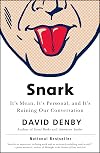
This short book is an extended essay on Denby's views on the problem of snark in our public discourse. On the cover it says, "Snark. It's Mean, It's Personal, and It's Ruining Our Conversation." He distinguishes snark from the more esteemed and legitimate irony and satire: "snark, by contrast, has zero interest in civic virtue or anything else except the power of ridicule." He finds snark "irresponsible" and that it has "a common tendency" of "disengagement from the matter at hand."
I didn't particularly like this book, and while reading I was thinking of what I'd say in my comments here, and planned to tell you that a university prof that I was friendly with told me she taught a class at Columbia University that Denby audited while he show more wrote Great Books, and that he was "an ass." Now I liked Great Books quite a bit (maybe because I was a mature student taking similar classes and so I could identify with some of what he wrote), and I've liked most of what I've read of his writing in the New Yorker, but I didn't much like Snark. While reading it, I kept thinking, "this guy IS an ass." Anyway, I probably shouldn't have shared this tidbit because, 1) it was told to me in a personal conversation, and 2), Denby would probably say I was using snark. And that's a bad thing. So ignore this paragraph.
Anyway, although I didn't much like this book, I do think he has a point, and it is thought-provoking. I had planned to pass it on, but I think I'll hold it for a bit, and maybe reread it if it's still on my mind. A book that makes you think is a good thing, isn't it. Also, he holds Stephen Colbert in the highest esteem (just a notch down from Jonathan Swift's A Modest Proposal). And he dislikes Sarah Palin for her snarkiness (never mind all the other reasons). So that's all good.
Recommended for: People interested in media and cultural studies. It's a quick read, so not much of a gamble if you think you might be interested. show less
I didn't particularly like this book, and while reading I was thinking of what I'd say in my comments here, and planned to tell you that a university prof that I was friendly with told me she taught a class at Columbia University that Denby audited while he show more wrote Great Books, and that he was "an ass." Now I liked Great Books quite a bit (maybe because I was a mature student taking similar classes and so I could identify with some of what he wrote), and I've liked most of what I've read of his writing in the New Yorker, but I didn't much like Snark. While reading it, I kept thinking, "this guy IS an ass." Anyway, I probably shouldn't have shared this tidbit because, 1) it was told to me in a personal conversation, and 2), Denby would probably say I was using snark. And that's a bad thing. So ignore this paragraph.
Anyway, although I didn't much like this book, I do think he has a point, and it is thought-provoking. I had planned to pass it on, but I think I'll hold it for a bit, and maybe reread it if it's still on my mind. A book that makes you think is a good thing, isn't it. Also, he holds Stephen Colbert in the highest esteem (just a notch down from Jonathan Swift's A Modest Proposal). And he dislikes Sarah Palin for her snarkiness (never mind all the other reasons). So that's all good.
Recommended for: People interested in media and cultural studies. It's a quick read, so not much of a gamble if you think you might be interested. show less
Too much of this slim volume was spent on the history of snark as well as splitting the hairs of snark, satire and criticism. While the definitions are important I would have appreciated more time on the impact that snark has on our conversations these days. Of course, the book was written in 2008 (published in 2009) and I'm reading it through the TikTok, Facebook, Twitter lens of 2020, so perhaps that's enough to slant my view. Perhaps it's time for an update?
I found Snark to be a very interesting read, but ultimately somewhat lacking. Denby tackles a topic that is incredibly huge -- the increasing use of uncivil, unpleasant, "attack"-oriented dialog, which has become the main modus operandi for columnists, political hacks, and discussion forum trolls. Throughout the course of his book-length essay, Denby offers an intriguing look at historical precedents to modern Snarkiness, all the way back to the early writer Juvenal. However, by the end of the book, although I had been disconcertedly entertained by some of his observations, I didn't really feel that Denby had succeeded in clearly enough identifying what distinguishes Snark (or snarkiness) from typical irony and/or vituperation or show more foaming-at-the-mouth ranting. If you're interested in the rapid degradation of common civility in public discourse, you'll probably appreciate Denby's examples and asides. If you're looking for a true academic exploration of the topic, Snark will probably fall a bit short of the mark for you. I'll definitely give Denby marks for being an entertaining writer, though -- he's a film critic for New Yorker magazine.
Originally reviewed for my local library's website: http://www.lincolnlibraries.org/depts/bookguide/srec/staffrec09-04.htm show less
Originally reviewed for my local library's website: http://www.lincolnlibraries.org/depts/bookguide/srec/staffrec09-04.htm show less
Members
- Recently Added By
Author Information

19+ Works 2,459 Members
David Denby is a film critic for The New Yorker and author of Great Books and American Sucker. He lives in New York City with his wife.
Common Knowledge
- Canonical title
- Snark
- Original publication date
- 2009
- Epigraph
- For the Snark was a Boojum, you see. —Lewis Carroll, "The Hunting of the Snark"
The hunt for snark never ends.
—Clive James, literary critic - Dedication
- For Susan Rieger
- First words
- This is an essay about a strain of nasty, knowing abuse spreading like pinkeye through the national conversation - a tone of snarking insult provoked and encouraged by the new hybrid world of print, television, radio, and the... (show all) Internet.
- Last words
- (Click to show. Warning: May contain spoilers.)You'll make other people feel better.
- Blurbers
- Pritchard, William H.; Harkin, James; Aspden, Peter; Herman, Carol
Classifications
- Genres
- Literature Studies and Criticism, Fiction and Literature
- DDC/MDS
- 809.7 — Literature & rhetoric Literature, rhetoric & criticism History, description, critical appraisal of more than two literatures Comedy
- LCC
- PN6231 .I65 .D46 — Language and Literature Literature (General) Literature (General) Collections of general literature Wit and humor
- BISAC
Statistics
- Members
- 173
- Popularity
- 190,055
- Reviews
- 14
- Rating
- (2.78)
- Languages
- English
- Media
- Paper, Audiobook, Ebook
- ISBNs
- 9
- ASINs
- 4