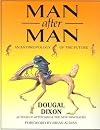
Man After Man: An Anthropology of the Future
by Dougal Dixon
On This Page
Tags
Recommendations

























Member Recommendations

Member Reviews
This book was very fanciful. I can see how the author may have developed some of the ideas, but the majority seemed incredibly far fetched, essentially an extreme devolution of what was left of humanity...back to the trees and primordial slime...I spent half my time rolling my eyes, especially considering the small time frame for such changes...200 years, 300 years by which stage we will be swimming in the ocean, unable to breathe air but circulate water around our mouths and pectoral gills to gather oxygen. Of course these skills were given a helping hand by civilisation when it still existed by way of genetic engineering. All I can say is Dixon has an incredible imagination.
I've had this on my list for awhile, seemed intriguing. Seemed less appealing when I picked it up, so I had my son 'guinea pig' it for me. He reports, from a thorough scan but not an every word read, that it's only mildly interesting and that the Hood and Dixon did not always agree on details.... I see a lot of genetic engineering in the first half of the book, and that is not what I'm interested in.... But I'm scanning it some more....
OK. I wanted more about how we'd naturally evolve, if we could adapt to Climate Change (not fast enough, of course, but still...) and if we'd get the big brain & feeble limb form that is popular among older SF writers.... But the forms shown aren't like that, and most seem entirely implausible to me: the show more massive sloth, for example, feeds its bulk on leaves in a temperate climate - but we all know leaves are low-calorie, so how do these folks survive winter?
Most significantly, none of these 'men' after an apocalypse are civilized. I sincerely doubt that an apocalypse that doesn't destroy life on earth down to the ants will be so harsh that man can't recover technology faster than the pace of evolution. In other words, we'll be making an assortment of weapons long before we can evolve claws as effective as daggers.
I trust that everything described is possible. I don't think any of it is likely.
Even if I were to read an SF treatment of these 'characters' I'd dismiss it as implausible, probably silly. show less
OK. I wanted more about how we'd naturally evolve, if we could adapt to Climate Change (not fast enough, of course, but still...) and if we'd get the big brain & feeble limb form that is popular among older SF writers.... But the forms shown aren't like that, and most seem entirely implausible to me: the show more massive sloth, for example, feeds its bulk on leaves in a temperate climate - but we all know leaves are low-calorie, so how do these folks survive winter?
Most significantly, none of these 'men' after an apocalypse are civilized. I sincerely doubt that an apocalypse that doesn't destroy life on earth down to the ants will be so harsh that man can't recover technology faster than the pace of evolution. In other words, we'll be making an assortment of weapons long before we can evolve claws as effective as daggers.
I trust that everything described is possible. I don't think any of it is likely.
Even if I were to read an SF treatment of these 'characters' I'd dismiss it as implausible, probably silly. show less
Although somewhat fanciful and largely conjecture, this "anthropology of the future" is also based on science and what we know of evolutionary history up until now. Some of these future humans are hard to swallow, but nature has already created bizarre variations that surprise us. It’s good lunchtime entertainment, and although the book was written nearly 20 years ago, we are still experiencing many of the same social and environmental concerns today that are mentioned in the book.
Ratings
Members
- Recently Added By
Lists

Best Post-Apocalyptic Stories
143 works; 88 members
Author Information

239 Works 5,593 Members
Dougal Dixon was born in Dumfries, Scotland in 1947. He received a bachelor of science degree in geology from the University of St. Andrews in 1970 and a master of science degree in 1972. He entered the publishing field in 1973 and became a freelancer in 1980. He is an internationally recognized authority on dinosaurs and is one of the most show more popular science writers in the United Kingdom. His books include After Man: A Zoology of the Future, The New Dinosaurs, Man After Man, and Time Exposure (aka The Age of Dinosaurs). He has also served as a special advisor for programs and motion pictures about dinosaurs in the United States, Great Britain and Japan. He received the Distinguished Achievement Award for Excellence in Educational Journalism by the Educational Press Association of America in 1993, the Helen Roney Sattler Award in 1993, the Children's Book Council 1994 Outstanding Trade Science Book Award, and the Times Educational Supplement Primary Schoolbook Award in 1996. (Bowker Author Biography) show less
All Editions
Common Knowledge
- Original publication date
- 1990
Classifications
Statistics
- Members
- 245
- Popularity
- 133,201
- Reviews
- 3
- Rating
- (3.50)
- Languages
- English
- Media
- Paper
- ISBNs
- 3
- ASINs
- 1