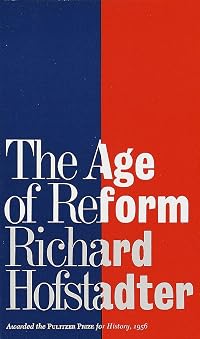
The Age of Reform
by Richard Hofstadter
On This Page
Description
This analysis of the reform movements in American politics from 1890-1940 reviews: (1) The agrarian uprising that found its expression in the Populist movement of the 1890's; (2) The Progressive movement from about 1900 to 1914; (3) The New Deal of the 1930's. Emphasis is placed upon the ideas of the leading political reformers, their aims and techniques, and the combined effect of all of these things upon American thinking.Tags
Recommendations

















Member Recommendations

Member Reviews
As usual, although less true than with The American Political Tradition and the Men Who Made It, the author enlivens the exegesis of the American political soul. Often this is done with witty and insightful quotations from unpublished dissertations and obscure works like this one from The New Democracy:
"By setting the pace for a frantic competitive consumption, our infinite gradations in wealth (with which gradations the plutocracy is inevitably associated) increase the general social friction and produce an acute social irritation. There was ostentatious spending before the plutocratic period, as there will be after, for display is an inveterate form of individuation, older than humanity. Our plutocracy, however, intent upon socially show more isolating itself and possessing no title to precedence other than the visible possession of money, makes of this competitive consumption a perennial handicap race of spenders. We are developing new types of destitutes — the automobileless, the yachtless, the Newport-cottageless. The subtlest of luxuries become necessities, and their loss is bitterly resented. The discontent of to-day reaches very high in the social scale..."
covering mainly the 19th to early 20th centuries, this book explores interesting trends like the decline in public institutions of clerical (religious) leadership and the replacement by lawyers as the face of corporate America. as with Democracy in America
Book by Alexis de Tocqueville, it fascinates me how much the essential elements of the American mind remains the same over the decades. the acceptance of American especialism breeds isolationism and xenophobia, and rural versus urban conflict only kinda regional and structured into our representative government generates a dangerous friction expressed in populist and progressive movements over cooperation. America believes it's own legend. the book ends "much of America still longs for - indeed, expects again to see - a return of the older individualism and the older isolation, and grows fanatic when it finds that even our conservative leaders are unable to restore such conditions. in truth we may well sympathize with the populists and with those who have shared their need to believe that somewhere in the American past there was a golden age whose life was far better than our own. but actually to live in that world, actually to enjoy its cherished promise and its imagined innocence, is no longer within our power. "
nor would we stand its lack of longevity and conveniences! show less
"By setting the pace for a frantic competitive consumption, our infinite gradations in wealth (with which gradations the plutocracy is inevitably associated) increase the general social friction and produce an acute social irritation. There was ostentatious spending before the plutocratic period, as there will be after, for display is an inveterate form of individuation, older than humanity. Our plutocracy, however, intent upon socially show more isolating itself and possessing no title to precedence other than the visible possession of money, makes of this competitive consumption a perennial handicap race of spenders. We are developing new types of destitutes — the automobileless, the yachtless, the Newport-cottageless. The subtlest of luxuries become necessities, and their loss is bitterly resented. The discontent of to-day reaches very high in the social scale..."
covering mainly the 19th to early 20th centuries, this book explores interesting trends like the decline in public institutions of clerical (religious) leadership and the replacement by lawyers as the face of corporate America. as with Democracy in America
Book by Alexis de Tocqueville, it fascinates me how much the essential elements of the American mind remains the same over the decades. the acceptance of American especialism breeds isolationism and xenophobia, and rural versus urban conflict only kinda regional and structured into our representative government generates a dangerous friction expressed in populist and progressive movements over cooperation. America believes it's own legend. the book ends "much of America still longs for - indeed, expects again to see - a return of the older individualism and the older isolation, and grows fanatic when it finds that even our conservative leaders are unable to restore such conditions. in truth we may well sympathize with the populists and with those who have shared their need to believe that somewhere in the American past there was a golden age whose life was far better than our own. but actually to live in that world, actually to enjoy its cherished promise and its imagined innocence, is no longer within our power. "
nor would we stand its lack of longevity and conveniences! show less
Love him or hate him, you just can't get around him. Hofstadter takes up a strong (and contested) position on the Populists, as already addressed in Week 2. He argues more extensively in this chapter that the irony of Populism is that, though they may have gone down to political defeat, they achieved most of their goals by the very fact that most of their causes became law. In the classic role of the third party, they were like bees, "once they have stung, they die" (pp. 97 and 108- 8 9).
Many would contest the idea that Populism was so very successful. Particularly Lawrence Goodwyn, but that will have to wait. Many too would contest Hofstadter's emphasis on the "success-hungriness" of the Populist leadership. As he did with Abraham show more Lincoln in The American Political Tradition, so he does with the Populist leaders such as General Weaver (p. 105). Ambition, not ideals, drive Hofstadter's Populists. Turning to free silver as the definitive issue, these ambitious leaders essentially sold out the movement for their own moment.
In sections entitled "The Golden Age and After" and "The Vanishing Hayseed" he traces what happened to the farmers' movement after the end of Populism. Despite the sentimental lament for a lost agrarian past, the farmers have done quite well in 20th century America. The farmers who had once been populists became the agribusiness bloc, and at the time of writing ( 1956) "industrial America goes on producing the social, surpluses out of which the commercial farmers are subsidized" (p. 120).1 One more irony of populism too. As the "hayseed" vanished, so too did the farmer's association with the laboring man. Taking up an increasingly conservative position, "the tone of the farmer's movement was completely transformed" and agribusiness was far more likely to support management than strikers 1( p. 123 ). In the end, the farmers' rebellion was turned into its opposite. show less
Many would contest the idea that Populism was so very successful. Particularly Lawrence Goodwyn, but that will have to wait. Many too would contest Hofstadter's emphasis on the "success-hungriness" of the Populist leadership. As he did with Abraham show more Lincoln in The American Political Tradition, so he does with the Populist leaders such as General Weaver (p. 105). Ambition, not ideals, drive Hofstadter's Populists. Turning to free silver as the definitive issue, these ambitious leaders essentially sold out the movement for their own moment.
In sections entitled "The Golden Age and After" and "The Vanishing Hayseed" he traces what happened to the farmers' movement after the end of Populism. Despite the sentimental lament for a lost agrarian past, the farmers have done quite well in 20th century America. The farmers who had once been populists became the agribusiness bloc, and at the time of writing ( 1956) "industrial America goes on producing the social, surpluses out of which the commercial farmers are subsidized" (p. 120).1 One more irony of populism too. As the "hayseed" vanished, so too did the farmer's association with the laboring man. Taking up an increasingly conservative position, "the tone of the farmer's movement was completely transformed" and agribusiness was far more likely to support management than strikers 1( p. 123 ). In the end, the farmers' rebellion was turned into its opposite. show less
A critical and contextual look at the Populist and Progressive movements in American politics; where they succeeded and failed, what forces shaped them and what their legacy was. Good background into a movement that I view as a big part of my political legacy. It has definitely removed any rose-colored view of them I might have had, but I’m still left with the lasting and important message that they accomplished a lot of worthwhile social and political change with minimal chaos and violence, whatever their faults may have been. This basically re-affirms why I identify as a Progressive to begin with.
I remember having to read this in High School and finding it tough to stay awake while reading it. I recently picked it up again to reread it and genuinely enjoyed it the second time. It is a good history of the American reform movements at the end of the 19th century and helps explain the motivations of the supporters of William Jennings Bryant.
3196. The Age of Reform / From Bryan to F.D.R., by Richard Hofstadter (read May 16, 1999) This was on the National Review's recent list of 100 best non-fiction books of the century (no. 42 thereon) and reading it brings to only 12 the number of books on that list I have read. Some of this book, especially that part on the Populists, is very insightful and I enjoyed. Some other parts were less fascinating. But I liked the book better than the same
author's The Progressive Historians / Turner, Beard, Parrington (read 2 March 1997).
author's The Progressive Historians / Turner, Beard, Parrington (read 2 March 1997).
http:/bactra.org/weblog/algae-2011-11.html#hofstadter
Members
- Recently Added By
Lists

r/AskHistorians' Recommended Books
1,068 works; 19 members

In Our Time books
4,934 works; 2 members
Author Information

53+ Works 6,924 Members
DeWitt Clinton Professor of History at Columbia University from 1959 until the time of his death, Richard Hofstadter was one of the most influential historians in post--World War II America. His political, social, and intellectual histories raised serious questions about assumptions that had long been taken for granted and cast the American show more experience in an interesting new light. His 1948 work, The American Political Tradition, is an enduring classic study in political history. His 1955 work, The Age of Reform, which still commands respect among both historians and general readers, won him that year's Pulitzer Prize. A measure of Hofstadter's standing in literary and scholarly circles is the honors he received in 1964 for Anti-Intellectualism in American Life (1963)---Pulitzer Prize for general nonfiction, the Ralph Waldo Emerson Prize of Phi Beta Kappa, and the Sidney Hillman Prize Award. Hofstadter's greatest talent, however, may have been his ability to order complex events and issues and to synthesize from them a rational, constructively critical perspective on American history. (Bowker Author Biography) show less
Awards and Honors
Awards
Notable Lists
Series
Belongs to Publisher Series
Vintage Books (V-95)
Work Relationships
Has as a student's study guide
Common Knowledge
- Original publication date
- 1955
- People/Characters
- William Jennings Bryan; Franklin Delano Roosevelt; Henry Adams; Louis D. Brandeis; Grover Cleveland; John Hicks (show all 12); Robert M. La Follette, Sr.; Theodore Roosevelt; William Howard Taft; William Allen White; Woodrow Wilson; Henry Demarest Lloyd
- Important events
- United States presidential election (1896); New Deal
- First words
- Introduction -- Just as the cycle of American history from the Civil War to the 1890's can be thought of chiefly as a period of industrial and continental expansion and political conservatism, so the age that has just passed,... (show all) running from about 1890 to the second World War, can be considered an age of reform.
Classifications
- Genres
- History, Nonfiction, General Nonfiction, Politics and Government
- DDC/MDS
- 973.91 — History & geography History of North America United States 1901- World Wars and Depression Era (1901-1953)
- LCC
- E743 .H63 — History of the United States United States Twentieth century General Political history Un-American activities
- BISAC
Statistics
- Members
- 849
- Popularity
- 32,359
- Reviews
- 7
- Rating
- (3.84)
- Languages
- English
- Media
- Paper, Audiobook, Ebook
- ISBNs
- 8
- UPCs
- 1
- ASINs
- 17