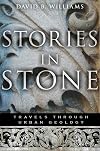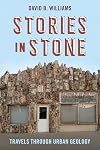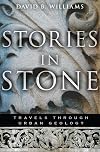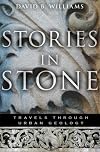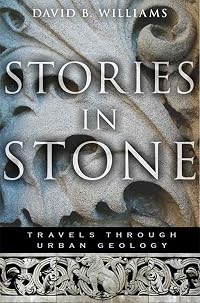
Stories in Stone
by David B. Williams
On This Page
Description
Most people do not think to observe geology from the sidewalks of a major city, but all David B. Williams has to do is look at building stone in any urban center to find a range of rocks equal to any assembled by plate tectonics. In Stories in Stone, he takes you on explorations to find 3.5-billion-year-old rock that looks like swirled pink-and-black taffy, a gas station made of petrified wood, and a Florida fort that has withstood three hundred years of attacks and hurricanes, despite being show more made of a stone that has the consistency of a granola bar.Williams also weaves in the cultural history of stone, explaining why a white fossil-rich limestone from Indiana became the only building stone used in all fifty states; how in 1825, the construction of the Bunker Hill Monument led to America ?s first commercial railroad; and why when the same kind of marble used by Michelangelo clad a Chicago skyscraper it warped so much after nineteen years that all 44,000 panels of it had to be replaced. This love letter to building stone brings to life the geology you can see in the structures of every city. show lessTags
Recommendations

















Member Recommendations
Member Reviews
David B. Williams’ Stories in Stone is an assemblage of metaphors of metamorphosis, of rock under earth pressure melting, crystallizing, eroding, and ever alive beneath one’s feet. Highlights:
The opening chapter is about sandstone quarried and shipped from Portland, Connecticut to become the ‘brownstone’ row houses of New York and other urban terrains during the nineteenth century. Manhattan’s Trinity Church (the second church so named, the first destroyed by fire in 1776) is made of brownstone, which is sandstone colored reddish brown by iron oxide, and survived the debris of the fallen World Trade Center’s twin towers on 9/11. Considered by novelist Edith Wharton, “the most hideous stone ever quarried” (Williams’ show more title for his opening chapter), today’s restored Brownstones are highly prized.
‘Poetry in Stone’, Chapter Three, is about the Salinian granite that poet Robinson Jeffers used to construct his life-long home, Tor House, which overlooks the Pacific at Carmel-by-the Sea, California. Jeffers’ autobiography in granite, as it were, is made of a unique stone found only between Carmel and Half Moon Bay, the result of recent geologic studies of the movement of multiple terranes (land masses) relative to ‘plate tectonic’ theory. As Williams says, Jeffers’ ideas took shape in Carmel at Tor House and as geologist Aaron Yoshinobu, student of both geology and Jeffers said, “[. . .] Jeffers found granite and granite found Jeffers.”
‘The Clam That Changed the World’, Chapter Five, discusses ‘coquina’, the stone used to construct the walls of the Castillo de San Marcos which Spanish fort protected the city of St. Augustine on Florida’s Atlantic coast. This elastic aggregate comprised of whole and crushed sea shells and the ‘Elmer’s’ glue of the day’ withstood naval artillery bombardment by absorbing the fragments of cannon balls to the dismay of attackers.
‘America’s Building Stone’, Chapter Six, focuses on Indiana (or Salem) limestone, made up of the skeletons of the brachiopods, bryozoans, and crinoids of the Mississippian Period (330 million years ago) of the Earth’s geologic timeline. This stone has been used in the construction of some 750 federal post offices, the Lincoln Monument, immigration buildings on Ellis Island, and in repairs to the White House and the Capitol.
Williams also delights readers with stories about the use of petrified wood to build a gas station in Lamar, Colorado; the failure of Michelangelo’s cherished Carrara marble as a facing for the corporate headquarters building of Standard Oil Company of Indiana, now Amoco, in Chicago; the dependable uses of slate in blackboards, billiard tables, and as roofing material.
This is a book chocked full of science, humor, history, manners and myth. It is as its author claims, a “story in stone that one can see every day if we take the time to look, to ask questions, to wonder about the world around us.” (p. 222) show less
The opening chapter is about sandstone quarried and shipped from Portland, Connecticut to become the ‘brownstone’ row houses of New York and other urban terrains during the nineteenth century. Manhattan’s Trinity Church (the second church so named, the first destroyed by fire in 1776) is made of brownstone, which is sandstone colored reddish brown by iron oxide, and survived the debris of the fallen World Trade Center’s twin towers on 9/11. Considered by novelist Edith Wharton, “the most hideous stone ever quarried” (Williams’ show more title for his opening chapter), today’s restored Brownstones are highly prized.
‘Poetry in Stone’, Chapter Three, is about the Salinian granite that poet Robinson Jeffers used to construct his life-long home, Tor House, which overlooks the Pacific at Carmel-by-the Sea, California. Jeffers’ autobiography in granite, as it were, is made of a unique stone found only between Carmel and Half Moon Bay, the result of recent geologic studies of the movement of multiple terranes (land masses) relative to ‘plate tectonic’ theory. As Williams says, Jeffers’ ideas took shape in Carmel at Tor House and as geologist Aaron Yoshinobu, student of both geology and Jeffers said, “[. . .] Jeffers found granite and granite found Jeffers.”
‘The Clam That Changed the World’, Chapter Five, discusses ‘coquina’, the stone used to construct the walls of the Castillo de San Marcos which Spanish fort protected the city of St. Augustine on Florida’s Atlantic coast. This elastic aggregate comprised of whole and crushed sea shells and the ‘Elmer’s’ glue of the day’ withstood naval artillery bombardment by absorbing the fragments of cannon balls to the dismay of attackers.
‘America’s Building Stone’, Chapter Six, focuses on Indiana (or Salem) limestone, made up of the skeletons of the brachiopods, bryozoans, and crinoids of the Mississippian Period (330 million years ago) of the Earth’s geologic timeline. This stone has been used in the construction of some 750 federal post offices, the Lincoln Monument, immigration buildings on Ellis Island, and in repairs to the White House and the Capitol.
Williams also delights readers with stories about the use of petrified wood to build a gas station in Lamar, Colorado; the failure of Michelangelo’s cherished Carrara marble as a facing for the corporate headquarters building of Standard Oil Company of Indiana, now Amoco, in Chicago; the dependable uses of slate in blackboards, billiard tables, and as roofing material.
This is a book chocked full of science, humor, history, manners and myth. It is as its author claims, a “story in stone that one can see every day if we take the time to look, to ask questions, to wonder about the world around us.” (p. 222) show less
 This review was written for LibraryThing Early Reviewers.
This book reminded me of all the reasons why I love Geology. David B. Williams is able to mix history, geology, and pure wonderment in such a way that the rocks took on a life of their own. You could feel the enthusiasm and love Williams has for these rocks and architecture on every page. I especially loved the Salem Limestone section and can say with absolute certainty it is everything Williams says and more. I’ve spent a lot of time staring at Maxwell Hall and all the other Limestone clad structures around Indiana University's beautiful campus. After reading this book, I have a new appreciation for urban geology that I was severely lacking. Now when I look at the city I live in I see a completely new landscape, full of rich stone show more and history. This book really has changed the way I look at buildings and defined why I really never liked the buildings made of glass and steel.
Williams did a terrific job of mixing the rocks geologic significance and the history of its use as a building stone making the book engaging and interesting for a reader that is not all that familiar with geology or arcitechiture. A glossary in the back of the book helps with some of the more obscure terminology for the uninitiated. My only complaint was a lack of color pictures, I found myself googling up images to see exactly the textures and colors Williams is so eloquently describing. But then again I love embedded pictures with the text they belong too, instead of some segregated section in the middle totally out of context. Overall a very enjoyable and educational read. show less
Williams did a terrific job of mixing the rocks geologic significance and the history of its use as a building stone making the book engaging and interesting for a reader that is not all that familiar with geology or arcitechiture. A glossary in the back of the book helps with some of the more obscure terminology for the uninitiated. My only complaint was a lack of color pictures, I found myself googling up images to see exactly the textures and colors Williams is so eloquently describing. But then again I love embedded pictures with the text they belong too, instead of some segregated section in the middle totally out of context. Overall a very enjoyable and educational read. show less
This review was written for LibraryThing Early Reviewers.I like pop science books a lot. I enjoy learning about things I've either avoided in the past or simply never thought thing one about. This subject is one of the latter.
Williams has an extra-interesting (to me) chapter on brownstone(s)...as I'm a few miles from Brooklyn, and a former resident of a brownstone-clad building in Manhattan, I've seen a lot of stuff about them. I've noticed, for example, a fact that Williams explores at some length...the rotten condition of a lot of brownstone facades...and always thought, "whatinaheck made people use this stuff?! It's ugly and it's fragile!" Well, Mr. Williams goes into the bad-condition part (cheap construction) and even comments on the changes that took place in attitudes towards the show more stone. Originally the brownstone wasn't thought highly of by the cognoscenti of the day, being drab and uniform and inidicative of a certain bourgeois striving that the haut ton has always smirkingly dismissed. Then it came to be seen as charming, for some damn reason, and now it seems that we're heading back into condescenscion. Fashion...plus ca change....
Granite, my personal favorite stone, gets a lot of play in this book, and I learned a great deal about its genesis and its manifold strengths. I lived in a part of Texas that is a big ol' granite shelf with dead coral reefs atop it (the Hill Country), whence cometh a lovely pink granite.
I think books like this offer a very useful meditation on the world around us. A built environment is every bit as complex and interesting and worthy of quiet contemplation as a natural environment is, and too few people afford the built environment more than a disparaging glance. It's foolish to think that a state of nature has more inherent interest than humanity's considered labors. Why should we humans dismiss the fruits of our labors? Why not appreciate both for their different strengths?
I don't think Williams exactly meant to bring this idea to the fore, but it's the first thing that sprang to my mind. I'd recommend the book more highly, but the author isn't a prose stylist of any great note. He's solid and informative and able to convey a sense of his pleasure in the stones we build our life-caves from, but his words take flight exactly never and I see that as a demerit. I'd like for people who *don't* like science to read the book. It's worth your while because you'll get a small sense of what science does...explain the universe to us in useful and interesting ways. show less
Williams has an extra-interesting (to me) chapter on brownstone(s)...as I'm a few miles from Brooklyn, and a former resident of a brownstone-clad building in Manhattan, I've seen a lot of stuff about them. I've noticed, for example, a fact that Williams explores at some length...the rotten condition of a lot of brownstone facades...and always thought, "whatinaheck made people use this stuff?! It's ugly and it's fragile!" Well, Mr. Williams goes into the bad-condition part (cheap construction) and even comments on the changes that took place in attitudes towards the show more stone. Originally the brownstone wasn't thought highly of by the cognoscenti of the day, being drab and uniform and inidicative of a certain bourgeois striving that the haut ton has always smirkingly dismissed. Then it came to be seen as charming, for some damn reason, and now it seems that we're heading back into condescenscion. Fashion...plus ca change....
Granite, my personal favorite stone, gets a lot of play in this book, and I learned a great deal about its genesis and its manifold strengths. I lived in a part of Texas that is a big ol' granite shelf with dead coral reefs atop it (the Hill Country), whence cometh a lovely pink granite.
I think books like this offer a very useful meditation on the world around us. A built environment is every bit as complex and interesting and worthy of quiet contemplation as a natural environment is, and too few people afford the built environment more than a disparaging glance. It's foolish to think that a state of nature has more inherent interest than humanity's considered labors. Why should we humans dismiss the fruits of our labors? Why not appreciate both for their different strengths?
I don't think Williams exactly meant to bring this idea to the fore, but it's the first thing that sprang to my mind. I'd recommend the book more highly, but the author isn't a prose stylist of any great note. He's solid and informative and able to convey a sense of his pleasure in the stones we build our life-caves from, but his words take flight exactly never and I see that as a demerit. I'd like for people who *don't* like science to read the book. It's worth your while because you'll get a small sense of what science does...explain the universe to us in useful and interesting ways. show less
Stories in Stone by David B. Williams chronicles the history, culture and science of a wide variety of stone and how mankind used it to build the country, and the world. The Castillo de San Marcos in Florida (coquina), Michelangelo's David in Italy (Cararra marble), poet Robinson Jeffer's cottage in California (granite) and chalkboards in any century-old small town classroom (slate) are just a few of the examples. This is a lively and enjoyable read. There's a fair amount of technical information, but it's more than manageable. You'll even find a bit of humor:
"Energized by pig fat and caffeine, we headed back out to find rocks."
I particularly enjoyed knowing where the rock was originally quarried and how and how far it traveled to its show more eventual building site. I didn't realize just how hard men toiled, and often even died, for stone. It seems that they coveted rock not because it was a perfect building or carving material -- in some monumental instances it wasn't -- but because it was gorgeous and moving and a universal symbol of power and timelessness. This book is a wonderfully unusual account of the many ways man has left his mark with rock. show less
"Energized by pig fat and caffeine, we headed back out to find rocks."
I particularly enjoyed knowing where the rock was originally quarried and how and how far it traveled to its show more eventual building site. I didn't realize just how hard men toiled, and often even died, for stone. It seems that they coveted rock not because it was a perfect building or carving material -- in some monumental instances it wasn't -- but because it was gorgeous and moving and a universal symbol of power and timelessness. This book is a wonderfully unusual account of the many ways man has left his mark with rock. show less
This review was written for LibraryThing Early Reviewers.I have a rock collection, so I hoped to find Stories in Stone "interesting." Instead, I found it fun and well-written ... and interesting.
Each of the ten chapters is indeed a story, most set in the U.S., about a particular kind of stone, how it has been used in buildings and how the stone got there. Mr. Williams makes ordinary brownstone dramatic and strange coquina understandable.
It should go without saying that Stories in Stone ought to be required reading for students of geology, architecture and building construction. But I also recommend it for those who are fenced inside urban landscapes; whose children assume milk comes from grocery refrigerators (though there's a cow involved somewhere) and gasoline comes from a pump (though a show more dinasour is in that story). Williams tells us how our building materials come from dynamic earth events - not simply a quarry pit.
As David B. Williams tells us in his Preface, we walk past buildings every day that are as geologically and historically fascinating as mountainsides in Italy, battlefields in Florida, and the fantastical worlds of ancient volcanos and fossils. His book is a great read, a great education and a great travel companion. show less
Each of the ten chapters is indeed a story, most set in the U.S., about a particular kind of stone, how it has been used in buildings and how the stone got there. Mr. Williams makes ordinary brownstone dramatic and strange coquina understandable.
It should go without saying that Stories in Stone ought to be required reading for students of geology, architecture and building construction. But I also recommend it for those who are fenced inside urban landscapes; whose children assume milk comes from grocery refrigerators (though there's a cow involved somewhere) and gasoline comes from a pump (though a show more dinasour is in that story). Williams tells us how our building materials come from dynamic earth events - not simply a quarry pit.
As David B. Williams tells us in his Preface, we walk past buildings every day that are as geologically and historically fascinating as mountainsides in Italy, battlefields in Florida, and the fantastical worlds of ancient volcanos and fossils. His book is a great read, a great education and a great travel companion. show less
This review was written for LibraryThing Early Reviewers.A very enjoyable journey. "Slow down and look more carefully..." says Mr. Williams and that's what he does as he visits and examines several classic stone building materials. You know these materials (brownstone, slate, etc.) because we have all seen them. But you may not have really experienced them until you have looked deeper. This is what this fine book provides. I enjoyed the wonderful connections that Mr. Williams orchestrates with these stone building materials. For each type stone he weaves a thread through history, poetry, architecture, art, culture, scientific principals, practical understanding etc. The book reads like a wonderful travel guide that stimulates your curiosity and yields not only insight but a occasional laugh show more along the way. I'm a High School science teacher and plan to use several of the geological connections to culture in my lessons. An engaging accessible read for anyone interested in history, science or the practical understanding of building with stone. show less
This review was written for LibraryThing Early Reviewers.I really enjoyed this. I'm a fan of John McPhee's geological adventures, and although I have a Ph.D. in the social sciences, I often find myself wishing I had studied lots more geology.
Williams wanders about cities and looks at what most of us just see as buildings, and walls, and stairs, and all sorts of other structures. but he sees the record of the earth's history, and he wants to illuminate it for us. I found his coverage of details interesting; for example, why are the brownstones outside Harvard Hall wearing down when they shouldn't be; what do different colors and patterns of granite tell us about how the granite was formed?; why are the stones from some quarries particularly prized and how is it that those conditions are often show more very localized?
All in all, an enjoyable romp connecting the world of artificial structures with the elemental forces of nature itself. show less
Williams wanders about cities and looks at what most of us just see as buildings, and walls, and stairs, and all sorts of other structures. but he sees the record of the earth's history, and he wants to illuminate it for us. I found his coverage of details interesting; for example, why are the brownstones outside Harvard Hall wearing down when they shouldn't be; what do different colors and patterns of granite tell us about how the granite was formed?; why are the stones from some quarries particularly prized and how is it that those conditions are often show more very localized?
All in all, an enjoyable romp connecting the world of artificial structures with the elemental forces of nature itself. show less
This review was written for LibraryThing Early Reviewers.Members
- Recently Added By
Author Information
11 Works 473 Members
David B. Williams is a freelance writer focused on the intersection of people and the natural world. A geologist by training, he is the author or coauthor of seven books, including most recently Seattle Walks: Discovering History and Nature in the City, Too High and Too Steep: Reshaping Seattle's Topography, and Waterway: The Story of Seattle's show more Locks and Ship Canal (with Jennifer Ott). He lives in Seattle. show less
Awards and Honors
Awards
Common Knowledge
- Canonical title
- Stories in Stone
- Alternate titles
- Stories in Stone
- Original publication date
- 2009
- Original language
- English
Classifications
Statistics
- Members
- 120
- Popularity
- 271,406
- Reviews
- 22
- Rating
- (3.63)
- Languages
- English
- Media
- Paper, Ebook
- ISBNs
- 4
- ASINs
- 2