Moby Dick
by Will Eisner (Adapter, Illustrator), Herman Melville (Original Author)
On This Page
Description
Ishmael, a sailor, recounts the ill-fated voyage of a whaling ship led by the fanatical Captain Ahab in search of the white whale that had crippled him. Presented in comic book format.Tags
Recommendations

















Member Reviews
*Book source ~ Library
From Goodreads:
A rich, complex, highly symbolic narrative that explores the deepest reaches of our moral and metaphysical dilemma through the extraordinary tale of Captain Ahab's insane quest for the great white whale. One of America's greatest novels.
Ok, anyone not living under a rock, in a cave or with monks on a mountain top knows this is a book about a guy hunting the whale who took his leg. Or what I consider obsession. One man’s obsession to be precise and how he got himself and a bunch of guys killed because of it. Because he couldn’t take Elsa’s advice and let it go.
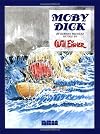
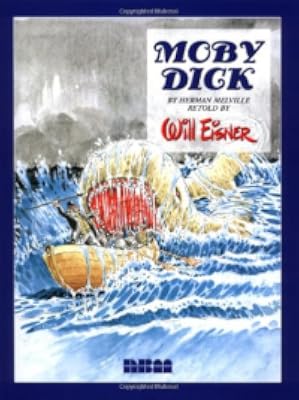
I’ll be the first to admit I couldn’t even read the novel. It bored me to tears when I tried. I ended up listening to the audio show more instead. Anyway, this graphic novel breaks that big ass book down quite nicely. The artwork is not my cup of tea, but it looks kinda old-timey as does the lettering. All-in-all not a bad adaptation. show less
From Goodreads:
A rich, complex, highly symbolic narrative that explores the deepest reaches of our moral and metaphysical dilemma through the extraordinary tale of Captain Ahab's insane quest for the great white whale. One of America's greatest novels.
Ok, anyone not living under a rock, in a cave or with monks on a mountain top knows this is a book about a guy hunting the whale who took his leg. Or what I consider obsession. One man’s obsession to be precise and how he got himself and a bunch of guys killed because of it. Because he couldn’t take Elsa’s advice and let it go.
I’ll be the first to admit I couldn’t even read the novel. It bored me to tears when I tried. I ended up listening to the audio show more instead. Anyway, this graphic novel breaks that big ass book down quite nicely. The artwork is not my cup of tea, but it looks kinda old-timey as does the lettering. All-in-all not a bad adaptation. show less
I think this is a very rich and powerful children's book that explains the great adventure of Captain Ahab's quest for the great white whale. The words Eisner uses is a hard book to understand for children. I would use this in my classroom as a group read or read aloud book to make sure children understood what was happening.
Ishmael meets Queequeg, the whale harpooner, who becomes his close friend. They find a ship to work on, captained by Ahab, who lost his leg to a whale named Moby Dick – the most ferocious whale in the sea. Captain Ahab relentlessly tries to kill Ahab but he is killed by Moby Dick and the entire ship sinks.
Summary: Ishmael, a sailor, recounts the ill-fated voyage of a whaling ship led by the fanatical Captain Ahab in search of the white whale that had crippled him. Presented in comic book format. -- DLC
Ratings
Members
- Recently Added By
Author Information

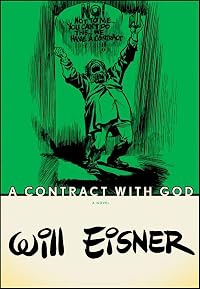
Will Eisner was born March 6, 1917 in Brooklyn, NY. As a child he worked for printers and sold newspapers. He attended De Witt Clinton High School in the Bronx, where his artwork first appeared in the school newspaper. His first job was at the New York American, but he lost that and found a job with WOW What a Magazine! in 1936. He created two show more features for the magazine, Harry Karry and The Flame. After the magazine went under, for a short time, he freelanced and drew stories for Comic Magazines before he and friend Jerry Iger formed a the Eisner-Iger studio. The two went their separate ways when Eisner joined the Quality Comics Group to produce a syndicated 16-page newspaper supplement. It was there that Eisner created his most well known character, the Spirit. In 1942, Eisner was drafted into the army where he produced posters and strips for the troops. After the war, he continued the Spirit strip until 1952. It was during this time that he created the American Visuals Corporation, a commercial art company that created comics for educational and commercial purposes. Some of the company's clients included RCA Records, the Baltimore Colts, and New York Telephone. Eisner had given up on the Spirit strip, but still produced new material for it from time to time. He chose to focus his efforts on a more mature storyline and so produced A Contract With God, which was published in 1978. It was the beginnings of the graphic novel. Eisner also taught cartooning at the School of Visual Arts in New York, in addition to writing Comics and Sequential Art and Graphic Storytelling. The Eisner Awards, one of only two comics industry awards, are named for Eisner and were established in 1988. Eisner's work was showcased in the Whitney Museum's 1996 "NYNY: City of Ambition" show. Will Eisner passed away on Monday January 3, 2005 at the age of 87 after undergoing quadruple bypass heart surgery. (Bowker Author Biography) show less

Herman Melville (August 1, 1819 - September 28, 1891) was born into a seemingly secure, prosperous world, a descendant of prominent Dutch and English families long established in New York State. That security vanished when first, the family business failed, and then, two years later, in young Melville's thirteenth year, his father died. Without show more enough money to gain the formal education that professions required, Melville was thrown on his own resources and in 1841 sailed off on a whaling ship bound for the South Seas. His experiences at sea during the next four years were to form in part the basis of his best fiction. Melville's first two books, Typee (1846) and Omoo (1847), were partly romance and partly autobiographical travel books set in the South Seas. Both were popular successes, particularly Typee, which included a stay among cannibals and a romance with a South Sea maiden. During the next several years, Melville published three more romances that drew upon his experiences at sea: Redburn (1849) and White-Jacket (1850), both fairly realistic accounts of the sailor's life and depicting the loss of innocence of central characters; and Mardi (1849), which, like the other two books, began as a romance of adventure but turned into an allegorical critique of contemporary American civilization. Moby Dick (1851) also began as an adventure story, based on Melville's experiences aboard the whaling ship. However, in the writing of it inspired in part by conversations with his friend and neighbor Hawthorne and partly by his own irrepressible imagination and reading of Shakespeare and other Renaissance dramatists Melville turned the book into something so strange that, when it appeared in print, many of his readers and critics were dumbfounded, even outraged. By the mid-1850s, Melville's literary reputation was all but destroyed, and he was obliged to live the rest of his life taking whatever jobs he could find and borrowing money from relatives, who fortunately were always in a position to help him. He continued to write, however, and published some marvelous short fiction pieces Benito Cereno" (1855) and "Bartleby, the Scrivener" (1853) are the best. He also published several volumes of poetry, the most important of which was Battle Pieces and Aspects of the War (1866), poems of occasionally great power that were written in response to the moral challenge of the Civil War. His posthumously published work, Billy Budd (1924), on which he worked up until the time of his death, became Melville's last significant literary work, a brilliant short novel that movingly describes a young sailor's imprisonment and death. Melville's reputation, however, rests most solidly on his great epic romance, Moby Dick. It is a difficult as well as a brilliant book, and many critics have offered interpretations of its complicated ambiguous symbolism. Darrel Abel briefly summed up Moby Dick as "the story of an attempt to search the unsearchable ways of God," although the book has historical, political, and moral implications as well. Melville died at his home in New York City early on the morning of September 28, 1891, at age 72. The doctor listed "cardiac dilation" on the death certificate. He was interred in the Woodlawn Cemetery in The Bronx, New York, along with his wife, Elizabeth Shaw Melville. (Bowker Author Biography) show less

Herman Melville has a Legacy Library. Legacy libraries are the personal libraries of famous readers, entered by LibraryThing members from the Legacy Libraries group.
Awards and Honors
Notable Lists
Work Relationships
Is a retelling of
Is an adaptation of
Common Knowledge
- Original publication date
- 1998
- People/Characters
- Moby Dick; Captain Ahab; Ishmael; Queequeg
- Original language
- English
- Disambiguation notice
- Eisner's adaptation of Moby Dick should not be combined with Melville's work. Eisner's is a graphic novel adaptation and is not the same as the original work.
Classifications
- Genre
- Graphic Novels & Comics
- DDC/MDS
- 741.5 — Arts & recreation Drawing & decorative arts Drawing Comic books, graphic novels, fotonovelas, cartoons, caricatures, comic strips
- LCC
- PN6727 .E4 .M63 — Language and Literature Literature (General) Literature (General) Collections of general literature Comic books, strips, etc.
- BISAC
Statistics
- Members
- 88
- Popularity
- 362,822
- Reviews
- 4
- Rating
- (3.12)
- Languages
- 5 — English, French, German, Norwegian (Bokmål), Spanish
- Media
- Paper
- ISBNs
- 7
- ASINs
- 1