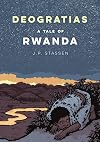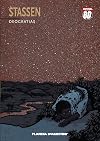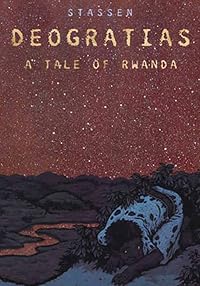
Deogratias, A Tale of Rwanda
by J. P. Stassen
On This Page
Description
The 2000 winner of the Goscinny Prize for outstanding graphic novel script, this is the harrowing tale of the Tutsi genocide in Rwanda, as seen through the eyes of a boy named Deogratias. He is an ordinary teenager, in love with a girl named Be;nigne, but Deogratias is a Hutu and Be;nigne is a Tutsi who dies in the genocide, and Deogratias himself plays a part in her death. As the story circles around but never depicts the terror and brutality of an entire country descending into violence, show more we watch Deogratias in his pursuit of Be;nigne, and we see his grief and descent into madness following her death, as he comes to believe he is a dog. Told with great artistry and intelligence, this book offers a window into a dark chapter of recent human history and exposes the West's role in the tragedy. Stassen's interweaving of the aftermath of the genocide and the events leading up to it heightens the impact of the horror, giving powerful expression to the unspeakable, indescribable experience of ordinary Hutus caught up in the violence. Difficult, beautiful, honest, and heartbreaking, this is a major work by a masterful artist. show lessTags
Recommendations



Member Reviews
Deogratias is a heart-wrenching graphic novel about the genocide in Rwanda that requires both a developed ability for comprehension and advanced emotional maturity, but tells its story with rare honesty and poignancy. The story follows an unsettled young man, Deogratias, and begins after the genocide is over. Through a series of flashbacks, the reader learns that Deogratias, a Hutu, is guilty of reluctantly participating in the slaughter of Tutsis, including several of his own friends. Deogratias has lost his mind as a result and believes that he turns into a dog, like the ones he saw eating his friends’ bodies, at night. The illustration is done in dark lines and simple, bold colors. The characters are expressive, even grotesque at show more times, reflecting their personalities. The dialogue is often stiff, which is likely a result of its translation. Both the language and images are graphically violent, but such violence is well-suited to the story. Because the flashbacks are signalled by subtle changes in colors and characters’ appearance, the story’s progression can be confusing. An introduction by the translator is helpful for readers who are not familiar with the events portrayed. Though it is often jarring and is not appropriate for younger readers, Deogratias tells an important story and will strongly impact those who read it. Recommended. Grade 11+ show less
A graphic novel covering the civil war in Rwanda. The action moves between the titular character's pre war and post war experiences, from school boy to young man made insane by what happened.
The book starts with Deogratias, a young Hutu, a broken man who is reminded of his past through a meeting with people he knew from before. This provokes a series of flashbacks, showing how Deogratias and his friends were affected by the civil war. Deogratias, a Hutu, was in love with two girls, both Tutsis, who must hide as the call comes over the radio to rid Rwanda from "cockroaches". The outside world is also involved, in the form of foreign priests and the Frenchman, none of which have a positive influence.
It's a short book, less than 100 show more pages, but, actually, the author packs in a great story, as well as showing us the personal cost of the genocide. I've read a few books and seen films about Rwanda, but what sets this apart is the fact that it is a graphic novel. This format actually allows the author to be more brutal, but leaves more room for the reader to reflect on what is happening. Recommended. show less
The book starts with Deogratias, a young Hutu, a broken man who is reminded of his past through a meeting with people he knew from before. This provokes a series of flashbacks, showing how Deogratias and his friends were affected by the civil war. Deogratias, a Hutu, was in love with two girls, both Tutsis, who must hide as the call comes over the radio to rid Rwanda from "cockroaches". The outside world is also involved, in the form of foreign priests and the Frenchman, none of which have a positive influence.
It's a short book, less than 100 show more pages, but, actually, the author packs in a great story, as well as showing us the personal cost of the genocide. I've read a few books and seen films about Rwanda, but what sets this apart is the fact that it is a graphic novel. This format actually allows the author to be more brutal, but leaves more room for the reader to reflect on what is happening. Recommended. show less
Deogratias, the protagonist of this graphic novel, is a young boy, living in a country torn by ethnic strife as the Hutu prepare and eventually attempt to eliminate the Tutsi. The story swings back and forth between the time before and after the genocide, and readers watch as a young boy concerned only about girls transforms into a young man tortured by his memories.
Hearing the word Rwanda evokes one of the most horrible feelings in me. The feeling of horror that permeates my soul when I hear Rwanda is entirely due to the film Hotel Rwanda, starring Don Cheadle, which brought the tragedy to life for me. Saying it like that, it seems trite, but it's honest. The film introduced me to the events that occurred and sparked in me my natural show more desire to research. I read the news articles, tracked down YouTube videos of broadcasts, and was heartwrenched to find the appalling lack of coverage by American news people. The blindness of the world during this atrocity fills me with shame for humanity and the willful resistance to helping makes me illogically angry.
All of this is just to say that going in to the graphic novel, I already had images, preconceived notions and biases, swimming in my head. This may be what caused the graphic novel to be rather underwhelming for me. I was struck, emotionally, by the plight of Deogratias as he suffers mentally in the brutal aftermath of the genocide. His madness sinks my soul in anguish.
And yet, overall, I was a bit disappointed. The juxtaposition of past and present seemed less than ideal, and the lack of depth to the plot and the characters left me feeling as if I had just scratched the surface of the story. Honestly, I enjoyed the text-based introduction to the graphic novel more as it informatively and evocatively covered the historical situation.
I realize that I am very much in the minority here. Most seem to adore this graphic novel; inasmuch as one can adore something exceedingly dark, full of despair, and painful to the heart. I don't know why I didn't feel this level of emotion while reading; perhaps it was the quickness of the read, the lateness of the hour, or the heart-wrenching images already present in my brain from other tellings of the genocide. I do not know. show less
Hearing the word Rwanda evokes one of the most horrible feelings in me. The feeling of horror that permeates my soul when I hear Rwanda is entirely due to the film Hotel Rwanda, starring Don Cheadle, which brought the tragedy to life for me. Saying it like that, it seems trite, but it's honest. The film introduced me to the events that occurred and sparked in me my natural show more desire to research. I read the news articles, tracked down YouTube videos of broadcasts, and was heartwrenched to find the appalling lack of coverage by American news people. The blindness of the world during this atrocity fills me with shame for humanity and the willful resistance to helping makes me illogically angry.
All of this is just to say that going in to the graphic novel, I already had images, preconceived notions and biases, swimming in my head. This may be what caused the graphic novel to be rather underwhelming for me. I was struck, emotionally, by the plight of Deogratias as he suffers mentally in the brutal aftermath of the genocide. His madness sinks my soul in anguish.
And yet, overall, I was a bit disappointed. The juxtaposition of past and present seemed less than ideal, and the lack of depth to the plot and the characters left me feeling as if I had just scratched the surface of the story. Honestly, I enjoyed the text-based introduction to the graphic novel more as it informatively and evocatively covered the historical situation.
I realize that I am very much in the minority here. Most seem to adore this graphic novel; inasmuch as one can adore something exceedingly dark, full of despair, and painful to the heart. I don't know why I didn't feel this level of emotion while reading; perhaps it was the quickness of the read, the lateness of the hour, or the heart-wrenching images already present in my brain from other tellings of the genocide. I do not know. show less
The history of Rwanda is mind numbingly sad, with torture and genocide back and forth between Hutu and Tutsi peoples. Stassen has written a complex, stylistic, and chilling story of the degradation that characterizes the struggles in Rwanda. Deogratias is a Hutu boy in love with Benina, a Tutsi girl. The story travels back and forth in time (pay attention page layout and design!). On page 27 Deogratias begins transforming into something less than human. The artwork hints at the dog he becomes. When Deogratias travels to meet Benina, she decides to become intimate with him. However, sex and male/female relationships in Rwanda between Hutu and Tutsis are not generally associated with love and romance. Deogratias relies on the beer-like show more Urwaga to help him through this night. His artwork profile changes; Deogratias is now more animal than human. This book would not be nearly as powerful if it were text only. Perhaps this will be the first graphic novel to win Printz recognition? The Printz does not concern itself at all with popularity; Deogratias will NOT be popular. It is a chilling, difficult book to experience. The natural world is turned upside down in this book, the subject matter brutal. Our inclination is to avoid seeing. Deogratias is worth a look, especially for readers who wonder about the literary value of graphic novels. Recommended for high school libraries. show less
The full-color realistic illustrations contrast against Deogratias' flashbacks as a happy boy with his friends Benina and Apollinaria who are Tutsis, and his present internal conflict with the atrocities he has committed against the Tutsi race are dramatic and will resonate with many readers. Stassen’s illustrations are brutally honest and depict the horrific atrocities of genocide. The complex subject matter and intense images makes this story suitable for older teens and adults (recommended for 10th grade and up).
Disturbing and graphic, but so important.
My library places this with adult nonfiction, perhaps with good reason....a depiction of the horror of the conflict that is disturbing in any format. Incredible graphics.
Members
- Recently Added By
Lists

Florida's Book Bans and Challenges
311 works; 4 members

Virginia Banned Books 2023
68 works; 3 members
Author Information
10+ Works 415 Members
Some Editions
Awards and Honors
Awards
Distinctions
Series
Belongs to Publisher Series
Common Knowledge
- Important places
- Rwanda
- Important events
- Rwandan Genocide (1994)
Classifications
- Genres
- Graphic Novels & Comics, Teen
- DDC/MDS
- 741.5944 — Arts & recreation Drawing & decorative arts Drawing Comic books, graphic novels, fotonovelas, cartoons, caricatures, comic strips History, geographic treatment, biography European France & Monaco
- LCC
- PN6790 .B43 .S73 — Language and Literature Literature (General) Literature (General) Collections of general literature Comic books, strips, etc.
- BISAC
Statistics
- Members
- 326
- Popularity
- 97,796
- Reviews
- 9
- Rating
- (3.74)
- Languages
- 6 — Dutch, English, French, Italian, Portuguese, Spanish
- Media
- Paper
- ISBNs
- 11
- ASINs
- 1