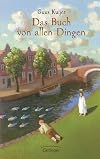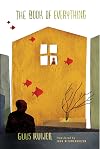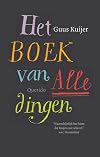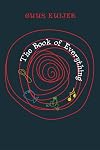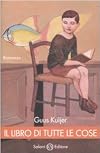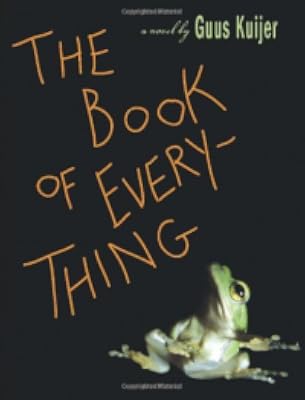
The Book of Everything
by Guus Kuijer
On This Page
Description
Nine-year-old Thomas receives encouragement from many sources, including candid talks with Jesus, to help him tolerate the strict family life dictated by his deeply-religious father.Tags
Recommendations


















Member Recommendations

Member Reviews
http://nwhyte.livejournal.com/1869271.html
It's quite a fascinating package, and very short at only 100 pages; Kuijer gives a very strong sense of a repressed Dutch society of the early 1950s, still coming to terms with the recent war and occupation (Thomas, the central character, is 9 so would have been born in 1942), combined with some startling magical realism as Thomas and the slightly sorcerous neighbour call down the plagues of Egypt on his wife-beating father. The line that sticks with me is from quite near the beginning (repeated again at the end) when Thomas first talks with the witch next door:
“Wat wil je later worden eigenlijk?” vroeg ze.
“Gelukkig”, zei Thomas. “Ik word later gelukkig.”
(“What do you want to be show more when you are older?” she asked.
“Happy”, said Thomas. “I want to be happy.”)
Anyway, definitely impressive enough for me to look out for more of Kuijer's work. show less
It's quite a fascinating package, and very short at only 100 pages; Kuijer gives a very strong sense of a repressed Dutch society of the early 1950s, still coming to terms with the recent war and occupation (Thomas, the central character, is 9 so would have been born in 1942), combined with some startling magical realism as Thomas and the slightly sorcerous neighbour call down the plagues of Egypt on his wife-beating father. The line that sticks with me is from quite near the beginning (repeated again at the end) when Thomas first talks with the witch next door:
“Wat wil je later worden eigenlijk?” vroeg ze.
“Gelukkig”, zei Thomas. “Ik word later gelukkig.”
(“What do you want to be show more when you are older?” she asked.
“Happy”, said Thomas. “I want to be happy.”)
Anyway, definitely impressive enough for me to look out for more of Kuijer's work. show less
This short book is a brutally honest work of young adult literature set in Amsterdam a few years after the liberation and end of World War II. Thomas only wishes to be happy but has to deal with his fundamentalist and abusive father. The book is colored by magical realism and a touch of surrealism as Thomas is aided by witches, calls down the plagues of Egypt, and converses with a lonely Jesus. A powerful and touching book that touches on a lot of issues: childhood, family, religion, community, and kindness.
From http://shawjonathan.wordpress.com/2009/10/31/childrens-literature-is-not-a-genre...
A lonely boy, helped by apparitions of Jesus and by an old woman who is almost certainly a witch, finds a way to free himself and his family from the dominion of his harsh, violent, religiously extreme father. The book speaks in particular to literate children. The hero,Thomas, finds inspiration in [Emil and the Detectives], Joanna Spyri's [All Alone in the World] and the Book of Genesis, and the narrative assumes familiarity with literary conventions about witches. I found my adult-reader self wanting explanations of Thomas's visions: 'Is the poor child hallucinating from terror, or is this a world where such things really happen?' Such questions show more are just plain irrelevant to the book's imagined reader, and once I moved over to occupy that position the book opened up to me – or I opened up to it.
It occurred to me that just as Pixar animations, among other children's movies, tend to wink knowingly over the heads of the children in their audience, this book is winking at the children – 'Don't tell the adults.' show less
A lonely boy, helped by apparitions of Jesus and by an old woman who is almost certainly a witch, finds a way to free himself and his family from the dominion of his harsh, violent, religiously extreme father. The book speaks in particular to literate children. The hero,Thomas, finds inspiration in [Emil and the Detectives], Joanna Spyri's [All Alone in the World] and the Book of Genesis, and the narrative assumes familiarity with literary conventions about witches. I found my adult-reader self wanting explanations of Thomas's visions: 'Is the poor child hallucinating from terror, or is this a world where such things really happen?' Such questions show more are just plain irrelevant to the book's imagined reader, and once I moved over to occupy that position the book opened up to me – or I opened up to it.
It occurred to me that just as Pixar animations, among other children's movies, tend to wink knowingly over the heads of the children in their audience, this book is winking at the children – 'Don't tell the adults.' show less
This is a gorgeous book, but I can't imagine who the kid audience would be. It's like A Monster Calls, if A Monster Calls were written from the perspective of an adult looking back on his childhood, without that authentic kid voice. I think it is a book for adults to read, particularly those who might still be processing childhood abuse.
De vader van de 9-jarige Thomas is erg gelovig. Uit naam van God straft hij zijn vrouw en zoon. Hij slaat hen. Thomas heeft zijn eigen manier van geloven en houdt hele gesprekken met Jezus. Thomas weet later wat hij wil worden. "Gelukkig". Maar hoe doe je dat? Zijn buurvrouw, waar alle kinderen bang voor zijn, omdat ze eruit ziet als een heks, helpt hem zijn angst te overwinnen, want daar begint het mee. Ook zorgt ze ervoor dat hij en zijn familie hulp krijgt. Een heel mooi boek over hoe de angst voor een orthodox geloof dat de bijbel letterlijk neemt, te overwinnen.
Storie di quotidiana sopraffazione - e di diseguale rivincita - dalla civilissima Olanda. Un libro utile ad adulti malati di fanatismo esistenziale che credo difficilmente potrà venire apprezzato da un adolescente.
Certi libri mi sembrano scritti a nuora perché suocera intenda, e quindi scritto per ragazzi ma in realta' indirizzato ai piu' grandi; non mi ha fatto tuttavia particolare impressione e non grido al capolavoro.. I fumetti di Eisner o i libri di Gaiman vanno molto più in la' - e, forse più sottilmente, ma lo fa anche Mc Schulz.
Bel racconto, una bella oretta di pensieri intelligenti - pero' la ragazza con la mano monca mi e' sembrata un poco sopra le righe. Poteva bastare la gamba di legno.
Certi libri mi sembrano scritti a nuora perché suocera intenda, e quindi scritto per ragazzi ma in realta' indirizzato ai piu' grandi; non mi ha fatto tuttavia particolare impressione e non grido al capolavoro.. I fumetti di Eisner o i libri di Gaiman vanno molto più in la' - e, forse più sottilmente, ma lo fa anche Mc Schulz.
Bel racconto, una bella oretta di pensieri intelligenti - pero' la ragazza con la mano monca mi e' sembrata un poco sopra le righe. Poteva bastare la gamba di legno.
I laughed out loud many times while reading this book. It’s a story of a boy whose faith saves him. It’s a glimpse into abuse. It’s funny and hopeful. Its magical. It’s aptly titled. Family read.
Members
- Recently Added By
Lists

Books Read in 2018
4,360 works; 110 members
Author Information

72+ Works 1,550 Members
Some Editions
Awards and Honors
Common Knowledge
- Canonical title
- The Book of Everything
- Original title
- Het boek van alle dingen
- Original publication date
- 2004
- First words*
- Thomas zag dingen die niemand anders zag.
- Last words*
- (Click to show. Warning: May contain spoilers.)Je kunt niet alles hebben.
- Original language
- Dutch
- Disambiguation notice
- This should not be confused with the stage play The Book of Everything by Richard Tulloch, which is an adaptation of this novel and as such is a separate work.
*Some information comes from Common Knowledge in other languages. Click "Edit" for more information.
Classifications
- Genres
- Fiction and Literature, Children's Books, Young Adult
- DDC/MDS
- 839.31364 — Literature & rhetoric German & related literatures Other Germanic literatures Netherlandish literatures Dutch Dutch fiction 20th Century 1945-1999
- LCC
- PZ7 .K9490143 .B — Language and Literature Fiction and juvenile belles lettres Fiction and juvenile belles lettres Juvenile belles lettres
- BISAC
Statistics
- Members
- 295
- Popularity
- 109,563
- Reviews
- 14
- Rating
- (3.90)
- Languages
- 10 — Czech, Dutch, English, French, German, Hungarian, Italian, Portuguese, Spanish, Swedish
- Media
- Paper, Ebook
- ISBNs
- 27
- ASINs
- 2