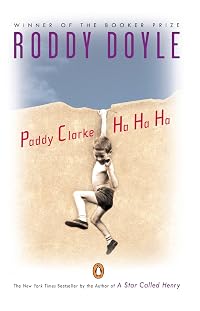
Paddy Clarke Ha Ha Ha
by Roddy Doyle
On This Page
Description
Life as seen through the eyes of a ten-year-old Irish boy, Patrick Clarke, is a poignant voyage through a bewildering, ever-changing world of family, friends, dreams, and growing up.Tags
Recommendations





Member Recommendations
Member Reviews
Paddy Clarke Ha Ha Ha achieves the remarkable feat of both depicting a childhood at its most normal and humdrum while also drawing out something much more profound about being a kid and coming of age. While Paddy and his friends are lighting fires, stealing magazines, and torturing his younger brother in the most typical of lowgrade miscreant ways, Doyle does a remarkable job of capturing the casual cruelty of childhood, the bullying, the posturing. At times the book is so good at portraying these things that it's almost hard to read, despite its impressive quality.
Doyle nails the random transitions of his child narrator's mind, the relationships that skirt the emotional depth that an adult can see but a child cannot, and the show more affliction of younger siblings that sits side by side with love. Most impressive of all, however, is Doyle's depiction of Paddy's confusion when adult situations have outpaced his understanding of them, but only by the slimmest of margins, so that while he knows something is amiss he can't grab ahold of what, if anything, he can do to fix it. Paddy Clarke Ha Ha Ha is one of those books that, for lack of any sort of linear plot, would seem to be about nothing, but in taking a snapshot of a life, it ends up being about a little of everything. show less
Doyle nails the random transitions of his child narrator's mind, the relationships that skirt the emotional depth that an adult can see but a child cannot, and the show more affliction of younger siblings that sits side by side with love. Most impressive of all, however, is Doyle's depiction of Paddy's confusion when adult situations have outpaced his understanding of them, but only by the slimmest of margins, so that while he knows something is amiss he can't grab ahold of what, if anything, he can do to fix it. Paddy Clarke Ha Ha Ha is one of those books that, for lack of any sort of linear plot, would seem to be about nothing, but in taking a snapshot of a life, it ends up being about a little of everything. show less
“We parked our bikes on verges so they could graze.”
SET in 1968 in the fictional Dublin suburb of Barrytown Paddy Clarke Ha Ha Ha is a boy's own account of when he was 10. The tale is told not with the benefit of hindsight but in the present tense.
The novel has no chapter divisions and Paddy Clarke has an infantile style matching his age. The story is told in fragments that appear to have no particular sequence but on closer inspection there is a definite thread as Paddy slowly matures as events in particular at home unfold.
Many of Paddy's sentences are amusing and many of his dealings with his friends seem to involve daily acts of minor violence - dead legs, 'prunings'- as Paddy struggles to sustain his friendships yet he appears show more blind to adult violence. Yet they also play games which seem to stretch their verbal
curiosity. In one, the boys each have to become a swear-word for the week. Paddy comes out with the word Fuck and becomes a kind of hero with his gang.
Fuck also represents a growth of a sort, but also marks a change in Paddy as he becomes sensitive to the discord within his parents marriage but his immaturity means that he is unable to fathom its cause. When his 'da' eventually leaves home, Paddy can find no reason for it 'why he hated Ma', since 'She was lovely looking, though it was hard to tell for sure'.
There is a also a separation between Paddy from his friends and in particular his former best friend and neighbour Kevin when Paddy becomes drawn to new boy and surly loner Charles Leavey. This culminates in a pretty vicious fight with Kevin which earns Paddy a general boycott: 'I had Kevin's blood on my trousers. I was on my own.' This then leads to the reason for the novels title as his former friends chant 'Paddy Clarke - / Paddy Clarke - / Has no da / Ha ha ha.'
This is the first novel by the author that I've read and overall I enjoyed it, in particular how he never strayed from the child's voice despite the serious events that are unfolding. However, I find it hard to imagine that when this book won the Booker Prize in 1993 that it was really the best book written in English that year or perhaps I've just had an overdose of harsh growing up in Ireland. Worth a read all the same. show less
SET in 1968 in the fictional Dublin suburb of Barrytown Paddy Clarke Ha Ha Ha is a boy's own account of when he was 10. The tale is told not with the benefit of hindsight but in the present tense.
The novel has no chapter divisions and Paddy Clarke has an infantile style matching his age. The story is told in fragments that appear to have no particular sequence but on closer inspection there is a definite thread as Paddy slowly matures as events in particular at home unfold.
Many of Paddy's sentences are amusing and many of his dealings with his friends seem to involve daily acts of minor violence - dead legs, 'prunings'- as Paddy struggles to sustain his friendships yet he appears show more blind to adult violence. Yet they also play games which seem to stretch their verbal
curiosity. In one, the boys each have to become a swear-word for the week. Paddy comes out with the word Fuck and becomes a kind of hero with his gang.
Fuck also represents a growth of a sort, but also marks a change in Paddy as he becomes sensitive to the discord within his parents marriage but his immaturity means that he is unable to fathom its cause. When his 'da' eventually leaves home, Paddy can find no reason for it 'why he hated Ma', since 'She was lovely looking, though it was hard to tell for sure'.
There is a also a separation between Paddy from his friends and in particular his former best friend and neighbour Kevin when Paddy becomes drawn to new boy and surly loner Charles Leavey. This culminates in a pretty vicious fight with Kevin which earns Paddy a general boycott: 'I had Kevin's blood on my trousers. I was on my own.' This then leads to the reason for the novels title as his former friends chant 'Paddy Clarke - / Paddy Clarke - / Has no da / Ha ha ha.'
This is the first novel by the author that I've read and overall I enjoyed it, in particular how he never strayed from the child's voice despite the serious events that are unfolding. However, I find it hard to imagine that when this book won the Booker Prize in 1993 that it was really the best book written in English that year or perhaps I've just had an overdose of harsh growing up in Ireland. Worth a read all the same. show less
Amikor az utolsó trópusi szigetet is belakták a turisták, amikor a sarkvidék utolsó szegletét is feltérképezték, az ember rájött, hogy nincs több felfedezni való. Dehogy nincs, felelték az írók, és arccal egy újabb ismeretlen kontinens felé fordultak: a saját gyermekkoruk felé. Nekiindultak szélcibálta vitorlával, hogy a hiányos emlékezet zátonyai és a fabulálás szirénénekén átvergődve eljussanak a múlt homokos partjaira. Akadtak köztük, akik azt hitték, János pap országába tartanak, a helyre, ahol tejjel s mézzel folyik a Kánaán, azt hitték (vagy csak azt akarták hinni és hitetni), hogy a gyermekkor az Ártatlanság Birodalma, a Paradicsom, ahol a tigris az őzhöz simulva dorombol. show more Pedig nem. A gyermek csak annyiban ártatlan, hogy nem tanulta még meg definiálni a rossz és a jó közötti különbséget. Kegyetlen tud lenni, ösztönösen kitapogatja a másik legérzékenyebb pontjait, és oda döf - néha csak azért, hogy jelezze, döfni is tud. De legalább tanul. Változik. Ez a mentsége: hogy levetkőzheti a kegyetlenségét.
Doyle töredezett prozódiája pazarul adja vissza a gyermekkor elemi bizonytalanságát, azt az érzést, hogy érthetetlen erők hajigálnak minket jobbra-balra, mi meg félünk, és mivel félünk, odacsapunk. Keresünk valakit, aki nálunk gyengébb - annak. Aztán van, hogy mi vagyunk a gyengék (hisz gyerekek vagyunk), akkor nekünk csapnak oda. Mást se szeretnénk, csak felnőni, mert a felnőttek nagyok és erősek, ők a pillanat urai.
Ne mondjuk meg a gyerekeknek, hogy ez nincs így. Egy világ dőlne össze bennük.
Ha ha ha. show less
Doyle töredezett prozódiája pazarul adja vissza a gyermekkor elemi bizonytalanságát, azt az érzést, hogy érthetetlen erők hajigálnak minket jobbra-balra, mi meg félünk, és mivel félünk, odacsapunk. Keresünk valakit, aki nálunk gyengébb - annak. Aztán van, hogy mi vagyunk a gyengék (hisz gyerekek vagyunk), akkor nekünk csapnak oda. Mást se szeretnénk, csak felnőni, mert a felnőttek nagyok és erősek, ők a pillanat urai.
Ne mondjuk meg a gyerekeknek, hogy ez nincs így. Egy világ dőlne össze bennük.
Ha ha ha. show less
Capisco quali sono tutti i motivi per cui questo romanzo è così apprezzato, però… a me non è piaciuto tanto! Innanzi tutto, non è affatto così divertente come prometteva di essere. Poi, Paddy mi suscitava a tratti molta tenerezza, ma per la maggior parte del tempo l’ho trovato odioso! Un teppistello della peggior specie: vigliacco con quelli più forti di lui, prepotente con i più deboli. Lo so, lo so che il libro non era solo questo, come ho detto all’inizio, capisco che ci sia molto di più, però proprio non è riuscito a conquistarmi! Non è brutto, però, gli do comunque la sufficienza, 3 stelline.
http://www.naufragio.it/iltempodileggere/3746
http://www.naufragio.it/iltempodileggere/3746
It used to be said that children should be seen and not heard, and, as I've heard it, most pre-moderns assumed children were, after the age of seven or so, pretty much like adults, so it's good to remind ourselves that, in some ways, childhood was something that literature, and society as a whole, had to create and then discover. In "Paddy Clarke Ha Ha Ha" Roddy Doyle places everyday experiences of an ordinary Irish nine-year-old at the center of a novel, and, in doing so, gets an absolutely unforgettable character and a really good novel out of a rather unlikely source. Oh, and the Booker Prize, too, I suppose.
Doyle's always struck me as a very local writer -- he's not afraid to include the specifics of twentieth-century Irish life in show more his books and leave the reader to figure out the references, slang terms, and brand names -- but his take on childhood also seems wonderfully universal. Paddy's word is an energetic mixture of innocence and knowingness, bedrock certainty and amorphous fear, kindness and cruelty, feelings of helplessness and an urge for control. I'm sure that many readers will find themselves thinking, "I know this kid!" or even "I used to be this kid!" What I most enjoyed about "Paddy Clarke," though, was its willingness to present the adult world through a child's eyes. Paddy himself can observe that important changes are going on around him: his parents are fighting, the farms near his house are disappearing, and he and his brother are growing older. The terms he uses to describe these changes, and the details he notices about them, aren't the ones that the adults around him would notice, and in this way he's both more perceptive and less perceptive than they are. He provides startlingly clear descriptions of father's unhappiness, his mother's love, and his teacher's frustrations without being quite aware of the implications of what he's describing, or that he's describing anything noteworthy at all. "Paddy Clarke" is a wonderfully natural performance, and Doyle, to his credit, presents Paddy's viewpoint without providing an ironic counterpoint or contrasting it with a more authoritative adult account of these events. Paddy stands more or less on his own here, and this childhood-specific sense of loneliness and defenselessness suffuses the entire novel.
This also means that, good as "Paddy Clarke" is, it's often sad, slow going; I found it an emotionally difficult read. I like to keep a good deal of distance from the characters between myself and the characters in the novels I read, and I seldom finish a novel with a specific like or dislike for a character. But I've met few literary characters that I've wanted help more than I wanted to help Paddy: the combination of his vulnerability and honesty is often hard to bear. This, of course, shouldn't be taken as a criticism, since it only goes to show what a marvelous job Doyle did with this novel. Recommended, but be warned: childhood may hurt even more than you remember. show less
Doyle's always struck me as a very local writer -- he's not afraid to include the specifics of twentieth-century Irish life in show more his books and leave the reader to figure out the references, slang terms, and brand names -- but his take on childhood also seems wonderfully universal. Paddy's word is an energetic mixture of innocence and knowingness, bedrock certainty and amorphous fear, kindness and cruelty, feelings of helplessness and an urge for control. I'm sure that many readers will find themselves thinking, "I know this kid!" or even "I used to be this kid!" What I most enjoyed about "Paddy Clarke," though, was its willingness to present the adult world through a child's eyes. Paddy himself can observe that important changes are going on around him: his parents are fighting, the farms near his house are disappearing, and he and his brother are growing older. The terms he uses to describe these changes, and the details he notices about them, aren't the ones that the adults around him would notice, and in this way he's both more perceptive and less perceptive than they are. He provides startlingly clear descriptions of father's unhappiness, his mother's love, and his teacher's frustrations without being quite aware of the implications of what he's describing, or that he's describing anything noteworthy at all. "Paddy Clarke" is a wonderfully natural performance, and Doyle, to his credit, presents Paddy's viewpoint without providing an ironic counterpoint or contrasting it with a more authoritative adult account of these events. Paddy stands more or less on his own here, and this childhood-specific sense of loneliness and defenselessness suffuses the entire novel.
This also means that, good as "Paddy Clarke" is, it's often sad, slow going; I found it an emotionally difficult read. I like to keep a good deal of distance from the characters between myself and the characters in the novels I read, and I seldom finish a novel with a specific like or dislike for a character. But I've met few literary characters that I've wanted help more than I wanted to help Paddy: the combination of his vulnerability and honesty is often hard to bear. This, of course, shouldn't be taken as a criticism, since it only goes to show what a marvelous job Doyle did with this novel. Recommended, but be warned: childhood may hurt even more than you remember. show less
Épp tegnap próbáltam összefoglalni két szöveget, de úgy éreztem, mint mindig, amikor egy nagyon jó könyvet olvastam, hogy méltatlan, amit mondok. Hiszen nem csak az a lényeg, amit mond, hanem az is, ahogyan. Ahogyan ennek a tízéves fiúnak ugyanolyan természetes az, hogy bandáznak a többi gyerekkel, hogy étel van az asztalon (bár fagyira csak csalással futja), mint az erőszak. Egyszerű, hiteles gyerekhangon mesél arról, hogy felgyújtják az öccse száját – és minden hasonló alkalommal a nagytesóra néznek a többiek, rendben van-e a kisebb testvér kínzása –, hogy a szadista tanár üti és alázza őket (nincs is hangoskodás, meg sem pisszennek), hogy amikor az apja a derékszíjával veri, akkor show more neki tulajdonképpen nem futnia kéne előle, hanem belehátrálnia, akkor nem csípne akkorát. A csupán bekezdésekre tagolt szövegben ugrálunk a szituációk közt és kis mértékben az időben is, így az első mondatokban időnként nem lehet tudni, az aktuális he kire vonatkozik. Egyszerű mondatok, semmi fölösleges cizelláltság, egy gyerek szájába nem is illene. Csúfolódások, a tiltott szavak élvezete, brahiból lopás, kegyetlen játékok. Nagyon jól olvasható, őrületesen erős szöveg. Végigkövethetjük, ahogy próbálja megállítani szülei egyre gyakoribb veszekedéseit, ahogy igyekszik megérteni, mi a baj. Anyu szereti aput, de apu nem szereti anyut, ez világos. De vajon miért? Hiszen anyu szép, jó az illata, mindig van vacsora az asztalon, a házban rend és tisztaság, türelemmel és kedvességgel neveli a négy gyereket. De apu is rendes, szereti, hiszen ő az apukája. És kettőn áll a vásár. Tehát biztos van valami, ami nem stimmel anyuval. De vajon mi? Szívszorító a gyerekszemszög ebben a helyzetben. És érdekes, hogy bár az erőszak természetes, ha a felnőtt vagy a nagyobb gyerek követi el a kisebbel szemben, a házastársi erőszak egyértelműen töréspont, mindannyiuknál. A szóbeli is, hiszen kétségbeesetten próbálja megállítani, jelenlétével, tereléssel, virrasztással, üdvözlégyekkel, de a fizikai az, ahonnan nincs visszaút, apa egyszer csak kimegy az ajtón, és tudja, hogy nem fog visszajönni többé. Ahogy figyeli a jeleket (az első ajtón ment ki, azt sosem használjuk, csak ha vendég jön; keresztbe van téve a lába, de nem rázza, támadni fog – szóval). Ahogy edzi magát, hogy ne féljen a sötétben, ha majd megszökik. Ahogy fordul a testvérek közötti viszony. Ahogy szembeszáll a vezérrel a bandában, ahogy az iskolai kiközösítés nem érdekli az otthoni probléma mellett. Ahogy a szülei széthulló házassága áthelyezi a súlypontokat az életében, ahogy kezd felnőni. Ahogy mindezt elmondja. Ahogy az utolsó oldalon derül ki, mire utal a cím. Akkorákat üt, hogy az ember csak pislog, de olvas rendületlenül, hiszen nem is lehetne semmi másképp. show less
I am reading all the Booker prize winners and blogging about it at www.methodtohermadness.com
Paddy Clarke Ha Ha Ha by Roddy Doyle (1993) was one of the few Booker prize winners that I had heard of before this project, so when I told my neighborhood book club about the project, and they graciously offered to read a book with me, this is one that I suggested.
We begin the book in medias res: “We were coming down our road. Kevin stopped at a gate and bashed it with his stick.” Readers slowly glean that the narrator is a young boy, living somewhere in Ireland, who runs wild with a group of like-minded boys, shoplifting and playing variations on soccer, but always doing their homework. They also commit some atrocious acts of violence and show more cruelty, like making the narrator’s little brother take a capsule of lighter fuel in his mouth, and then lighting it. Fortunately, Paddy does become more aware and compassionate as the book progresses.
Because narrator Paddy is a child, we don’t really know where he lives, but we know all about the boys’ turf wars, which are exacerbated by the building of a whole new suburb around them. The boys play on construction sites as the formerly open spaces shrink. One of the most interesting aspects of the boys’ play for me was their nascent curiosity about language. They have two rituals involving language, one in which they chant new and unfamiliar words, like “trellis” and “substandard.” In the other, one boy hits the others on the back with a poker, and the curse word that the smitten boy blurts out becomes his name for the week.
But back at home, the unspoken conflict driving the book is the deteriorating relationship between Paddy’s parents. His father oscillates between normal dad and uncaring martinet, while mom tries to protect the four children. Paddy’s anxiety has become so fine-tuned to his parents’ moods that he thinks he can control them, by making a joke, or by staying awake all night. The discord at home leads Paddy to become dissatisfied with the balance of power in his play group. He discovers a desire to become closer to his brother – too late. Paddy then wants to run away, to be emotionally disconnected. But of course, the family structure is out of his control, and it changes before he can act.
One of the book club members said that this novel “threw her off balance,” and I agree. That’s the genius of this book: Doyle is the consummate master of the oft-cited advice “show, don’t tell.” It’s a tour de force, to write an entire novel in the pure voice of a child, without the adult voice and the “I later realized…” bleeding through. Doyle tells us nothing, but shows us everything, through the mixed-up thoughts of an anxious little boy. show less
Paddy Clarke Ha Ha Ha by Roddy Doyle (1993) was one of the few Booker prize winners that I had heard of before this project, so when I told my neighborhood book club about the project, and they graciously offered to read a book with me, this is one that I suggested.
We begin the book in medias res: “We were coming down our road. Kevin stopped at a gate and bashed it with his stick.” Readers slowly glean that the narrator is a young boy, living somewhere in Ireland, who runs wild with a group of like-minded boys, shoplifting and playing variations on soccer, but always doing their homework. They also commit some atrocious acts of violence and show more cruelty, like making the narrator’s little brother take a capsule of lighter fuel in his mouth, and then lighting it. Fortunately, Paddy does become more aware and compassionate as the book progresses.
Because narrator Paddy is a child, we don’t really know where he lives, but we know all about the boys’ turf wars, which are exacerbated by the building of a whole new suburb around them. The boys play on construction sites as the formerly open spaces shrink. One of the most interesting aspects of the boys’ play for me was their nascent curiosity about language. They have two rituals involving language, one in which they chant new and unfamiliar words, like “trellis” and “substandard.” In the other, one boy hits the others on the back with a poker, and the curse word that the smitten boy blurts out becomes his name for the week.
But back at home, the unspoken conflict driving the book is the deteriorating relationship between Paddy’s parents. His father oscillates between normal dad and uncaring martinet, while mom tries to protect the four children. Paddy’s anxiety has become so fine-tuned to his parents’ moods that he thinks he can control them, by making a joke, or by staying awake all night. The discord at home leads Paddy to become dissatisfied with the balance of power in his play group. He discovers a desire to become closer to his brother – too late. Paddy then wants to run away, to be emotionally disconnected. But of course, the family structure is out of his control, and it changes before he can act.
One of the book club members said that this novel “threw her off balance,” and I agree. That’s the genius of this book: Doyle is the consummate master of the oft-cited advice “show, don’t tell.” It’s a tour de force, to write an entire novel in the pure voice of a child, without the adult voice and the “I later realized…” bleeding through. Doyle tells us nothing, but shows us everything, through the mixed-up thoughts of an anxious little boy. show less
Members
- Recently Added By
Published Reviews
ThingScore 100
This must be one of the truest and funniest presentations of juvenile experience in any recent literature.
The novel's boldest feature is its infantile style of narrative.
Roddy Doyle's book has already dead-legged the assumption that grown-ups are more interesting. To borrow the formula: 'It was sad and brilliant; I liked it.'
The novel's boldest feature is its infantile style of narrative.
Roddy Doyle's book has already dead-legged the assumption that grown-ups are more interesting. To borrow the formula: 'It was sad and brilliant; I liked it.'
added by sneuper
Lists

Booker Prize
491 works; 62 members
Best Contemporary Literary Fiction (Around the Last 30 Years)
388 works; 124 members

20th Century Literature
1,161 works; 54 members

child hero ~ adult novel
60 works; 12 members

TED 2013 Summer Reading List
190 works; 13 members
Booker Prize Shortlist: Titles Read
103 works; 10 members

Tour of Ireland
40 works; 11 members

BBC Radio 4 Bookclub
340 works; 13 members
Man Booker Prize Longlist 1993
6 works; 2 members

Fiction about the Working Class
74 works; 10 members

Books About Boys
175 works; 15 members

Books Read in 2021
5,361 works; 114 members

Fiction with Men's Given Names in the Title
302 works; 11 members

Fiction (Non-Fantasy) by Irish Authors Set in Ireland
87 works; 3 members
Author Information

73+ Works 21,393 Members
Roddy Doyle is the author of five previous novels, including a Booker Prize nominee, The Van, and a Booker Prize winning international bestseller Paddy Clarke Ha Ha Ha. He has also written several screenplays, most recently When Brendan Met Trudy. His first children's book, The Giggler Treatment, will be published in September by Scholastic. He show more lives in Dublin. (Publisher Provided) Roddy Doyle was born in Dublin on May 8, 1958, and grew up in Kilbarrack, Ireland. Doyle graduated with a Bachelor of Arts degree from University College Dublin. He spent several years as an English and geography teacher before becoming a full-time writer in 1993. His personal notes and work books reside at the National Library of Ireland. Doyle's first three novels, The Commitments (1987), The Snapper (1990) and The Van (1991) comprise The Barrytown Trilogy, a trilogy centred around the Rabbitte family. All three novels were made into successful films. In 1993, Doyle published Paddy Clarke Ha Ha Ha, winner of the 1993 Man Booker Prize. Doyle is the author of ten novels for adults, seven books for children, seven plays and screenplays, and dozens of short stories. His work is set primarily in Ireland, especially working-class Dublin, and is notable for its heavy use of dialogue written in slang and Irish English dialect. (Bowker Author Biography) show less
Some Editions
Awards and Honors
Awards
Distinctions
Notable Lists
Series
Belongs to Publisher Series
Work Relationships
Is contained in
Has as a student's study guide
Common Knowledge
- Canonical title*
- Paddy Clarke Ha Ha Ha
- Original title
- Paddy Clarke Ha Ha Ha
- Original publication date
- 1993
- People/Characters
- Patrick Clarke; Francis "Sinbad" Clarke
- Important places
- Ireland; Barrytown, Dublin, Ireland; Dublin, Ireland
- Dedication
- This book is dedicated to Rory
- First words
- We were coming down our road. Kevin stopped at a gate and bashed it with a stick. It was Missis Quigley's gate; she was always looking out the window but she never did anything.
- Last words
- (Click to show. Warning: May contain spoilers.)His hand felt cold and big, dry and hard.
Very well, thank you. - Blurbers
- See, Carolyn
*Some information comes from Common Knowledge in other languages. Click "Edit" for more information.
Classifications
Statistics
- Members
- 4,321
- Popularity
- 3,482
- Reviews
- 84
- Rating
- (3.66)
- Languages
- 19 — Chinese, Danish, Dutch, English, Estonian, Finnish, French, German, Greek, Hungarian, Icelandic, Italian, Latvian, Norwegian (Bokmål), Norwegian, Polish, Portuguese, Spanish, Swedish
- Media
- Paper, Audiobook, Ebook
- ISBNs
- 81
- UPCs
- 1
- ASINs
- 25