On This Page
Tags
Recommendations












Member Reviews
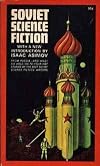
I picked this up at a used bookstore based on the cover alone, and for the chance of a glimpse into the Soviet mindset. From a literary perspective, there's not much to recommend these stories. They're fairly standard Golden Age scifi, with all the clumsiness that that entails, plus the added awkwardness of being a work in translation. Sadly, of the six stories only two are of any interest; a pair of linked stories theorizing that the Tunguska explosion was a spacecraft from Mars. The theory that the Martians must be advanced Socialists come to peacefully trade for Greenland's icecap is a rather nice antidote to the standard alien invasion story, but aside from the names, there's little that's particularly "Soviet" about these stories. show more The only recognizable name in collection are the Strugatsky brothers, and they're wasted with a bog standard 'robot gains self-awareness/goes berserk' golem fable.
On the other hand, as a historical artifact this collection is quite neat. Released in 1962, at the height of the Cold War, and with a decent introduction by Isaac Asimov, it serves a reminder of an attempt to build international bridges at a time of immense paranoia. show less
On the other hand, as a historical artifact this collection is quite neat. Released in 1962, at the height of the Cold War, and with a decent introduction by Isaac Asimov, it serves a reminder of an attempt to build international bridges at a time of immense paranoia. show less
Published in 1962, this collection is surprisingly light on blatant political commentary. Only one story mentions the present Soviet system, and then as a model system. Overall, the stories were OK. All had a strong emphasis on describing the science behind whatever endeavor the story was about. "Hoity-Toity" was the least interesting story, in my opinion. It tells of a man, whose brain is transposed into an elephant's and his experience of being an elephant, both in Africa and then in a circus after he was captured.
The Strugatsky brothers' story "Spontaneous Reflex" is about a robot who is designed to learn and adapt. When it does, it goes amok. The next two stories are really one story by Kazantsev. A group of scientists from various show more fields go on a mission. During the long voyage, one scientist tells his theory about what had really happened in Siberia in 1908, which he believes was not a meteor hitting the earth, but a Martian vessel landing. In the second story, a different scientist tells the group of a man he met, whom he believes to be a survivor of that same Martian vessel "Infra Draconis" by Gurevich is about the crew of a 30 year voyage to deep space, and the last story, "Professor Bern's Awakening" by Savchenko, is a scientific Rip Van Winkle story. show less
The Strugatsky brothers' story "Spontaneous Reflex" is about a robot who is designed to learn and adapt. When it does, it goes amok. The next two stories are really one story by Kazantsev. A group of scientists from various show more fields go on a mission. During the long voyage, one scientist tells his theory about what had really happened in Siberia in 1908, which he believes was not a meteor hitting the earth, but a Martian vessel landing. In the second story, a different scientist tells the group of a man he met, whom he believes to be a survivor of that same Martian vessel "Infra Draconis" by Gurevich is about the crew of a 30 year voyage to deep space, and the last story, "Professor Bern's Awakening" by Savchenko, is a scientific Rip Van Winkle story. show less
Ratings
Members
- Recently Added By
Lists

Best Science Fiction Originally Published in a Language Other Than English
449 works; 34 members

Speculative Fiction from around the World
610 works; 17 members
Author Information

Isaac Asimov was born in Petrovichi, Russia, on January 2, 1920. His family emigrated to the United States in 1923 and settled in Brooklyn, New York, where they owned and operated a candy store. Asimov became a naturalized U.S. citizen at the age of eight. As a youngster he discovered his talent for writing, producing his first original fiction at show more the age of eleven. He went on to become one of the world's most prolific writers, publishing nearly 500 books in his lifetime. Asimov was not only a writer; he also was a biochemist and an educator. He studied chemistry at Columbia University, earning a B.S., M.A. and Ph.D. In 1951, Asimov accepted a position as an instructor of biochemistry at Boston University's School of Medicine even though he had no practical experience in the field. His exceptional intelligence enabled him to master new systems rapidly, and he soon became a successful and distinguished professor at Columbia and even co-authored a biochemistry textbook within a few years. Asimov won numerous awards and honors for his books and stories, and he is considered to be a leading writer of the Golden Age of science fiction. While he did not invent science fiction, he helped to legitimize it by adding the narrative structure that had been missing from the traditional science fiction books of the period. He also introduced several innovative concepts, including the thematic concern for technological progress and its impact on humanity. Asimov is probably best known for his Foundation series, which includes Foundation, Foundation and Empire, and Second Foundation. In 1966, this trilogy won the Hugo award for best all-time science fiction series. In 1983, Asimov wrote an additional Foundation novel, Foundation's Edge, which won the Hugo for best novel of that year. Asimov also wrote a series of robot books that included I, Robot, and eventually he tied the two series together. He won three additional Hugos, including one awarded posthumously for the best non-fiction book of 1995, I. Asimov. "Nightfall" was chosen the best science fiction story of all time by the Science Fiction Writers of America. In 1979, Asimov wrote his autobiography, In Memory Yet Green. He continued writing until just a few years before his death from heart and kidney failure on April 6, 1992. (Bowker Author Biography) show less
All Editions
Some Editions
Series

Common Knowledge
- Canonical title
- Soviet Science Fiction
- Original language
- Russian
- Disambiguation notice
- This reprint of the original anthology, Visitor from Outer Space, contains an introduction by Isaac Asimov. This work also does not contain the footnotes of the original work. For now (March 1, 2016) they are separate ... (show all)for these reasons.
Classifications
- Genres
- Science Fiction, Fiction and Literature
- DDC/MDS
- 891.73087 — Literature & rhetoric Asian Literature East Indo-European and Celtic literatures Russian and East Slavic languages Russian fiction Fantacy
- LCC
- PZ1 .D6595 .S — Language and Literature Fiction and juvenile belles lettres Fiction and juvenile belles lettres Fiction in English
Statistics
- Members
- 156
- Popularity
- 209,259
- Reviews
- 2
- Rating
- (3.23)
- Languages
- English
- Media
- Paper
- ISBNs
- 1
- ASINs
- 6