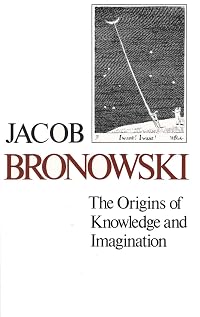
The Origins of Knowledge and Imagination
by Jacob Bronowski
On This Page
Description
"A gem of enlightenment. . . . One rejoices in Bronowski's dedication to the identity of acts of creativity and of imagination, whether in Blake or Yeats or Einstein or Heisenberg."--"Kirkus Reviews" "According to Bronowski, our account of the world is dictated by our biology: how we perceive, imagine, symbolize, etc. He proposes to explain how we receive and translate our experience of the world so that we achieve knowledge. He examines the mechanisms of our perception; the origin and show more nature of natural language; formal systems and scientific discourse; and how science, as a systematic attempt to establish closed systems one after another, progresses by exploring its own errors and new but unforeseen connections. . . . A delightful look at the inquiring mind."--"Library Journal" "Eminently enjoyable to read, with a good story or 'bon mot' on every page."--"Nature" "A well-written and brilliantly presented defense of the scientific enterprise which could be especially valuable to scientists and to teachers of science at all levels."--"AAAS Science Books & Films" Contents 1. The Mind as an Instrument for Understanding 2. The Evolution and Power of Symbolic Language 3. Knowledge as Algorithm and as Metaphor 4. The Laws of Nature and the Nature of Laws 5. Error, Progress, and the Concept of Time 6. Law and Individual Responsibility show lessTags
Recommendations














Member Recommendations
Member Reviews
The best kind of book on science, full of wit and erudition, asking questions instead of making declarations. Bronowski celebrates and encourages keen wonder and the human drive to understand, while reminding us that science, which rests on its own kinds of faith, incompleteness and paradox, is only one version of knowledge and understanding.
Shiner Bock
Otter Creek Citra Mantra Pils
Shiner Bock
Otter Creek Citra Mantra Pils
It isn't clear how Jacob Bronowski came to be delivering the Silliman lectures for 1967 at Yale University, but in doing so he delivered a marvellous and, apparently, criminally overlooked book which many of today's leading popular science writers might do well to read. Bronowski was by training an academic algebraic geometrist (I'm not sure that there is any other kind), but by inclination a polymath, working in a remarkably eclectic range of fields from operations research to biology to anthropology to poetry, and as he did so taking time to publish an acclaimed biography of William Blake and write and produce a well-received BBC anthropology series, The Ascent of Man.
The Silliman foundation at Yale is dedicated to "illustrating the show more presence and providence of God, as demonstrated in the natural and moral world", so it made an odd choice in selecting Bronowski, a non-religious scientist, to present its 1967 lectures, but the choice was an inspired one, for instead of banging on sanctimoniously about how only science and mathematics can bring us to a true understanding of the universe, Bronowski the polymath instead put these endeavours in their human, social and - literally - literal context.
Bronowski's view is that our sciences contantly evolve and that they are a function of our favoured modes of observation (primarily visual) and means of description (wholly linguistic - in the sense that we can only theorise what we can commit to some formal symbolic system or other). Not just pure mathematics but any science - or language, for that matter - is a closed symbolic system, and is subject to the formal limitations of such systems which have been explained by mathematicians (such as Goedel's undecidability), practical limitations, and epistemological limitations. Even ignoring the formal limitations, practically we never have anything like enough evidence to soundly make a "true" theory - that would involve all data in the universe. But curiously, even if we had this, the theory wouldn't tell us anything interesting anyway, since we'd be able to deduce all possible consequences as a matter of logic - the empirical theory wouldn't add anything, in the same way that repeatedly rolling dice won't tell you anything you couldn't work out anyway about probability theory). In a fascinating chapter entitled "knowledge as algorithm and as metaphor" Bronowski charts this inevitable trade-off between theoretical completeness and practical usefulness and makes the (quite unexpected, but undeniable) observation that the very very incompleteness of a theory is what gives it its power.
Curiously, Bronowski speaks in terms of thorough reductionism - he says "I believe that the world is totally connected: that is to say, that there are no events anywhere in the universe that are not tied to every other event in the universe" but in contrast to writers like Dawkins reaches a surprisingly pragmatist conclusion: since it is not just practically but *conceptually* impossible to gather all data in the universe (which is what you would need to truthfully explain any single one of these events) we should resign ourselves to an imperfect solution which we must always remember is contingent and subject to improvement or change. This argument, like Quine's as to the dogmas of empiricism, is arrived at from a purely traditional, analytic approach, and is relatively immune to charges of woolly postmodernism. But in every other way it resonates far more closely with anti-essentialists like Richard Rorty, Thomas Kuhn and Paul Feyerabend than it does with the latter day Dawkinses.
The final chapter strays off brief into political and moral matters, and suffers because of it: Bronowski makes an unconvincing attempt to rebut Hume's statement of the naturalistic fallacy that you can't convert an 'is' to an 'ought', and ends up saying (and immediately regretting) things like "once you know that there are two sexes, then certain behaviour becomes pointless". My guess is he wasn't talking about fishing. Leaving aside the quaint value-judgments this seems to imply, it also seems to have abandoned the idea, forcefully argued in the first five lectures, that these "truths" we know are contingent anyway and that behaviour which seems ridiculous from one perspective might have a perfectly sensible utility described from another: there's no priority of perspective, after all.
Nonetheless, these final comments aren't anything like enough to detract from the quality of this overall book, which I recommend warmly to all inquiring minds. show less
The Silliman foundation at Yale is dedicated to "illustrating the show more presence and providence of God, as demonstrated in the natural and moral world", so it made an odd choice in selecting Bronowski, a non-religious scientist, to present its 1967 lectures, but the choice was an inspired one, for instead of banging on sanctimoniously about how only science and mathematics can bring us to a true understanding of the universe, Bronowski the polymath instead put these endeavours in their human, social and - literally - literal context.
Bronowski's view is that our sciences contantly evolve and that they are a function of our favoured modes of observation (primarily visual) and means of description (wholly linguistic - in the sense that we can only theorise what we can commit to some formal symbolic system or other). Not just pure mathematics but any science - or language, for that matter - is a closed symbolic system, and is subject to the formal limitations of such systems which have been explained by mathematicians (such as Goedel's undecidability), practical limitations, and epistemological limitations. Even ignoring the formal limitations, practically we never have anything like enough evidence to soundly make a "true" theory - that would involve all data in the universe. But curiously, even if we had this, the theory wouldn't tell us anything interesting anyway, since we'd be able to deduce all possible consequences as a matter of logic - the empirical theory wouldn't add anything, in the same way that repeatedly rolling dice won't tell you anything you couldn't work out anyway about probability theory). In a fascinating chapter entitled "knowledge as algorithm and as metaphor" Bronowski charts this inevitable trade-off between theoretical completeness and practical usefulness and makes the (quite unexpected, but undeniable) observation that the very very incompleteness of a theory is what gives it its power.
Curiously, Bronowski speaks in terms of thorough reductionism - he says "I believe that the world is totally connected: that is to say, that there are no events anywhere in the universe that are not tied to every other event in the universe" but in contrast to writers like Dawkins reaches a surprisingly pragmatist conclusion: since it is not just practically but *conceptually* impossible to gather all data in the universe (which is what you would need to truthfully explain any single one of these events) we should resign ourselves to an imperfect solution which we must always remember is contingent and subject to improvement or change. This argument, like Quine's as to the dogmas of empiricism, is arrived at from a purely traditional, analytic approach, and is relatively immune to charges of woolly postmodernism. But in every other way it resonates far more closely with anti-essentialists like Richard Rorty, Thomas Kuhn and Paul Feyerabend than it does with the latter day Dawkinses.
The final chapter strays off brief into political and moral matters, and suffers because of it: Bronowski makes an unconvincing attempt to rebut Hume's statement of the naturalistic fallacy that you can't convert an 'is' to an 'ought', and ends up saying (and immediately regretting) things like "once you know that there are two sexes, then certain behaviour becomes pointless". My guess is he wasn't talking about fishing. Leaving aside the quaint value-judgments this seems to imply, it also seems to have abandoned the idea, forcefully argued in the first five lectures, that these "truths" we know are contingent anyway and that behaviour which seems ridiculous from one perspective might have a perfectly sensible utility described from another: there's no priority of perspective, after all.
Nonetheless, these final comments aren't anything like enough to detract from the quality of this overall book, which I recommend warmly to all inquiring minds. show less
you know, for a textbook, this was pretty interesting.
I read this for a required honors class entitled, Intersections Between the Humanities and Sciences. the whole point of the class is for us to understand how the humanities and sciences complement each other and even need one another to thrive.
this book did a great job of covering just that in a way that was both incredibly dense, yet remarkably interesting. the book consists of seven lectures, each one building upon the last. these lectures as a whole bring attention to one thing: that man is greater than beast.
being a Christian myself, this is a conversation I have had many times. this was the first time, however, that I saw this conversation take place from a purely scientific show more perspective (though Bronowski touches on the subject of God and man's idea of Him, he himself is an atheist and thus perceives God to be something more akin to Knowledge itself, and its connection with nature). despite this, Bronowski holds adamantly to the fact that the human race is special, the human brain is special, and human emotion, imagination, and reasoning are wholly unique among the lifeforms.
I will take the next part of this review to summarize each chapter, as I have to do this for school anyway. though this is more for me than for anyone else, I will put it here since it might be beneficial to someone...
(spoilers ahead—can a textbook have spoilers??)...
lecture one: the mind as an instrument for understanding
In this lecture, Bronowski argues that our five senses impact how we interact with the world. These five senses are connected to the brain, and because of them, we can interpret the things around us. In the first few pages, Bronowski argues that “You cannot see that world without the intervention of the physical senses.” This relates to the title of the chapter in that it is our five senses (and therefore, our mind) which give us understanding. Our perceptions of the world are directly connected to our experiences.
Bronowski spends the majority of this lecture arguing what this means for man regarding his relation to animals. How are man and beast alike? How are they different? Bronowski says that the human mind is a large part of what makes them different—that is, the human mind’s ability to perceive the world differently than animals. Man’s abilities to understand and create are born from his five senses. The author even argues that “The abilities that we have in the way of memory and imagination, of symbolism and emblem, are all conditioned by the sense of sight.” Every abstract thing we understand is directly related to our kinesthetic senses—that is, our minds.
lecture two: the evolution and power of symbolic language
In lecture two, Bronowski continues to argue that there are distinctions between man and beast. In this case, he discusses the importance of human senses to man's interpretation of the world. He draws attention to the way that man can separate his instruction (or instinct) from the information he receives. Things like foresight, internalization, and reconstitution, differentiate man from beast. This is all concerning mankind's ability to process and structure language as a means of communication, which is so specific and complex. Brnonowski has it right when he says that "it is impossible to have a symbolic system without [language]" (p.38).
lecture three: knowledge as algorithm and as metaphor
In lecture three, Bronowski remarks that "consciousness ... is our mode of analysis of the outside world into objects and actions" (p.44). He discusses man's ability to interpret both metaphor and scientific facts, such as the phrase, "A Red Robin breast in a cage /Puts all Heaven in a Rage" (William Blake), or scientific questions about the state of the universe. He then continues his discussion of human language and how it relates to science. He finishes the chapter with a discussion of how every event that takes place in this world is connected to all other events.
lecture four: the laws of nature and the nature of laws
Bronowski spends this lecture discussing what constitutes a law and asking the question, “What is real, and how can we know it?” He argues that if there is absolute truth, man in his finite-ness, cannot access it. For because everything is connected, man cannot discover truth without deeply oversimplifying it. “There is no system which can embrace the whole of nature, or for that matter, the whole of mathematics.” (p.80) By this, he argues that every law that man discovers will probably, at some point, be disproven.
lecture five: error, progress, and the concept of time
Bronowski takes most of his time during this lecture to talk about the human brain and its relation to the body. He says that we cannot separate the brain from the human body, because they become one in the senses. Instead, we must look at the human being as a whole. Furthermore, he argues that the brain is far more complex than we could ever realize because it utilizes a language of statistics which we do not know. There are things, then, that we can never understand due to our finiteness. He thus concludes that while science is “an attempt to represent the known world as a closed system with a perfect formalism” (p.108), every scientific discovery reopens that system, making it impossible to truly achieve any sure knowledge of absolute truth. This all paves the way for his next and final lecture.
lecture six: law and individual responsibility
In his final lecture, Bronowski sets out to discuss the relationship between “scientific ethics” and legality. To do this, he first spends a great deal of the lecture asking the questions, “What is science?” and “How is it done?” He follows these questions with a final: “Can ethics and science be connected?” His answer, after all of this debating is an adamant “Yes,” and even goes so far as to say that in many cases, science can teach us ethics. He holds to this opinion for a few reasons, but his third reason (which is what he believes to be the strongest of the three arguments) is this: “You cannot know what is true unless you behave in certain ways” (p. 129). show less
I read this for a required honors class entitled, Intersections Between the Humanities and Sciences. the whole point of the class is for us to understand how the humanities and sciences complement each other and even need one another to thrive.
this book did a great job of covering just that in a way that was both incredibly dense, yet remarkably interesting. the book consists of seven lectures, each one building upon the last. these lectures as a whole bring attention to one thing: that man is greater than beast.
being a Christian myself, this is a conversation I have had many times. this was the first time, however, that I saw this conversation take place from a purely scientific show more perspective (though Bronowski touches on the subject of God and man's idea of Him, he himself is an atheist and thus perceives God to be something more akin to Knowledge itself, and its connection with nature). despite this, Bronowski holds adamantly to the fact that the human race is special, the human brain is special, and human emotion, imagination, and reasoning are wholly unique among the lifeforms.
I will take the next part of this review to summarize each chapter, as I have to do this for school anyway. though this is more for me than for anyone else, I will put it here since it might be beneficial to someone...
(spoilers ahead—can a textbook have spoilers??)...
lecture one: the mind as an instrument for understanding
In this lecture, Bronowski argues that our five senses impact how we interact with the world. These five senses are connected to the brain, and because of them, we can interpret the things around us. In the first few pages, Bronowski argues that “You cannot see that world without the intervention of the physical senses.” This relates to the title of the chapter in that it is our five senses (and therefore, our mind) which give us understanding. Our perceptions of the world are directly connected to our experiences.
Bronowski spends the majority of this lecture arguing what this means for man regarding his relation to animals. How are man and beast alike? How are they different? Bronowski says that the human mind is a large part of what makes them different—that is, the human mind’s ability to perceive the world differently than animals. Man’s abilities to understand and create are born from his five senses. The author even argues that “The abilities that we have in the way of memory and imagination, of symbolism and emblem, are all conditioned by the sense of sight.” Every abstract thing we understand is directly related to our kinesthetic senses—that is, our minds.
lecture two: the evolution and power of symbolic language
In lecture two, Bronowski continues to argue that there are distinctions between man and beast. In this case, he discusses the importance of human senses to man's interpretation of the world. He draws attention to the way that man can separate his instruction (or instinct) from the information he receives. Things like foresight, internalization, and reconstitution, differentiate man from beast. This is all concerning mankind's ability to process and structure language as a means of communication, which is so specific and complex. Brnonowski has it right when he says that "it is impossible to have a symbolic system without [language]" (p.38).
lecture three: knowledge as algorithm and as metaphor
In lecture three, Bronowski remarks that "consciousness ... is our mode of analysis of the outside world into objects and actions" (p.44). He discusses man's ability to interpret both metaphor and scientific facts, such as the phrase, "A Red Robin breast in a cage /Puts all Heaven in a Rage" (William Blake), or scientific questions about the state of the universe. He then continues his discussion of human language and how it relates to science. He finishes the chapter with a discussion of how every event that takes place in this world is connected to all other events.
lecture four: the laws of nature and the nature of laws
Bronowski spends this lecture discussing what constitutes a law and asking the question, “What is real, and how can we know it?” He argues that if there is absolute truth, man in his finite-ness, cannot access it. For because everything is connected, man cannot discover truth without deeply oversimplifying it. “There is no system which can embrace the whole of nature, or for that matter, the whole of mathematics.” (p.80) By this, he argues that every law that man discovers will probably, at some point, be disproven.
lecture five: error, progress, and the concept of time
Bronowski takes most of his time during this lecture to talk about the human brain and its relation to the body. He says that we cannot separate the brain from the human body, because they become one in the senses. Instead, we must look at the human being as a whole. Furthermore, he argues that the brain is far more complex than we could ever realize because it utilizes a language of statistics which we do not know. There are things, then, that we can never understand due to our finiteness. He thus concludes that while science is “an attempt to represent the known world as a closed system with a perfect formalism” (p.108), every scientific discovery reopens that system, making it impossible to truly achieve any sure knowledge of absolute truth. This all paves the way for his next and final lecture.
lecture six: law and individual responsibility
In his final lecture, Bronowski sets out to discuss the relationship between “scientific ethics” and legality. To do this, he first spends a great deal of the lecture asking the questions, “What is science?” and “How is it done?” He follows these questions with a final: “Can ethics and science be connected?” His answer, after all of this debating is an adamant “Yes,” and even goes so far as to say that in many cases, science can teach us ethics. He holds to this opinion for a few reasons, but his third reason (which is what he believes to be the strongest of the three arguments) is this: “You cannot know what is true unless you behave in certain ways” (p. 129). show less
This book was written as a series of six lectures by the author. It was written around 50 years ago. The lofty title of the book seems inappropriate for the somewhat blase information provided. I am not confident that there was anything said that was of consequence. The author describes our perception of the world as a function of our senses. He indicates that science is a limited description of reality, since all of reality is interrelated while science tends to compartmentalize analysis and theory. He describes the use of language and symbols to describe the world. He finishes with a discussion of science being productive due to the honesty of the process and that while the theories change over time, they do so because new truths are show more incorporated into the theory. show less
Ratings
Members
- Recently Added By
Lists

Blue Pyramid 1,276 Best Books of All Time
1,248 works; 32 members
Author Information

33+ Works 5,461 Members
Born in Poland, Jacob Bronowski moved to England at the age of 12. He received a scholarship to study mathematics at Cambridge University, where he earned a Ph.D. in 1933. At Cambridge, Bronowski edited a literary magazine and wrote verse. He served as lecturer at University College in Hull before joining the government service in 1942. During show more World War II Bronowski participated in military research. He pioneered developments in operations research, which enhanced the effectiveness of Allied bombing raids. After viewing the ruins of Hiroshima and Nagasaki in 1945, Bronowski refused to continue military research and became involved with the ethical and technological issues related to science. When he wrote a report on the devastating effects of the atomic bomb, the experience became critical to his career as an author. The report was eventually incorporated in his book Science and Human Values (1965). After World War II Bronowski joined the Ministry of Works, assuming several government posts concerned with research in power resources. In 1964 he came to the United States and served as senior fellow (1964-70) and then director (1970-74) of the Council for Biology in Human Affairs at the Salk Institute for Biological Studies in La Jolla, California. He taught and lectured at several American universities, including MIT, Columbia University, and Yale. Until his death, Bronowski remained a resident fellow at the Salk Institute. Bronowski's writing career can be divided into two periods. Prior to World War II, he wrote mathematical papers, poetry, and literary criticism. After the war, Bronowski wrote mainly about scientific values, science as a humanistic enterprise, language, and creativity. In 1973 Bronowski's acclaimed 13-part BBC television series titled The Ascent of Man chronicled attempts to understand and control nature from antiquity to the present. The series called for a democracy of intellect in which "knowledge sits in the homes and heads of people with no ambition to control others, and not up in the isolated seats of power." Neither naive nor utopian, Bronowski remained a consistent optimist and defender of science. In A Sense of the Future (1977), Bronowski states that, as science becomes increasingly preoccupied with relations and arrangement, it too becomes engaged in the search for structure that typifies modern art. He believed that self-knowledge brings together the experience of the arts and the explanations of science. (Bowker Author Biography) show less
Series
Belongs to Publisher Series
Silliman Memorial Lectures (1967-68)
Common Knowledge
- Canonical title
- The Origins of Knowledge and Imagination
- Original publication date
- 1978
Classifications
- Genres
- Philosophy, Science & Nature, Nonfiction, General Nonfiction, History
- DDC/MDS
- 121 — Philosophy & psychology Epistemology (how do you know what you know?) Epistemology (Theory of knowledge)
- LCC
- BD181 .B76 — Philosophy, Psychology and Religion Speculative philosophy Speculative philosophy Epistemology. Theory of knowledge
- BISAC
Statistics
- Members
- 344
- Popularity
- 92,154
- Reviews
- 4
- Rating
- (4.17)
- Languages
- English, Polish, Portuguese, Spanish
- Media
- Paper, Ebook
- ISBNs
- 7
- ASINs
- 7