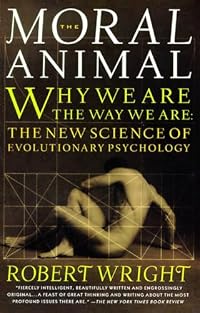
The Moral Animal : Why We Are the Way We Are: The New Science of Evolutionary Psychology
by Robert Wright
On This Page
Description
Psychology. Science. Nonfiction. Are men literally born to cheat? Does monogamy actually serve women's interests? These are among the questions that have made The Moral Animal one of the most provocative science books in recent years. Wright unveils the genetic strategies behind everything from our sexual preferences to our office politics—as well as their implications for our moral codes and public policies. Illustrations.Tags
Recommendations


Member Reviews
Not quite what I expected but in a way so much more.
I am interested in the genetic underpinnings of our moral codes. I know that there are evolutionary reasons that we think killing is wrong, that we believe it's best to treat others as we'd like to be treated. This kind of code is in the genes. It doesn't come from a religious book, although many religions would like to take the credit.
In this book Wright explains "evolutionary psychology" in an interesting way. He offers theories on why it is in our best interest to behave certain ways. To be more specific, that would be why it is in the best interests of our bloodlines to behave in certain ways during the dawn of humankind. After all, humans have not changed a whole lot in thousands show more of years, so we need to look at what was necessary for survival of the species back in hunter-gatherer days.
And thus we learn about the differences between the way males and females approach sex, the law of reciprocal altruism and how it extends past the immediate family, the role of social status in our actions, why we lie and deceive even ourselves. What makes this investigation even more interesting is that each topic is then applied to a human example: Charles Darwin. Darwin, as many know, was well known for his modesty and empathy, and for having a warm, loving personality. He was also plagued with frequent illnesses and depression. His life is well-documented, which provides a good basis for an evaluation of the man in relation to his psychological behaviors.
Darwin figured out some evolutionary morality behaviors early on. Others were left for over 100 years to be picked up by other scientists.
While I loved this book I found one aspect of it a little disturbing. I may have read it wrong, of course. I understood the chapters on ethics to suggest that essentially when a person is born into a certain culture he learns that culture's ethics. I do believe that, to an extent, this is true. But while I believe self-serving criminals find it easier to rob and steal than do those who had a more compassionate upbringing, I also believe that these criminals do know that what they are doing is "wrong" - not just illegal, but wrong. And I believe that certain behaviors are considered "wrong" in all cultures. There will always be psychopaths but apart from them humankind does appear to share some basic moral codes. And we get them in our genes.
Nothing, of course, is all that simple. There is a lot of room for maneuver within "human nature". show less
I am interested in the genetic underpinnings of our moral codes. I know that there are evolutionary reasons that we think killing is wrong, that we believe it's best to treat others as we'd like to be treated. This kind of code is in the genes. It doesn't come from a religious book, although many religions would like to take the credit.
In this book Wright explains "evolutionary psychology" in an interesting way. He offers theories on why it is in our best interest to behave certain ways. To be more specific, that would be why it is in the best interests of our bloodlines to behave in certain ways during the dawn of humankind. After all, humans have not changed a whole lot in thousands show more of years, so we need to look at what was necessary for survival of the species back in hunter-gatherer days.
And thus we learn about the differences between the way males and females approach sex, the law of reciprocal altruism and how it extends past the immediate family, the role of social status in our actions, why we lie and deceive even ourselves. What makes this investigation even more interesting is that each topic is then applied to a human example: Charles Darwin. Darwin, as many know, was well known for his modesty and empathy, and for having a warm, loving personality. He was also plagued with frequent illnesses and depression. His life is well-documented, which provides a good basis for an evaluation of the man in relation to his psychological behaviors.
Darwin figured out some evolutionary morality behaviors early on. Others were left for over 100 years to be picked up by other scientists.
While I loved this book I found one aspect of it a little disturbing. I may have read it wrong, of course. I understood the chapters on ethics to suggest that essentially when a person is born into a certain culture he learns that culture's ethics. I do believe that, to an extent, this is true. But while I believe self-serving criminals find it easier to rob and steal than do those who had a more compassionate upbringing, I also believe that these criminals do know that what they are doing is "wrong" - not just illegal, but wrong. And I believe that certain behaviors are considered "wrong" in all cultures. There will always be psychopaths but apart from them humankind does appear to share some basic moral codes. And we get them in our genes.
Nothing, of course, is all that simple. There is a lot of room for maneuver within "human nature". show less
Double colon in the title aside, this is actually a pretty good overview of evolutionary psychology, with some (less successful) attempts to use Darwin’s own personal life to illustrate particular strategies people use as a result of evolved traits. Wright generally does a good job of reminding readers that traits evolved to improve reproductive success in the environment of evolutionary adaptation may be useless or counterproductive outside that environment, and he strongly argues that there is no moral force to evolution. Indeed, properly understood, he contends, evolution can make us more moral: recognizing that many of our impulses (to punish, to cheat, to love our children, to favor ourselves and our relatives over other people) show more are directed by biology frees us to become more universally minded, since in fact we have no unique moral claims and should treat all humans as having equal interests in well-being.
Still, Wright also demonstrates the temptation to equate “evolved” with “unchangeable,” for example by equivocating in his definition of equality. He argues that we have to choose between equality for men (that is, roughly equal access to women imposed by monogamy) and equality for women (that is, roughly equal access to resources held by men, which would be possible if multiple women could marry the same wealthy man). Obviously he’s defining equality differently for each condition, which is a problem, but the bigger problem is the acceptance of the constraint that wealth will be so unequally distributed that an individual woman (or her family) might prefer marriage as a subsequent wife to a very wealthy man over marriage to a very poor one. As he then touches on briefly, without recognizing that it avoids the “choice of inequalities” issue, the third way to solve the problem of potentially conflicting preferences is to avoid huge resource disparities (and, not for nothing, to allow women to accumulate wealth in ways other than by marrying men). Oddly, he is only willing to allow for “mildly” progressive taxation, for no evolutionarily grounded reason I can discern.
There may be a more technical literature on this, but I was also unsatisfied with his discussion of Victorian morality (and hypocrisy, which he thinks is fine from an evolutionary perspective). He cogently explains why “high-quality” women might prefer a madonna/whore morality and condemn “lower-quality” women who were more promiscuous, who would be pursuing their own strategy of getting as much investment from multiple men as they could given their relative undesirability as long-term mates (this is a consequence of the idea that any fertile female can expect to reproduce, but not every fertile male can). However, he then skips to the idea that the beneficial effects of repressive sexuality for “high-quality” women grounded social morality, and I just don’t understand why (1) “low-quality” women wouldn’t fight back or (2) the overall effects on society would be positive, as he suggests. He might well say that multiple equilibria are possible since competing strategies co-exist, but I still don’t get from there to his apparent assumption that Victorian morality was either shared by all Victorians—even the poor people excluded from respectability and often sexually exploited by it—or a good idea on balance despite its excesses. I don’t get how you can say prudery for upper-class women combined with unspoken but widespread sexual access of upper-class men to prostitutes and servants is a stable and/or productive strategy without addressing the interests of, you know, all the other people on which this strategy relied. More generally, there just wasn’t enough about change over time. Obviously Victorian morality was not so stable that it couldn’t change; Wright suggests that sexual mores are likely to move in cycles, but to me this just highlights the gap between evolutionary psychology and real explanations. There are too many moving parts between what the science can tell you and actual social issues. His metaphor is that evolution has produced dials which environment can move around a lot. But I’m less interested in the dials than in the settings! show less
Still, Wright also demonstrates the temptation to equate “evolved” with “unchangeable,” for example by equivocating in his definition of equality. He argues that we have to choose between equality for men (that is, roughly equal access to women imposed by monogamy) and equality for women (that is, roughly equal access to resources held by men, which would be possible if multiple women could marry the same wealthy man). Obviously he’s defining equality differently for each condition, which is a problem, but the bigger problem is the acceptance of the constraint that wealth will be so unequally distributed that an individual woman (or her family) might prefer marriage as a subsequent wife to a very wealthy man over marriage to a very poor one. As he then touches on briefly, without recognizing that it avoids the “choice of inequalities” issue, the third way to solve the problem of potentially conflicting preferences is to avoid huge resource disparities (and, not for nothing, to allow women to accumulate wealth in ways other than by marrying men). Oddly, he is only willing to allow for “mildly” progressive taxation, for no evolutionarily grounded reason I can discern.
There may be a more technical literature on this, but I was also unsatisfied with his discussion of Victorian morality (and hypocrisy, which he thinks is fine from an evolutionary perspective). He cogently explains why “high-quality” women might prefer a madonna/whore morality and condemn “lower-quality” women who were more promiscuous, who would be pursuing their own strategy of getting as much investment from multiple men as they could given their relative undesirability as long-term mates (this is a consequence of the idea that any fertile female can expect to reproduce, but not every fertile male can). However, he then skips to the idea that the beneficial effects of repressive sexuality for “high-quality” women grounded social morality, and I just don’t understand why (1) “low-quality” women wouldn’t fight back or (2) the overall effects on society would be positive, as he suggests. He might well say that multiple equilibria are possible since competing strategies co-exist, but I still don’t get from there to his apparent assumption that Victorian morality was either shared by all Victorians—even the poor people excluded from respectability and often sexually exploited by it—or a good idea on balance despite its excesses. I don’t get how you can say prudery for upper-class women combined with unspoken but widespread sexual access of upper-class men to prostitutes and servants is a stable and/or productive strategy without addressing the interests of, you know, all the other people on which this strategy relied. More generally, there just wasn’t enough about change over time. Obviously Victorian morality was not so stable that it couldn’t change; Wright suggests that sexual mores are likely to move in cycles, but to me this just highlights the gap between evolutionary psychology and real explanations. There are too many moving parts between what the science can tell you and actual social issues. His metaphor is that evolution has produced dials which environment can move around a lot. But I’m less interested in the dials than in the settings! show less
An excellent insightful book. Explains some of the complexity of the mind through evolution and how the combination of Reciprocal Altruism (tit for tat) and Social Hierarchy has led to our behaviour and understanding of morals. He uses Utilitarianism as a lens to look man behaviour and its compatibility with morality. A bit waffly towards the end, but, as I say, very insightful.
I was introduced to this book during a course on Buddhism and Modern Psychology. Wright covers a lot of ground in this well organized and tightly written book.
Wright doesn't hand down laws, saying "This is how it is," but rather leads with questions and tries to work out the answers based on Darwinian Natural Selection. This is not an easy task; so much is not available when examining the world from a purely materialistic point of view. When one is not allowed to give credit to supernatural, or even non-biological mental events, it really demands a serious and deep interrogation of the biological, chemical, and other physical causes of why people do the things they do. Wright uses several events from Darwin's life as examples, and in show more doing so makes both evolutionary psychology and Darwinian Natural Selection accessible to his readers.
If you're interested in morality, Darwin, evolutionary psychology, or why people do what they do, this is an excellent read.
If you're not interested in those topics, it's STILL and excellent read! I highly recommend it. show less
Wright doesn't hand down laws, saying "This is how it is," but rather leads with questions and tries to work out the answers based on Darwinian Natural Selection. This is not an easy task; so much is not available when examining the world from a purely materialistic point of view. When one is not allowed to give credit to supernatural, or even non-biological mental events, it really demands a serious and deep interrogation of the biological, chemical, and other physical causes of why people do the things they do. Wright uses several events from Darwin's life as examples, and in show more doing so makes both evolutionary psychology and Darwinian Natural Selection accessible to his readers.
If you're interested in morality, Darwin, evolutionary psychology, or why people do what they do, this is an excellent read.
If you're not interested in those topics, it's STILL and excellent read! I highly recommend it. show less
I imagine if there is a bible for Darwinians, this would be it. It's as much a biography of Darwin himself as it is an examination of human behavior through the lens of evolutionary biology. I think that this is a deeply important read, and thanks to Wright's masterful penmanship, it's also deeply engaging.
This book is a must read and must analyse and tease out the contradictions, inconsistencies and general confusion with respect to what it means for something to be scoentific fact.
The author even brings much caution himself to the field and to how many evolutionary interpretations are post hoc explanations. And yet thoroughout the text the author makes mistakes of ascribing what is “self evident” evolutionary mechanism without explaining what kind of knowledge this is, without noting how it is not falsifiable.
It is a huge challenge but any logical thinker should be prepared to explain how they relate.
For me the biggest issue is one of types of knowledge. The idea that a particular trait might play a key role in the evolutionary show more mechanics of a species is not the same kind of absolute knowledge that it is optimal, that it is well adapted, that it is a special adaptation even that it is a solution to something...
In the real evolutionary context you cannot run perfect simulations and so you cannot falsify a particular trait. When you use genetic algorithms in computing there is a huge difference which is that you know the fitting function. For anything real this is so complex that it is nearly meaningless.
Still this is a book one must read to articulate your thinking around the intrinsic limitations of this field. show less
The author even brings much caution himself to the field and to how many evolutionary interpretations are post hoc explanations. And yet thoroughout the text the author makes mistakes of ascribing what is “self evident” evolutionary mechanism without explaining what kind of knowledge this is, without noting how it is not falsifiable.
It is a huge challenge but any logical thinker should be prepared to explain how they relate.
For me the biggest issue is one of types of knowledge. The idea that a particular trait might play a key role in the evolutionary show more mechanics of a species is not the same kind of absolute knowledge that it is optimal, that it is well adapted, that it is a special adaptation even that it is a solution to something...
In the real evolutionary context you cannot run perfect simulations and so you cannot falsify a particular trait. When you use genetic algorithms in computing there is a huge difference which is that you know the fitting function. For anything real this is so complex that it is nearly meaningless.
Still this is a book one must read to articulate your thinking around the intrinsic limitations of this field. show less
A great book, very thought provoking, but it left me kind of pessimistic about humanity's ability to transcend it's primitive origins. Then again, if we acknowledge those origins they don't have to limit us, they just need to taken into account.
Members
- Recently Added By
Lists

Psicología - Clásicos
165 works; 2 members

Atheism, humanism, freethought, &c. — Best nonfiction books in favour of
167 works; 14 members

KayStJ's to-read list
1,616 works; 11 members

Ryan Holiday's Books To Base Your Life On
97 works; 2 members
Author Information

6+ Works 6,488 Members
Robert Wright is the bestselling author of The Evolution of God, The Moral Animal, and Nonzero. He has taught in the psychology department at the University of Pennsylvania and the religion department at Princeton University. He is currently Visiting Professor of Science and Religion at Union Theological Seminary in New York.
Some Editions
Awards and Honors
Awards
Distinctions
Common Knowledge
- Canonical title
- The Moral Animal : Why We Are the Way We Are: The New Science of Evolutionary Psychology
- Original title
- The Moral Animal: The New Science of Evolutionary Psychology
- Original publication date
- 1994-11-01
- People/Characters
- Martin Daly; Charles Darwin [Charles Robert: 1809-1882]; Emma Wedgwood Darwin; Sigmund Freud; William D. Hamilton; Joseph Dalton Hooker (show all 12); Charles Lyell; John Stuart Mill; Samuel Smiles; Robert Trivers; George Williams; Margo Wilson
- Epigraph
- Without thinking what he was doing, he took another drink of brandy. As the liquid touched his tougue he remembered his child, coming in out of the glare: the sullen unhappy knowledgeable face. He said, "oh God, help her. Dam... (show all)n me, I deserve it, but let her live for ever." This was the love he should have felt for every soul in the world: all the fear and the wish to save concentrated unjustly on the one child. He began to weep; it was as if he had to watch her from the shore drown slowly because he had forgotten how to swim. He thought: This is what I should feel all the time for everyone....
—Graham Greene, The Power and the Glory - Dedication
- For Lisa
- First words
- Introduction: DARWIN AND US
The Origin of Species contains almost no mention of the human species. - Original language
- English
Classifications
- Genres
- Science & Nature, Nonfiction, Anthropology, General Nonfiction, Philosophy, Religion & Spirituality
- DDC/MDS
- 304.5 — Social sciences Social sciences, sociology & anthropology Factors affecting social behavior Genetic factors
- LCC
- GN365.3 .W75 — Geography, Anthropology and Recreation Anthropology Anthropology Ethnology. Social and cultural anthropology Culture and cultural processes
- BISAC
Statistics
- Members
- 2,065
- Popularity
- 9,938
- Reviews
- 20
- Rating
- (4.00)
- Languages
- 7 — Chinese, Czech, Dutch, English, French, German, Portuguese (Portugal)
- Media
- Paper, Audiobook, Ebook
- ISBNs
- 16
- UPCs
- 1
- ASINs
- 7