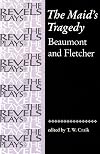
The maid's tragedy
by Francis Beaumont, John Fletcher
90 Members (3.83)
On This Page
Description
Generally acknowledged to be the most powerful of Beaumont and Fletcher's plays and frequently performed by the best actors of the seventeenth and early eighteenth century, The Maid's Tragedy then disappeared from the stage (except in a much-altered and very successful Victorian adaptation)until recent years, when major companies have rediscovered its appeal. In this fully annotated edition, the editor has given careful attention to the sense of the lines, the stage action and the verse. show more Many new readings, as well as improvements in stage directions and lineation, are either introduced or proposed. The introduction throws new light on Beaumont and Fletcher's use of the three known sources (two of them previously neglected) of incidents in the play, gives the fullest available account of its stage history and provides a sympathetic interpretation of the play as a romantic tragedy. show lessTags
Recommendations

















Member Reviews
Members
- Recently Added By
Lists

Best Early Modern Plays Not By Shakespeare
78 works; 8 members

My Play Collection
769 works; 3 members
Author Information

82+ Works 888 Members
Francis Beaumont (1584-1616) and his collaborator John Fletcher (1579-1625) wrote some of the most popular dramas of Elizabethan England. Beaumont and Fletcher began to work together in about 1606 and continued their partnership until Beaumont's retirement in 1613. Beaumont apparently was the primary plotter of their plays, while Fletcher had a show more strong flair for language. Their comedies and tragedies include The Woman Hater, The Coxcomb, A Maid's Tragedy, The Knight of the Burning Pestle, Wit Without Money, and Philaster, Or Love Lies A Bleeding. Fletcher authored several other plays alone, such as the comedy The Wild Goose Chase (1621) and the tragedy Bonduca (1614). Cardenio, or the Second Maiden's Tragedy, and Two Noble Kinsmen are attributed to Fletcher, although there has been some speculation that he collaborated with Shakespeare on the plays. Beaumont and Fletcher's work is energetic, rich in stage thrills, declamatory speeches and bizarre plots. Although their work is not as unified as that of some of their contemporaries including Shakespeare and Webster, it influenced the development of Restoration comedy and tragedy, and thus played an important role in the history of drama. (Bowker Author Biography) show less

86+ Works 3,482 Members
The team of Francis Beaumont (1584-1616) and John Fletcher (1579-1625) wrote some of the most popular dramas of Elizabethan England. Beaumont and Fletcher began to work together in about 1606 and continued their partnership until Beaumont's retirement in 1613. Beaumont apparently was the primary plotter of their plays, while Fletcher had a strong show more flair for language. Their comedies and tragedies include The Woman Hater, The Coxcomb, A Maid's Tragedy, The Knight of the Burning Pestle, Wit Without Money, and Philaster, Or Love Lies A Bleeding. Fletcher wrote several plays alone as well, such as the comedy The Wild Goose Chase (1621) and the tragedy Bonduca (1614). Cardenio, or the Second Maiden's Tragedy, and Two Noble Kinsmen are attributed to Fletcher, although there has been some speculation he collaborated on these with Shakespeare. Beaumont and Fletcher's work is energetic, full of stage thrills, declamatory speeches and bizarre plots. Though it is not as rich and unified as that of some of their contemporaries including Shakespeare and Webster, it influenced the development of Restoration comedy and tragedy, and thus played an important role in the history of drama. (Bowker Author Biography) show less
Some Editions
Series
Belongs to Publisher Series
Work Relationships
Classifications
Statistics
- Members
- 90
- Popularity
- 358,130
- Rating
- (3.83)
- Languages
- English
- Media
- Paper, Ebook
- ISBNs
- 16
- ASINs
- 4