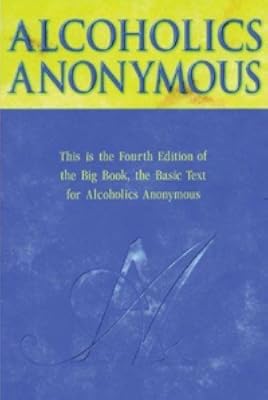
Alcoholics Anonymous
by Alcoholics Anonymous, W. Bill (Contributor)
On This Page
Description
Known as the "Big Book," the basic text of Alcoholics Anonymous has helped millions of people worldwide get and stay sober since the first edition appeared in 1939. Opening chapters articulate A.A.'s program of recovery from alcoholism - the original Twelve Steps - and recount the personal histories of A.A.'s co-founders, Bill W. and Dr. Bob. In the pages that follow, more than 40 A.A. members share how they stopped drinking and found a new healthier and more serene way of life through the show more Fellowship of Alcoholics Anonymous. Whether reading passages at meetings, reading privately for personal reflection, or working with a sponsor, the Big Book can be a source of inspiration, guidance and comfort on the journey to recovery. This Fourth Edition of Alcoholics Anonymous has been approved by the General Service Conference. show lessTags
Recommendations
















Member Recommendations
Member Reviews
This is the "Big Book" of Alcoholics Anonymous--its basic text. At the core are the "12 Steps" and "Twelve Step" programs are legion--including Overeaters Anonymous--which I was a part of for a time. I'm not saying there isn't wisdom in the twelve-steps. But it's very much God-based. Even though I found a Atheist Group in my area, that aspect of the program was very hard for me to translate into secular terms. Making an inventory of your faults, making amends, promptly admitting when you're wrong--these are all good, healthy and healing things--for yourselves and others. But half the steps cite God--and too often the program as I experienced it had uncomfortably cult-like aspects and I drifted away from it. And goodness knows, the whole show more concept of "addiction" and "abstinence" are hard to translate when you're dealing with a substance--food--you can't really make a clean break from. And I think making food the enemy--as an addiction model does--is not in the end the way to go about gaining a healthy relationship with it--at least not for me long-term.
So my relatively low rating reflects my personal reaction and experience with a Twelve Step Program--even though I know millions have claimed this book and its principles saved their lives. And so pervasive are Twelve-Step groups, I'd argue that cultural literacy alone means you should be familiar with this book. And certainly many of the personal stories in this book are harrowing and riveting--and inspiring. show less
So my relatively low rating reflects my personal reaction and experience with a Twelve Step Program--even though I know millions have claimed this book and its principles saved their lives. And so pervasive are Twelve-Step groups, I'd argue that cultural literacy alone means you should be familiar with this book. And certainly many of the personal stories in this book are harrowing and riveting--and inspiring. show less
As flawed as it is to compare people, since it doesn’t *really* matter, I think that the common alcoholic actually lives a worse life that you learn less from than those involved with the “epic” sort of sins of history. I know that might come off as just sounding like I’m trying to trash people, but as part of my holistic studies, I just think that acquiring a few lesser virtues and abusing and misusing them is actually better than acquiring fewer or no virtues and just falling apart because you have no idea how to live. There are certainly gradations of the disease, but at its worst it brings you to a total loss of virtue and even in more moderate gradations tends to be more perverse than simply being legalistically pure but show more lacking charity. You can be “as pure as angels but as proud as devils”, and down that road lies “epic” sin, but you cannot really be as impure as devils but as humble as angels, although you can be in denial about that. To the alcoholic, it’s all about me— this “I” that cannot pull itself together enough to live.
“Denial ain’t just a river in Egypt”, it’s widespread, and it’s the greatest barrier. Once you can remind yourself what addiction is, whether it’s alcohol, the great classic addiction, or something more obscure, you can remind yourself that it’s not actually worth the price it imposes. Constantly you will forget; repeatedly you must be reminded.
.................................
Food service is often a great way to see people at their worst. I’m a dishwasher at an assisted living home, where a man died recently. In his obituary, there are examples of the various ways that his long life was good and productive, but all I knew about him was that he liked to drink after everybody else was done drinking. (No way to tell if it was only after his wife died, etc.)
I say this by way of qualification, since obviously the above is a hard saying.
....................................
It’s immensely satisfying to read; screw up; make it right; repeat.
...............................................
Perhaps the greatest problem with my life has been my conviction that sin is stronger than grace. show less
“Denial ain’t just a river in Egypt”, it’s widespread, and it’s the greatest barrier. Once you can remind yourself what addiction is, whether it’s alcohol, the great classic addiction, or something more obscure, you can remind yourself that it’s not actually worth the price it imposes. Constantly you will forget; repeatedly you must be reminded.
.................................
Food service is often a great way to see people at their worst. I’m a dishwasher at an assisted living home, where a man died recently. In his obituary, there are examples of the various ways that his long life was good and productive, but all I knew about him was that he liked to drink after everybody else was done drinking. (No way to tell if it was only after his wife died, etc.)
I say this by way of qualification, since obviously the above is a hard saying.
....................................
It’s immensely satisfying to read; screw up; make it right; repeat.
...............................................
Perhaps the greatest problem with my life has been my conviction that sin is stronger than grace. show less
How does one judge the merit of a book? Is it based purely on the writing or on the effect it has? This book is not particularly well written, but the effect it has had on many peoples lives including my own has been remarkable. In this respect it must be one of the most significant books of the 20th century.
The very title - The Big Book - sounds so cheesy, so all-American [especially since at the time it was written the book really wasn't all that big and by today's standards its positively minute. It's only one volume, for Heaven's sake] that I'd sooner put faith in one of those Eat all your favourite fattening foods in huge quantities and Lose Weight Hand over Fist type books.
So when I was told I needed the Big Book to stop drinking I reluctantly purchased a copy and hied off the a Big Book meeting. It was unlike anything I've ever been to before and the book is nothing short of a miracle.
The author, Bill Wilson, was a hopeless alcoholic and non-practising Christian when he recieved divine inspiration and, having joined the Oxford show more group, bought the still-suffering alcoholic Dr Bob Smith to sobriety. The two men together founded alcoholics Anontymous in 1935.
One of Dr Bob's best friend was a Catholic priest, Father Edward Dowling, and he flirted with the church for many years without actually converting because, he said, AA could not be seen to ally itself to any one faith. Both Bob and Bill were Christians however, and the Big Book is a true reflection of the essence of Christ's teachings.
Surprisingly though, Jews and other non-Christians also see the book as being spiritual and encapsulating the messages of love central to their beliefs, while even athiests can recognise the humanist principals of treating others decently and doing the next best thing, and have no problem - after initial reservations - embracing the Big Book whole-heartedly.
To say a piece of writing is divinely inspired reeks of either anachronism or charlatanry: however, for a work to have save so many lives and to be all things to all men who really need it, argues the interception of a higher power. A wonderful work for everyone, not just alcoholics - not just addicts, unless your addiction is to living a good life. show less
So when I was told I needed the Big Book to stop drinking I reluctantly purchased a copy and hied off the a Big Book meeting. It was unlike anything I've ever been to before and the book is nothing short of a miracle.
The author, Bill Wilson, was a hopeless alcoholic and non-practising Christian when he recieved divine inspiration and, having joined the Oxford show more group, bought the still-suffering alcoholic Dr Bob Smith to sobriety. The two men together founded alcoholics Anontymous in 1935.
One of Dr Bob's best friend was a Catholic priest, Father Edward Dowling, and he flirted with the church for many years without actually converting because, he said, AA could not be seen to ally itself to any one faith. Both Bob and Bill were Christians however, and the Big Book is a true reflection of the essence of Christ's teachings.
Surprisingly though, Jews and other non-Christians also see the book as being spiritual and encapsulating the messages of love central to their beliefs, while even athiests can recognise the humanist principals of treating others decently and doing the next best thing, and have no problem - after initial reservations - embracing the Big Book whole-heartedly.
To say a piece of writing is divinely inspired reeks of either anachronism or charlatanry: however, for a work to have save so many lives and to be all things to all men who really need it, argues the interception of a higher power. A wonderful work for everyone, not just alcoholics - not just addicts, unless your addiction is to living a good life. show less
I'm reading this because many of my friends & my loved one live the Steps, and I want to understand better what is going on in his life.
The book is at times difficult to read, because of how it is written, which is more of a "stream of consciousness" style.
Some parts, I can not get into, but I find that if I just open the book to a random page and read, then there is some piece of knowledge/information there for me that I happen to need at the moment.
The "Big Book" has saved many lives...and I really believe that those of us who have loved ones living the steps could benefit from reading the book as well.
The book is at times difficult to read, because of how it is written, which is more of a "stream of consciousness" style.
Some parts, I can not get into, but I find that if I just open the book to a random page and read, then there is some piece of knowledge/information there for me that I happen to need at the moment.
The "Big Book" has saved many lives...and I really believe that those of us who have loved ones living the steps could benefit from reading the book as well.
This edition differs from the previous ones only in an extra introduction & some updating of the stories at the end - as usual. The basic text & page numbers of that text remain unchanged. Good news for those with a 'Little Red Book' or other guide/index to the Big Book.For those unfamiliar with the Big Book, it's the instruction set for the AA program. The wording is a little dated, but it is the instruction set for the most widespread self-help program in the world. AA is the basis of all other 12 step programs, most of whom changed the program only slightly to fit the addiction of choice - narcotics, cocaine, gambling, sex, etc.. Many have problems with the 'God' concept, swearing AA is a religious program. They have a point, show more although it doesn't have to be, as many have proved. AA tends to pick up the 'religious flavor of the group - people have trouble separating spirituality from religion. The book was written by Christians & loosely based on the tenets of an earlier Christian organization (the Oxford Group, now defunct). Non-Christians should read & come to terms with the chapter, "To the Agnostic" before jumping to conclusions. Those with an open mind can work the AA program without a belief in the Christian or any 'God'.While most chapters are devoted exclusively to the alcoholic, there are chapters to the family & employer of the alcoholic, as well. Anyone who knows an alcoholic or anyone who suffers from an addiction, would do well to read this book. It offers an insight into the mind of the alcoholic both before & after sobriety is achieved, as well as practical advice to those that live with him/her. show less
While it may not be great literature, I can state that the book was instrumental in saving my life. Therefore, I hold a special fondness for it. This work, the product of Dr. Bob and Bill Wilson, has helped millions of people around the world find a way from the throes of addition to alcohol. It may seem hokey and dated, but it works.
Members
- Recently Added By
Lists

Books that changed the world
67 works; 65 members

Best Self Help Books
87 works; 18 members

Spiritual Growth/Philosophy/Self-Help
15 works; 1 member

Tom's Bookstore
346 works; 2 members

Men's healing resources
754 works; 1 member
Author Information

136 Works 8,176 Members
Awards and Honors
Common Knowledge
- Canonical title
- Alcoholics Anonymous
- Original publication date
- 1939
- People/Characters
- Bill W.; Dr. Bob [Robert Holbrook Smith] (Alcoholics Anonymous); Roland H.; Ebbie; Carl Jung; William D. Silkworth M.D. (show all 12); Herbert Spencer; Dr. Harry M. Tiebout; Edward Dowling, S.J. {Father Ed}; John D. Rockefeller Jr.,; Dr. Harry Emerson Fosdick; Lois W.
- Important places
- Towns Hospital, New York, New York, USA; Akron, Ohio, USA
- First words
- War fever ran high in the New England town to which we new, young officers from Plattsburg were assigned, and we were flattered when the first citizens took us to their homes, making us feel more heroic.
- Quotations
- But there is One who has all power--that One is God. May you find Him now. p. 59
My friend suggested what then seemed a novel idea. He said, 'Why don't you choose your own conception of God?' That statement hit me hard. It melted the icy intellectual mountain in whose shadow I had lived and shivered ma... (show all)ny years. I stood in the sunlight at last. p. 12
...they cannot start drinking without developing the phenomenon of craving. This phenomenon, as we have suggested, may be the manifestation of an allergy which differentiates these people, and sets them apart as a distinct e... (show all)ntity. p.xviii
There is a principle which is a bar against all information, which cannot fail to keep a man in everlasting ignorance-- that principle is contempt prior to investigation. Herbert Spencer p. 570
They are restless irritable and discontented, unless they can again experience the sense of ease and comfort which comes at once by taking a few drinks--drinks which they see others taking with impunity
Here are the steps we took which are suggested as a program of recovery. p 59
...many of them do recover if they have the capacity to be honest.
Abandon yourself to God as you understand God. Admit your faults to Him and to your fellows. Clear away the wreckage of your past. Give freely of what your find and join us. We shall be with you in the Fellowship of the S... (show all)pirit, and you will surely meet some us as you trudge the Road of Happy Destiny.
May God bless you and keep you--until then.
We, of Alcoholics Anonymous, are more than one hundred men and women who have recovered from a seemingly hopeless state of mind and body. To show other alcoholics 'precisely how we have recovered' {'...' italicized} is the m... (show all)ain purpose of this book. p. xiii Foreword to the First Edition - Last words
- (Click to show. Warning: May contain spoilers.)Abandon yourself to God as you understand God. Admit your faults to Him and to your fellows. Clear away the wreckage of your past. Give freely of what you find and join us. We shall be with you in the Fellowship of the Spirit, and you will surely meet some of us as you trudge the Road of Happy Destiny.
May God bless you and keep you--until then. p. 164 - Canonical DDC/MDS
- 362.2928
Classifications
- Genres
- Nonfiction, General Nonfiction, Religion & Spirituality
- DDC/MDS
- 362.2928 — Society, government, & culture Social problems and social services Social Welfare Mental illness Substance abuse
- LCC
- HV5275 .W15 — Social sciences Social pathology. Social and public welfare. Criminology Social pathology. Social and public welfare. Alcoholism. Intemperance. Temperance reform
- BISAC
Statistics
- Members
- 3,658
- Popularity
- 4,459
- Reviews
- 33
- Rating
- (4.27)
- Languages
- English, French, Spanish
- Media
- Paper, Audiobook, Ebook
- ISBNs
- 72
- UPCs
- 2
- ASINs
- 83
