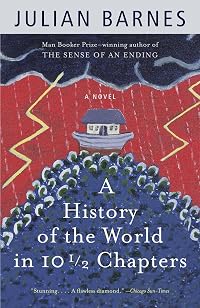
A History of the World in 10½ Chapters
by Julian Barnes
On This Page
Description
The voyage of Noah's Ark is recounted by a stowaway; terrorists board a cruise ship, and a correspondence between lovers reveals cracks in the relationship. In this extraordinary collection of stories and styles, Julian Barnes paints a history of man.Tags
Recommendations













Member Recommendations

Member Reviews
Some may call this a nonlinear novel, I prefer loosely connected short stories. It's certainly not a history book. There is useful plot summary by chapter on Wikipedia for those looking for a synopsis. I'm not a huge fan of postmodernist literature: this stuff about ambiguity and unreliable narrators was never my thing. However, this book grew on me as it went on. Several themes were thoughtfully and humorously crafted, I've selected a few below.
Maritime disasters: By far my favourite story is The Stowaway, a satirical description of Noah's ark from the perspective of stowaway woodworms. But there are also some gems later on, such as a shipwreck prompting cannibalism, the Titanic, Jonah and the whale, and a take on Jewish refugees in show more 1939 in limbo on the sea. The last three of these, encapsulated in Three Simple Stories, is probably my next favourite.
Art as propaganda: Barnes lays a particular emphasis, mostly satirical, on how historical or mythical events are treated in art. In The Shipwreck, he describes what a painting leaves out as much as what it includes, and how human interpretation motivates these choices. In the Titanic story, a survivor attempts to take part in a re-enactment of the ship's sinking.
Irreverence to religion: In The Wars of Religion, woodworms are threatened with excommunication for attacking a church and humiliating a priest. Noah is frequently mentioned: in separate stories, a fanatically religious woman and a credulent astronaut seek Noah's ark on a mountain.
Philosophy of life: The second half of the novel focuses more on philosophical questions and attitudes to life. In Upstream!, an actor travels to an exotic jungle and comes to terms with a colleague drowning in a raft accident. There's an isolated discourse on love in the half-chapter Parenthesis. The final chapter, The Dream, is an extreme account of a life where every desire is met.
A History of the World in 10½ Chapters is "clever" in the sense there are many interlocking elements, even while the stories themselves cover a range of epochs, perspectives and literary forms. But is this really clever, or just a gimmick? I lean towards the former. My only complaint is the absence of any memorable characters or relationships. Overall, I found the novel highly readable and would certainly recommend it to those looking for something different. show less
Maritime disasters: By far my favourite story is The Stowaway, a satirical description of Noah's ark from the perspective of stowaway woodworms. But there are also some gems later on, such as a shipwreck prompting cannibalism, the Titanic, Jonah and the whale, and a take on Jewish refugees in show more 1939 in limbo on the sea. The last three of these, encapsulated in Three Simple Stories, is probably my next favourite.
Art as propaganda: Barnes lays a particular emphasis, mostly satirical, on how historical or mythical events are treated in art. In The Shipwreck, he describes what a painting leaves out as much as what it includes, and how human interpretation motivates these choices. In the Titanic story, a survivor attempts to take part in a re-enactment of the ship's sinking.
Irreverence to religion: In The Wars of Religion, woodworms are threatened with excommunication for attacking a church and humiliating a priest. Noah is frequently mentioned: in separate stories, a fanatically religious woman and a credulent astronaut seek Noah's ark on a mountain.
Philosophy of life: The second half of the novel focuses more on philosophical questions and attitudes to life. In Upstream!, an actor travels to an exotic jungle and comes to terms with a colleague drowning in a raft accident. There's an isolated discourse on love in the half-chapter Parenthesis. The final chapter, The Dream, is an extreme account of a life where every desire is met.
A History of the World in 10½ Chapters is "clever" in the sense there are many interlocking elements, even while the stories themselves cover a range of epochs, perspectives and literary forms. But is this really clever, or just a gimmick? I lean towards the former. My only complaint is the absence of any memorable characters or relationships. Overall, I found the novel highly readable and would certainly recommend it to those looking for something different. show less
This clever book is titled "A Novel" on the cover to differentiate it from actual non-fiction history and to backup the author's position that history is really only a set of subjective narratives or stories. The chapters have a common theme and cross references but this is really a collection of short stories and an essay or two.
The first chapter takes place on Noah's Ark, a story from the Bible, a book that for most of Western civilization's time was viewed as factual history. However, the story of the Ark here is told from the viewpoint of a stowaway who has a very different version of Noah and the events of the Ark than that told in the Bible.
Throughout the book, different viewpoints are recounted in 15th century court cases, show more psychiatric wards, epic motion pictures, and paintings based on terrible shipwrecks. History is manipulated according to the needs of the interpreter of the events. The most closely related stories each involve an expedition to Mt. Ararat separated by 150 years. The last chapter takes place in Heaven, where each person is able to spend eternity getting exactly what one wants, until that too isn't enough.
Rich with different story styles and voices, Barnes has created a work that both entertains and inspires some deep thinking. show less
The first chapter takes place on Noah's Ark, a story from the Bible, a book that for most of Western civilization's time was viewed as factual history. However, the story of the Ark here is told from the viewpoint of a stowaway who has a very different version of Noah and the events of the Ark than that told in the Bible.
Throughout the book, different viewpoints are recounted in 15th century court cases, show more psychiatric wards, epic motion pictures, and paintings based on terrible shipwrecks. History is manipulated according to the needs of the interpreter of the events. The most closely related stories each involve an expedition to Mt. Ararat separated by 150 years. The last chapter takes place in Heaven, where each person is able to spend eternity getting exactly what one wants, until that too isn't enough.
Rich with different story styles and voices, Barnes has created a work that both entertains and inspires some deep thinking. show less
A deep rumination on woodworms on the Arc and other related maritime excursions with love and a rather loveless afterlife for spice. Somewhere between nightmare and dream is the strange heart of this biblical group of salted fantasies.
What fun. The title, while accurate enough, doesn't begin to convey the delightful, and cleverly constructed book. At first, the chapters are quite disparate:
the memoir of a stowaway on Noah's ark (the woodworm), an account of a lawsuit brought in Portugal to have the woodworm excommunicated (because it was not in the Ark). These are both true things. There's an account of efforts to find the Ark.
Barnes gives us a thoughtful meditation on time and on love and the role of religion in shaping our understanding of love.
Highly recommended
the memoir of a stowaway on Noah's ark (the woodworm), an account of a lawsuit brought in Portugal to have the woodworm excommunicated (because it was not in the Ark). These are both true things. There's an account of efforts to find the Ark.
Barnes gives us a thoughtful meditation on time and on love and the role of religion in shaping our understanding of love.
Highly recommended
This is a weird book and that's why I loved it and read it twice in 15 days. The book is about exactly what it says in the title: history of the world. Not entire history of the world obviously, just some stories. While at first these 10 stories may seem random, each of them has something that connects them. It's usually some form of an a ship (an ark, a boat or a raft) and woodworms. I love each story. (with the exception of the sixth) Just like "The Sense of an Ending", this book is also philosophical.
The "half chapter" is not a story but rather an essay on love. It's probably one of my favorite chapters of all time. One of the funnies stories is the trial of the woodworms.
The other chapters seem to tell us that the history always show more repeats itself. People will always divide each other (by the type of an animal, nationality or religious beliefs) There will also be love. And love will always help us. Barnes analyzes and sometimes overanalyzes everything. And as an overthinker myself, I must admire his way of telling a coherent story.
2nd read:June 28-July 2 show less
The "half chapter" is not a story but rather an essay on love. It's probably one of my favorite chapters of all time. One of the funnies stories is the trial of the woodworms.
The other chapters seem to tell us that the history always show more repeats itself. People will always divide each other (by the type of an animal, nationality or religious beliefs) There will also be love. And love will always help us. Barnes analyzes and sometimes overanalyzes everything. And as an overthinker myself, I must admire his way of telling a coherent story.
2nd read:June 28-July 2 show less
Gordon Bennett what a read!. This offering by Julian Barnes published 1989 defies being put into any particular genre. It's not a novel and it’s not strictly a collection of short stories in so much as each chapter is dependent to some degree on each of the chapters before it. No chronological order either as the reader jumps like a time traveller through the ages.
I have reached a stage in my reading where I am wanting to get more from a book than an enjoyable read. I want to connect with the text in a more meaningful way. I want to read critically. I want to read the author as well as the written words.
This book was for me a lesson in literary theory - Postmodernism. Of course I am only just beginning to understand where studying show more literature will take me but with this one I really did take more of an active role in the reading process.
It's a book for raising questions, something that made me think a lot about all kinds of things. Many of the questions I have had floating about in my mind for some time. Thoughts about life, what it is to be human and how we as humans connect with our world and each other.
So what's it all about? Well do not try to figure it out and expect answers or any eureka moments because I do believe doing so would be a mistake and will affect your enjoyment of some brilliant story-telling. For me it is a reflection of life on earth as a human race since life began ( more or less ) and essentially summed up that means a bloody mess with a few bits that seem to be connected somehow throughout the history of time.
I took this extract from the book which I think sums up what I am trying to say about it from Chapter 8 - Upstream which is in an epistolary form - ooh get me picking up the literature lingo already:
" .... it's about the sort of conflict running through human life in every time and every civilisation. Discipline v Permissiveness. Sticking to the letter of the law v sticking to its spirit. Means and ends. Doing the right thing for the wrong reason v doing the wrong thing for the right reason.
This all makes it sound pretty heavy but it is far from it. It's funny, quirky, moving, thought-provoking, thrilling and utterly gripping. This is the first book I have read that I really wanted to savour and take my time over. It's the first book I have read that I have actually shouted out to when Mr Barnes playfully teases us with a ' forgotten' name in the first chapter and like being in a pub quiz team I had to shout out the answer. Totally engaging.
Every chapter is different in style and voice. You will read the story of Noah like you have never read it before - Noah pops up throughout as one of the threads that binds the chapters together. You will have a lesson in art appreciation - which was one of my favourite chapters as I have a thing for art too. You will attend the trial of woodworms who will also feature regularly throughout. You will go on a cruise or two both of which will be nothing like you expected and also very relevant to what's happening in the world today. Ships and the sea are another theme. Ooh I forgot Jonah - that was a fab bit. There is lots of searching going on too and a quote related to searching which I think really sums up the intention of the book but I will let you find that quote yourself - because I forgot to write it down!
This was the kind of reading experience that I have been craving. It was enjoyable, it gave me pleasure. It was thought-provoking - it fed my soul. It was a learning journey and made me explore further into the realms of critical reading and literary theory.
There is an interesting essay on this book by Brian Finney which can be found on the net.
A superb offering from Julian Barnes which I heartily recommend. show less
I have reached a stage in my reading where I am wanting to get more from a book than an enjoyable read. I want to connect with the text in a more meaningful way. I want to read critically. I want to read the author as well as the written words.
This book was for me a lesson in literary theory - Postmodernism. Of course I am only just beginning to understand where studying show more literature will take me but with this one I really did take more of an active role in the reading process.
It's a book for raising questions, something that made me think a lot about all kinds of things. Many of the questions I have had floating about in my mind for some time. Thoughts about life, what it is to be human and how we as humans connect with our world and each other.
So what's it all about? Well do not try to figure it out and expect answers or any eureka moments because I do believe doing so would be a mistake and will affect your enjoyment of some brilliant story-telling. For me it is a reflection of life on earth as a human race since life began ( more or less ) and essentially summed up that means a bloody mess with a few bits that seem to be connected somehow throughout the history of time.
I took this extract from the book which I think sums up what I am trying to say about it from Chapter 8 - Upstream which is in an epistolary form - ooh get me picking up the literature lingo already:
" .... it's about the sort of conflict running through human life in every time and every civilisation. Discipline v Permissiveness. Sticking to the letter of the law v sticking to its spirit. Means and ends. Doing the right thing for the wrong reason v doing the wrong thing for the right reason.
This all makes it sound pretty heavy but it is far from it. It's funny, quirky, moving, thought-provoking, thrilling and utterly gripping. This is the first book I have read that I really wanted to savour and take my time over. It's the first book I have read that I have actually shouted out to when Mr Barnes playfully teases us with a ' forgotten' name in the first chapter and like being in a pub quiz team I had to shout out the answer. Totally engaging.
Every chapter is different in style and voice. You will read the story of Noah like you have never read it before - Noah pops up throughout as one of the threads that binds the chapters together. You will have a lesson in art appreciation - which was one of my favourite chapters as I have a thing for art too. You will attend the trial of woodworms who will also feature regularly throughout. You will go on a cruise or two both of which will be nothing like you expected and also very relevant to what's happening in the world today. Ships and the sea are another theme. Ooh I forgot Jonah - that was a fab bit. There is lots of searching going on too and a quote related to searching which I think really sums up the intention of the book but I will let you find that quote yourself - because I forgot to write it down!
This was the kind of reading experience that I have been craving. It was enjoyable, it gave me pleasure. It was thought-provoking - it fed my soul. It was a learning journey and made me explore further into the realms of critical reading and literary theory.
There is an interesting essay on this book by Brian Finney which can be found on the net.
A superb offering from Julian Barnes which I heartily recommend. show less
During a heated discussion several years ago, my wife accused me of being “way too linear” in my thinking. (I’m still not quite sure what she meant by that, but I’m reasonably certain it wasn’t a compliment.) Given that comment, however, I am sure that she would appreciate the sort of novels that Julian Barnes writes.
In fact, as with Flaubert’s Parrot, some might argue that A History of the World is not really a novel at all but rather a collection of tangentially connected stories that are as much documentary as they are fiction. What the book clearly is not is linear story-telling, mixing as it does a retelling of the Noah’s Ark tale from the perspective of a stowaway with a detailed analysis of a painting that hangs in show more the Louvre and an archeological expedition to Mt. Ararat.
It all does make sense ultimately—the chapters actually do progress from Genesis to Revelations—and much of what it contains is both philosophically challenging and very funny. show less
In fact, as with Flaubert’s Parrot, some might argue that A History of the World is not really a novel at all but rather a collection of tangentially connected stories that are as much documentary as they are fiction. What the book clearly is not is linear story-telling, mixing as it does a retelling of the Noah’s Ark tale from the perspective of a stowaway with a detailed analysis of a painting that hangs in show more the Louvre and an archeological expedition to Mt. Ararat.
It all does make sense ultimately—the chapters actually do progress from Genesis to Revelations—and much of what it contains is both philosophically challenging and very funny. show less
Members
- Recently Added By
Published Reviews
Lists

The Guardian's 1000 Novels Everyone Must Read
1,005 works; 552 members
20th Century Literature
1,161 works; 55 members

Recommend the 20 best books you've read in the last five years
2,168 works; 608 members

Experimental Literature
141 works; 19 members

Books as Objects & Metatextual Works
32 works; 3 members

Books Read in 2022
5,226 works; 115 members

Books Read in 2012
816 works; 34 members

Time-Sweep Novels
28 works; 3 members

Genesis in literature
47 works; 7 members

Gen X Library
245 works; 4 members

Books I Read Before The Invention Of The Internet.
144 works; 1 member

Books Read in 2025
4,128 works; 98 members
Author Information

89+ Works 43,196 Members
Julian Barnes was born in Leicester, England, on January 19, 1946. He received a degree in modern languages from Magdalen College, Oxford University in 1968. He has held jobs as a lexicographer for the Oxford English Dictionary, a reviewer and literary editor for the New Statesmen and the New Review, and a television critic. He has written show more numerous works of fiction including Arthur and George, Pulse: Stories, The Noise of Time, and England, England. He received the Somerset Maugham Award in 1980 for Metroland, the Geoffrey Faber Memorial Prize in 1985 and a Prix Medicis in 1986 for Flaubert's Parrot, and the Man Booker Prize in 2011 for The Sense of an Ending. He also writes non-fiction works including Letters from London, The Pedant in the Kitchen, and Nothing to Be Frightened Of. He received the Shakespeare Prize by the FVS Foundation in 1993, the Austrian State Prize for European Literature in 2004, and the David Cohen Prize for Literature in 2011. He writes detective novels under the pseudonym Dan Kavanaugh. His works under this name include Duffy, Fiddle City, Putting the Boot In, and Going to the Dogs. (Bowker Author Biography) show less
All Editions
Some Editions
Awards and Honors
Distinctions
Series
Belongs to Publisher Series
Иллюминатор (5)
rororo (22134)
Work Relationships
Is contained in
Common Knowledge
- Canonical title
- A History of the World in 10½ Chapters
- Original title
- A History of the World in 10½ Chapters
- Alternate titles*
- История мира в 10 1/2 главах
- Original publication date
- 1989
- People/Characters
- Noah; Franklin Hughes; Kath Ferris; Théodore Géricault; Amanda Fergusson; Spike Tiggler
- Important places
- Mount Ararat (Genesis 8:4); Dublin, Ireland; The Raft of the Medusa; Noah's Ark; Ireland
- Important events
- Wreck of the Méduse
- Dedication
- to Pat Kavanagh
- First words
- They put the behemoths in the hold along with the rhinos, the hippos and the elephants.
- Quotations
- These are grand words. We must make sure we deserve them. Listen to them again: 'I love you.' Subject, verb, object: the unadorned impregnable sentence. The subject is a short word, implying the self-effacement of the lover. ... (show all)The verb is longer but unambiguous, a demonstrative moment as the tongue flicks anxiously away from the palate to release the vowel. The object, like the subject, has no consonants, and is attained by pushing the lips forward as if for a kiss. 'I love you.' How serious, how weighted, how freighted it sounds.
Here the manuscript ... breaks off, without giving details of the annual penance ... It appears from the condition of the parchment that in the course of the last four and a half centuries it has been attacked, perhaps on mor... (show all)e than one occasion, by some species of termite, which has devoured the closing words of the juge d'Eglise. - Last words
- (Click to show. Warning: May contain spoilers.)It's the oldest dream of all, and I've just had it.
- Blurbers
- Rushdie, Salman; Carey, Peter; Smith, Anne; Gordimer, Nadine
- Original language
- English
*Some information comes from Common Knowledge in other languages. Click "Edit" for more information.
Classifications
Statistics
- Members
- 4,120
- Popularity
- 3,766
- Reviews
- 69
- Rating
- (3.83)
- Languages
- 22 — Catalan, Chinese, Czech, Danish, Dutch, English, Estonian, Finnish, French, German, Greek, Hungarian, Italian, Japanese, Lithuanian, Polish, Portuguese, Russian, Serbian, Spanish, Swedish, Turkish
- Media
- Paper, Audiobook, Ebook
- ISBNs
- 76
- UPCs
- 2
- ASINs
- 27