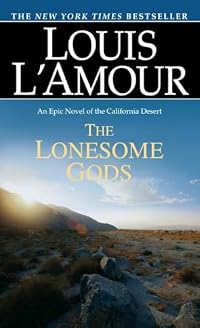
The Lonesome Gods
by Louis L'Amour
On This Page
Description
The classic Western, now newly repackaged as part of Bantam's Louis L'Amour's Lost Treasures program—with never-before-seen material from Louis and his son, Beau L'Amour."I am Johannes Verne, and I am not afraid."
This was the boy's mantra as he plodded through the desert alone, left to die by his vengeful grandfather. Johannes Verne was soon to be rescued by outlaws, but no one could save him from the lasting memory of his grandfather's eyes, full of impenetrable hatred. Raised in part show more by Indians, then befriended by a mysterious woman, Johannes grew up to become a rugged adventurer and an educated man. But even now, strengthened by the love of a golden-haired girl and well on his way to making a fortune in bustling early-day Los Angeles, the past may rise up to threaten his future once more. And this time only the ancient gods of the desert can save him.
Louis L’Amour’s Lost Treasures is a project created to release some of the author’s more unconventional manuscripts from the family archives.
In Louis L’Amour’s Lost Treasures: Volume 1 and Volume 2, Beau L’Amour takes the reader on a guided tour through many of the finished and unfinished short stories, novels, and treatments that his father was never able to publish during his lifetime. L’Amour’s never-before-seen first novel, No Traveller Returns, faithfully completed for this program, is a voyage into danger and violence on the high seas.
Additionally, many beloved classics will be rereleased with an exclusive Lost Treasures postscript featuring previously unpublished material, including outlines, plot notes, and alternate drafts. These postscripts tell the story behind the stories that millions of readers have come to know and cherish.. show less
Tags
Recommendations














Member Reviews
Louis L'Amour has a reputation as a prolific storyteller and a dependable one, but not as a remarkable one. Relying on formula to churn out bestselling potboilers by the hundreds, L'Amour established himself as the best-known writer of Westerns, even if he wasn't the best. I had, however, heard The Lonesome Gods described as one of this prolific, dependable storyteller's most remarkable books. This novel, longer than your usual L'Amour fare, was – I was told – more philosophical, more introspective, perhaps (whisper it) more literary.
Unfortunately, I found this not to be the case. The introspection, such as it is, is surface-level stuff; it is unfair to label it superficial, but it doesn't really do anything other than polish hoary show more old sentiments about desert mysticism. It might get your more casual reader thinking, but it will be completely underwhelming to anyone who reads regularly and widely. Nor is the book helped by the fact that the introspection comes from a very young protagonist: Johannes Verne is six years old when the story begins, and it follows him into his teens, but at all points he speaks logically, soberly and maturely. It's as though L'Amour could only write from the perspective of a taciturn, dyed-in-the-wool plainsman, and couldn't shake the narrative voice even when it's a six-year-old boy. Because of this, the more serious and thoughtful parts of the story are spiked with some unwelcome absurdity.
With The Lonesome Gods falling short in its ill-defined thematic goals, the reader retreats towards more dependable L'Amour terrain, in the hope of salvaging something from the experience. But the book struggles to make a mark even as a pulpy Western adventure. The characters are samey and the plot is unfocused; we're never entirely sure what Johannes Verne's goals are. Is he to defeat the villains and avenge his father? Is he to claim his rightful inheritance as a leader of men? Is he to claim the girl? Or is he meant to retreat into a solitary, spiritual life in the desert? We're never sure, and so when Verne claims a semblance of all of them, but none completely, we're left unfulfilled. L'Amour is on autopilot here, stirring the pot and bubbling up new points of conflict and resolving plot points, until the book's gone on so long that it's all gone a bit off the boil.
The book has its moments, but the moments it does have are ones that you can find more readily in leaner L'Amour adventures. And what it tries to do differently doesn't really work; there are interesting hints of 'the lonesome gods' of ancient, pre-Indian peoples who lived in the desert, but they're never really utilised – a decision made even stranger by the fact they are seemingly lent central importance by the title. Plot, character and theme don't support the book's ambitions, and the book muddles through without striking upon any note of substance. "There's something out there," Johannes Verne says on one of his many longing looks towards the desert, "something I've got to find. I feel sometimes like I'd lost something out there, but I don't know what it is" (pp277-8). L'Amour doesn't seem to know either, and the reader never finds out. show less
Unfortunately, I found this not to be the case. The introspection, such as it is, is surface-level stuff; it is unfair to label it superficial, but it doesn't really do anything other than polish hoary show more old sentiments about desert mysticism. It might get your more casual reader thinking, but it will be completely underwhelming to anyone who reads regularly and widely. Nor is the book helped by the fact that the introspection comes from a very young protagonist: Johannes Verne is six years old when the story begins, and it follows him into his teens, but at all points he speaks logically, soberly and maturely. It's as though L'Amour could only write from the perspective of a taciturn, dyed-in-the-wool plainsman, and couldn't shake the narrative voice even when it's a six-year-old boy. Because of this, the more serious and thoughtful parts of the story are spiked with some unwelcome absurdity.
With The Lonesome Gods falling short in its ill-defined thematic goals, the reader retreats towards more dependable L'Amour terrain, in the hope of salvaging something from the experience. But the book struggles to make a mark even as a pulpy Western adventure. The characters are samey and the plot is unfocused; we're never entirely sure what Johannes Verne's goals are. Is he to defeat the villains and avenge his father? Is he to claim his rightful inheritance as a leader of men? Is he to claim the girl? Or is he meant to retreat into a solitary, spiritual life in the desert? We're never sure, and so when Verne claims a semblance of all of them, but none completely, we're left unfulfilled. L'Amour is on autopilot here, stirring the pot and bubbling up new points of conflict and resolving plot points, until the book's gone on so long that it's all gone a bit off the boil.
The book has its moments, but the moments it does have are ones that you can find more readily in leaner L'Amour adventures. And what it tries to do differently doesn't really work; there are interesting hints of 'the lonesome gods' of ancient, pre-Indian peoples who lived in the desert, but they're never really utilised – a decision made even stranger by the fact they are seemingly lent central importance by the title. Plot, character and theme don't support the book's ambitions, and the book muddles through without striking upon any note of substance. "There's something out there," Johannes Verne says on one of his many longing looks towards the desert, "something I've got to find. I feel sometimes like I'd lost something out there, but I don't know what it is" (pp277-8). L'Amour doesn't seem to know either, and the reader never finds out. show less
I have long thought that Louis L'Amour's The Lonesome Gods had a lovely title. Even in the days when I was a student shelver at a provincial public library and thought westerns beneath me (largely due to their popularity with the Amish boys of the district), that title seemed wistfully appealing. Since my shelving days I have overcome quite a few prejudices, including that against westerns, and have enjoyed several of L'Amour's stories on audiobook. So when I saw this edition at the library, read by David Strathairn, I decided to find out why L'Amour's gods were so lonesome.
This is the story of Johannes Vern, whose parents were pursued into the Californian desert by his Spanish grandfather who was enraged at his daughter's marrying a show more poor white sailor. They escaped, but the old man's hatred never abated. Now at age six, his mother having died and his father dying of lung disease, Johannes is soon to be alone in the world. His father takes him to California, hoping the boy's grandfather will take him in, but Don Isidro has Zachary Vern shot and maroons Johannes in the desert. Johannes survives and grows to be a man, intent on revenge even while he is fascinated with the beauty of the desert and the mystery of the Indian legend of the giant Tahquitz.
I liked this story a lot less than I expected. For one thing, L'Amour is overly fond of waxing eloquent on reams of advice... most of it antithetical to my personal beliefs (very self-centered, self-reliant, tough-guy-type wisdom). Nor did I care for the mysticism and idealism with which he vests the Indians, or the needy, rather pathetic deities he imagines. At times the plot is rather forced, with friends and enemies of Johannes popping up at just the right moment. There are tons of people who want Johannes dead, more than are really necessary for the story (Fletcher in particular, but also Don Federico). The dialogue is frequently stilted, too.
And while L'Amour has certainly done his research, he is prone to info dumps, with a character expounding for pages and pages on the history of a region or people. Often this character is some rough cowhand or trapper who would be very unlikely to know the type of information he is imparting to Johannes (and us). L'Amour tries to explain that away by saying the men of California had lots of time in the wilderness to think and read, and many devoured all the books they could get their hands on. That may well be, but it's still strange to have a cowboy talk about ancient Greece and Shakespeare and other such subjects.
I have enjoyed several of L'Amour's other books so I won't drop him completely. But if this had been my introduction to his work, I might well have thought my old prejudice justified. Meh. show less
This is the story of Johannes Vern, whose parents were pursued into the Californian desert by his Spanish grandfather who was enraged at his daughter's marrying a show more poor white sailor. They escaped, but the old man's hatred never abated. Now at age six, his mother having died and his father dying of lung disease, Johannes is soon to be alone in the world. His father takes him to California, hoping the boy's grandfather will take him in, but Don Isidro has Zachary Vern shot and maroons Johannes in the desert. Johannes survives and grows to be a man, intent on revenge even while he is fascinated with the beauty of the desert and the mystery of the Indian legend of the giant Tahquitz.
I liked this story a lot less than I expected. For one thing, L'Amour is overly fond of waxing eloquent on reams of advice... most of it antithetical to my personal beliefs (very self-centered, self-reliant, tough-guy-type wisdom). Nor did I care for the mysticism and idealism with which he vests the Indians, or the needy, rather pathetic deities he imagines. At times the plot is rather forced, with friends and enemies of Johannes popping up at just the right moment. There are tons of people who want Johannes dead, more than are really necessary for the story (Fletcher in particular, but also Don Federico). The dialogue is frequently stilted, too.
And while L'Amour has certainly done his research, he is prone to info dumps, with a character expounding for pages and pages on the history of a region or people. Often this character is some rough cowhand or trapper who would be very unlikely to know the type of information he is imparting to Johannes (and us). L'Amour tries to explain that away by saying the men of California had lots of time in the wilderness to think and read, and many devoured all the books they could get their hands on. That may well be, but it's still strange to have a cowboy talk about ancient Greece and Shakespeare and other such subjects.
I have enjoyed several of L'Amour's other books so I won't drop him completely. But if this had been my introduction to his work, I might well have thought my old prejudice justified. Meh. show less
“I am Johannes Verne, and I am not afraid."
This was the boy’s mantra as he plodded through the desert alone, left to die by his vengeful grandfather. Johannes Verne was soon to be rescued by outlaws, but no one could save him from the lasting memory of his grandfather’s eyes, full of impenetrable hatred. Raised in part by Indians, then befriended by a mysterious woman, Johannes grew up to become a rugged adventurer and an educated man. But even now, strengthened by the love of a golden-haired girl and well on his way to making a fortune in bustling early-day Los Angeles, the past may rise up to threaten his future once more. And this time only the ancient gods of the desert can save him.
This was the boy’s mantra as he plodded through the desert alone, left to die by his vengeful grandfather. Johannes Verne was soon to be rescued by outlaws, but no one could save him from the lasting memory of his grandfather’s eyes, full of impenetrable hatred. Raised in part by Indians, then befriended by a mysterious woman, Johannes grew up to become a rugged adventurer and an educated man. But even now, strengthened by the love of a golden-haired girl and well on his way to making a fortune in bustling early-day Los Angeles, the past may rise up to threaten his future once more. And this time only the ancient gods of the desert can save him.
Louis L'Amour saved me with The Lonesome Gods, the story of Johannes Verne, a young boy who quickly becomes as man as he struggles for survival after his father dies. A sprawling tale set largely in the unforgiving landscapes of the deserts of California, New Mexico and Arizona, it is a classic western full of really bad dudes who eventually get what they deserve. Throughout, L'Amour digs into the human spirit with timely observations and lessons about how to live an honorable life.
I thoroughly enjoyed this book and have another L'Amour on the pile waiting for me!
I thoroughly enjoyed this book and have another L'Amour on the pile waiting for me!
A really good novel. Early Los Angeles setting and the Mojave Desert. Boy left orphaned and raised by woman with a past. Mystic elements which really work if you have ever sat alone in the desert. Good reading. Probably his most fully developed and rounded longer work.
All of L'Amour's writings encourage hard work and exercising one's character. This one in particular has a "relatively typical" plot line for LL in that a man alone must grow mentally, socially, and in knowledge in order to overcome all that life and his enemies throw at him.
In The Lonesome Gods, L'Amour departed from "typical" in that (like a few of his other novels) this one dwelt on our lack of understanding of supernatural manifestations. I generally don't enjoy these as much, nor jump at the chance to read pseudo-spiritual works. This one was tolerable because of other aspects.
Another component of every LL novel is the conflict of good and evil. Especially how small-minded individuals that have no desire to build anything lasting show more (and only take from anyone and everyone) not only harm individuals, but also communities and society as a whole. The main evil characters were Don Isidro: vain, extremely prejudiced grandfather, Frederico: selfish, Fletcher: cruel and suspicious of everyone, expecting them to have a similar lack of character as himself, Rad: an immature bully, and Chato: a purely evil murderer.
In most of his novels, "the man alone" prevails over "the crowd of evil," but this one also highlights everyone's need for loyal, morally good, and tough friends, as well as how sometimes the friends one has made are all that stand between a long, full life and an untimely death. The good characters are (of course) the main character -- Johannes Verne, his father Zachary, Miss Nesselrode, Farley, Kelso, Meghan, and Thomas Fraser.
The element of the novel that tied it all together was the desert. It is harsh, yet one can live in harmony with it, or not -- and suffer terminal consequences.
While I enjoyed the book, it was not one of my all-time favorites. show less
In The Lonesome Gods, L'Amour departed from "typical" in that (like a few of his other novels) this one dwelt on our lack of understanding of supernatural manifestations. I generally don't enjoy these as much, nor jump at the chance to read pseudo-spiritual works. This one was tolerable because of other aspects.
Another component of every LL novel is the conflict of good and evil. Especially how small-minded individuals that have no desire to build anything lasting show more (and only take from anyone and everyone) not only harm individuals, but also communities and society as a whole. The main evil characters were Don Isidro: vain, extremely prejudiced grandfather, Frederico: selfish, Fletcher: cruel and suspicious of everyone, expecting them to have a similar lack of character as himself, Rad: an immature bully, and Chato: a purely evil murderer.
In most of his novels, "the man alone" prevails over "the crowd of evil," but this one also highlights everyone's need for loyal, morally good, and tough friends, as well as how sometimes the friends one has made are all that stand between a long, full life and an untimely death. The good characters are (of course) the main character -- Johannes Verne, his father Zachary, Miss Nesselrode, Farley, Kelso, Meghan, and Thomas Fraser.
The element of the novel that tied it all together was the desert. It is harsh, yet one can live in harmony with it, or not -- and suffer terminal consequences.
While I enjoyed the book, it was not one of my all-time favorites. show less
This is my second of L'Amour's books I have read, and the quality continues. He missed earning a full five stars only because his point-of-view changes are sometimes uncomfortable and he repeats several sentgences again and again. But when I step into his world, I am in the desert with the people he introduceds me to.
Members
- Recently Added By
Author Information

870+ Works 99,425 Members
Born in Jamestown, North Dakota on March 22, 1908, Louis L'Amour's adventurous life could have been the subject of one of his novels. Striking out on his own in 1923, at age 15, L'Amour began a peripatetic existence, taking whatever jobs were available, from skinning dead cattle to being a sailor. L'Amour knew early in life that he wanted to be a show more writer, and the experiences of those years serve as background for some of his later fiction. During the 1930s he published short stories and poetry; his career was interrupted by army service in World War II. After the war, L'Amour began writing for western pulp magazines and wrote several books in the Hopalong Cassidy series using the pseudonym Tex Burns. His first novel, Westward the Tide (1950), serves as an example of L'Amour's frontier fiction, for it is an action-packed adventure story containing the themes and motifs that he uses throughout his career. His fascination with history and his belief in the inevitability of manifest destiny are clear. Also present and typical of L'Amour's work are the strong, capable, beautiful heroine who is immediately attracted to the equally capable hero; a clear moral split between good and evil; reflections on the Native Americans, whose land and ways of life are being disrupted; and a happy ending. Although his work is somewhat less violent than that of other western writers, L'Amour's novels all contain their fair share of action, usually in the form of gunfights or fistfights. L'Amour's major contribution to the western genre is his attempt to create, in 40 or more books, the stories of three families whose histories intertwine as the generations advance across the American frontier. The novels of the Irish Chantry, English Sackett, and French Talon families are L'Amour's most ambitious project, and sadly were left unfinished at his death. Although L'Amour did not complete all of the novels, enough of the series exists to demonstrate his vision. L'Amour's strongest attribute is his ability to tell a compelling story; readers do not mind if the story is similar to one they have read before, for in the telling, L'Amour adds enough small twists of plot and detail to make it worth the reader's while. L'Amour fans also enjoy the bits of information he includes about everything from wilderness survival skills to finding the right person to marry. These lessons give readers the sense that they are getting their money's worth, that there is more to a L'Amour novel than sheer escapism. With over 200 million copies of his books in print worldwide, L'Amour must be counted as one of the most influential writers of westerns in this century. He died from lung cancer on June 10, 1988. (Bowker Author Biography) Louis L'Amour, truly America's favorite storyteller, was the first fiction writer ever to receive the Congressional Gold Medal from the United States Congress in honor of his life's work, & was also awarded the Medal of Freedom. There are over 260 million copies of his books in print worldwide. (Publisher Provided) show less
Awards and Honors
Distinctions
Common Knowledge
- Canonical title
- The Lonesome Gods
- Original title
- The Lonesome Gods
- Original publication date
- 1983
- People/Characters
- Johannes Verne; Zachery Verne; Jacob Finney; Miss Nesselrode; Peg-Leg Smith; Kelso (show all 45); Peter Burkin; Francisco; Tahquitz (Alfredo Verne); Meghan Laurel; Don Isidro Verne; Tia Elena Verne; Doug Farley; Fletcher; Thomas Fraser; Mrs. Weber; William Wolfskill; Benito Wilson; Workman; Abel Stearns; Isaac Williams; Adam Verne; Rad Huber; Philo Burns; Dela Court; Kelda O'Brien; Pio Pico; R. F. Stockton; Monte McCalla; Paulino Weaver; Sexton; Juan Antonio; Ramon; Alejandro; Martin; Diego; Jaime; Selmo; Chato Valdez; Federico Villegra; Yacub Khan; Liu Ch'ag; Alexis Murchison; Owen Hardin; Myron Brodie
- Important places
- Los Angeles, California, USA; Mohave Desert, California, USA; Agua Caliente, California, USA; Cahuilla, California, USA; La Brea Tar Pits, Los Angeles, California, USA
- Epigraph
- [None]
- Dedication
- To the Applebaum boys, Stuart and Irwyn
- First words
- I sat very still, as befitted a small boy among strangers, staring wide-eyed into a world I did not know.
- Last words
- (Click to show. Warning: May contain spoilers.)"I am Johannes Verne," I said, "and I was not afraid."
Classifications
Statistics
- Members
- 1,348
- Popularity
- 17,673
- Reviews
- 18
- Rating
- (4.04)
- Languages
- English, Norwegian (Bokmål), Russian, Swedish
- Media
- Paper, Audiobook, Ebook
- ISBNs
- 25
- ASINs
- 16