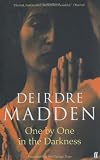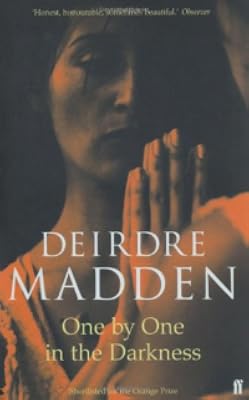
One by One in the Darkness
by Deirdre Madden
On This Page
Description
This is a novel about three sisters: Helen, a lawyer in Belfast; Cate, who works for a magazine in London; and Sally, a teacher in a mid-Ulster primary school. The story describes their childhood and the impact of terrorism on their community.Tags
Recommendations












Member Recommendations
Member Reviews
I am so grateful for the Women's Prize for Fiction (formerly the Orange Prize), for introducing me to Deirdre Madden. I read her 2009 shortlisted novel, Molly Fox's Birthday, two years ago, and then discovered she'd been nominated once before, in 1997, for One by One in the Darkness. It took ages for me to find this book -- my library didn't have it, and it was outrageously expensive through online retailers. Finally, Paperbackswap granted my wish. And I couldn't be happier; this quiet, unassuming novel is a gem.
The story is set in 1994, just before the IRA ceasefire. Three sisters converge on their family home for a week. Middle sister Cate arrives on her annual visit, weeks earlier than usual, citing work as an excuse. Oldest sister show more Helen visits almost every weekend, and immediately spots inconsistencies in Cate's story. Sally, the youngest, is a teacher in the village and lives at home with her mother. Not surprisingly, it turns out Cate has reasons for visiting early which create some conflict in the family.
The relationships between the sisters and their mother are fleshed out through flashbacks to their childhood:
For the pattern of their lives was as predictable as the seasons. The regular round of necessity was broken by celebrations and feasts: Christmas, Easter, family birthdays. The scope of their lives was tiny but it was profound, and to them, it was immense. The physical bounds of their world were confined to little more than a few fields and houses, but they knew these places with the deep, unconscious knowledge that a bird or a fox might have for its habitat. The idea of home was something they lived so completely that they would be been at a loss to define it. But they would have known to be inadequate such phrases as 'It's where you're from,' 'It's the place you live,' 'It's where your family are.'
Sadly, this predictable, peaceful pattern was shattered in 1968-69 as civil rights protests became increasingly violent. Living in a rural village, events seemed remote for a while. But eventually they, too, were affected by senseless, tragic acts.
I loved the juxtaposition of past and present, which delivered a richly detailed story in just 180 pages. This was the first time I had read such a personal account of this period in Irish history. I felt like I knew these people. Their history was new to me, but their contemporary struggles were not. And the ending took my breath away, revealing details only alluded to before, while leaving so much open to interpretation. show less
The story is set in 1994, just before the IRA ceasefire. Three sisters converge on their family home for a week. Middle sister Cate arrives on her annual visit, weeks earlier than usual, citing work as an excuse. Oldest sister show more Helen visits almost every weekend, and immediately spots inconsistencies in Cate's story. Sally, the youngest, is a teacher in the village and lives at home with her mother. Not surprisingly, it turns out Cate has reasons for visiting early which create some conflict in the family.
The relationships between the sisters and their mother are fleshed out through flashbacks to their childhood:
For the pattern of their lives was as predictable as the seasons. The regular round of necessity was broken by celebrations and feasts: Christmas, Easter, family birthdays. The scope of their lives was tiny but it was profound, and to them, it was immense. The physical bounds of their world were confined to little more than a few fields and houses, but they knew these places with the deep, unconscious knowledge that a bird or a fox might have for its habitat. The idea of home was something they lived so completely that they would be been at a loss to define it. But they would have known to be inadequate such phrases as 'It's where you're from,' 'It's the place you live,' 'It's where your family are.'
Sadly, this predictable, peaceful pattern was shattered in 1968-69 as civil rights protests became increasingly violent. Living in a rural village, events seemed remote for a while. But eventually they, too, were affected by senseless, tragic acts.
I loved the juxtaposition of past and present, which delivered a richly detailed story in just 180 pages. This was the first time I had read such a personal account of this period in Irish history. I felt like I knew these people. Their history was new to me, but their contemporary struggles were not. And the ending took my breath away, revealing details only alluded to before, while leaving so much open to interpretation. show less
In this 1996 novel, Deirdre Madden writes movingly about three sisters in their thirties who grew up in rural Northern Ireland as the late 1960s Troubles flared. The novel is premised on the middle sister's visit home to share important news. Beautiful, glamorous Kate (or, as she has preferred to call herself "Cate"--to shave off some of the "Irishness", much to her family's chagrin) fled the misery of her homeland to work for a London fashion magazine. Since tragedy struck the family a couple of years ago, however, her life has lacked its former lustre. The eldest Quinn daughter, Helen, is a successful Belfast lawyer, some of whose professional work involves defending young men charged with terrorism. Studious and driven in girlhood show more and now perceived by her family as austere, Helen was the closest of the girls to their kind and principled father. She was also the one laid lowest by his death. Sally, the youngest sister, always a frail girl growing up, has over the years become her mother's right hand, demonstrating remarkable emotional strength. She has followed in her mother and maternal grandfather's footsteps and teaches at the local primary school. It has not been easy, and in recent years she has felt compelled to escape.
This short fourteen-chapter novel is structured in an interesting manner. Odd chapters are named for the days of the week that Kate visits with her family; they focus on the present. Even chapters focus on the past: the girls' lovely outings with their father and lively paternal grandmother; the strained visits with their embittered black-clad maternal grandmother; their uncles--one, a sensitive, troubled alcoholic and the other, a jolly but worrisomely committed Republican. As the novel progresses, The Troubles increasingly encroach on the lives of the Quinn family. The older brother of a schoolmate is killed. Protestant tradesmen who used to do business with the family no longer do. The British soldiers arrive, and even pay a visit to the Quinn home--to scout out the outbuildings of the farm and inquire about dogs. Civil rights demonstrations dominate the news. Checkpoints become a fact of life.
Elegiac in tone, much of the novel focuses on the death of Charlie Quinn, the sisters' father. Madden presents a particularly moving scene that Helen remembers from childhood when she heard her father moving about downstairs and left her bed to speak to him. But the book is also forward-looking: Kate's news must be absorbed and adjusted to.
One by One in the Darkness is a beautiful novel, which, in spite of its brevity, manages to say a great deal about life in Northern Ireland in the latter part of the twentieth century. Recommended. show less
This short fourteen-chapter novel is structured in an interesting manner. Odd chapters are named for the days of the week that Kate visits with her family; they focus on the present. Even chapters focus on the past: the girls' lovely outings with their father and lively paternal grandmother; the strained visits with their embittered black-clad maternal grandmother; their uncles--one, a sensitive, troubled alcoholic and the other, a jolly but worrisomely committed Republican. As the novel progresses, The Troubles increasingly encroach on the lives of the Quinn family. The older brother of a schoolmate is killed. Protestant tradesmen who used to do business with the family no longer do. The British soldiers arrive, and even pay a visit to the Quinn home--to scout out the outbuildings of the farm and inquire about dogs. Civil rights demonstrations dominate the news. Checkpoints become a fact of life.
Elegiac in tone, much of the novel focuses on the death of Charlie Quinn, the sisters' father. Madden presents a particularly moving scene that Helen remembers from childhood when she heard her father moving about downstairs and left her bed to speak to him. But the book is also forward-looking: Kate's news must be absorbed and adjusted to.
One by One in the Darkness is a beautiful novel, which, in spite of its brevity, manages to say a great deal about life in Northern Ireland in the latter part of the twentieth century. Recommended. show less
Madden has woven a literary tapestry of sorts by exploring the memories and reflections of three sisters and their mother in Northern Ireland as they face a development in one of their lives and think back over their past. None of the sisters have married, yet they have chosen very different paths in adulthood; one a magazine editor, one a lawyer whose firm often defends IRA terrorists, and one a stay-home-and-care-for-Mother teacher. We see how their personalities developed to make them who they are in the 1990's. As they remember their early life, it becomes clear that their father was a victim of the violence during the Troubles, as as result of a case of mistaken identity. Naturally this was a defining moment, not only for them and show more their mother, but for other members of the family as well. The novel's pattern is intricate, yet all the threads come together without a tangle at the end. Usually with a set-up like this, I would favor one character over the others, or strongly dislike and disagree with one of them. That didn't happen here. I felt sympathy for each woman, and understood how their varied life choices arose from the same set of circumstances. My reservations about the structure are two-fold. First, I occasionally got lost in time, and was a bit muddled as to whose memories I was sharing. There is very little action in real time, so it takes concentration to keep track of the who and when. The author used a nifty trick with one of the characters, who changed the spelling of her first name when she left home. That leads me to my second quibble; although recognizing the difference between "Kate" and "Cate" made it easy to keep track of her, it also made me too aware of the presence of the author, a feeling that sometimes carried over into other sections of the novel. So although the overall effect is of a well-crafted work, at times I was a little distracted by the technique involved. I think I'd benefit by re-reading the book, but I don't think it warrants that much more of my time.
Review written in September 2017 show less
Review written in September 2017 show less
The political Troubles (a euphemism for civil war) and the personal troubles of one close-knit Irish family are the backbone of this lyrical novel set in Northern Ireland in 1994. The chapters alternate between the present time when the Quinn family was trying to reconcile themselves to their patriarch's senseless death and the earlier memories of the 25 years of random violence that shaped the lives of the three Quinn sisters: Helen, Cate, and Sally.
The author made me care about this family and helped me understand the ramifications of daily life in troubled times. There were notable brief glimpses into history such as protest marches that turned into riots; however, the significance of family ties between the sisters whose "idea of show more home was something they lived so completely that they would ave been at a loss to define it" allowed me to grasp the pain and sacrifice that underlies historical events.
This book was shortlisted for the Orange Prize in 1997 and, in my opinion, deserves more recognition for a quiet well-told story about a tumultuous time. show less
The author made me care about this family and helped me understand the ramifications of daily life in troubled times. There were notable brief glimpses into history such as protest marches that turned into riots; however, the significance of family ties between the sisters whose "idea of show more home was something they lived so completely that they would ave been at a loss to define it" allowed me to grasp the pain and sacrifice that underlies historical events.
This book was shortlisted for the Orange Prize in 1997 and, in my opinion, deserves more recognition for a quiet well-told story about a tumultuous time. show less
Three sisters have gathered at their childhood home in Northern Ireland for a visit. Cate, a journalist for a home/fashion magazine in London, is early for her annual visit; a detail that is not lost on older sister, Helen. Helen, a solicitor in Belfast, comes home every weekend, and Sally, the youngest and a teacher, already lives at home with their mother. The story bounces between present day and the three sisters's childhood in alternating chapters. Madden uses clever clues like the spelling of Cate/Kate to indicate past or present. When Kate became an adult she changed her name to Cate. So for chapters in the past it is Kate while for present-day chapters it is Cate.
Cate, Helen and Sally grew up in the 1960s and 70s during the show more Troubles and it's this historical background that drives the present day story of the mid 1990s and the IRA ceasefire. There isn't a plot to speak of, just the coping of four women after the death of the head of the household. show less
Cate, Helen and Sally grew up in the 1960s and 70s during the show more Troubles and it's this historical background that drives the present day story of the mid 1990s and the IRA ceasefire. There isn't a plot to speak of, just the coping of four women after the death of the head of the household. show less
A quietly powerful book. I wasn't sure about it to start with. We have these three sisters in Northern Ireland in 1994. One is beautiful, one is clever and the third is kind. Yes, I think I've met them before! There are regular flashbacks to a pretty average childhood with Sunday Mass, various uncles and aunts and chicken dinners followed by tinned peaches.The writing was fairly simple and it all seemed a bit ho-hum.
But then things change. The rest of the sisters' childhood is spent during a time of fear, violence and agression which leads to personal tragedy for the family and which affects each of them into their adult lives. I found the effects of The Troubles on this family all the more shocking because things had been plodding show more along so quietly before hand and realised Madden was doing much more with this book than I'd realised.
I am probably the same age as the sisters in this book and grew up in England with constant news stories about the situation in Northern Ireland. Much of the information was sensational. Just about all of it was political. I don't remember hearing much sympathy for those living through it. This book made me realise how little I'd thought about how growing up at this time would feel.
The final pages were devastating. I was left needing to sit quietly afterwards and think of those affected, not very far away and not very long ago. show less
But then things change. The rest of the sisters' childhood is spent during a time of fear, violence and agression which leads to personal tragedy for the family and which affects each of them into their adult lives. I found the effects of The Troubles on this family all the more shocking because things had been plodding show more along so quietly before hand and realised Madden was doing much more with this book than I'd realised.
I am probably the same age as the sisters in this book and grew up in England with constant news stories about the situation in Northern Ireland. Much of the information was sensational. Just about all of it was political. I don't remember hearing much sympathy for those living through it. This book made me realise how little I'd thought about how growing up at this time would feel.
The final pages were devastating. I was left needing to sit quietly afterwards and think of those affected, not very far away and not very long ago. show less
I found this to be quite an interesting read, telling me more about The Troubles in Northern Ireland than I knew. However I was surprised that I didn't find the story more emotionally engaging. It seemed to me that Madden's style of story telling was to avoid the detail of conflict and emotion and I was left wondering why that was so and how this approach might or might not contribute to the power of the story
Members
- Recently Added By
Lists

Best Books With Sisters
130 works; 30 members
Talk Discussions
Past Discussions
One by One in Darkness by Deirdre Madden in Orange January/July (August 2011)
Author Information

12+ Works 855 Members
Awards and Honors
Awards
Notable Lists
Common Knowledge
- Original publication date
- 1996
- Important places
- Northern Ireland, UK
- First words
- Home was a huge sky; it was flat fields of poor land fringed with hawthorn and alder.
- Last words
- (Click to show. Warning: May contain spoilers.)In the solid stone house, the silence was uncanny. One by one in the darkness, the sisters slept.
Classifications
Statistics
- Members
- 142
- Popularity
- 229,823
- Reviews
- 13
- Rating
- (3.90)
- Languages
- English, French, Spanish
- Media
- Paper, Ebook
- ISBNs
- 8
- ASINs
- 2