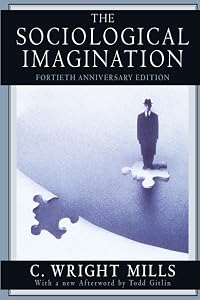
The Sociological Imagination
by C. Wright Mills
On This Page
Description
C. Wright Mills is best remembered for his highly acclaimed work The Sociological Imagination, in which he set forth his views on how social science should be pursued. Hailed upon publication as a cogent and hard-hitting critique, The Sociological Imagination took issue with the ascendant schools of sociology in the United States, calling for a humanist sociology connecting the social, personal, and historical dimensions of our lives. The sociological imagination Mills calls for is a show more sociological vision, a way of looking at the world that can see links between the apparently private problems of the individual and important social issues. show lessTags
Recommendations




















Member Recommendations
Member Reviews
Probably some good stuff here, but past the first chapter it becomes unbearably dense, and I was unsure of how each of the chapters connected to each other. Will probably appreciate more after it's taught/put into better context vis a vis other works of soc theory
covers have age wear but good overall condition.
Ratings
Members
- Recently Added By
Lists

Sociology
18 works; 1 member
Author Information

42+ Works 4,260 Members
C. Wright Mills, an American sociologist, was one of the most controversial social scientists of the mid-twentieth century. He considered himself a rebel against both the academic establishment and American society in general, and he rarely tried to separate his radical ideas from his teaching and writing. Irving Louis Horowitz summarized much of show more Mills's ideas in the subtitle of his biography of him: An American Utopian. Mill's most traditional sociological study is The Puerto Rican Journey. His most direct attack on his colleagues in sociology is The Sociological Imagination (1959) (which he found left much to be desired). His most ideological work is The Power Elite (1956), an attempt to explain the overall power structure of the United States. Mills thought that the dominant "value-free" methodology of American sociology was an ideological mask, hiding values that he did not share. According to his younger colleague Immanuel Wallerstein, Mills was essentially a utopian reformer who thought that knowledge properly used could bring about a better society. (Bowker Author Biography) show less
Awards and Honors
Series
Belongs to Publisher Series
Aula-boeken (491)
Common Knowledge
- Canonical title
- The Sociological Imagination
- Original publication date
- 1959
- Dedication
- For Harvey and Bette
- First words
- Nowadays men often feel that their private lives are a series of traps.
- Last words
- (Click to show. Warning: May contain spoilers.)Within that range the life of the individual and the making of societies occur; and within that range the sociological imagination has its chance to make a difference in the quality of human life in our time.
- Original language*
- Engels
*Some information comes from Common Knowledge in other languages. Click "Edit" for more information.
Classifications
Statistics
- Members
- 999
- Popularity
- 26,237
- Reviews
- 2
- Rating
- (4.07)
- Languages
- 13 — Catalan, Chinese, Czech, Danish, Dutch, English, Finnish, French, German, Italian, Spanish, Swedish, Turkish
- Media
- Paper, Audiobook, Ebook
- ISBNs
- 36
- ASINs
- 11