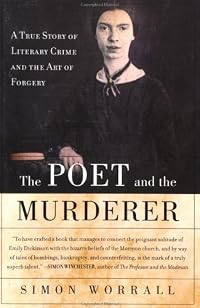
The Poet and the Murderer
by Simon Worrall
On This Page
Description
Chronicles Mark Hofmann's attempt to forge an Emily Dickinson poem at the end of the twentieth century, and discusses how his deceit and greed undermined some of the most prominent institutions of present-day academia.Tags
Recommendations






Member Reviews
I was excited to learn that there had been an attempted Dickinson forgery not too long ago. Not only did Mark Hofmann successfully (and profitably) forge Dickinson's writing; he wrote a whole new poem and passed it off as a previously unknown piece of her work.
A "new" Dickinson poem is always a possibility. She left behind a disordered mass of writing that, fortunately for all of us, her sister ignored instructions to destroy and instead set about attempting to publish. This was no easy task for many reasons, including Dickinson's difficult handwriting and her sister's eventual choice of editors -- namely, her brother's mistress. That brother's wife didn't appreciate this choice at all -- and she happened to live right next door, and show more had her own copies of plenty of Dickinson's poems.
More about this in my upcoming review of Lives Like Loaded Guns: Emily Dickinson and Her Family's Feuds. Suffice to say, no writer has ever had a more bizarre publication history than Dickinson. Lots of court battles; hatred passed down to the next generation; trunks of precious manuscripts hidden away by people who were NOT Dickinson's literary heirs -- really, it's a wonder any of us have even heard of Emily Dickinson, let alone had the chance to read her work.
Anyway. More about that in another review. My point is, the idea of a lost Dickinson poem is a good one, as criminal ideas go, and Mark Hofmann ran with it. Unrelated to this particular forgery, he also murdered two people.
My current work in progress involves a young woman who's the focal point of a slew of unsolved murders. She's also obsessed with Emily Dickinson. A case of the poet's life intersecting with that of a murderer seemed like something my heroine would be drawn to.
The short review: I would have been better off just reading an article about the forger.
The details: The only good I got out of this book was the chance to look at a photo of the forgery.
Yes, okay, hindsight is 20-20 and I'm an arrogant jerk for saying this, but I didn't think the writing was especially convincing. There aren't enough dashes, for one thing. The question mark is too tall. And the handwriting is too loopy to be an early poem and too neat to be a late one. (Yes, I'm lucky enough to own The Manuscript Books Of Emily Dickinson, which I never would have been able to afford to buy myself. Thank you, Mama Ginny, for stepping in and letting me pretend to be as rich as my own heroine.)
In case you're wondering, here's the poem itself:
That God cannot
be understood
Everyone agrees
We do not know
His motives nor
Comprehend his
Deeds ---
Then why should I
Seek solace in
What I cannot
Know?
Better to play
In winter's sun
Than to fear the
Snow
It's not a particularly good poem, as scholars agreed even at the time they believed it was hers. It's also not nearly as shocking as Hofmann, a disillusioned Mormon, apparently thought it would be.
Dickinson's poetry is often surprisingly sassy when it comes to religion. Having read a decent number of her poems and letters, as well as a lot of biographical material, I think it's safe to conclude she was an agnostic. She seems to have believed in a God, but not necessarily the Christian one. She didn't feel at all sure there was any afterlife, as we can see from this snippet from a letter to a friend who'd recently been widowed and who talked about seeing his wife in Heaven:
You speak with so much trust of that which only trust can prove, it makes me feel away, as if my English mates spoke sudden in Italian.
It grieves me that you speak of Death with so much expectation....Dying is a wild Night and a new Road.
So Hofmann may not have been as shocking as he expected to be by implying that Dickinson didn't think the mind of God could be known.
Unfortunately for me, most of this book is about the rest of Hofmann's career, which was largely involved with Mormon forgeries. Even more unfortunately for me, the parts of this book that deal with Dickinson are so annoyingly misleading and inaccurate that I did a lot of yelling, and I've been trying so hard to cut down on that.
He gets little things wrong:
After her death many poems and letters were destroyed by her family.
Not true. So far as I know, not a single poem was destroyed. Letters written to her were, and her sister Lavinia regretted that immediately -- but it was the custom of the time as well as Dickinson's wish for her to do so. But the poems were recognized immediately as too valuable to go under the match.
No forger would know this most private and secretive of poets well enough to know that though she kept almost everyone else in her life at arm's length, she had always felt at ease with children. It would have taken Hofmann months, if not years, of research to get to this level of intimacy with her.
Not true at all. One of the best-known stories about Dickinson is her habit during her life of lowering treats in a basket to the children who came to play in the Dickinson yard. One of those children grew up to write a book about how much those kids loved Dickinson because she so clearly loved them. And every major biographer seems in agreement that the death of her young nephew seems to have hastened her own death.
And then he gets BIG things wrong:
That was the other side of small-town life. Everyone was in everyone else's business. Emily had known that. Eventually she would not even leave her house, so frightened and disgusted was she by the rumors and back-biting, the matrons in black tut-tutting on the street, those mean-spirited shrews, who all claimed to be good Christian women, whispering about Sapphic love and secret meetings she was supposed to have with married men.
Where do I even begin? For one thing, Dickinson's famous reclusiveness is famous most of all for being so mysterious. No one knows exactly why she began to stay more and more at home, eventually barely leaving even her own room. Some think this must have been mental illness of one kind or another -- depression and/or agoraphobia certainly don't seem unlikely. One biographer thinks she was epileptic. But none of them can say for certain that they've solved this strange, quiet mystery.
Enter Simon Worrall, who apparently managed a posthumous mind meld with the poet!
As for the "Sapphic love" -- oh, give me strength. It wasn't until comparatively recently that Dickinson's deep affection for her sister-in-law was considered -- by scholars, not gossipy neighbor women -- to have been perhaps more than just friendly. And even these scholars don't all think this romantic love was ever expressed physically. NO one during Dickinson's life ever thought or said any such thing. If anything, the myth ran too far in the other direction -- that in spite of Dickinson's love for her family, she eventually wouldn't leave her house even to visit dear Sue who lived right next door.
And affairs with married men? Unless Worrall's talking about biographers speculating that Dickinson had a crush on married friend Samuel Bowles, I don't know what he could mean.
At times, Worrall's inaccuracy leaps into the offensive:
Dickinson and her family took great pains to ensure that her secret lover remained secret (there are suggestions that she had a clandestine abortion in Amherst in 1861).
(head DESK)
The "secret lover" is a reference to a few letters Dickinson wrote but never sent. We have no idea to whom, if anyone, they were intended. Susan Howe, in My Emily Dickinson, makes an excellent argument that these should be regarded as works of literature rather than the pitiful remains of an unrequited passion. One question I've never seen any biographer willing to tackle is why, if these letters were just plain hot stuff meant for a real person, Dickinson kept them in the first place, knowing that someday they were bound to be found by her family.
As for the alleged "suggestions" of an abortion -- where? Where are the suggestions? I've been reading a bleep-ton about Dickinson lately (as you may have noticed), and I've never heard a thing about this.
What I have heard is that Austin Dickinson's mistress insisted that Sue Dickinson (his wife and Emily's cherished friend) had attempted a few abortions of her own. The fact that this mistress was looking for every piece of fuel she could find to justify her affair with Dickinson's brother means that we should regard her as a hostile witness and take anything she says with a world-record sized boulder of salt.
It is clear that Emily Dickinson fell madly, deeply in love with him [Samuel Bowles].
No, it ISN'T. Again, that's one of the mysteries of Dickinson's deeply mysterious life: who, if anyone, did she love in her younger years?
She did have a late-life love affair of sorts with Otis Phillips Lord, but this consisted primarily of tender and often passionate letters, and occasional make-out sessions on the sofa. (No, really. She was in her fifties. I was so thrilled to hear about that, I can't even.) That's all we know for sure about her love life.
But here comes Worrall, insisting in a book that isn't even primarily about Dickinson that he's the world expert on the things that still baffle other biographers.
So, yeah, I learned a lot about forgery in general and Mark Hofmann's career in particular. Maybe. Frankly, given the mistakes Worrall made about Dickinson, I'm worried that the rest of this book may not be particularly credible.
I regret to say that -- other than the peek it gave me of the Dickinson forgery -- this book was a huge disappointment. show less
A "new" Dickinson poem is always a possibility. She left behind a disordered mass of writing that, fortunately for all of us, her sister ignored instructions to destroy and instead set about attempting to publish. This was no easy task for many reasons, including Dickinson's difficult handwriting and her sister's eventual choice of editors -- namely, her brother's mistress. That brother's wife didn't appreciate this choice at all -- and she happened to live right next door, and show more had her own copies of plenty of Dickinson's poems.
More about this in my upcoming review of Lives Like Loaded Guns: Emily Dickinson and Her Family's Feuds. Suffice to say, no writer has ever had a more bizarre publication history than Dickinson. Lots of court battles; hatred passed down to the next generation; trunks of precious manuscripts hidden away by people who were NOT Dickinson's literary heirs -- really, it's a wonder any of us have even heard of Emily Dickinson, let alone had the chance to read her work.
Anyway. More about that in another review. My point is, the idea of a lost Dickinson poem is a good one, as criminal ideas go, and Mark Hofmann ran with it. Unrelated to this particular forgery, he also murdered two people.
My current work in progress involves a young woman who's the focal point of a slew of unsolved murders. She's also obsessed with Emily Dickinson. A case of the poet's life intersecting with that of a murderer seemed like something my heroine would be drawn to.
The short review: I would have been better off just reading an article about the forger.
The details: The only good I got out of this book was the chance to look at a photo of the forgery.
Yes, okay, hindsight is 20-20 and I'm an arrogant jerk for saying this, but I didn't think the writing was especially convincing. There aren't enough dashes, for one thing. The question mark is too tall. And the handwriting is too loopy to be an early poem and too neat to be a late one. (Yes, I'm lucky enough to own The Manuscript Books Of Emily Dickinson, which I never would have been able to afford to buy myself. Thank you, Mama Ginny, for stepping in and letting me pretend to be as rich as my own heroine.)
In case you're wondering, here's the poem itself:
That God cannot
be understood
Everyone agrees
We do not know
His motives nor
Comprehend his
Deeds ---
Then why should I
Seek solace in
What I cannot
Know?
Better to play
In winter's sun
Than to fear the
Snow
It's not a particularly good poem, as scholars agreed even at the time they believed it was hers. It's also not nearly as shocking as Hofmann, a disillusioned Mormon, apparently thought it would be.
Dickinson's poetry is often surprisingly sassy when it comes to religion. Having read a decent number of her poems and letters, as well as a lot of biographical material, I think it's safe to conclude she was an agnostic. She seems to have believed in a God, but not necessarily the Christian one. She didn't feel at all sure there was any afterlife, as we can see from this snippet from a letter to a friend who'd recently been widowed and who talked about seeing his wife in Heaven:
You speak with so much trust of that which only trust can prove, it makes me feel away, as if my English mates spoke sudden in Italian.
It grieves me that you speak of Death with so much expectation....Dying is a wild Night and a new Road.
So Hofmann may not have been as shocking as he expected to be by implying that Dickinson didn't think the mind of God could be known.
Unfortunately for me, most of this book is about the rest of Hofmann's career, which was largely involved with Mormon forgeries. Even more unfortunately for me, the parts of this book that deal with Dickinson are so annoyingly misleading and inaccurate that I did a lot of yelling, and I've been trying so hard to cut down on that.
He gets little things wrong:
After her death many poems and letters were destroyed by her family.
Not true. So far as I know, not a single poem was destroyed. Letters written to her were, and her sister Lavinia regretted that immediately -- but it was the custom of the time as well as Dickinson's wish for her to do so. But the poems were recognized immediately as too valuable to go under the match.
No forger would know this most private and secretive of poets well enough to know that though she kept almost everyone else in her life at arm's length, she had always felt at ease with children. It would have taken Hofmann months, if not years, of research to get to this level of intimacy with her.
Not true at all. One of the best-known stories about Dickinson is her habit during her life of lowering treats in a basket to the children who came to play in the Dickinson yard. One of those children grew up to write a book about how much those kids loved Dickinson because she so clearly loved them. And every major biographer seems in agreement that the death of her young nephew seems to have hastened her own death.
And then he gets BIG things wrong:
That was the other side of small-town life. Everyone was in everyone else's business. Emily had known that. Eventually she would not even leave her house, so frightened and disgusted was she by the rumors and back-biting, the matrons in black tut-tutting on the street, those mean-spirited shrews, who all claimed to be good Christian women, whispering about Sapphic love and secret meetings she was supposed to have with married men.
Where do I even begin? For one thing, Dickinson's famous reclusiveness is famous most of all for being so mysterious. No one knows exactly why she began to stay more and more at home, eventually barely leaving even her own room. Some think this must have been mental illness of one kind or another -- depression and/or agoraphobia certainly don't seem unlikely. One biographer thinks she was epileptic. But none of them can say for certain that they've solved this strange, quiet mystery.
Enter Simon Worrall, who apparently managed a posthumous mind meld with the poet!
As for the "Sapphic love" -- oh, give me strength. It wasn't until comparatively recently that Dickinson's deep affection for her sister-in-law was considered -- by scholars, not gossipy neighbor women -- to have been perhaps more than just friendly. And even these scholars don't all think this romantic love was ever expressed physically. NO one during Dickinson's life ever thought or said any such thing. If anything, the myth ran too far in the other direction -- that in spite of Dickinson's love for her family, she eventually wouldn't leave her house even to visit dear Sue who lived right next door.
And affairs with married men? Unless Worrall's talking about biographers speculating that Dickinson had a crush on married friend Samuel Bowles, I don't know what he could mean.
At times, Worrall's inaccuracy leaps into the offensive:
Dickinson and her family took great pains to ensure that her secret lover remained secret (there are suggestions that she had a clandestine abortion in Amherst in 1861).
(head DESK)
The "secret lover" is a reference to a few letters Dickinson wrote but never sent. We have no idea to whom, if anyone, they were intended. Susan Howe, in My Emily Dickinson, makes an excellent argument that these should be regarded as works of literature rather than the pitiful remains of an unrequited passion. One question I've never seen any biographer willing to tackle is why, if these letters were just plain hot stuff meant for a real person, Dickinson kept them in the first place, knowing that someday they were bound to be found by her family.
As for the alleged "suggestions" of an abortion -- where? Where are the suggestions? I've been reading a bleep-ton about Dickinson lately (as you may have noticed), and I've never heard a thing about this.
What I have heard is that Austin Dickinson's mistress insisted that Sue Dickinson (his wife and Emily's cherished friend) had attempted a few abortions of her own. The fact that this mistress was looking for every piece of fuel she could find to justify her affair with Dickinson's brother means that we should regard her as a hostile witness and take anything she says with a world-record sized boulder of salt.
It is clear that Emily Dickinson fell madly, deeply in love with him [Samuel Bowles].
No, it ISN'T. Again, that's one of the mysteries of Dickinson's deeply mysterious life: who, if anyone, did she love in her younger years?
She did have a late-life love affair of sorts with Otis Phillips Lord, but this consisted primarily of tender and often passionate letters, and occasional make-out sessions on the sofa. (No, really. She was in her fifties. I was so thrilled to hear about that, I can't even.) That's all we know for sure about her love life.
But here comes Worrall, insisting in a book that isn't even primarily about Dickinson that he's the world expert on the things that still baffle other biographers.
So, yeah, I learned a lot about forgery in general and Mark Hofmann's career in particular. Maybe. Frankly, given the mistakes Worrall made about Dickinson, I'm worried that the rest of this book may not be particularly credible.
I regret to say that -- other than the peek it gave me of the Dickinson forgery -- this book was a huge disappointment. show less
An interesting, narrative accounts of the crimes of Mark Hoffman, forger and bomber, through the lens of an Emily Dickinson poem he faked. Thus it serves as a breezy, but thorough introduction to Hoffman and his crimes as well as Emily Dickinson and her poetry. It is a good book for many readers and is accessible for a wide audience. Two problems, though. First, less important, there is no bibliographic matter. No footnotes, no citations, no bibliography. And no index. But this is meant to be for a wide readership, not a scholarly tome. But the second problem is glaring, there are only two images. There is only a picture of the forged Dickinson poem at the end and one legitimate Dickinson poem at the end. If any book begged to have show more dozens of images, this is it. Pictures of Dickinson, Hoffman, the poems, Lombardo, Hoffman's various forgeries, the bomb damage, the forensic evidence of Hoffman's forgery, etc. But, no, two crummy pictures. That knocks this down a star. You must turn to Salamander: The Story of the Mormon Forgery Murders and other books for better images of Hoffman and his work. Not a replacement for books on Hoffman's crimes or Dickinson's life, but a nice appetizer.
Fun fact, Walter McCrone, who is praised for "proving" the Shroud of Turin was painted, failed to recognize a Hoffman forgery. show less
Fun fact, Walter McCrone, who is praised for "proving" the Shroud of Turin was painted, failed to recognize a Hoffman forgery. show less
An interesting tale of the dogged pursuit to uncover what might be a forgery. It bashes a few sacred cows such as Sotheby's and the Mormon Church, exposing both duplicity and incompetency. The research necessary to uncover the truth about an Emily Dickinson poem uncovers many other falsehoods, and, the book is informative about handwriting analysis and the art and the science of reproducing pages that were created in the past. What would seem to be a dry and bland subject becomes an intriguing account of the hunt to unearth the truth.
A non-fiction hybrid of true crime, history, literature, and religion, The Poet and the Murderer is the fascinating tale of a forged Emily Dickinson poem, and the storied past of the forger himself.
Worrall weaves in the history of Mormonism and its most important religious documents, with details of Emily Dickinson's life and poetry. He does this all while telling the tale of Mark Hofmann, a man who began committing forgeries both to become wealthy, and to bring down a church he considered hypocritical, but whose hubris brought him down in a highly dramatic fashion.
Having clearly done his research, Worrall is also able to more than competently discuss handwriting analysis, which is an important component to detecting a forgery. These show more parts were the sections that got a little dry for me, but I will be the first to admit I picked up this book more for the literature, history, and true crime elements than the science. show less
Worrall weaves in the history of Mormonism and its most important religious documents, with details of Emily Dickinson's life and poetry. He does this all while telling the tale of Mark Hofmann, a man who began committing forgeries both to become wealthy, and to bring down a church he considered hypocritical, but whose hubris brought him down in a highly dramatic fashion.
Having clearly done his research, Worrall is also able to more than competently discuss handwriting analysis, which is an important component to detecting a forgery. These show more parts were the sections that got a little dry for me, but I will be the first to admit I picked up this book more for the literature, history, and true crime elements than the science. show less
Just so it's clear, the description & title of the book are a tad misleading - the book really has very little to do with Emily Dickinson. She is just one of many famous names caught in the middle of the scandal of forgery master Mark Hofmann & the tangled web of forged documents that brought the historical document community to it's knees. Book goes into fine detail about how Hofmann parlayed his skills into a good amount of money & prestige, and a peek into the closed world of the trade of historical documents. The book is also an expose on the Mormon Church. It's pretty amazing the lengths the Mormon Church leaders went to hide documents that were potentially embarrassing to the Church. Documents that Hofmann conjured up out of thin show more air seeking revenge against the LDS Church. It certainly makes one wonder how many other times the Church has paid money to brush under the rug real historical documention that doesn't speak highly of LDS founders. show less
certain parts were fascinating. Enjoyed the details of how the forger worked and the parts that dealt with Dickinson's history and the history of forgery and Mormonism. the parts about the psychology of the forger were less appealing, I felt a few times like the author was repeating things the manipulative cold blooded killer had shared as truths, his difficulty with his parents and with the church, it's really all their fault that this guy was willing to let a woman or child he had no interaction with be shredded by a pipe bomb. That was a little off putting, but in general a really interesting and enjoyable read
This is a pretty interesting book about forgery. It is not about Emily Dickinson and it isn't even really about murder. As I approached the end of the book I found myself waiting pretty uncertainly to find out if the main guy was allowed to return the fake Emily Dickinson poem, as I thought that was going to be left unresolved after all that. The book ended on a sour note for me, with the author talking about how "feminist theorists" think Dickinson is a lesbian (...okay?) and going pretty hard to the mat for his theory about who Dickinson's love was. It felt like people's theories regarding Jack the Ripper. If you want to write a book about who Dickinson was inspired to write about, write about that. Don't shoehorn it in at the end of show more a book about Mormon forgery. Super weird. show less
Members
- Recently Added By
Lists

Literary Forgeries
212 works; 4 members
Author Information
14+ Works 484 Members
Simon Worrall lives in East Hampton, New York.
Series
Belongs to Publisher Series
Impedimenta (199)
Common Knowledge
- Canonical title
- The Poet and the Murderer
- Original publication date
- 2002
- People/Characters
- Mark Hofmann; Emily Dickinson; Dan Lombardo
- Important places
- Amherst, Massachusetts, USA
- Epigraph
- "The Heart wants what it wants -- or else it does not care --" Emily Dickinson
"We have the greatest and smoothest liars in the world, the cunningest and most adroit thieves, and any other shade of character that you mention....I can produce Elders here who can shave their smartest shavers, and take the... (show all)ir money from them. We can beat the world at any game." Brigham Young - Dedication
- To my parents, Nancy and Philip, and my beloved wife, Kate
- First words
- It was a cold, crisp fall day as I walked up the driveway of the Emily Dickinson Homestead in Amherst, Massachusetts.
- Last words
- (Click to show. Warning: May contain spoilers.)"I've picked up my father's mandolin," he wrote at the end of his letter, "and I'm learning to play the songs he played."
- Original language
- English
Classifications
- Genres
- Nonfiction, Biography & Memoir, Literature Studies and Criticism, History
- DDC/MDS
- 364 — Society, Government, and Culture Social problems and social services Crime
- LCC
- HV6684 .U8 .W67 — Social sciences Social pathology. Social and public welfare. Criminology Social pathology. Social and public welfare. Criminology Crimes and offenses
- BISAC
Statistics
- Members
- 441
- Popularity
- 69,251
- Reviews
- 18
- Rating
- (3.63)
- Languages
- English, French, Spanish
- Media
- Paper, Ebook
- ISBNs
- 9
- ASINs
- 5