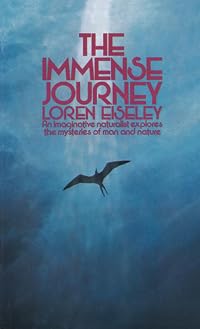
The Immense Journey: An Imaginative Naturalist Explores the Mysteries of Man and Nature
by Loren Eiseley
On This Page
Description
Anthropologist and naturalist Loren Eiseley blends scientific knowledge and imaginative vision in this story of man.Tags
Recommendations






















Member Reviews
Simply the most beautiful science writing I have ever read. An “imaginative naturalist,” according to the cover of his book, The Immense Journey. An anthropologist, a scholar, a poet, a genius. Eiseley wears all of these hats. He observes the story of life unfolding throughout history, recounting some of it to us in his own story. “Forward and backward I have gone, and for me it has been an immense journey” (p 13). By the time we read these words we have come to realize that Eiseley is not just talking about his own life’s journey. Eiseley’s narrator is metaphor for the journey of all humankind through the vast dimension of time and space—a journey filled with perplexity, delight, and impermanence. Eiseley might refute show more that, if he were alive today. He claims he does not pretend to speak for anyone but himself.
“I have given the record of what one man thought as he pursued research and pressed his hands against the confining walls of scientific method in his time. But men see differently. I can at best report only from my own wilderness” (p 13).
This book is science and philosophy presented in lucid, beautiful prose - a reader's delight. show less
“I have given the record of what one man thought as he pursued research and pressed his hands against the confining walls of scientific method in his time. But men see differently. I can at best report only from my own wilderness” (p 13).
This book is science and philosophy presented in lucid, beautiful prose - a reader's delight. show less
Despite--or perhaps because of--his elegant writing style, you need to pay close attention when reading Loren Eiseley. For someone who writes about science, for instance, he never gives specific locations. It is all like a long ago memory that may or may not have actually happened. It's hard to know exactly how to interpret some of these pieces. I didn't enjoy this book as much as the first one I read, The Night Country. I think this is perhaps because so much of its talk about evolution is a bit outdated. It is in the most personal moments, such as the story about a caged hawk, when Eiseley reaches the heights of his ability and leaves us with emotional, unforgettable images and lessons.
A beautiful work of meditations on the natural world and the human journey through it, pervaded by a kind of tragic sensibility that isn't usually associated with nature or science writing, but is thoroughly wise and appropriate. This book sat unread on my shelf for years, what a loss! I'm so grateful I finally picked it up; it's a touchstone now.
This is a fantastic book.
There are places where Eiseley’s prose is absolutely beautiful. Consider this excerpt, plucked from a random page:
“The stolen energy that would take man across the continents would fail him at last. The great Ice Age herds were destined to vanish. When they did so, another hand like the hand that grasped the stone by the river long ago would pluck a handful of grass seed and hold it contemplatively. In that moment, the golden towers of man, his swarming millions, his turning wheels, the vast learning of his packed libraries, would glimmer dimly there in the ancestor of wheat, a few seeds held in a muddy hand.” (“How Flowers Changed the World”)
If the whole book were like this, it might be florid and show more unreadable. But it’s not: the poetry never lasts for very long. Eiseley deploys it strategically, to get his readers wondering or marveling. And then, instead of just going on and on until we’re glutted and bored, he shifts to an explanation or reflection or anecdote. We have to start thinking again. And then there’s another dollop of stunning beauty; the constant switch-ups keep the reader engaged and interested and following along as Eiseley makes his argument. I find the technique to be incredibly effective.
The substance is mostly equal to the style. It’s true that there’s a great deal of artifice and affect: Eiseley is very careful about how he presents himself, and it’s entirely possible that some of the incidents that he relates here are terrific lies. Even if that’s the case, though, they’re offered in the service of important and beautiful ideas. “The Secret of Life,” for example, suggests that the precise origins of life (if we ever discover them) may end up telling us far less than we assume. Eiseley does not start out with theses, or declare his arguments in advance, so it would perhaps spoil the essay to say more. I’ll simply point out that he makes a compelling and intuitive point that we (or at least I) routinely and inexplicably overlook.
I withhold half a star mainly because of the bits on human origins. Compared to the other essays, they’re long on detail and short on wonder. There’s nothing wrong with that, but it’s not what Eiseley does best. The problem is compounded by the fact that some of the information is now thoroughly discredited; scientists today don’t really believe what Eiseley says about “boskopoids,” for example. That’s not really his fault, but it’s a second strike against what I already took to be the weakest part of the book.
Make no mistake, though: you should read The Immense Journey. I myself intend to read it again. And when I do, I’ll savor all of it, weak parts included. show less
There are places where Eiseley’s prose is absolutely beautiful. Consider this excerpt, plucked from a random page:
“The stolen energy that would take man across the continents would fail him at last. The great Ice Age herds were destined to vanish. When they did so, another hand like the hand that grasped the stone by the river long ago would pluck a handful of grass seed and hold it contemplatively. In that moment, the golden towers of man, his swarming millions, his turning wheels, the vast learning of his packed libraries, would glimmer dimly there in the ancestor of wheat, a few seeds held in a muddy hand.” (“How Flowers Changed the World”)
If the whole book were like this, it might be florid and show more unreadable. But it’s not: the poetry never lasts for very long. Eiseley deploys it strategically, to get his readers wondering or marveling. And then, instead of just going on and on until we’re glutted and bored, he shifts to an explanation or reflection or anecdote. We have to start thinking again. And then there’s another dollop of stunning beauty; the constant switch-ups keep the reader engaged and interested and following along as Eiseley makes his argument. I find the technique to be incredibly effective.
The substance is mostly equal to the style. It’s true that there’s a great deal of artifice and affect: Eiseley is very careful about how he presents himself, and it’s entirely possible that some of the incidents that he relates here are terrific lies. Even if that’s the case, though, they’re offered in the service of important and beautiful ideas. “The Secret of Life,” for example, suggests that the precise origins of life (if we ever discover them) may end up telling us far less than we assume. Eiseley does not start out with theses, or declare his arguments in advance, so it would perhaps spoil the essay to say more. I’ll simply point out that he makes a compelling and intuitive point that we (or at least I) routinely and inexplicably overlook.
I withhold half a star mainly because of the bits on human origins. Compared to the other essays, they’re long on detail and short on wonder. There’s nothing wrong with that, but it’s not what Eiseley does best. The problem is compounded by the fact that some of the information is now thoroughly discredited; scientists today don’t really believe what Eiseley says about “boskopoids,” for example. That’s not really his fault, but it’s a second strike against what I already took to be the weakest part of the book.
Make no mistake, though: you should read The Immense Journey. I myself intend to read it again. And when I do, I’ll savor all of it, weak parts included. show less
Even though this book is about 50 years old, it still sings. Eisley is an anthropologist who writes like a poet. The book is not religious, but Eisley conveys his sense of wonder, appreciation and awe with the world and particularly man in elegant prose. A native of Nebraska, he loves wandering and searching the west but also finds scenes of mystery and intrigue in the pigeons of New York City. His field has doubtless changed some by now, but his science is still good and his narratives captivating.
Ten thousand years ago, a species of human came into existence in southern Africa. His teeth were smaller than ours; his face smaller. His brain... one third larger. He soon became extinct. What does that say about the chances for survival of Homo sapiens. These are some of the questions Loren Eiseley addresses in exploring our origins. From oxygen breathing fish who, under necessity, used fins to pull itself over land to the next pond to monkeys who finally came down from trees to walk in the savanna, Eisley eloquently puts into words our immense journey.
Such a beautiful, beautiful book.
As all collections of essays, not all of them are standouts. The final essay was gorgeous, and many others sprinkled throughout were also. And approaching these as a science guy, some of the essays don't weather the vicissitudes of time as well as others.
But overall, the poetic prose that Eiseley lays down is well worth the read.
As all collections of essays, not all of them are standouts. The final essay was gorgeous, and many others sprinkled throughout were also. And approaching these as a science guy, some of the essays don't weather the vicissitudes of time as well as others.
But overall, the poetic prose that Eiseley lays down is well worth the read.
Members
- Recently Added By
Lists

Recommended Nature Writing
346 works; 180 members

BIRDS IN FICTION & NON-FICTION
17 works; 1 member

Mustich's 1000 Books to Read Before You Die: A Life Changing List
1,001 works; 20 members

Books We Love to Reread
695 works; 298 members
Author Information

34+ Works 4,784 Members
Awards and Honors
Series
Belongs to Publisher Series
Work Relationships
Is contained in
Is abridged in
Common Knowledge
- Original publication date
- 1946
- Dedication
- dedicated to the memory of
CLYDE EDWIN EISELEY,
who lies in the grass of the prairie frontier
but is not forgotten by his son - First words
- Some lands are flat and grass-covered, and smile so evenly up at the sun that they seem forever youthful, untouched by man or time.
Classifications
Statistics
- Members
- 1,055
- Popularity
- 24,480
- Reviews
- 18
- Rating
- (4.33)
- Languages
- English
- Media
- Paper, Ebook
- ISBNs
- 5
- ASINs
- 25