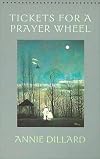
Tickets for a Prayer Wheel
by Annie Dillard
On This Page
Description
Celebrate re-publication of this Pulitzer Prize-winning author's first book.Tags
Recommendations























Member Reviews
Some books I want to hold in my hand as tenderly as the magnolia blossom I plucked from the limb to help celebrate my mother’s recovery, as tenderly as a Christmas gift too lovely to unwrap, as tenderly as a baby chick I am returning to the warmth of the nest; as tenderly as a piece of crystal that is as fragile as it is valuable.
Such a book is Tickets for a Prayer Wheel by Annie Dillard (University of Missouri Press, 1974). Its dust jacket is like linen, ecru with delicate line drawings of foliage, in sepia. Its cloth-bound cover, cerise with the title embossed in old gold, is flexible, light and delicate. I know from the wrinkled end-papers and from other copies I have seen that it will warp easily if it is exposed to humidity or show more heat. The words on its pages are printed in a soft brown on verso only, with plenty of white space, which really is off-white, almost translucent, textured like the jacket in a fine linen pattern.
I have a paperback copy, published by Bantam, that I read, itself more attractive than the mass-market paperback one might expect. I have two copies of the original that I have treasured for over thirty years, that I hold tenderly but rarely read from. I do not want to risk leaving fingerprints on the pages or staining the jackets or bending the delicate covers.
Is Annie Dillard’s poetry worthy of such exquisite book design? Perhaps. Certainly, some of the poems are sensitive and thoughtful, of the sort that might be expected from the author of Pilgrim at Tinker Creek. The imagery, drawn from nature, from trees and the planets and weather, from holidays and seasons, from light and shadows, from young love, and perhaps not so young, is often precise and elegant. Sometimes it sidles too quickly, too often into the oblique, but other poems are simple and down-to-earth, like little jokes or snapshots. Tinker Creek is still a source of reflections, of gossamer metaphors:
I kick through a forest of hands
by Tinker Creek. The sassafras hands
wear mittens; the tulip tree hands
demand money; “Wait!” cry the fraying hands
of a frivolous silver maple,
“I love you!”
A cottonwood hand floats down the creek
on its back, like Ophelia.
And deep on the banks of the creek
some hands uncurl;
some hands unleaf, and damply become rich water,
wild and bitter perfume,
and loam, where bluets will bloom.
(from “Feast Days,” iii)
And then there’s that little puppy running in the deep snow, “like a tiny whale,” sinking in, soon to surface somewhere else.
Not very profound. Just cute.
But, frankly, I do not think of this volume as a collection of lyric poems. I think of it as only one poem, the title poem, of some length and of enigmatic sensibility, certainly worthy of the graceful book in which it is encased.
Our family is looking
for someone who knows how to pray.
Ora pro nobis, pray for us now
and now.
Cast amid a catalog of allusions and quotations—St. Irenaeus, the New Testament, the Dominican Gregorio Lopez, astronomy, Saint Thomas, Pascal, Martin Luther, Archimedes, sculpture—the lines follow the family in their quest to speak what is unspeakable.
There is one prayer left:
“Teach us to pray.”
Teach us to pray.
Again and again, they go down the hall and down the hall and down the dark hall. And then, at last, unexpectedly the speaker finds the image in which she casts her prayer:
I saw all the time of this planet
pulled like a scarf
through the sky.
Time, that lorn and furling
oriflamme . . .
And without quite knowing why, or how, we are drawn to conclude with her:
I think that the dying
pray at last
not “please”
but “thank you”
as a guest thanks his host at the door.
For “Tickets for a Prayer Wheel,” the fragile poem, and for Tickets for a Prayer Wheel, the fragile book, I too am thankful. show less
Such a book is Tickets for a Prayer Wheel by Annie Dillard (University of Missouri Press, 1974). Its dust jacket is like linen, ecru with delicate line drawings of foliage, in sepia. Its cloth-bound cover, cerise with the title embossed in old gold, is flexible, light and delicate. I know from the wrinkled end-papers and from other copies I have seen that it will warp easily if it is exposed to humidity or show more heat. The words on its pages are printed in a soft brown on verso only, with plenty of white space, which really is off-white, almost translucent, textured like the jacket in a fine linen pattern.
I have a paperback copy, published by Bantam, that I read, itself more attractive than the mass-market paperback one might expect. I have two copies of the original that I have treasured for over thirty years, that I hold tenderly but rarely read from. I do not want to risk leaving fingerprints on the pages or staining the jackets or bending the delicate covers.
Is Annie Dillard’s poetry worthy of such exquisite book design? Perhaps. Certainly, some of the poems are sensitive and thoughtful, of the sort that might be expected from the author of Pilgrim at Tinker Creek. The imagery, drawn from nature, from trees and the planets and weather, from holidays and seasons, from light and shadows, from young love, and perhaps not so young, is often precise and elegant. Sometimes it sidles too quickly, too often into the oblique, but other poems are simple and down-to-earth, like little jokes or snapshots. Tinker Creek is still a source of reflections, of gossamer metaphors:
I kick through a forest of hands
by Tinker Creek. The sassafras hands
wear mittens; the tulip tree hands
demand money; “Wait!” cry the fraying hands
of a frivolous silver maple,
“I love you!”
A cottonwood hand floats down the creek
on its back, like Ophelia.
And deep on the banks of the creek
some hands uncurl;
some hands unleaf, and damply become rich water,
wild and bitter perfume,
and loam, where bluets will bloom.
(from “Feast Days,” iii)
And then there’s that little puppy running in the deep snow, “like a tiny whale,” sinking in, soon to surface somewhere else.
Not very profound. Just cute.
But, frankly, I do not think of this volume as a collection of lyric poems. I think of it as only one poem, the title poem, of some length and of enigmatic sensibility, certainly worthy of the graceful book in which it is encased.
Our family is looking
for someone who knows how to pray.
Ora pro nobis, pray for us now
and now.
Cast amid a catalog of allusions and quotations—St. Irenaeus, the New Testament, the Dominican Gregorio Lopez, astronomy, Saint Thomas, Pascal, Martin Luther, Archimedes, sculpture—the lines follow the family in their quest to speak what is unspeakable.
There is one prayer left:
“Teach us to pray.”
Teach us to pray.
Again and again, they go down the hall and down the hall and down the dark hall. And then, at last, unexpectedly the speaker finds the image in which she casts her prayer:
I saw all the time of this planet
pulled like a scarf
through the sky.
Time, that lorn and furling
oriflamme . . .
And without quite knowing why, or how, we are drawn to conclude with her:
I think that the dying
pray at last
not “please”
but “thank you”
as a guest thanks his host at the door.
For “Tickets for a Prayer Wheel,” the fragile poem, and for Tickets for a Prayer Wheel, the fragile book, I too am thankful. show less
There's a lovely love poem called Arches and shadows on page 77. Half the pages are blank. What a waste.
Dillard is one of my all time favorite writers and this is one of my all time favorite books of poetry.
The shape of the air
around a sycamore
is shot with sparks,
elastic, slit with leaves.
The shape of the air
around a city
in cross section
is like a broken comb.
Ratings
Members
- Recently Added By
Author Information

31+ Works 22,071 Members
Annie Dillard was born Annie Doak in Pittsburgh, Pennsylvania on April 30, 1945. She received a B.A and an M.A. in English from Hollins College. She writes both fiction and nonfiction books including Tickets for a Prayer Wheel, Holy the Firm, Teaching a Stone to Talk, The Living, and Mornings Like This: Found Poems. She won the 1975 Pulitzer Prize show more for General Nonfiction for Pilgrim at Tinker Creek. She wrote an autobiography entitled An American Childhood. Her work also has appeared in such periodicals as The Atlantic, Harper's Magazine, The Christian Science Monitor, and Cosmopolitan. She taught for 21 years in the English department of Wesleyan University. (Bowker Author Biography) show less
Some Editions
Series
Belongs to Publisher Series
Common Knowledge
- Canonical title
- Tickets for a Prayer Wheel
- Original publication date
- 1974
Classifications
Statistics
- Members
- 290
- Popularity
- 110,364
- Reviews
- 4
- Rating
- (3.85)
- Languages
- English
- Media
- Paper
- ISBNs
- 4
- ASINs
- 6