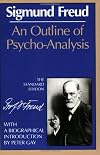
An Outline of Psychoanalysis
by Sigmund Freud
On This Page
Description
"In June 1938, at eighty-two, Freud began writing this terse survey of the fundamentals of psychoanalysis. He marshals here the whole range of psychoanalytic theory and therapy in lucid prose and continues his open-mindedness to new departures, such as the potential of drug therapy. While the book remains unfinished, it covers the essentials of psychoanalysis"--Back cover.Tags
Recommendations
































Member Reviews
One must be careful when reading Freud—every once in a while, he makes a little bit of sense and the reader may follow him down his blind alleys. An interesting albeit unsupportable treatise, good only for an overview of Freudian thought.
http://lifelongdewey.wordpress.com/2012/06/24/131-an-outline-of-psychoanalysis-b...
http://lifelongdewey.wordpress.com/2012/06/24/131-an-outline-of-psychoanalysis-b...
This is standardized Freud, repeating his principles, insinuations, and theories in a compact form. For those who are not familiar with Freud's oeuvre, this might be a good place to start. Although the text was sufficient and clean, besides a basic explanation of the tenements of his thinking, there is not much else here. All logistics inside, it is still an insightful read.
3.5 stars.
3.5 stars.
Freud has had an incredible impact on modern thought and our perception of the world and of ourselves. Though fraught with problems, including some very sexist notions of the female psyche that have been discussed at length by later writers, Freud remains foundational in the fields of both psychology (even though most of his ideas are no longer accepted) and literary criticism. Freudian psychoanalysis, dealing as it does with symbolism in dreams, has many techniques that are useful in deciphering literary subtext. Psychoanalysis, the notion of the unconscious, Freud's stages of development, and the famous Oedipus Complex are now part of our cultural vocabulary, and as such Freud's writings are useful to read. This particular text gives show more a quick and easily understandable summary of the major points of psychoanalysis. If you want to read some Freud, this is the way to go.
Rating: Recommended, if only because it's so important to modern thought. show less
Rating: Recommended, if only because it's so important to modern thought. show less
What a brilliant scientist Freud was! And how eloquent he puts forward his views. At times the arguments are weathered by time, but no doubt this book represents the most important thoughts in the history of psychology.
Ratings
Members
- Recently Added By
Lists

Jordan B. Peterson's Recommended Books
104 works; 5 members
Author Information

1,428+ Works 51,817 Members
Sigmund Freud was the founder of psychoanalysis, simultaneously a theory of personality, a therapy, and an intellectual movement. He was born into a middle-class Jewish family in Freiburg, Moravia, now part of Czechoslovakia, but then a city in the Austro-Hungarian Empire. At the age of 4, he moved to Vienna, where he spent nearly his entire life. show more In 1873 he entered the medical school at the University of Vienna and spent the following eight years pursuing a wide range of studies, including philosophy, in addition to the medical curriculum. After graduating, he worked in several clinics and went to Paris to study under Jean-Martin Charcot, a neurologist who used hypnosis to treat the symptoms of hysteria. When Freud returned to Vienna and set up practice as a clinical neurologist, he found orthodox therapies for nervous disorders ineffective for most of his patients, so he began to use a modified version of the hypnosis he had learned under Charcot. Gradually, however, he discovered that it was not necessary to put patients into a deep trance; rather, he would merely encourage them to talk freely, saying whatever came to mind without self-censorship, in order to bring unconscious material to the surface, where it could be analyzed. He found that this method of free association very often evoked memories of traumatic events in childhood, usually having to do with sex. This discovery led him, at first, to assume that most of his patients had actually been seduced as children by adult relatives and that this was the cause of their neuroses; later, however, he changed his mind and concluded that his patients' memories of childhood seduction were fantasies born of their childhood sexual desires for adults. (This reversal is a matter of some controversy today.) Out of this clinical material he constructed a theory of psychosexual development through oral, anal, phallic and genital stages. Freud considered his patients' dreams and his own to be "the royal road to the unconscious." In The Interpretation of Dreams (1900), perhaps his most brilliant book, he theorized that dreams are heavily disguised expressions of deep-seated wishes and fears and can give great insight into personality. These investigations led him to his theory of a three-part structure of personality: the id (unconscious biological drives, especially for sex), the superego (the conscience, guided by moral principles), and the ego (the mediator between the id and superego, guided by reality). Freud's last years were plagued by severe illness and the rise of Nazism, which regarded psychoanalysis as a "Jewish pollution." Through the intervention of the British and U.S. governments, he was allowed to emigrate in 1938 to England, where he died 15 months later, widely honored for his original thinking. His theories have had a profound impact on psychology, anthropology, art, and literature, as well as on the thinking of millions of ordinary people about their own lives. Freud's daughter Anna Freud was the founder of the Hampstead Child Therapy Clinic in London, where her specialty was applying psychoanalysis to children. Her major work was The Ego and the Mechanisms of Defense (1936). (Bowker Author Biography) show less
Some Editions
Awards and Honors
Distinctions
Work Relationships
Common Knowledge
- Canonical title
- An Outline of Psychoanalysis
- Original title
- Abriß der Psychoanalyse
- Original publication date
- 1940
- Disambiguation notice
- This work should contain the Outline only. There are a number of (chiefly German-language) editions that combine the Abriß with Das Unbehagen in der Kultur; these are a work of their own.
Classifications
- Genres
- Nonfiction, General Nonfiction, Philosophy
- DDC/MDS
- 150.1952 — Philosophy & psychology Psychology Emotions, Relationships, & Family Theory And Instruction Systems, schools, viewpoints Psychoanalytic systems Freudian system
- LCC
- BF173 .F62913 — Philosophy, Psychology and Religion Psychology Psychology Psychoanalysis
- BISAC
Statistics
- Members
- 765
- Popularity
- 36,809
- Reviews
- 4
- Rating
- (3.38)
- Languages
- 5 — English, French, German, Italian, Portuguese
- Media
- Paper, Ebook
- ISBNs
- 23
- ASINs
- 19