On This Page
Description
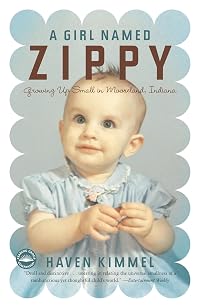
This Today Show book club selection is now available on audio.Kimmel takes readers back to a time when small-town America was caught in the amber of the innocent postwar period: people helped their neighbors, went to church on Sunday, and kept barnyard animals in their backyards.Tags
Recommendations








Member Recommendations
Member Reviews
This book alternates between absolutely hilarious and decidedly uncomfortable. It's a good, fun, quick read that I breezed through in two days. The characters are quirky and larger than life, the situations often ridiculous, but all supposedly true, or at least true in the writer's memory.
One thing really bugged me: the misleading subtitle. I interpreted "growing up small" to mean that Zippy/Haven was a little person, but actually she is normal sized and makes several references to being in the back row of pictures because she was among the tallest of her peers.
One thing really bugged me: the misleading subtitle. I interpreted "growing up small" to mean that Zippy/Haven was a little person, but actually she is normal sized and makes several references to being in the back row of pictures because she was among the tallest of her peers.
This is the story of Zippy, an imaginative, precocious girl who grew up in the small town of Mooreland, Indiana during the 1960's and 1970's. She tells stories about her family members, childhood friends, eccentric neighbors, and various pets. Through it all, Zippy has a resilience of spirit and a positive attitude that shine through, even in situations that otherwise may not be ideal.
This book is unusual in that it is written with a child's voice, but is interesting and humorous to adults. Haven Kimmel is really able to capture the feeling of being a child, and how even the most minor of events can have major importance. While reading this book, I found myself reciting several sweet and funny passages out loud to various family show more members. I loved how Zippy shared the stories of the first memory she ever had, the first time she thought about family genes, and the first time she thought about the passage of time. The book is written in very simple prose, but has depth to it as well.
I highly, highly recommend this book. It was an absolute joy, and I loved every minute of it. Do not miss this one!!!! show less
This book is unusual in that it is written with a child's voice, but is interesting and humorous to adults. Haven Kimmel is really able to capture the feeling of being a child, and how even the most minor of events can have major importance. While reading this book, I found myself reciting several sweet and funny passages out loud to various family show more members. I loved how Zippy shared the stories of the first memory she ever had, the first time she thought about family genes, and the first time she thought about the passage of time. The book is written in very simple prose, but has depth to it as well.
I highly, highly recommend this book. It was an absolute joy, and I loved every minute of it. Do not miss this one!!!! show less
Presented in a series of not always connected vignettes, Kimmel gives us a picture of simple, uncomplicated, untechnical life in the 1950s and 60s, growing up with a mother who is physically present, but mentally off in the land of her books (she seems to have lived almost permanently reclining on the sofa), and a father who could provide a seemingly coherent answer to just about any curious question Zippy dreamed up. Her observations on Jesus and organized religion will have you howling. They are funny without being sacriligious, and insightful far beyond the normal level of an 8-10 year old. There are several other stories written by Kimmel, and I'm definitely planning to explore them.
A charming collection of stories from a very unconventional childhood. I loved reading this book as it had be snorting and giggling at the antics of the author's family. I felt like I was part of the family by the end and wanted to hear a hundred more stories about them all. I also grew up in Indiana, so a lot of this was familiar but most of it was delightfully new. An unmitigated pleasure.
This is a memoir of a happy, if imperfect, childhood. Kimmel has a gift for putting the reader into the mind of an 8-year-old.
We learn about the evil old lady across the street, the pharmacist who can't be bothered with kids reading comic books in his store, the horrible neighbors with a sadistic son, beloved pets (chicken love), the freedom of riding your bike all over town (without touching the handlebars), favorite teachers, dreaded band leaders, best friends, schoolyard fights and the miracle of Christmas. But mostly we glimpse small-town life viewed from the safety of a loving (if unconventional) family.
I love this girl named Zippy.
We learn about the evil old lady across the street, the pharmacist who can't be bothered with kids reading comic books in his store, the horrible neighbors with a sadistic son, beloved pets (chicken love), the freedom of riding your bike all over town (without touching the handlebars), favorite teachers, dreaded band leaders, best friends, schoolyard fights and the miracle of Christmas. But mostly we glimpse small-town life viewed from the safety of a loving (if unconventional) family.
I love this girl named Zippy.
Some reviews talk about the sad treatment of animals in this story. I think it's important to note that rural America does have a different take on man v animal. There are distinctions between barn cats and house cats, between family pets and hunting dogs, etc. I don't hold the author accountable for the way things are (or may be) in these types of stories. She is writing about an authentically different community life from one that would say put a family pet through 12 months of chemo.
This story made me laugh. Hard. I bought the tape for my sister and book copy for a friend. If the way life in this story is depicted isn't funny to some, maybe that's the point. Personally I keep it handy for the humorless landscape of winter and show more drudgery of office life in the big city. It's help enough to know that somewhere, out there in the Midwest perhaps, people are just getting by, too. Without all our veneer. Not because life is perfect, but what isn't perfect about life forces the characters in this story to consider what aspects of civility really matter. On a daily and hilarious basis. Let's recall, life begins in a rather undignified, messy manner, and it doesn't move far from that perch no matter the gloss we try to apply. The only gloss in this story is a healthy application of perspective and the steady relief of humor. And with her technique, Kimmel's story shines. show less
This story made me laugh. Hard. I bought the tape for my sister and book copy for a friend. If the way life in this story is depicted isn't funny to some, maybe that's the point. Personally I keep it handy for the humorless landscape of winter and show more drudgery of office life in the big city. It's help enough to know that somewhere, out there in the Midwest perhaps, people are just getting by, too. Without all our veneer. Not because life is perfect, but what isn't perfect about life forces the characters in this story to consider what aspects of civility really matter. On a daily and hilarious basis. Let's recall, life begins in a rather undignified, messy manner, and it doesn't move far from that perch no matter the gloss we try to apply. The only gloss in this story is a healthy application of perspective and the steady relief of humor. And with her technique, Kimmel's story shines. show less
"It's a cliche to say that a good memoir reads like a well-crafted work of fiction, but Kimmel's smooth, impeccably humorous prose evokes her childhood as vividly as any novel. Born in 1965, she grew up in Mooreland Indiana, a place that by some mysterious and powerful mathematical prinicple retains a population of 300, a place where there's no point learning the street names because it's just as easy to say, "We live at the four-way stop sign."
Hers is less a formal autobiography than a collection of vignettes comprising the things a small child would remember; sick birds, a new bike, reading comics at the drugstore, the mean old lady down the street. The truths of childhood are rendered in lush yet simple prose; here's Zippy show more describing a friend who hates wearing girls' clothes: "Julie in a dress was like the rest of us in quicksand." Over and over we encounter pearls of third-grade wisdom revealed in a child's assured voice. "There are a finite number of times one can safely climb the same tree in a single day". show less
Hers is less a formal autobiography than a collection of vignettes comprising the things a small child would remember; sick birds, a new bike, reading comics at the drugstore, the mean old lady down the street. The truths of childhood are rendered in lush yet simple prose; here's Zippy show more describing a friend who hates wearing girls' clothes: "Julie in a dress was like the rest of us in quicksand." Over and over we encounter pearls of third-grade wisdom revealed in a child's assured voice. "There are a finite number of times one can safely climb the same tree in a single day". show less
Members
- Recently Added By
Author Information

11 Works 5,256 Members
Haven Kimmel studied English & creative writing at Ball State University & North Carolina State University & attended seminary at the Earlham School of Religion. She lives in Durham, North Carolina. (Bowker Author Biography)
Awards and Honors
Distinctions
Series

Common Knowledge
- Canonical title
- A Girl Named Zippy: Growing Up Small in Mooreland, Indiana
- Original publication date
- 2001
- Important places
- Indiana, USA; Mooreland, Indiana, USA; USA
- Epigraph
- So is there no fact, no event, in our private history,, which shall not, sooner or later, lose its adhesive, inert form, and astonish us by souring from our body into the empyrean? Cradle and infancy, school and playground, t... (show all)he fear of boys, and dogs, and ferules, the love of little maids and verries, and many another facts that once filled the whole sky, are gone already; friend and relative, profession and party, town and country, nation and world, must also soar and sing. --Ralph Waldo Emerson, The American Soldier
- Dedication
- For my mother and my sister
For absent friends - First words
- If you look at an atlas of the United States, one published around, say, 1940, there is, in the state of Indiana, north of New Castle and east of the Epileptic Village, a small town called Mooreland.
- Last words
- (Click to show. Warning: May contain spoilers.)Thank you for being so brave tonight. Love, Santa
Classifications
- Genres
- Biography & Memoir, Nonfiction, General Nonfiction
- DDC/MDS
- 977.264 — History & geography History of North America North central United States Indiana East central counties Henry
- LCC
- F534 .M675 .K56 — Local History of the United States, Canada and Latin America United States local history Indiana
- BISAC
Statistics
- Members
- 2,490
- Popularity
- 7,773
- Reviews
- 100
- Rating
- (3.85)
- Languages
- English, Italian
- Media
- Paper, Audiobook, Ebook
- ISBNs
- 17
- UPCs
- 1
- ASINs
- 8