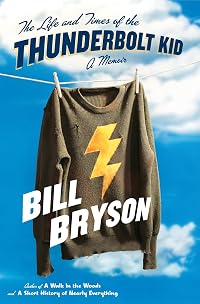
The Life and Times of the Thunderbolt Kid: A Memoir
by Bill Bryson
On This Page
Description
From one of the world's most beloved writers and New York Times bestselling author of A Walk in the Woods and The Body, a vivid, nostalgic, and utterly hilarious memoir of growing up in the 1950s.Bill Bryson was born in the middle of the American century—1951—in the middle of the United States—Des Moines, Iowa—in the middle of the largest generation in American history—the baby boomers. As one of the best and funniest writers alive, he is perfectly positioned to mine his memories show more of a totally all-American childhood for 24-carat memoir gold. Like millions of his generational peers, Bill Bryson grew up with a rich fantasy life as a superhero. In his case, he ran around his house and neighborhood with an old football jersey with a thunderbolt on it and a towel about his neck that served as his cape, leaping tall buildings in a single bound and vanquishing awful evildoers (and morons)—in his head—as "The Thunderbolt Kid."
Using this persona as a springboard, Bill Bryson re-creates the life of his family and his native city in the 1950s in all its transcendent normality—a life at once completely familiar to us all and as far away and unreachable as another galaxy. It was, he reminds us, a happy time, when automobiles and televisions and appliances (not to mention nuclear weapons) grew larger and more numerous with each passing year, and DDT, cigarettes, and the fallout from atmospheric testing were considered harmless or even good for you. He brings us into the life of his loving but eccentric family, including affectionate portraits of his father, a gifted sportswriter for the local paper and dedicated practitioner of isometric exercises, and of his mother, whose job as the home furnishing editor for the same paper left her little time for practicing the domestic arts at home. The many readers of Bill Bryson’s earlier classic, A Walk in the Woods, will greet the reappearance in these pages of the immortal Stephen Katz, seen hijacking literally boxcar loads of beer. He is joined in the Bryson gallery of immortal characters by the demonically clever Willoughby brothers, who apply their scientific skills and can-do attitude to gleefully destructive ends.
Warm and laugh-out-loud funny, and full of his inimitable, pitch-perfect observations, The Life and Times of the Thunderbolt Kid is as wondrous a book as Bill Bryson has ever written. It will enchant anyone who has ever been young.
. show less
Tags
Recommendations

















Member Recommendations
Member Reviews
I was born in 1950, a year before Bryson was born. This memoir brings back memories of that era for anyone born during this idyllic decade, although others would enjoy it too. Bryson’s humor and writing talent are unmatched these days. I’ve read one other Bryson book, “A Walk in the Woods,” and this one is equally hilarious, but like it, “A Walk in the Woods” carries serious messages as well. Bryson is able to use his humor to expose culture’s weaknesses in a critical light where many humorists would rather not tread. A few warnings if you plan to read Bryson, especially this particular book: don’t read while eating or drinking. Whatever is in your mouth is likely to be ejected before you finish a sentence. And if you show more are like me and you read at bedtime to gently carry you to slumber, don’t try to use “Thunderbolt Kid” this way. You’ll be wide awake trying to stifle laughter and, if there is a partner next to you, he or she will be wide awake too compliments of your bed shaking. Only difference is he or she won’t be nearly as amused as you. Unless, of course, you read Bryson out loud and share the laughter. And that’s the last point I’d like to make. Bryson’s books, at least the two I’ve read, are “share books.” It’s impossible to read Bryson and not stop once or twice every page to read a sentence or a paragraph out loud to whoever is sitting near you. The guy is just too talented to waste on just one person at a time. You don’t have to be from Des Moines, Bryson’s home town, to appreciate “Thunderbolt Kid,” but if you’re from the Iowa capital or really anywhere in Iowa, you’ll experience another level of appreciation for what he has to say. Des Moines’ transformation during the 1950s is much like the transformation of most of urban America: inevitable but not altogether desirable. I spent part of my high school and college days living in Iowa, so I can appreciate what is happening to Iowa and many Midwestern cities and towns. Bryson speaks to this transformation with a critical eye that is worth reading the book even if it weren’t the funniest book I’ve ever read. Bryson rolls the best of the likes of Bombeck, Martin, and Franken into the perfect read for a time when we need intelligent humor to carry us, albeit temporarily, from this nightmare that was 2020. show less
This memoir should come with a warning, thus: CHOKING HAZARD!! DO NOT ATTEMPT TO READ WHILE RECLINING, EATING or DRINKING! DO NOT ATTEMPT TO READ OUT LOUD!
As usual, Bryson mixes gaspingly funny observations with sobering facts and statistics, giving you time to catch your breath between bouts of helpless, breathless laughter. This is his recollection of growing up in the 1950s and 1960s in Des Moines, Iowa. He was born exactly one week before I came down to earth in East B'Jesus, Pennsylvania, but we both basically grew up in Middle America. Humor is a funny thing, and his brand may not tickle everyone, but boy, can I relate.
As usual, Bryson mixes gaspingly funny observations with sobering facts and statistics, giving you time to catch your breath between bouts of helpless, breathless laughter. This is his recollection of growing up in the 1950s and 1960s in Des Moines, Iowa. He was born exactly one week before I came down to earth in East B'Jesus, Pennsylvania, but we both basically grew up in Middle America. Humor is a funny thing, and his brand may not tickle everyone, but boy, can I relate.
OMG, this one was a lot of fun. I can’t believe it took me this long to get to this hilarious and well-written memoir. Bryson was born in 1951 in Des Moines IA, during the rise of the mighty baby boomers. It was a rollicking childhood, in a perfectly normal family and his descriptions and tales of life in this mid-western city are a treat to behold. Like many boys his age, he had fantasies of being a superhero and donned an old sweatshirt with a lightning bolt on it, becoming the Thunderbolt Kid. Bryson was eight years older than me but I could relate to many of these experiences. I can not recommend this memoir high enough, especially if you need a good laugh during trying times.
Within recent memory, I can't think of another book I was quite so blasé about. The Life and Times of the Thunderbolt Kid is unlikely to upset anyone, but I was consistently left wanting more than it was willing to give.
This is a memoir told from the lens of Bryson's childhood years in 1950s Des Moines, during a period of ridiculous resource abundance, yet also within puritanical and conservatively rigid times. Bryson intersperses his childhood memories with a broad-scale history of the United States during that period, remarking on: the Cold War, the vague yet ever-present threat of communism, the civil rights movement, the advent of television, and the rise and fall of small-town America before corporate conglomeration and show more monopolization. He offers some tepid, common criticism of the conservative values and over-consumption that ran rampant at the time but declines to get into the mud and say anything strongly.
A consistent refrain is Bryson saying, "I saw the last of something really special," especially when it comes to small-town America. Bryson grew up as a well-off white kid in a well-off white neighborhood to well-off white parents who were at worst slightly negligent about their children's safety. He admits himself that, in most ways, he was sheltered from most forms of adversity—not something particularly conducive to rich storytelling.
Fortunately, Bryson is an above-average storyteller who writes with a wry and mischievous sense of humor, mostly by playing with the absurdity and irony of both living as a child and living in post-WWII America. He is heavily hyperbolic and truth-stretching, reminiscent of a family member telling you a tall tale about their upbringing from across the dinner table. He's unevenly successful at getting that humor across, mostly eliciting a small rush of air out of my nose when he succeeded. Despite that, it's undeniably a cozy atmosphere he creates. Bryson's storytelling makes what could easily be a dry and boring memoir into something worth an afternoon. There are certainly some funny hijinks and capers, as well as moments of shock, like when he recalls being legally allowed into a stripper's tent at the state fair when he was thirteen.
To tell you the truth, though, I found it hard to summon the interest required to enjoy hearing Bryson talk about just how good he had it as a kid past the first hundred pages. Part of this disinterest also falls at the feet of his rather abortive attempt to tell parts of the story through the fictitious actions of his childhood superhero alter ego; the aforementioned Thunderbolt Kid. These afterthoughts in the text came out half-baked and silly rather than endearing, because they were so few and far between. These were the beginnings of a much more fictitious representation of his adolescence, a different book entirely. So why include them?
Unfortunately, The Life and Times of the Thunderbolt Kid ends up feeling quite benign. This is a very safe and comfortable memoir about a very safe and comfortable moment in his life. Bryson does not compensate for his overly-sheltered upbringing by digging hard into the topics that defined it, leaving the work adrift in a feeling of timidness. If you can relate to Bryson's baby-boomer upbringing and enjoy light/carefree reading, you might enjoy this much more than I did. Much like any inside joke, reading the lore of a family you don't belong to is not nearly as fun as talking about your own. show less
This is a memoir told from the lens of Bryson's childhood years in 1950s Des Moines, during a period of ridiculous resource abundance, yet also within puritanical and conservatively rigid times. Bryson intersperses his childhood memories with a broad-scale history of the United States during that period, remarking on: the Cold War, the vague yet ever-present threat of communism, the civil rights movement, the advent of television, and the rise and fall of small-town America before corporate conglomeration and show more monopolization. He offers some tepid, common criticism of the conservative values and over-consumption that ran rampant at the time but declines to get into the mud and say anything strongly.
A consistent refrain is Bryson saying, "I saw the last of something really special," especially when it comes to small-town America. Bryson grew up as a well-off white kid in a well-off white neighborhood to well-off white parents who were at worst slightly negligent about their children's safety. He admits himself that, in most ways, he was sheltered from most forms of adversity—not something particularly conducive to rich storytelling.
Fortunately, Bryson is an above-average storyteller who writes with a wry and mischievous sense of humor, mostly by playing with the absurdity and irony of both living as a child and living in post-WWII America. He is heavily hyperbolic and truth-stretching, reminiscent of a family member telling you a tall tale about their upbringing from across the dinner table. He's unevenly successful at getting that humor across, mostly eliciting a small rush of air out of my nose when he succeeded. Despite that, it's undeniably a cozy atmosphere he creates. Bryson's storytelling makes what could easily be a dry and boring memoir into something worth an afternoon. There are certainly some funny hijinks and capers, as well as moments of shock, like when he recalls being legally allowed into a stripper's tent at the state fair when he was thirteen.
To tell you the truth, though, I found it hard to summon the interest required to enjoy hearing Bryson talk about just how good he had it as a kid past the first hundred pages. Part of this disinterest also falls at the feet of his rather abortive attempt to tell parts of the story through the fictitious actions of his childhood superhero alter ego; the aforementioned Thunderbolt Kid. These afterthoughts in the text came out half-baked and silly rather than endearing, because they were so few and far between. These were the beginnings of a much more fictitious representation of his adolescence, a different book entirely. So why include them?
Unfortunately, The Life and Times of the Thunderbolt Kid ends up feeling quite benign. This is a very safe and comfortable memoir about a very safe and comfortable moment in his life. Bryson does not compensate for his overly-sheltered upbringing by digging hard into the topics that defined it, leaving the work adrift in a feeling of timidness. If you can relate to Bryson's baby-boomer upbringing and enjoy light/carefree reading, you might enjoy this much more than I did. Much like any inside joke, reading the lore of a family you don't belong to is not nearly as fun as talking about your own. show less
Bill Bryson’s The Life and Times of the Thunderbolt Kid is subtitled "Travels Through My Childhood" on my copy of the British edition paperback. Halfway through reading this wonderfully humorous memoir, I realized that I was reading about my own childhood – great chunks of it at any rate. We moved around quite a bit when I was a youngster in the 1970’s, but the flatlands of West Texas, the cave-riddled hills of rural central Tennessee, and the suburbs of northeastern Kansas were virtually identical to Bryson’s own Des Moines of the 1950’s.
Never before have I read a book that evoked such clear memories of so many items that I’d completely forgotten about. Lincoln Logs, for instance, is a toy I haven’t thought of in many, show more many years (and, as a kid, I never knew that peeing on them would bleach the logs white). The following excerpts about NeHi soda pop provided not only a visual in my brain but resurrected the distinct taste in my mouth all the way to the salivatory stage:
NeHi was the pop of small towns – I don’t know why – and it had the intensest flavour and most vivid colours of any products yet cleared by the Food and Drug Administration for human consumption. It came in six select flavours – grape, strawberry, orange, cherry, lime-lemon (never ‘lemon-lime’) and root beer – but each was so potently flavoured that it made your eyes water like an untended sprinkler, and so sharply carbonated that it was like swallowing a thousand tiny razor blades. It was wonderful.
. . . (Grape was the one flavour that could actually make you hallucinate; I once saw the edge of the universe while drinking grape NeHi.)
Grape happened to me my favorite flavor of NeHi; I don’t recall ever seeing the root beer flavor but Kansas – my memories from the latter portion of my adolescence are the most vivid – was strictly A&W territory anyway with possibly the last A&W Root Beer Restaurant left in America at that time (it wasn’t until my first visit to Bangkok many years later that I discovered another outlet, astounded it had gone international).
A few pages later, Bryson discusses potluck dinners. This brought back distinct memories of attending various church or school social events featuring a large variety of enormous meatloafs and other strange foods, similarly "presided over by armies of immense, chuckling women who had arms and necks that sagged in an impossible manner, like really wet clothes." One or two of these socials occurred in the very 1950’s-like small town of Waterloo, Iowa, and Bryson’s descriptions of the tree-lined boulevards and old homes with the wraparound porches reminded me of a visit to my great aunt and uncle on the occasion of their 50th wedding anniversary in the late 1970’s or early 1980’s. This passage, among others, positively transported me back to a hot summer’s evening in Waterloo:
On the few nights when we weren’t at a church social, we had enormous meals at my grandparents’ house, often on a table carried out to the lawn. (It seemed important to people in those days to share dinner with as many insects as possible.) Uncle Dee would be there, of course, burping away, and Uncle Jack from Wapello, who was notable for never managing to finish a sentence.
I can almost hear the conversations of those distant relatives I’d never met before that trip, accompanied by my mom and a few select members of her side of the family (having flown to Kansas City from New Jersey and California for the drive up to Waterloo). Most of the whispering seemed to be about "Crazy Larry" – I believe he was my second- or third-cousin – who, supposedly, has been an agent for the CIA! Pretty heady stuff for a small-town teenager like myself. It might say something about the perceived "oddity" about the Iowa branch of the family that we only visited them once in all the years that we lived in Kansas, just four hours or so away…
This book is full of priceless gems. Take, for example, the passage on building plastic models – something I attempted numerous times in my own childhood, with often frustrating results:
At least candy gave actual pleasure. Most things that were supposed to be fun turned out not to be fun at all. Model making, for instance. Making models was reputed to be hugely enjoyable but it was really just a mysterious ordeal that you had to go through from time to time as part of the boyhood process. The model kids always looked fun, to be sure. . .
. . .But when you got the kit home and opened the box the contents turned out to be of a uniform leaden grey or olive green, consisting of perhaps sixty thousand tiny parts, some no larger than a proton, all attached in some organic, insperable way to plastic stalks like swizzle sticks. The tubes of glue by contrast were the size of large pastry tubes. No matter how gently you depressed them they would blurp out a pint or so of a clear viscous goo whose one instinct was to attach itself to some foreign object — a human finger, the living-room drapes, the fur of a passing animal — and become an infinitely long string.
Any attempt to break the string resulted in the creation of more strings. Within moments you would be attached to hundreds of sagging strands, all connected to something that had nothing to do with model aeroplanes or the Second World War. The only thing the glue wouldn’t stick to, interestingly, was a piece of plastic model; then it just became a slippery lubricant that allowed any two pieces of model to glide endlessly over each other, never drying. The upshot was that after about forty minutes of intensive but troubled endeavour you and your immediate surroundings were covered in a spider’s web of glue at the heart of which was a grey fuselage with one wing on upside down and a pilot accidentally but irremediably attached by his flying cap to the cockpit ceiling. Happily by this point you were so high on the glue that you didn’t give a shit about the pilot, the model or anything else.
Kid-oriented views about attending movie matinees, the evolution of comic books, and the space race made me want to read more about the cultural history of 1950’s America (and Bryson thoughtfully includes a bibliography to facilitate just that). The chapters relating to the testing of atomic bombs and the Communist scare (not to mention polio and bigotry) are downright frightening. But through it all, Bryson drives home the perception that Iowans – indeed most Americans – of at least the first seven years or so of the 1950’s were just downright happy people who didn’t seem to worry about much if anything at all.
The Thunderbolt Kid does end with a touch of sadness while, in a chapter entitled "Farewell," Bryson recounts how much Des Moines has changed in the forty years since his childhood – listing the many closures of businesses large and small; the death of the downtown is so familiar to anybody who grew up in any sized community in America over the past half-century or so.
I would have liked to have visited the Des Moines of Bryson’s youth. I’ve only known it as yet another faceless, sprawling city — one to pass through on the way to somewhere else. In fact, I only spent the night in Des Moines once – all of the hotel rooms in the nearby small town of Ames were booked during the night of a Paul McCartney concert at the Iowa State University’s Cyclone Stadium. I only recall congested interstate highways encircling the city (with the state capitol dome in the distance). The city seemed to be just another faceless sprawling city without either heart or soul. It certainly wasn’t a community that seemed inviting to explore. As Bryson so poignantly states in the penultimate paragraph, "We won’t see its like again, I’m afraid."
The Life and Times of the Thunderbolt Kid was interesting to me as it presented several firsts for me, something that doesn’t happen too often to this lifelong reader. One one thing, this was the first book (at least in quite a long while) that has provoked such longing to those simple days of my childhood, a period in my life that I rarely think about. It’s also the first memoir that I recall truly enjoying – I tend to stick to fiction or travelogues. For the first time since I was a student (and that’s a great many years), I found myself eagerly jotting down notes and quotes as I read. If you’ve read my “About Me,” you’ll know that I greatly disliked writing book reports while in school (such a shocking thing for a reading teacher to admit!) and that has carried over to my adult life as someone who doesn’t write reviews of what he has read. Well, that all has changed with Bryson’s memoir as this is my first-ever book review. I hope you’ve enjoyed reading it as much as I know you will enjoy reading The Thunderbolt Kid. show less
Never before have I read a book that evoked such clear memories of so many items that I’d completely forgotten about. Lincoln Logs, for instance, is a toy I haven’t thought of in many, show more many years (and, as a kid, I never knew that peeing on them would bleach the logs white). The following excerpts about NeHi soda pop provided not only a visual in my brain but resurrected the distinct taste in my mouth all the way to the salivatory stage:
NeHi was the pop of small towns – I don’t know why – and it had the intensest flavour and most vivid colours of any products yet cleared by the Food and Drug Administration for human consumption. It came in six select flavours – grape, strawberry, orange, cherry, lime-lemon (never ‘lemon-lime’) and root beer – but each was so potently flavoured that it made your eyes water like an untended sprinkler, and so sharply carbonated that it was like swallowing a thousand tiny razor blades. It was wonderful.
. . . (Grape was the one flavour that could actually make you hallucinate; I once saw the edge of the universe while drinking grape NeHi.)
Grape happened to me my favorite flavor of NeHi; I don’t recall ever seeing the root beer flavor but Kansas – my memories from the latter portion of my adolescence are the most vivid – was strictly A&W territory anyway with possibly the last A&W Root Beer Restaurant left in America at that time (it wasn’t until my first visit to Bangkok many years later that I discovered another outlet, astounded it had gone international).
A few pages later, Bryson discusses potluck dinners. This brought back distinct memories of attending various church or school social events featuring a large variety of enormous meatloafs and other strange foods, similarly "presided over by armies of immense, chuckling women who had arms and necks that sagged in an impossible manner, like really wet clothes." One or two of these socials occurred in the very 1950’s-like small town of Waterloo, Iowa, and Bryson’s descriptions of the tree-lined boulevards and old homes with the wraparound porches reminded me of a visit to my great aunt and uncle on the occasion of their 50th wedding anniversary in the late 1970’s or early 1980’s. This passage, among others, positively transported me back to a hot summer’s evening in Waterloo:
On the few nights when we weren’t at a church social, we had enormous meals at my grandparents’ house, often on a table carried out to the lawn. (It seemed important to people in those days to share dinner with as many insects as possible.) Uncle Dee would be there, of course, burping away, and Uncle Jack from Wapello, who was notable for never managing to finish a sentence.
I can almost hear the conversations of those distant relatives I’d never met before that trip, accompanied by my mom and a few select members of her side of the family (having flown to Kansas City from New Jersey and California for the drive up to Waterloo). Most of the whispering seemed to be about "Crazy Larry" – I believe he was my second- or third-cousin – who, supposedly, has been an agent for the CIA! Pretty heady stuff for a small-town teenager like myself. It might say something about the perceived "oddity" about the Iowa branch of the family that we only visited them once in all the years that we lived in Kansas, just four hours or so away…
This book is full of priceless gems. Take, for example, the passage on building plastic models – something I attempted numerous times in my own childhood, with often frustrating results:
At least candy gave actual pleasure. Most things that were supposed to be fun turned out not to be fun at all. Model making, for instance. Making models was reputed to be hugely enjoyable but it was really just a mysterious ordeal that you had to go through from time to time as part of the boyhood process. The model kids always looked fun, to be sure. . .
. . .But when you got the kit home and opened the box the contents turned out to be of a uniform leaden grey or olive green, consisting of perhaps sixty thousand tiny parts, some no larger than a proton, all attached in some organic, insperable way to plastic stalks like swizzle sticks. The tubes of glue by contrast were the size of large pastry tubes. No matter how gently you depressed them they would blurp out a pint or so of a clear viscous goo whose one instinct was to attach itself to some foreign object — a human finger, the living-room drapes, the fur of a passing animal — and become an infinitely long string.
Any attempt to break the string resulted in the creation of more strings. Within moments you would be attached to hundreds of sagging strands, all connected to something that had nothing to do with model aeroplanes or the Second World War. The only thing the glue wouldn’t stick to, interestingly, was a piece of plastic model; then it just became a slippery lubricant that allowed any two pieces of model to glide endlessly over each other, never drying. The upshot was that after about forty minutes of intensive but troubled endeavour you and your immediate surroundings were covered in a spider’s web of glue at the heart of which was a grey fuselage with one wing on upside down and a pilot accidentally but irremediably attached by his flying cap to the cockpit ceiling. Happily by this point you were so high on the glue that you didn’t give a shit about the pilot, the model or anything else.
Kid-oriented views about attending movie matinees, the evolution of comic books, and the space race made me want to read more about the cultural history of 1950’s America (and Bryson thoughtfully includes a bibliography to facilitate just that). The chapters relating to the testing of atomic bombs and the Communist scare (not to mention polio and bigotry) are downright frightening. But through it all, Bryson drives home the perception that Iowans – indeed most Americans – of at least the first seven years or so of the 1950’s were just downright happy people who didn’t seem to worry about much if anything at all.
The Thunderbolt Kid does end with a touch of sadness while, in a chapter entitled "Farewell," Bryson recounts how much Des Moines has changed in the forty years since his childhood – listing the many closures of businesses large and small; the death of the downtown is so familiar to anybody who grew up in any sized community in America over the past half-century or so.
I would have liked to have visited the Des Moines of Bryson’s youth. I’ve only known it as yet another faceless, sprawling city — one to pass through on the way to somewhere else. In fact, I only spent the night in Des Moines once – all of the hotel rooms in the nearby small town of Ames were booked during the night of a Paul McCartney concert at the Iowa State University’s Cyclone Stadium. I only recall congested interstate highways encircling the city (with the state capitol dome in the distance). The city seemed to be just another faceless sprawling city without either heart or soul. It certainly wasn’t a community that seemed inviting to explore. As Bryson so poignantly states in the penultimate paragraph, "We won’t see its like again, I’m afraid."
The Life and Times of the Thunderbolt Kid was interesting to me as it presented several firsts for me, something that doesn’t happen too often to this lifelong reader. One one thing, this was the first book (at least in quite a long while) that has provoked such longing to those simple days of my childhood, a period in my life that I rarely think about. It’s also the first memoir that I recall truly enjoying – I tend to stick to fiction or travelogues. For the first time since I was a student (and that’s a great many years), I found myself eagerly jotting down notes and quotes as I read. If you’ve read my “About Me,” you’ll know that I greatly disliked writing book reports while in school (such a shocking thing for a reading teacher to admit!) and that has carried over to my adult life as someone who doesn’t write reviews of what he has read. Well, that all has changed with Bryson’s memoir as this is my first-ever book review. I hope you’ve enjoyed reading it as much as I know you will enjoy reading The Thunderbolt Kid. show less
Bill Bryson is always fun, and his switch from travel memoirs to autobiography isn't really much of a switch at all - this book is a natural for him. But it will never be my favorite of his works.
That said, the book is good. Bryson's work is all about the narrative voice, and he's right at the peak of his ability here; he's honed and developed his voice and his style, but he hasn't reached what we might call the Dave Barry point, the place where a writer's current work becomes a caricature of his older, better work. So, for the sheer craft of it, this book is a great read. It's funny, it's light, it's fast.
Unfortunately, Bryson falls into basically every trap that waits for an autobiographer. He persistently mourns all the changes show more that have taken place since the '50s - oh noes! The world is different! And I remember liking the old things, therefore all this change is bad! He doesn't get that he remembers things as being shiny and golden because he had a happy childhood. Things look fabulous through a nostalgic lens, and it's the lens that matters, not the things themselves. If he'd had that same happy childhood in the 1900s, he'd be mourning the introduction of cars and women's suffrage.
Which is the other problem. Bryson was privileged, and he seems to have missed that - sure, he writes about McCarthyism and racism, but he doesn't seem to understand that his own perfect, shiny childhood was largely a result of his own privilege - and other people's lack of privilege.
Just in general, the section dealing with race is painful to read; he says he never heard anyone say anything racist (except his grandmother) even as he spouts every possible racist stereotype about the blacks who attended his high school. It's pretty clear that he doesn't really understand that racism is more than shooting blacks who try to vote. (And I'm not going to go into the sexism, largely because I suspect any honest memoir of a teenaged boy is going to be, well, hugely sexist.)
So, while this is a fun book to read, it's also uncomfortable in places - the places where Bryson exposes much more of himself than he intended to. show less
That said, the book is good. Bryson's work is all about the narrative voice, and he's right at the peak of his ability here; he's honed and developed his voice and his style, but he hasn't reached what we might call the Dave Barry point, the place where a writer's current work becomes a caricature of his older, better work. So, for the sheer craft of it, this book is a great read. It's funny, it's light, it's fast.
Unfortunately, Bryson falls into basically every trap that waits for an autobiographer. He persistently mourns all the changes show more that have taken place since the '50s - oh noes! The world is different! And I remember liking the old things, therefore all this change is bad! He doesn't get that he remembers things as being shiny and golden because he had a happy childhood. Things look fabulous through a nostalgic lens, and it's the lens that matters, not the things themselves. If he'd had that same happy childhood in the 1900s, he'd be mourning the introduction of cars and women's suffrage.
Which is the other problem. Bryson was privileged, and he seems to have missed that - sure, he writes about McCarthyism and racism, but he doesn't seem to understand that his own perfect, shiny childhood was largely a result of his own privilege - and other people's lack of privilege.
Just in general, the section dealing with race is painful to read; he says he never heard anyone say anything racist (except his grandmother) even as he spouts every possible racist stereotype about the blacks who attended his high school. It's pretty clear that he doesn't really understand that racism is more than shooting blacks who try to vote. (And I'm not going to go into the sexism, largely because I suspect any honest memoir of a teenaged boy is going to be, well, hugely sexist.)
So, while this is a fun book to read, it's also uncomfortable in places - the places where Bryson exposes much more of himself than he intended to. show less
This is the best of Bill Bryson's books. The thing about Bryson is that he cannot leave a fact behind. He appears to conduct a great amount of research for each of his books and inserts it all in the chapters in between the ones that are actually much more interesting! His personal narrative is so entertaining, and the chapters of statistics and background are so dry, that the net effect is horribly lopsided. I always end up skipping the chapters I dislike, like pushing aside half the food on my plate in order to get to the good stuff. Nonetheless, the good chapters in this memoirs are so worth it, especially if you are a Baby Boomer.
Members
- Recently Added By
Published Reviews
ThingScore 63
The Life and Times of the Thunderbolt Kid by Bill Bryson is a memoir of growing up in Iowa, during the 1950's. The memoir was classic fun and an exploration into memories of growing up in the middle of America in the middle of the twentieth century. The book begins with a panoramic point of view on what the 1950's were about, and then Bryson gets closer and closer into his personal life. He show more masterfully pens his memories of pranks, jobs, candy, sex, politics, main-street, with a well crafted efficacy. So many memories of growing up in Longmont Colorado in the 1970's bubbled up. A fun listen. show less
added by Gregorio_Roth
Bill Bryson is erudite, irreverent, funny and exuberant, making the temptation to quote endlessly from The Life and Times of the Thunderbolt Kid: A Memoir (Broadway, $25) hard to resist. Bryson interweaves childhood reminiscences seamlessly with observations about 1950s America, evoking a zeitgeist that will be familiar to almost everyone past middle age.
added by MikeBriggs
Had he written a purely personal view of his youth and left out the bits explaining how 1950s America was the best country in the world, my chuckles might not so often have given way to groans of annoyance.
added by MikeBriggs
Lists

Best Autobiographies and Memoirs
370 works; 67 members

Best Biographies, Autobiographies and Memoirs
465 works; 160 members
Childhood Memoirs
7 works; 3 members

Non-Fiction Worth Reading
1,016 works; 262 members

Books Set in Iowa
34 works; 8 members

Carole's List
445 works; 13 members
Tour of Iowa
25 works; 3 members

Books Read in 2016
4,666 works; 199 members

Best 21st Century Books (So Far)
670 works; 86 members

20 books to cheer you up now.
20 works; 2 members

Books Read in 2021
5,361 works; 114 members

Hulk's Essential Reading List
38 works; 1 member

Books About Boys
175 works; 15 members

Read
27 works; 1 member
Author Information

70+ Works 136,293 Members
Bill Bryson was born in Des Moines, Iowa on December 8, 1951. In 1973, he went backpacking in England, where he eventually decided to settle. He wrote for the English newspapers The Times and The Independent, as well as supplementing his income by writing travel articles. He moved back to the United States in 1995. His first travel book, The Lost show more Continent: Travels in Small-Town America, was published in 1989. His other books include I'm a Stranger Here Myself, In a Sunburned Country, Bill Bryson's Dictionary of Troublesome Words, Neither Here nor There: Travels in Europe, Made in America, The Mother Tongue, Bill Bryson's African Diary, A Short History of Nearly Everything, At Home: A Short History of Private Life, Walk About, and Seeing Further: The Story of Science, Discovery, the Genius of the Royal Society. A Walk in the Woods was adapted into a movie starring Robert Redford and Nick Nolte. Bryson's titles, The Road to Little Dribbling: Adventures of an American in Britain, Notes from a Small Island and Neither Here Nor There made the New York Times bestseller list in 2016. (Bowker Author Biography) show less
Some Editions
Awards and Honors
Awards
Distinctions
Notable Lists
Work Relationships
Is contained in
Is abridged in
Common Knowledge
- Canonical title
- The Life and Times of the Thunderbolt Kid: A Memoir
- Original title
- The Life and Times of the Thunderbolt Kid: A Memoir
- Alternate titles
- The Life and Times of the Thunderbolt Kid: Travels Through My Childhood
- Original publication date
- 2006
- People/Characters
- Bill Bryson; Lumpy Kawalski; Milton Milton; Stephen Katz; Doug Willoughby; Jed Mattes (show all 8); Buddy Doberman; Mary O'Leary
- Important places
- Des Moines, Iowa, USA
- Dedication
- In memory of Jed Mattes
- First words
- In the late 1950s, the Royal Canadian Air Force produced a booklet on isometrics, a form of exercise that enjoyed a short but devoted vogue with my father.
- Quotations
- You really should never fuck with the Thunderbolt Kid....He had, as he would boast in later years, a pornographic memory.
- Last words
- (Click to show. Warning: May contain spoilers.)We won't see its like again, I'm afraid.
- Original language
- English
- Disambiguation notice
- Abridged versions should not be combined with the full work. "Parts of this book first appeared in somewhat different form in The New Yorker." T.p. verso
Classifications
- Genres
- Biography & Memoir, General Nonfiction, Nonfiction, Travel
- DDC/MDS
- 910.4092 — History & geography Geography & travel modified standard subdivisions of Geography and travel Pirates & Shipwrecks Biography
- LCC
- G154.5 .B79 .A3 — Geography, Anthropology and Recreation Geography (General) Travel. Voyages and travels (General)
- BISAC
Statistics
- Members
- 7,022
- Popularity
- 1,686
- Reviews
- 248
- Rating
- (3.88)
- Languages
- 9 — Dutch, English, French, German, Italian, Norwegian (Bokmål), Portuguese, Spanish, Swedish
- Media
- Paper, Audiobook, Ebook
- ISBNs
- 62
- ASINs
- 31