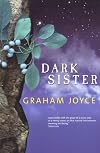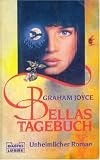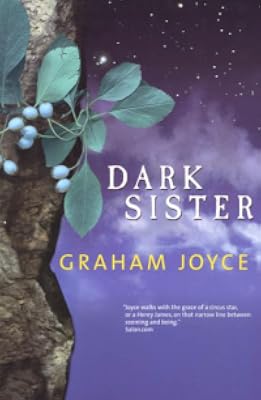
Dark Sister
by Graham Joyce
On This Page
Description
A woman discovers an old diary on witchcraft, uses it to help her archeologist husband find things, then clairvoyantly sees him commit adultery. When he obtains custody of the children she must use witchcraft to regain them.Tags
Recommendations




Member Reviews
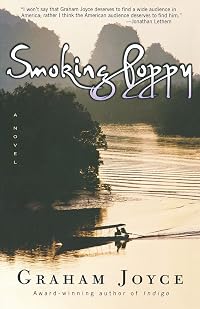
Maybe it's because this is one of Joyce's earlier books but I didn't find this novel by him quite as gripping as his others. But considering that SMOKING POPPY, INDIGO, and THE TOOTH FAIRY are all extremely well written and strong in their story telling, being the weakest of the four is nothing to be ashamed about. The story follows Maggie, wife of Alex and mother of Amy and Sam, as she picks up an interest aside from being a housewife. The interest is herbal lore / witchcraft and is keyed off a diary found in their chimney. Without ruining why, the story takes a sudden twist about a third of the way through and has a new layer of depth added to it. The story runs its course and finishes in a satisfactory way but doesn't share the show more strength of completion that his other novels do. I would still recommend it but if you are a first time Joyce reader, start with SMOKING POPPY instead. It's a much stronger story and one that will show the heights of what Joyce can reach. show less
Joyce's picture of a woman's interest in a folkloric past rapidly transforms into a study of obsession and of wiccan lore. In the course of the story, the central character, Maggie, takes up a friendship with a wise old woman, who is exceptionally well-drawn; and the owner of an occult shop, Ash, who acts as a focus and a catalyst for her developing knowledge.
Given the subject matter, I suppose I wasn't surprised to see the men in the story less clearly drawn. Maggie's husband, Alex, became a little one-dimensional when the story wasn't focused on him, and he seemed an odd character to be an archaeologist, coming over rather more like some manipulative middle-manager alpha male wannabe. Ash, the shopkeeper, is more sympathetic; perhaps show more the most disappointing character was the psychologist, de Sang, who is brought in to help with the couple's young son, (whose behavioural problems start out as a focus for Maggie's desire to use her new-found knowledge to heal and to help, and who becomes embroiled in the occult events); and who ends up treating Maggie directly to try to draw her out of what he thinks of as a fugue state but which has more in common with possession. Near the end of the book, Ash and de Sang have a conversation which suggested to me that they had some shared history, and perhaps even a joint role in a wider occult community (and for that matter, his name, echoing the French word for blood, seems a bit suggestive) ; but nothing came of that. I suspect that Joyce may well have been laying us a false trail; or perhaps it was a possible plot route not travelled.
This is a sound early novel that helped cement Joyce's position as a leading fantasy writer. It is grounded in the real world, the occult lore is never fey but has a good sense of authenticity, and the whole book comes over not as a mainstream fantasy but as a novel exploring the impact of the past on the present, and of a hidden history on a contemporary life. show less
Given the subject matter, I suppose I wasn't surprised to see the men in the story less clearly drawn. Maggie's husband, Alex, became a little one-dimensional when the story wasn't focused on him, and he seemed an odd character to be an archaeologist, coming over rather more like some manipulative middle-manager alpha male wannabe. Ash, the shopkeeper, is more sympathetic; perhaps show more the most disappointing character was the psychologist, de Sang, who is brought in to help with the couple's young son, (whose behavioural problems start out as a focus for Maggie's desire to use her new-found knowledge to heal and to help, and who becomes embroiled in the occult events); and who ends up treating Maggie directly to try to draw her out of what he thinks of as a fugue state but which has more in common with possession. Near the end of the book, Ash and de Sang have a conversation which suggested to me that they had some shared history, and perhaps even a joint role in a wider occult community (and for that matter, his name, echoing the French word for blood, seems a bit suggestive) ; but nothing came of that. I suspect that Joyce may well have been laying us a false trail; or perhaps it was a possible plot route not travelled.
This is a sound early novel that helped cement Joyce's position as a leading fantasy writer. It is grounded in the real world, the occult lore is never fey but has a good sense of authenticity, and the whole book comes over not as a mainstream fantasy but as a novel exploring the impact of the past on the present, and of a hidden history on a contemporary life. show less
February, 2002
Dark Sister
Graham Joyce
This is the first book I recall reading this year. I read parts of other books, but didn’t actually finish anything, I don’t think.
I really enjoyed this book. It was well-written, distinctly different from the “B” grade horror I usually go for in that it was much better quality. Bordering on too intense at time, but still, I finished it in a matter of days because it was so compelling.
Maggie, a frustrated English housewife, discovers an old book in her house, which at first appears to be empty, but whose pages soon fill with delicate, pale writing. It appears to be a diary of sorts, of a woman who lived long ago. There are journal type entries, as well as recipes for healing different show more ailments. It’s a Book of Shadows, and its owner was a witch. Maggie discovers her own powers and meets several strange characters, among the owner of a local occult store and a strange old woman, much to her husband’s distaste. It’s a strange mix of mysticism and the mundane, which makes it fascinating. Joyce’s writing is clean and uncluttered. He tells very little and shows everything. I’d like to read other books by him, especially Tooth Fairy. show less
Dark Sister
Graham Joyce
This is the first book I recall reading this year. I read parts of other books, but didn’t actually finish anything, I don’t think.
I really enjoyed this book. It was well-written, distinctly different from the “B” grade horror I usually go for in that it was much better quality. Bordering on too intense at time, but still, I finished it in a matter of days because it was so compelling.
Maggie, a frustrated English housewife, discovers an old book in her house, which at first appears to be empty, but whose pages soon fill with delicate, pale writing. It appears to be a diary of sorts, of a woman who lived long ago. There are journal type entries, as well as recipes for healing different show more ailments. It’s a Book of Shadows, and its owner was a witch. Maggie discovers her own powers and meets several strange characters, among the owner of a local occult store and a strange old woman, much to her husband’s distaste. It’s a strange mix of mysticism and the mundane, which makes it fascinating. Joyce’s writing is clean and uncluttered. He tells very little and shows everything. I’d like to read other books by him, especially Tooth Fairy. show less
This is one of my favorite books. Graham Joyce manages to weave together a book that explores the dark side of human nature and a woman's awakening and discovery of hidden powers within herself that she never knew she possessed. Weaving ancient folklore with modern science, Joyce weaves a spell sure that's sure to entice and thrill.
Ratings
Members
- Recently Added By
Author Information

47+ Works 5,020 Members
Graham Joyce, a four-time winner of the British Fantasy Award, lives in Leicester, England. His books include Dark Sister, Requiem, and The Tooth Fairy, which received a Booker nomination and was chosen as a Publishers Weekly Best Book of 1998. (Publisher Provided) Graham Joyce was born on October 22, 1954. He received a Master's Degree in modern show more English and American literature from Leicester University. Before becoming an author, he worked for the National Association of Youth Clubs for eight years. His first novel, Dreamside, was published in 1991. His other works included House of Lost Dreams, Requiem, The Tooth Fairy, Some Kind of Fairy Tale, and The Year of the Ladybird. He won several awards including the British Fantasy award. He also taught a creative writing course at Nottingham Trent University. He died of lymphoma cancer on September 9, 2014 at the age of 59. (Bowker Author Biography) show less
Awards and Honors
Series
Belongs to Publisher Series
Casino grøsser (160)
Common Knowledge
- Canonical title*
- En hånd fra graven
- Original title
- Dark Sister
- Original publication date
- 1992-11-12
*Some information comes from Common Knowledge in other languages. Click "Edit" for more information.
Classifications
Statistics
- Members
- 285
- Popularity
- 113,709
- Reviews
- 6
- Rating
- (3.59)
- Languages
- 5 — English, French, German, Norwegian (Bokmål), Norwegian
- Media
- Paper, Ebook
- ISBNs
- 7
- ASINs
- 1