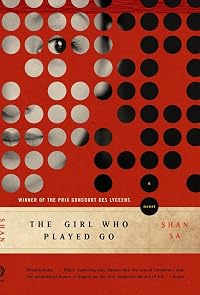
The Girl Who Played Go
by Shan Sa
On This Page
Description
Set in Japanese occupied Manchuria in the 1930s, The Girl Who Played Go is harsher, more shocking than Balzac, a timeless tale of love and war reflected in the age-old game of go. In the Place of a Thousand Winds, snow falls as a sixteen-year-old Chinese girl beats all-comers at the game of go. One of her opponents is a young Japanese officer of the occupying power, rigidly militaristic, imbued with the imperial ethic, yet intrigued by this young opponent who plays like a man. Their show more encounters are like the game itself, restrained, subtle, surprisingly fierce. But as their two stories unfold, and the Chinese try to ignore their oppressors, the Japanese army moves inexorably through their huge land, in the vanguard of a greater war, leaving blood and destruction in its wake. Shan Sa's novel has a wonderful directness and deceptive simplicity that catches the reader by the throat, and makes the cruelty and tragedy of its outcome all the more shocking. An exquisite and unusual novel with strange twists on the Romeo and Juliet theme, The Girl Who Played Go is already a bestseller in France. show lessTags
Recommendations























Member Recommendations
Member Reviews
The Girl Who Played Go by Shan Sa is deceptively simple book about two people - a Chinese girl in Manchuria who excels at the game of go and a Japanese officer sent to Manchuria en route to the frontline in China, and how their lives cross and are changed.
Just as in a game of go, the two players do not interact much as first; Shan Sa deftly and poetically portrays the two characters individual lives. As time goes on, the two draw inexorably closer and moves are played faster, as the climax of the game and of the story rapidly approaches. From the book's halfway point, the two plots become more and more intertwined and what began as a light-hearted game soon becomes cruel and tragic.
Shan Sa's writing style is simple yet elegant and she show more manages to portray the lives of both Japanese and Chinese in Manchuria well. Using the game of go as a metaphor, she is able to explore the choices people make in life and the effects they have: Go imitates life, life imitates go. show less
Just as in a game of go, the two players do not interact much as first; Shan Sa deftly and poetically portrays the two characters individual lives. As time goes on, the two draw inexorably closer and moves are played faster, as the climax of the game and of the story rapidly approaches. From the book's halfway point, the two plots become more and more intertwined and what began as a light-hearted game soon becomes cruel and tragic.
Shan Sa's writing style is simple yet elegant and she show more manages to portray the lives of both Japanese and Chinese in Manchuria well. Using the game of go as a metaphor, she is able to explore the choices people make in life and the effects they have: Go imitates life, life imitates go. show less
La joueuse de go is an historical novel, set in Manchuria during the Japanese occupation in the 1930s, although it obviously also draws obliquely on the author's experience as a young woman growing up in Beijing around the time of the Tiananmen Square protests of 1989. The book uses the "alternating chapters" structure, with the odd-numbered chapters (the black moves) being given to a sixteen-year-old Chinese girl, and the even ones (the white moves) to a lieutenant in the Japanese army of occupation. As we would expect, the two meet over a go board, but this only happens about halfway through the book, and even then they scarcely talk apart from the few phrases they need to exchange in the course of the game. By then the author has show more established both their characters: the girl is tough on the outside, but very much an adolescent, more in love with the idea of growing up than with the young radicals who draw her into the fringes of the communist underground; the officer is a creature of acute, if rather conservative, aesthetic sensibilities, following a career that involves dealing out violence and death (and frequenting prostitutes) because of his sense of duty to his family and his emperor, but obviously - as he dimly starts to realise himself - someone who would have been far happier as a poet or a watercolorist. We know this isn't going to end well, but it's a great pleasure to watch the elegant way in which Shan Sa manoeuvres her two narrators around within the frameworks of their respective cultures to get them to the point where she wants them.
Basically it's Romeo and Juliet with lashings of what we used to call "oriental subtlety", so you probably shouldn't take it too seriously, but there's a great deal to enjoy in the style and execution, which are for the most part absolutely spot on.
Fun fact: like Gilbert & Sullivan's The Mikado, this book is claimed to have been inspired by a chance encounter with an antique Japanese sword in a market. ("Un sabre japonais était exposé. On m'a dit qu'il datait du XVIIe siècle. Personne ne s'attendait à ce que je le dégaine. J'ai tiré cette lame incandescente et tout d'un coup, j'avais l'impression de tenir la mort entre mes mains...") show less
Basically it's Romeo and Juliet with lashings of what we used to call "oriental subtlety", so you probably shouldn't take it too seriously, but there's a great deal to enjoy in the style and execution, which are for the most part absolutely spot on.
Fun fact: like Gilbert & Sullivan's The Mikado, this book is claimed to have been inspired by a chance encounter with an antique Japanese sword in a market. ("Un sabre japonais était exposé. On m'a dit qu'il datait du XVIIe siècle. Personne ne s'attendait à ce que je le dégaine. J'ai tiré cette lame incandescente et tout d'un coup, j'avais l'impression de tenir la mort entre mes mains...") show less
Un peu tiré par les cheveux dans les péripéties et rencontres, un peu gavé de métaphores de poête-pouet-pouet - peut-être pas toutes les phrases, mais pas loin, ce livre reste très agréable à lire, et les personnages intéressants à suivre - je suppose que le "je" y aide, même si l'auteur "triche" un peu parfois, laissant penser que les narrateurs sont comme des livres ouverts (si j'ose dire) pour le lecteur, pour finalement nous révéler des actes et pensées quand même un peu importants pour le récit.
Mais je pardonne, car vraiment j'ai apprécié lire ce récit à deux voix, au rythme maîtrisé, aux enchaînements qui fonctionnent très bien, à l'ambiance balançant entre la mélancolie et la franche déprime, qui show more plus est dans un contexte historique que je ne conaissais que très peu, et même si ce n'est pas un roman historique, ça éclaire un peu. show less
Mais je pardonne, car vraiment j'ai apprécié lire ce récit à deux voix, au rythme maîtrisé, aux enchaînements qui fonctionnent très bien, à l'ambiance balançant entre la mélancolie et la franche déprime, qui show more plus est dans un contexte historique que je ne conaissais que très peu, et même si ce n'est pas un roman historique, ça éclaire un peu. show less
I want to inhabit a world built of Shan Sa’s dreamy metaphors—A woman is bathing in thermal springs, her body glistening under the water where it writhes and twists like a slender leaf, or The moon looks like a line of chalk drawn on the sky. Even her name (a pen name) has the alluring meaning: rustle of the wind in the mountains.
The author, born in Beijing, began writing poetry at age 6 and received her first national poetry award at 12. In her 20s she moved to Paris to study philosophy and apprentice with a Swiss painter, and began writing novels in French. Her multi-cultural artistic sensibility, with the help of an outstanding English translator, shines through in every sentence on the page.
The novel is the parallel stories of a show more 15-year-old girl in Japanese-occupied Manchuria and a Japanese officer, in 1934, told through 92 short, alternating first-person chapters. The protagonists meet daily in a public park to play the game of Go, though they rarely speak and don’t know each other’s name or history. Against the common backdrop of the Japanese invasion of China, the stories of her sexual coming of age and his inner struggle between duty and desire, only converge near the end.
Her writing reads like prose poetry, whittled down to the bare minimum, each word thoughtful and deliberate, in sentences which burst with sensuous energy. She portrays the game of Go, played on a large checkerboard with smooth round black and white stones:
The chequered board is a violent sea with white and black waves chasing and crashing into each other. Towards the four shores they draw back, spin around and head for the skies. But where they mingle, they clash and come together in a fierce embrace.
The sight of a bombarded building in which the girl’s lover has died is made all the more horrible by showing her first glimpse in a single terse sentence:
The windows with their shattered panes are dark as the mouths of animal lairs.
I feel like framing the sentence in which the Japanese soldier describes the very first smile he receives from the girl:
Her mouth opens with all the irresistible power of a grenade exploding.
Too many similes and metaphors packed into a novel can overwhelm and detract from the story, but Shan Sa doesn’t do this. Although there are a lot of them, each one teems with emotion and fits perfectly within the context. Plus they’re so gorgeous I keep looking forward to the next one.
I remain a not-so-secret admirer, in love with her language. show less
The author, born in Beijing, began writing poetry at age 6 and received her first national poetry award at 12. In her 20s she moved to Paris to study philosophy and apprentice with a Swiss painter, and began writing novels in French. Her multi-cultural artistic sensibility, with the help of an outstanding English translator, shines through in every sentence on the page.
The novel is the parallel stories of a show more 15-year-old girl in Japanese-occupied Manchuria and a Japanese officer, in 1934, told through 92 short, alternating first-person chapters. The protagonists meet daily in a public park to play the game of Go, though they rarely speak and don’t know each other’s name or history. Against the common backdrop of the Japanese invasion of China, the stories of her sexual coming of age and his inner struggle between duty and desire, only converge near the end.
Her writing reads like prose poetry, whittled down to the bare minimum, each word thoughtful and deliberate, in sentences which burst with sensuous energy. She portrays the game of Go, played on a large checkerboard with smooth round black and white stones:
The chequered board is a violent sea with white and black waves chasing and crashing into each other. Towards the four shores they draw back, spin around and head for the skies. But where they mingle, they clash and come together in a fierce embrace.
The sight of a bombarded building in which the girl’s lover has died is made all the more horrible by showing her first glimpse in a single terse sentence:
The windows with their shattered panes are dark as the mouths of animal lairs.
I feel like framing the sentence in which the Japanese soldier describes the very first smile he receives from the girl:
Her mouth opens with all the irresistible power of a grenade exploding.
Too many similes and metaphors packed into a novel can overwhelm and detract from the story, but Shan Sa doesn’t do this. Although there are a lot of them, each one teems with emotion and fits perfectly within the context. Plus they’re so gorgeous I keep looking forward to the next one.
I remain a not-so-secret admirer, in love with her language. show less
The most notable thing about this book is the remarkably poetic prose. The book has nearly a hundred short chapters, which in some cases function better as poetic prose rather than as straight prose. Considering the book was first written in French and has since been translated into English for publication in the US, I can’t help but wonder if this is due to the translation process or true to the author’s original stylings. In either case, it brings to mind the style of Michael Ondaatje’s The English Patient due to the poetic writing and the vast amount of imagery revolving around nature.
The plot centers around two main characters, whose viewpoints alternate between chapters. The voice in the prose doesn’t change and both show more viewpoints are written in the first person, which confuses things until one gets used to how the book is oriented. Fortunately, the two characters lead very different lifestyles—one is a teenaged Chinese girl, the other is a Japanese soldier—so they both reference different things that have to do with one another.
The two characters are never named, and the only thing they have in common is a love of the game go. The Japanese soldier has been stationed somewhere in Manchuria, in a town called Thousand Winds, which happens to be where the Chinese girl lives. They encounter one another when the girl is waiting for a challenger in the town center, where go tables are set up. The soldier, posing as a Chinese man, accepts her challenge and they begin a game of go that lasts for an indefinite amount of time. In the intervening time, the Chinese girl meets two young revolutionaries, one of whom she shares a platonic relationship with and the other of whom ends up impregnating her. The Japanese soldier yearns for her, but because he is acting as a spy and they don’t converse much during their game, he feels that it would be inappropriate to tell her anything about that.
This book has the only one that I’ve read that has made me out-and-out cry as opposed to just welling up—the only other one that has done that for me is The Pact by Jodi Picoult. Though the prose feels rather stiff and formal, the characterization is genuine and leads to a definite attachment to each of the characters; because the story takes place during a Japanese invasion, there are quite a few deaths and other tragedies.
This is a beautifully written story, and it makes me wish I had the original French to compare it with. The sentimental part of me thoroughly enjoyed the plot, while there was enough gore and lust to intrigue the rest of me. This is the sort of book that you read in a day or two, preferably during a cold snap, because it lends itself so well to that atmosphere. show less
The plot centers around two main characters, whose viewpoints alternate between chapters. The voice in the prose doesn’t change and both show more viewpoints are written in the first person, which confuses things until one gets used to how the book is oriented. Fortunately, the two characters lead very different lifestyles—one is a teenaged Chinese girl, the other is a Japanese soldier—so they both reference different things that have to do with one another.
The two characters are never named, and the only thing they have in common is a love of the game go. The Japanese soldier has been stationed somewhere in Manchuria, in a town called Thousand Winds, which happens to be where the Chinese girl lives. They encounter one another when the girl is waiting for a challenger in the town center, where go tables are set up. The soldier, posing as a Chinese man, accepts her challenge and they begin a game of go that lasts for an indefinite amount of time. In the intervening time, the Chinese girl meets two young revolutionaries, one of whom she shares a platonic relationship with and the other of whom ends up impregnating her. The Japanese soldier yearns for her, but because he is acting as a spy and they don’t converse much during their game, he feels that it would be inappropriate to tell her anything about that.
This book has the only one that I’ve read that has made me out-and-out cry as opposed to just welling up—the only other one that has done that for me is The Pact by Jodi Picoult. Though the prose feels rather stiff and formal, the characterization is genuine and leads to a definite attachment to each of the characters; because the story takes place during a Japanese invasion, there are quite a few deaths and other tragedies.
This is a beautifully written story, and it makes me wish I had the original French to compare it with. The sentimental part of me thoroughly enjoyed the plot, while there was enough gore and lust to intrigue the rest of me. This is the sort of book that you read in a day or two, preferably during a cold snap, because it lends itself so well to that atmosphere. show less
In a small town in Manchuria in the 1930s, a 16-year-old girl is more concerned with her daily game of go and her fledgling romantic relationship with a dissident student, than she is with the potential for war with Japan. She is a master at the game, surprising for one so young (and a girl, no less). One day a stranger challenges her. Their game continues for days; they rarely speak, never introduce themselves, and she does not know that he is a Japanese soldier in disguise.
The novel is told in alternating points of view, yet both are related in first person. It took me a few chapters to get into the rhythm of the work, but the author remains consistent; first the girl, then the soldier. The chapters are short and I had little trouble show more telling which character was narrating.
I’m glad that Shan Sa included footnotes on the Japanese and Chinese history, because my own education in this is woefully lacking. I wish I understood more about the game of go, though I do know that it is a game of strategy.
What really shines in the novel, however, is how the characters come to life. The reader witnesses the headlong rush of first love, the despair of a broken relationship, the longing for understanding and/or deeper connection, the yearning for home, the desire to break away, the realization of a misguided decision. I was engrossed in their lives, and completely stunned by the ending. show less
The novel is told in alternating points of view, yet both are related in first person. It took me a few chapters to get into the rhythm of the work, but the author remains consistent; first the girl, then the soldier. The chapters are short and I had little trouble show more telling which character was narrating.
I’m glad that Shan Sa included footnotes on the Japanese and Chinese history, because my own education in this is woefully lacking. I wish I understood more about the game of go, though I do know that it is a game of strategy.
What really shines in the novel, however, is how the characters come to life. The reader witnesses the headlong rush of first love, the despair of a broken relationship, the longing for understanding and/or deeper connection, the yearning for home, the desire to break away, the realization of a misguided decision. I was engrossed in their lives, and completely stunned by the ending. show less
I began reading this book believing it to be one thing (about a young Chinese girl who plays the ancient game of 'go') and then finding out it was something else entirely. The edition I have doesn't have a description on the back, just reviews of the book and I had honestly bought it knowing nothing about the author or book. It was at the bookstore, it sounded intriguing, so I bought it. I shelved it at some point and only recently brought it back out again.
The book is narrated by two people in alternating chapters--a young girl in Manchuria during the Japanese invasion of her country and the other is a young soldier in the invading army. The chapters are short--barely 3 pages in most cases--and written in a simply elegant way as to show more make me envy it. The novel reads almost like a poem at times, reminding me of the Japanese poetic verse of 'tanka' (Tanka are 31-syllable poems that have been the most popular form of poetry in Japan for at least 1300 years. As a form of poetry, tanka is older than haiku, and tanka poems evoke a moment or mark an occasion with concision and musicality.) but extended.
There is a brutal reality to both of their lives, rising tensions and political hostilities that can't be ignored. When they play though, when they are facing each other across the Go board and match wits and strategies, there is nothing else in world except the need to out-maneuver the other.
The book is translated into English, so there are occasional translator notes strewn throughout to explain why certain phrases/words were kept intact, but there are also historical annotations made when an event or person is mentioned. Especially when the soldier is narrating. Sometimes I appreciated them, but other times I was just annoyed because in the beginning some of the explanations take up a third of the page.
A reviewer commented that the romance between both is rather Romeo/Juliet like. I suppose if I had to describe it that would be accurate enough. Certainly there's the same sort of urgent secrecy to their love, but when one is dissatisfied with life and the other is doubting the very foundations of their life, it only seems logical they would be drawn together. show less
The book is narrated by two people in alternating chapters--a young girl in Manchuria during the Japanese invasion of her country and the other is a young soldier in the invading army. The chapters are short--barely 3 pages in most cases--and written in a simply elegant way as to show more make me envy it. The novel reads almost like a poem at times, reminding me of the Japanese poetic verse of 'tanka' (Tanka are 31-syllable poems that have been the most popular form of poetry in Japan for at least 1300 years. As a form of poetry, tanka is older than haiku, and tanka poems evoke a moment or mark an occasion with concision and musicality.) but extended.
There is a brutal reality to both of their lives, rising tensions and political hostilities that can't be ignored. When they play though, when they are facing each other across the Go board and match wits and strategies, there is nothing else in world except the need to out-maneuver the other.
The book is translated into English, so there are occasional translator notes strewn throughout to explain why certain phrases/words were kept intact, but there are also historical annotations made when an event or person is mentioned. Especially when the soldier is narrating. Sometimes I appreciated them, but other times I was just annoyed because in the beginning some of the explanations take up a third of the page.
A reviewer commented that the romance between both is rather Romeo/Juliet like. I suppose if I had to describe it that would be accurate enough. Certainly there's the same sort of urgent secrecy to their love, but when one is dissatisfied with life and the other is doubting the very foundations of their life, it only seems logical they would be drawn together. show less
Members
- Recently Added By
Author Information

15 Works 2,066 Members
Some Editions
Awards and Honors
Awards
Notable Lists
Series
Belongs to Publisher Series
Common Knowledge
- Canonical title
- The Girl Who Played Go
- Original title
- La joueuse de go
- Original publication date
- 2001 (original French) (original French); 2007 (Hungarian: Ulpius-ház) (Hungarian: Ulpius-há | z)
- Important places*
- Mandschurei, China
- Dedication*
- Meinen Eltern
Meinem Bruder und Wendy
Meinen Grosseltern
Sie waren die Seele der neuen Mandschurei. - First words*
- Die Spieler auf dem Platz der Tausend Winde sehen aus wie Schneemänner, so sind sie vom reif bedeckt.
- Last words*
- (Click to show. Warning: May contain spoilers.)Um meine Geliebte zu betrachten, strenge ich mich an und halte die Augen geöffnet.
- Original language
- French
*Some information comes from Common Knowledge in other languages. Click "Edit" for more information.
Classifications
- Genres
- Fiction and Literature, General Fiction, Historical Fiction
- DDC/MDS
- 843.92 — Literature & rhetoric French Literature French fiction 1900- 2000-
- LCC
- PQ3979.2 .S47 .J6813 — Language and Literature French, Italian, Spanish and Portuguese literatures French literature Provincial, local, colonial, etc.
- BISAC
Statistics
- Members
- 993
- Popularity
- 26,515
- Reviews
- 30
- Rating
- (3.62)
- Languages
- 12 — Catalan, Danish, English, French, German, Greek, Hungarian, Italian, Portuguese, Russian, Spanish, Swedish
- Media
- Paper, Audiobook, Ebook
- ISBNs
- 34
- ASINs
- 5