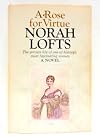
A Rose for Virtue
by Norah Lofts
On This Page
Description
Hortense Beauharnais finds herself rubbing shoulders with royalty as her mother remarries to become Napoleon Bonaparte's wife. Despite attempts to retain her individuality, Hortense finds herself married to Napoleon's brother Louis, but her heart is with Charles de Flahaut, a gallant young officer.Tags
Recommendations






















Member Reviews
I liked the opening line not for its content but for the way it makes me feel like I’ve just stepped into a room at the end of someone’s conversation. Starting in the middle of some action – in this case a conversation – is always a good way to hook the reader.
While I like Hortense’s first-person narrative, at times I had to re-read certain sentences to grasp their meaning. It’s a good style overall, but it features an element on confusion. Or maybe that’s just me.
I liked how the story tracks Napoleon’s fall and rise from Hortense’s viewpoint, though this does have drawbacks, namely that many exciting or dramatic events are “told”, not “shown”.
The most dramatic event that Hortense witnesses first-hand is not show more handled as well as it could’ve been. Without giving anything away, the scene involves two women and a waterfall. It starts off tense and frightening, but ultimately the scene lacks all sense of threat and drama. The consequences are not all that convincingly portrayed, either. I didn’t feel like I was there. It felt like reading a news report.
This is essentially a story of relationships, be they sexual, platonic, or otherwise. This aspect is what the author is best at. I felt sorry for Hortense being married to such a man as Louis Bonaparte. He’s a paranoid nutcase.
Just as I appreciate the novel’s first line, I equally appreciate the last line. Again, not because of its content, but from a creative writing point of view. show less
While I like Hortense’s first-person narrative, at times I had to re-read certain sentences to grasp their meaning. It’s a good style overall, but it features an element on confusion. Or maybe that’s just me.
I liked how the story tracks Napoleon’s fall and rise from Hortense’s viewpoint, though this does have drawbacks, namely that many exciting or dramatic events are “told”, not “shown”.
The most dramatic event that Hortense witnesses first-hand is not show more handled as well as it could’ve been. Without giving anything away, the scene involves two women and a waterfall. It starts off tense and frightening, but ultimately the scene lacks all sense of threat and drama. The consequences are not all that convincingly portrayed, either. I didn’t feel like I was there. It felt like reading a news report.
This is essentially a story of relationships, be they sexual, platonic, or otherwise. This aspect is what the author is best at. I felt sorry for Hortense being married to such a man as Louis Bonaparte. He’s a paranoid nutcase.
Just as I appreciate the novel’s first line, I equally appreciate the last line. Again, not because of its content, but from a creative writing point of view. show less
Hortense Beauharnais finds herself rubbing shoulders with royalty when her mother remarries to become the wife of Napoleon Bonaparte. As Napoleon struggles for power on the battlefields of Europe, so Hortense navigates her way through the French court - a precarious chessboard world where the motivations are jealousy and greed and the prizes are the thrones of conquered countries.
Despite attempts to retain her individuality, Hortense soon finds herself married to Napoleon's younger brother Louis - who is later crowned King of Holland. However, Hortense's heart belongs to Charles de Flahaut, a gallant young officer. Unwilling to cross her stepfather, Hortense must bide her time and wait and see whether time will take her to her lover.
I show more absolutely loved this book! It seems to be almost a forgone conclusion with me that I'll really enjoy any book written by Norah Lofts, I know, but that's just the way it has to be, I guess! :) In my opinion, she really captures the nuances of any particular historical period that she writes about.
Also, I find that the historical people who she writes about truly come alive - at least for me. I truly began to care for the characters as actual people, and not just as dry, historical symbols from a bygone era. I will certainly give this book an A+! and I definitely look forward to reading - or rereading - more books by this author in the future. show less
Despite attempts to retain her individuality, Hortense soon finds herself married to Napoleon's younger brother Louis - who is later crowned King of Holland. However, Hortense's heart belongs to Charles de Flahaut, a gallant young officer. Unwilling to cross her stepfather, Hortense must bide her time and wait and see whether time will take her to her lover.
I show more absolutely loved this book! It seems to be almost a forgone conclusion with me that I'll really enjoy any book written by Norah Lofts, I know, but that's just the way it has to be, I guess! :) In my opinion, she really captures the nuances of any particular historical period that she writes about.
Also, I find that the historical people who she writes about truly come alive - at least for me. I truly began to care for the characters as actual people, and not just as dry, historical symbols from a bygone era. I will certainly give this book an A+! and I definitely look forward to reading - or rereading - more books by this author in the future. show less
Another interesting historical fiction by Norah Lofts. This one documents the life of Hortense de Beauharnais Bonaparte, Napoleon Bonaparte's step-daughter, and wife to his brother, Louis Bonaparte. Hortense led a privileged, yet tragic life through the rise of Napoleon Bonaparte I's empire in the early 1800's. In the end, she was forced to flee France with her two sons when the empire fell and Napoleon was imprisoned on St. Helena Island in 1815. She was one of the few family members to be with The Little Corporal at the time of his defeat. Norah hints that Hortense may have been in love with her mother's husband, but this is undocumented.
It might have been better for Norah Lofts to have kept to writing English history rather than made any attempt at French history. This novel cannot compare with her earlier works [about Anne Boleyn] such as The Concubine or The King’s Pleasure. She has taken a very ugly rumor from contemporary English newspapers, not to mention having invented her own, & woven them into a barely mediocre novel.
In no source whatsoever have I read mention of a fourth illegitimate child born unto Hortense. And then the ending, in which Lofts writes of Hortense realizing that Napoleon always comes first instead…what rubbish!
If the author had perhaps proofread her own work, she might have realized that the ending contradicted several incidences earlier show more in the book. Such as Hortense’s constant concern for her lover, then the Emperor, then Eugine. But unfortunately, she had not taken that precaution & the result is a totally ludicrous work, unworthy of the author. show less
In no source whatsoever have I read mention of a fourth illegitimate child born unto Hortense. And then the ending, in which Lofts writes of Hortense realizing that Napoleon always comes first instead…what rubbish!
If the author had perhaps proofread her own work, she might have realized that the ending contradicted several incidences earlier show more in the book. Such as Hortense’s constant concern for her lover, then the Emperor, then Eugine. But unfortunately, she had not taken that precaution & the result is a totally ludicrous work, unworthy of the author. show less
Fascinating.
Ratings
Members
- Recently Added By
Author Information

84+ Works 6,098 Members
Celebrated novelist Norah Lofts perfected the art of bringing the past alive in her works of historical fiction. She remains one of England's most distinguished and best loved women of letters, selling more than a million books and captivating generations of readers. Lofts' first novel, "I Met a Gypsy", won the American Booksellers' Award for show more 1935. In her long and prolific career, she wrote more than 60 books of nonfiction, biography and historical fiction, animating history and yet preserving historical accuracy. In works such as "Scent of Cloves" (1940), "Bless This House" (1954), and "Crown of Aloes" (1979), period detail and language are blended with a masterful storytelling technique. Lofts is also well known for biographical novels about great and fascinating women of history such as Anne Boleyn and Catherine of Aragon. In addition, Lofts has written thrillers under the pseudonym Peter Curtis and novels as Juliet Astley. Norah (Robinson) Lofts was born in Norfolk, England on August 27, 1904. She credited her history-teaching years, 1925 to 1936, for developing a sense of history which became the foundation for her writings. Married and the mother of two sons, she lived in an ancient English city, among medieval ruins, in a 250-year-old house. She died there on September 10, 1983. (Bowker Author Biography) show less
Common Knowledge
- Original publication date
- 1971
- People/Characters
- Hortense de Beauharnais, Queen Consort of Holland; Napoleon Bonaparte; Empress Josephine; Louis Bonaparte, King of Holland
Classifications
- Genres
- Fiction and Literature, General Fiction, Historical Fiction, Romance
- DDC/MDS
- 823.914 — Literature & rhetoric English & Old English literatures English fiction 1900- 1901-1999 1945-1999
- LCC
- PZ3 .L825 — Language and Literature Fiction and juvenile belles lettres Fiction and juvenile belles lettres Fiction in English
Statistics
- Members
- 116
- Popularity
- 281,727
- Reviews
- 5
- Rating
- (3.68)
- Languages
- English, German
- Media
- Paper, Audiobook, Ebook
- ISBNs
- 14
- ASINs
- 9