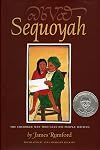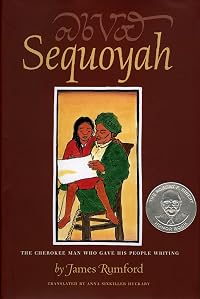
Sequoyah: The Cherokee Man Who Gave His People Writing
by James Rumford
On This Page
Description
While walking through a forest of sequoias, a father tells his family the story of the tree's namesake. Sequoyah was a Cherokee man who invented a system of writing for his people. His neighbors feared the symbols he wrote and burned down his home. All of his work was lost, but, still determined, he tried another approach. The Cherokee people finally accepted the written language after Sequoyah taught his six-year-old daughter to read.Tags
Recommendations


Member Reviews
With simple text and gorgeous illustrations, this brilliant bilingual picture-book by James Rumford highlights the achievements of Sequoyah, the Cherokee metalworker who invented a syllabary for his people's language. Born some time in the 1760s, Sequoyah spent most of his life in obscurity, only beginning his work on a writing system when he was approaching fifty. Ridiculed, and sometimes even persecuted by the those who feared that his signs were evil, he nevertheless persisted, eventually creating the 86-character syllabic system that is still in use today...
Rumford's narrative, translated into Cherokee by Anna Sixkiller Huckaby - the language training coordinator at the Cherokee Nation Cultural Resource Center - is a lyrical tribute show more to this extraordinary act of creation. His illustrations, done in ink, watercolor, pastel and pencil, are reminiscent of woodcuts, and have a lovely folk-quality to them. Included at the rear is a table with the complete syllabary, a brief afterword, and a time-line of Sequoyah's life. All in all, Sequoyah: The Cherokee Man Who Gave His People Writing is the sort of book that educates and entertains, all while providing a gorgeous aesthetic experience. Well worth the time of any reader with an interest in the Cherokee people, their writing system, or the man who created it. show less
Rumford's narrative, translated into Cherokee by Anna Sixkiller Huckaby - the language training coordinator at the Cherokee Nation Cultural Resource Center - is a lyrical tribute show more to this extraordinary act of creation. His illustrations, done in ink, watercolor, pastel and pencil, are reminiscent of woodcuts, and have a lovely folk-quality to them. Included at the rear is a table with the complete syllabary, a brief afterword, and a time-line of Sequoyah's life. All in all, Sequoyah: The Cherokee Man Who Gave His People Writing is the sort of book that educates and entertains, all while providing a gorgeous aesthetic experience. Well worth the time of any reader with an interest in the Cherokee people, their writing system, or the man who created it. show less
The story of Sequoyah is the tale of an ordinary man with an extraordinary idea—to create a writing system for the Cherokee Indians and turn his people into a nation of readers and writers. The task he set for himself was daunting. Sequoyah knew no English and had no idea how to capture speech on paper. But slowly and painstakingly, ignoring the hoots and jibes of his neighbors and friends, he worked out a system that surprised the Cherokee Nation—and the world of the 1820s—with its beauty and simplicity. James Rumford’s Sequoyah is a poem to celebrate literacy, a song of a people’s struggle to stand tall and proud. (Robert F. Sibert Informational Book Honor Award)
The story of Sequoyah is the tale of an ordinary man with an extraordinary idea--to create a writing system for the Cherokee Indians and turn his people into a nation of readers and writers. The task he set for himself was daunting. Sequoyah knew no English and had no idea how to capture speech on paper. But slowly and painstakingly, ignoring the hoots and jibes of his neighbors and friends, he worked out a system that surprised the Cherokee Nation--and the world of the 1820s--with its beauty and simplicity. James Rumford's Sequoyah is a poem to celebrate literacy, a song of a people's struggle to stand tall and proud.
This book about the man who invented a system of writing for the Cherokee people is an inspiring story of resiliency, hard work, and ethnic pride. I think that this book succeeded in achieving that which many other nonfiction children's books fail to do-- it stayed interesting while also remaining informative. I liked that this story read almost like a folk tale, which accommodated for any possible unverifiable information that may have been stated in the book. As I personally had no idea who Sequoya was before reading this book, I feel as though I've gained a decent understanding of him from this twenty-or-so-paged picture book. Admittedly, it is not so in-depth that I would give it to any child above a fifth grade reading level, but I show more was definitely recommend it for grades 1-5. show less
I found this book quite bothersome. While debate may continue about cultural authenticity and whether an outsider can write about a particular culture, I feel this book is an example of what can go wrong when white men try to write about Native Americans. Sequoyah's fellow Cherokee are described as "jeering," portrayed as needlessly violent and aggressive towards their own, and are basically the 'bad guys' Sequoyah must struggle against in order to finally 'overcome' and invent a system of Cherokee writing. The author notes in the book covers how much respect and interest he has in Native people, and yet, his portrayal is most prejudicial, and reflects white culture much more than Native culture. A very awkward read.
I would not show more recommend teachers or librarians utilize this book as part of any curriculum about Native Americans, as it promotes negative images of Native Americans. show less
I would not show more recommend teachers or librarians utilize this book as part of any curriculum about Native Americans, as it promotes negative images of Native Americans. show less
I liked this book for a couple reasons. One reason I liked this book was because it was about a person that most children in our society have never heard of. The book was about a Cherokee man who gave his people writing. Students today are unaware of history that doesn’t relate to them and that is why I like this book. The book provided the basic information that explained who the man was and how he did what he did. I also liked this book because of the extra text features that were incorporated into the story. This book had the English written words translated into the Cherokee written language and was placed beneath the English. This was a really interesting touch that the author included. It added new information for the readers show more and they were able to see what Sequoyah actually made for his people. The book also included a list of all the symbols that represent sounds in English in the back of the book. The main idea of this story was to inform readers about who Sequoyah was and what he did. And also to provide examples of leadership and perseverance. show less
This was a really great book, however, I'm not sure of the veracity of some of the factual information provided. The book says Sequoyah was a cripple, but another book, and the Sequoyah Birthplace Museum website states he was a soldier. This book's account of the destruction of his first attempts at developing the system of writing differs from the other book's which has more scholarly references. Still, it is an engaging book with beautiful pictures. I would use this book during a unit on Native Americans and the Cherokee. I could use it as a tie in if discussing a novel by or about a Native American (maybe referring to the "voices fading away" ...how relevant that is today!)
Members
- Recently Added By
Lists

Robert F. Sibert Informational Book Medal
102 works; 1 member

Books Read in 2025
4,091 works; 97 members
Author Information

22 Works 3,330 Members
All Editions
Awards and Honors
Awards
Distinctions
Common Knowledge
- Canonical title
- Sequoyah: The Cherokee Man Who Gave His People Writing
- People/Characters
- Sequoyah; Ayoka; Worcester
- Important places
- Tennesee (1760s)
- Dedication
- To my father, Sydney Rumford, who would stop the car to read every historic marker and who would certainly have told us this story.
- First words
- California, 1958.
- Last words
- (Click to show. Warning: May contain spoilers.)He was a leader because he showed his people how to survive--How to stand tall and proud like these trees.
Classifications
Statistics
- Members
- 367
- Popularity
- 85,610
- Reviews
- 42
- Rating
- (4.18)
- Languages
- English
- Media
- Paper, Ebook
- ISBNs
- 3
- UPCs
- 1
- ASINs
- 2