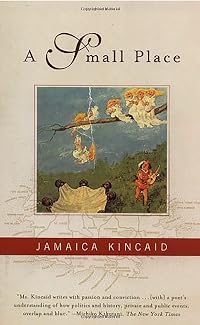
A Small Place
by Jamaica Kincaid
On This Page
Description
A brilliant look at colonialism and its effects in Antigua-by the author of Annie John "If you go to Antigua as a tourist, this is what you will see. If you come by aeroplane, you will land at the V. C. Bird International Airport. Vere Cornwall (V. C.) Bird is the Prime Minister of Antigua. You may be the sort of tourist who would wonder why a Prime Minister would want an airport named after him-why not a school, why not a hospital, why not some great public monument. You are a tourist and show more you have not yet seen . . ." So begins Jamaica Kincaid's expansive essay, which shows us what we have not yet seen of the ten-by-twelve-mile island in the British West Indies where she grew up. Lyrical, sardonic, and forthright by turns, in a Swiftian mode, A Small Place cannot help but amplify our vision of one small place and all that it signifies. show lessTags
Recommendations








Member Recommendations
Member Reviews
Jamaica Kincaid is pissed. Also: Jamaica Kincaid can write. It's a potent combination, and in such a small book it packs an awful lot of power. The first chapter, especially, is really a stunning read. She pulls no punches, and she's talking to you. Assuming you are or ever have been a tourist, especially.
The whole thing isn't written like that, and fortunately the whole thing isn't just a diatribe against—well, you. But those are the best parts. The best written and the most powerful. This is the first thing I've read from her, and in a way she reminds me of one of my favorite writers, bell hooks. I'll probably check out either Lucy or Autobiography of My Mother at some point. show less
An ugly thing, that is what you are when you become a tourist, an ugly, empty thing, a stupid thing, a piece of rubbish pausing here and there to gaze at this and taste that, and it will never occur to you that the people who inhabit the place in which you have just paused cannot stand you, that behind their closed doors they laugh at your strangeness (you do not look the way they look); the physical sight of you does not please them;show more
you have bad manners (it is their custom to eat their food with their hands; you try eating their way, you look silly; you try eating the way you always eat, you look silly); they do not like the way you speak (you have an accent); they collapse helpless from laughter, mimicking the way they imagine you must look as you carry out some everyday bodily function. They do not like you.So there.
The whole thing isn't written like that, and fortunately the whole thing isn't just a diatribe against—well, you. But those are the best parts. The best written and the most powerful. This is the first thing I've read from her, and in a way she reminds me of one of my favorite writers, bell hooks. I'll probably check out either Lucy or Autobiography of My Mother at some point. show less
This author is very angry, and I felt chastised! First among various reasons for being a tourist! It should be required reading for anyone vacationing in the Caribbean, where the tourists have plenty and the locals do not. Take for instance, water. Tourists can swim in it, and then bathe in it, and drink as much as they like. But many islands have no water source so the locals have to conserve every last drop. From there, the author delves into how the residents of Antigua came to live there—slave ships, and the dire faults in the English empire. It’s a tongue-lashing for sure.
We’ve all at some point been a tourist. To go somewhere you never knew, to explore, is almost natural. Almost. In this short book about her native Antigua, Kincaid lays bare the brutal heart of tourism and exploration, the narcissism of travel. Sparing no one, she also reveals the dangers of being tied to “a small place,” as she exposes the normal, human ugliness of Antigua, hidden by white sand beaches. If you’re willing to risk it, this surprisingly amiable book will leave you bruised and wiser.
I'm not sure I've ever come across a voice so forthright and beautiful at the same time. Jamaica Kincaid manages to reveal the underbelly of colonization (specifically in regard to her birthplace Antigua) while writing with blurry metaphor (blurry in the sense that things seems like metaphors and also not metaphors), wry humor, and a telling of political history in an almost folk-style narrative like a parable, but in reference to specific people. She unflinchingly deals out critiques yet manages to convey a sadness at the same time:
"And it is in that strange voice, then--the voice that suggests innocence, art, lunacy--that they say these things, pausing to take breath before this monument to rottenness, that monument to rottenness, as show more if they were tour guides; as if, having observed the event of tourism, they have absorbed it so completely that they have made the degradation and humiliation of their daily lives into their own tourist attraction." (69)
In eighty short pages, Kincaid shares a truthful experience of a land, the likes of which few get to see or experience when caught up in the "unreal beauty" of a tourist destination. Kincaid describes beauty as a prison, and in so doing, changes our understanding of that which might deserve a deeper look beyond the blue of the ocean and the colors of the sky. show less
"And it is in that strange voice, then--the voice that suggests innocence, art, lunacy--that they say these things, pausing to take breath before this monument to rottenness, that monument to rottenness, as show more if they were tour guides; as if, having observed the event of tourism, they have absorbed it so completely that they have made the degradation and humiliation of their daily lives into their own tourist attraction." (69)
In eighty short pages, Kincaid shares a truthful experience of a land, the likes of which few get to see or experience when caught up in the "unreal beauty" of a tourist destination. Kincaid describes beauty as a prison, and in so doing, changes our understanding of that which might deserve a deeper look beyond the blue of the ocean and the colors of the sky. show less
Salman Rushdie describes A Small Place perfectly on the back cover of my edition: "A jeremiad of great clarity and force that one might have called torrential were the language not so finely controlled."
This is an overwhelming piece, and a bitter one--Kincaid admits it openly. It is brutally honest and at times, in my opinion, even cruel (I think she is especially uncharitable to young Antiguans here). But the word that kept coming to mind was baffled; Jamaica Kincaid is baffled at the contradiction between the unreal beauty of Antigua and its poverty; baffled at the depth of its corruption and the way nobody seems to care; baffled at the colonial legacy and the way the descendants of slaves and colonizers now mingle in this strange show more twenty-first century.
A solid, jam-packed essay. A must-read for anyone who thinks critically about tourism, colonialism, or the unique culture and economy of island nations.
____________________
Global Challenge: Antigua & Barbuda show less
This is an overwhelming piece, and a bitter one--Kincaid admits it openly. It is brutally honest and at times, in my opinion, even cruel (I think she is especially uncharitable to young Antiguans here). But the word that kept coming to mind was baffled; Jamaica Kincaid is baffled at the contradiction between the unreal beauty of Antigua and its poverty; baffled at the depth of its corruption and the way nobody seems to care; baffled at the colonial legacy and the way the descendants of slaves and colonizers now mingle in this strange show more twenty-first century.
A solid, jam-packed essay. A must-read for anyone who thinks critically about tourism, colonialism, or the unique culture and economy of island nations.
____________________
Global Challenge: Antigua & Barbuda show less
An initial thought: Jamaica Kincaid is writing, as the blurb from Salman Rushdie alerts us, a “jeremiad.” She first expresses her discontent by scorning modern-day tourists in her native Antigua. She illustrates her feelings not by documenting behavior but by attributing behavior, a curious thing, as it duplicates the attitude, though not the damaging impact, of racial attributions made by the tourists’ ancestors.
But no. No. That’s not it. I mean, she is upset by the tourists but no, that’s not really the problem, this thing about how out-of-place the tourists are in this “small place” they treat as their own place. And while Antigua is a small place, and is her subject, the physical smallness is not her subject either. show more
The problem Kincaid is addressing is the smallness of place most Antiguans have in Antigua, the consciousness of that small place they have in comparison to the Europeans and North Americans there, in the small place that supposedly is their own.
To her mind and heart the situation is one from which she sees no justice issue, not from the foreign investors, the tourist economy, or her fellow citizens in government acting to procure riches and status for themselves alone. Kincaid is outraged, aghast, contemptuous, caustic, strident, vehement, accusatory. She repeatedly is witness to what is comic but what good is comedy without the reward brought by laughter and smiles? Bitter comedy it is.
She personalizes this in a gentler way, a way a book lover will appreciate, by expressing her love for a library:
“But if you saw the old library, situated as it was, in a big, old wooden building painted a shade of yellow that is beautiful to people like me, with its wide veranda, its big, always open windows, its rows and rows of shelves filled with books, its beautiful wooden tables and chairs for sitting and reading, if you could hear the sound of its quietness (for the quiet in this library was a sound in itself), the smell of the sea (which was a stone’s throw away), the heat of the sun (no building could protect us from that), the beauty of us sitting there like communicants at an altar, taking in, again and again, the fairy tale of how we met you, your right to do the things you did, how beautiful you were, are, and always will be; if you could see all of that in just one glimpse, you would see why my heart would break at the dung heap that now passes for a library in Antigua. The place where the library is now, above the dry-goods store, in the old run-down concrete building, is too small to hold all the books from the old building, and so most of the books, instead of being on their nice shelves, resting comfortably, waiting to acquaint me with you in all your greatness, are in cardboard boxes in a room, gathering mildew, or dust, or ruin.”
Imagine, then, will you, any one thing you ought to love best, would love best if it were possible. Further, imagine losing faith it can become possible. How would you feel? Read A Small Place with that thought dwelling in your imagination. Consider how impoverishing it would be to feel differently than does Jamaica Kincaid. show less
But no. No. That’s not it. I mean, she is upset by the tourists but no, that’s not really the problem, this thing about how out-of-place the tourists are in this “small place” they treat as their own place. And while Antigua is a small place, and is her subject, the physical smallness is not her subject either. show more
The problem Kincaid is addressing is the smallness of place most Antiguans have in Antigua, the consciousness of that small place they have in comparison to the Europeans and North Americans there, in the small place that supposedly is their own.
To her mind and heart the situation is one from which she sees no justice issue, not from the foreign investors, the tourist economy, or her fellow citizens in government acting to procure riches and status for themselves alone. Kincaid is outraged, aghast, contemptuous, caustic, strident, vehement, accusatory. She repeatedly is witness to what is comic but what good is comedy without the reward brought by laughter and smiles? Bitter comedy it is.
She personalizes this in a gentler way, a way a book lover will appreciate, by expressing her love for a library:
“But if you saw the old library, situated as it was, in a big, old wooden building painted a shade of yellow that is beautiful to people like me, with its wide veranda, its big, always open windows, its rows and rows of shelves filled with books, its beautiful wooden tables and chairs for sitting and reading, if you could hear the sound of its quietness (for the quiet in this library was a sound in itself), the smell of the sea (which was a stone’s throw away), the heat of the sun (no building could protect us from that), the beauty of us sitting there like communicants at an altar, taking in, again and again, the fairy tale of how we met you, your right to do the things you did, how beautiful you were, are, and always will be; if you could see all of that in just one glimpse, you would see why my heart would break at the dung heap that now passes for a library in Antigua. The place where the library is now, above the dry-goods store, in the old run-down concrete building, is too small to hold all the books from the old building, and so most of the books, instead of being on their nice shelves, resting comfortably, waiting to acquaint me with you in all your greatness, are in cardboard boxes in a room, gathering mildew, or dust, or ruin.”
Imagine, then, will you, any one thing you ought to love best, would love best if it were possible. Further, imagine losing faith it can become possible. How would you feel? Read A Small Place with that thought dwelling in your imagination. Consider how impoverishing it would be to feel differently than does Jamaica Kincaid. show less
In A Small Place, Jamaica Kincaid reflects on the legacy of colonialism and its interaction with tourism in Antigua. She condemns the colonists who forever changed the Antiguans' world, including their language, and left a vacuum when they left into which flooded various corrupt officials as well as the tourists who represent the latest assault on the island nation. Kincaid's acerbic wit adds a surprising amount of humor to her condemnation of these two forces that shaped her homeland. She has explored similar themes in her other work, but this one feels the most personal, the most unfiltered.
Members
- Recently Added By
Published Reviews
ThingScore 100
There are places worth revisiting not to relive joyful memories, but to allow for the catharsis that comes from exposing festering wounds so that cleansing, and perhaps healing, can begin. This is the kind of journey Jamaica Kincaid allows us to witness. In this essay, orginally published in 1988 and recently released in paperback, she takes us behind idyllic countrysides and sun-kissed show more beaches to examine the underbelly of life in Antigua, the tiny island in the West Indies where she grew up. It is a place she lovingly describes as "too beautiful." But Antigua also elicits bitter memories for our tour guide, who makes it clear she has an ax to grind in this short but powerful billyclub of a book. show less
added by meggyweg
Lists

500 Great Books by Women
507 works; 60 members

Literary Witches
86 works; 4 members

Second-person fiction
63 works; 3 members

Favorite Caribbean Books
60 works; 26 members

Books Read in 2023
5,638 works; 147 members

Sense of place
156 works; 13 members

Schomburg Centennial Reading List
100 works; 4 members

NTS Book Channel
316 works; 1 member
Author Information

51+ Works 8,480 Members
Jamaica Kincaid came to the United States in 1966 as a free-lance writer and is now on staff at the New Yorker. Her first volume of stories, At the Bottom of the River (1983), depicts men and women alienated from each other by conflict, physical separation, or death. The story "My Mother" vividly describes the painful separation between mother and show more daughter; and the stories in Annie John (1985) clearly reveal that the world of the past cannot be recaptured. Kincaid's poetic use of language and everyday images allows the reader to experience ordinary events with a new and heightened sensitivity. Kincaid is a relatively new writer whose works are beginning to receive critical attention. (Bowker Author Biography) Jamaica Kincaid, novelist, memoirist, & essayist, was born in St. John's, Antigua. Her books include At the Bottom of the River, Annie John, Lucy, The Autobiography of My Mother, and My Brother, all published by FSG. She lives with her family in Vermont. (Publisher Provided) show less
Awards and Honors
Work Relationships
Common Knowledge
- Original title
- A Small Place
- Original publication date
- 1988-01-01
- People/Characters
- Vere Cornwall Bird
- Important places
- Antigua; Caribbean Region; Leeward Islands; Antigua, Antigua and Barbuda; St. John's, Antigua, Antigua and Barbuda; England, UK (show all 9); British Empire; Antigua and Barbuda; Redonda, Antigua and Barbuda
- Important events
- Antiguan Earthquake (1974); Colonial Era; British Empire
- Dedication
- For Brian and Veronica Dyde; for my brothers Joseph, Dalma, and Devin Drew with love; and for William Shawn (again) with gratitude and love
- First words
- If you go to Antigua as a tourist, this is what you will see.
- Quotations
- As your plane descends to land, you might say, What a beautiful island Antigua is—more beautiful than any of the other islands you have seen, and they were beautiful, in their way, but they were much too green, much too lus... (show all)h with vegetation, which indicated to you, the tourist, that they got quite a bit of rainfall, and rain is the very thing that you, just now, do not want, for you are thinking of the hard and cold and dark and long days you spent working in North America (or, worse, Europe), earning some money so that you could stay in this place (Antigua) where the sun always shines and where the climate is deliciously hot and dry for the four to ten days you are going to be staying there; and since you are on your holiday, since you are a tourist, the thought of what it might be like for someone who had to live day in, day out in a place that suffers constantly from drought, and so has to watch carefully every drop of fresh water used (while at the same time surrounded by a sea and an ocean—the Caribbean Sea on one side, the Atlantic Ocean on the other), must never cross your mind.
In the Antigua that I knew, we lived on a street named after an English maritime criminal, Horatio Nelson, and all the other streets around us were named after some other English maritime criminals. There was Rodney Street, t... (show all)here was Hood Street, there was Hawkins Street, and there was Drake Street.
And then there was another place, called the Mill Reef Club. It was built by some people from North America who wanted to live in Antigua and spend their holidays in Antigua but who seemed not to like Antiguans (black people)... (show all) at all, for the Mill Reef Club declared itself completely private, and the only Antiguans (black people) allowed to go there were servants.
I attended a school named after a Princess of England. Years and years later, I read somewhere that this Princess made her tour of the West Indies (which included Antigua, and on that tour she dedicated my school) because she... (show all) had fallen in love with a married man, and since she was not allowed to marry a divorced man she was sent to visit us to get over her affair with him. How well I remember that all of Antigua turned out to see this Princess person, how every building that she would enter was repaired and painted so that it looked brand-new, how every beach that she would sun herself on had to look as if no one had ever sunned there before (I wonder now what they did about the poor sea? I mean, can a sea be made to look brand-new?), and how everybody she met was the best Antiguan body to meet, and no one told us that this person we were putting ourselves out for on such a big scale, this person we were getting worked up about as if she were God Himself, was in our midst because of something so common, so everyday: her life was not working out the way she had hoped, her life was one big mess.
(The people at the Mill Reef Club love the old Antigua. I love the old Antigua. Without question, we don't have the same old Antigua in mind.)
I had heard from many people that the person who wanted to develop that part of St. John's was a foreigner, who was once wanted in the Far East for swindling a government out of oil profits, a man so notorious that he cannot ... (show all)travel with a passport from the country of which he is a citizen but travels on a diplomatic passport issued by the government of Antigua.
(But let me just tell you something about Ministers of Culture: in places where there is a Minister of Culture it means that there is no culture. For have you ever heard of any culture springing up under the umbrella of a Min... (show all)ister of Culture? Countries with Ministers of Culture must be like countries with Liberty Weekend. Do you remember Liberty Weekend? In the week before Liberty Weekend, the United States Supreme Court ruled that ordinary grown-up people could not do as they pleased behind the locked doors of their own bedroom. I would have thought, then, that the people whose idea it was to have the Liberty Weekend business would have been so ashamed at such a repudiation of liberty that they would have cancelled the whole thing. But not at all; and so in a country that had less liberty than it used to have, Liberty Weekend was celebrated. In countries that have no culture or afraid they may have no culture, there is a Minister of Culture. And what is culture, anyway? In some places, it's the way they play drums; in other places, it's the way you behave out in public; and in still other places, it's just the way a person cooks food. And so what is there to preserve about these things? For is it not so that people make them up as they go along, make them up as they need them?) - Last words
- (Click to show. Warning: May contain spoilers.)Only once they are no longer slaves, once they are free, they are no longer noble and exalted; they are just human beings.
- Blurbers
- Kakutani, Michiko; Rushdie, Salman; Phillips, Caryl; Rodgers, Jeffrey
- Original language
- English
Classifications
- Genres
- Biography & Memoir, Nonfiction
- DDC/MDS
- 972.92 — History & geography History of North America Mexico, Central America, West Indies, Bermuda West Indies (Antilles) and Bermuda; Caribbean Jamaica; Cayman Islands
- LCC
- F2035 .K56 — Local History of the United States, Canada and Latin America Latin America. Spanish America Lesser Antilles Individual islands
- BISAC
Statistics
- Members
- 1,558
- Popularity
- 14,725
- Reviews
- 36
- Rating
- (3.79)
- Languages
- 6 — Dutch, English, German, Italian, Spanish, Swedish
- Media
- Paper, Audiobook, Ebook
- ISBNs
- 32
- ASINs
- 6