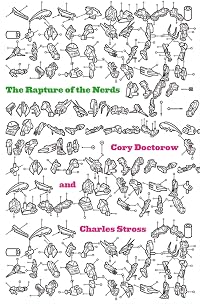
The Rapture of the Nerds
by Cory Doctorow, Charles Stross
On This Page
Description
Welcome to the fractured future, at the dusk of the twenty-first century. Earth has a population of roughly a billion hominids. For the most part, they are happy with their lot. Those who are unhappy have emigrated, joining the swarming dense thinker clades that fog the inner solar system with a dust of molecular machinery so thick it obscures the sun. The splintery metaconsciousness of the solar system has largely sworn off its pre-post-human cousins dirtside, but its minds sometimes wander show more ... and when that happens, it casually spams Earth's networks with plans for cataclysmically disruptive technologies that emulsify whole industries, cultures, and spiritual systems. A sane species would ignore these get-evolved-quick schemes, but there's always someone who'll take a bite from the forbidden apple. So until the overminds bore of stirring Earth's anthill, there's Tech Jury Service: random humans, selected arbitrarily, charged with assessing dozens of new inventions and ruling on whether to let them loose. Young Huw, a technophobic, misanthropic Welshman, has been selected for the latest jury, a task he does his best to perform despite an itchy technovirus, the apathy of the proletariat, and a couple of truly awful moments on bathroom floors. The Rapture of the Nerds is a brilliant collaboration by Cory Doctorow and Charles Stross, two of the defining personalities of post-cyberpunk science fiction. show lessTags
Recommendations






Member Recommendations
Member Reviews
Doctorow, Cory, and Charles Stross. The Rapture of the Nerds. Tor, 2012.
In The Rapture of the Nerds Cory Doctorow and Charles Stross are out on the kind of lark that only they could create. You have Doctorow’s skepticism about the Internet of Things and Stross’s Kafkaesque satire of bureaucracy on full display. And when they get together to lampoon American religious bigotry and hypocrisy, they pull all the stops. Here’s the premise: Hugh is a neo-luddite Welsh potter, whose parents have given up their meat bodies for a virtual life in in space. Poor Hugh is drawn into the center of things when he is put on a jury to evaluate the effects of off-planet technology on terrestrial society. Hugh is an absolute innocent in machinations show more that are his worst nightmares. Rapture holds up very well on rereading. show less
In The Rapture of the Nerds Cory Doctorow and Charles Stross are out on the kind of lark that only they could create. You have Doctorow’s skepticism about the Internet of Things and Stross’s Kafkaesque satire of bureaucracy on full display. And when they get together to lampoon American religious bigotry and hypocrisy, they pull all the stops. Here’s the premise: Hugh is a neo-luddite Welsh potter, whose parents have given up their meat bodies for a virtual life in in space. Poor Hugh is drawn into the center of things when he is put on a jury to evaluate the effects of off-planet technology on terrestrial society. Hugh is an absolute innocent in machinations show more that are his worst nightmares. Rapture holds up very well on rereading. show less
It's been a half-century or so since the advent of the Singularity, and most of humanity now exists as disembodied simulations in a solar system-spanning computational cloud. Huw Jones is one of those still stubbornly clinging to a low-tech meatspace existence, but that existence gets badly disrupted when he's selected for a jury empowered to decide whether the Earth should adopt or reject a weird piece of technology sent back by the uploaded masses, only to discover that he himself has been infected with, well, a weird piece of technology sent back by the uploaded masses.
It's a fun book, at least if you have a particularly geeky sense of fun, which I do. There's lots of wild imaginings, lots of silly jokes and sly references. I will show more say that by the time I got to the halfway point, I was starting to think, OK, this has been entertaining enough, but it feels like it's all flash and no substance, and another 150 pages of this is probably going to be entirely too much. But then, for the second half of the novel, things shifted a bit, not dramatically, but just enough to make me wonder if the two authors had split the writing just there at the midpoint, and I found myself actually engaged in the story, as well as entertained by all the creativity and ridiculousness. I did find the resolution a bit anticlimactic, or at least a bit too abstractly presented to be satisfying, but overall I enjoyed the novel for the crazy, nerdy romp it was. show less
It's a fun book, at least if you have a particularly geeky sense of fun, which I do. There's lots of wild imaginings, lots of silly jokes and sly references. I will show more say that by the time I got to the halfway point, I was starting to think, OK, this has been entertaining enough, but it feels like it's all flash and no substance, and another 150 pages of this is probably going to be entirely too much. But then, for the second half of the novel, things shifted a bit, not dramatically, but just enough to make me wonder if the two authors had split the writing just there at the midpoint, and I found myself actually engaged in the story, as well as entertained by all the creativity and ridiculousness. I did find the resolution a bit anticlimactic, or at least a bit too abstractly presented to be satisfying, but overall I enjoyed the novel for the crazy, nerdy romp it was. show less
Living on a ragged and ruined Earth, after most of humanity has uploaded itself into a thought cloud surrounding the Sun, Huw Jones mostly just wants to get drunk, work on his ceramics, and grouse about his long-gone parents. Then, one day, Jones gets swept up in a public inquiry about whether a new technology should be allowed to enter the reservation that is Earth. While Huw had looked forward to this process as an opportunity to vent his frustrations about his up-lifted parents, our protagonist soon finds himself in an infuriating adventure that is by turns dangerous and mind-boggling, and where he might just be forced to grow up and get a life. If you've read Doctorow or Stross in the past you have no good reason to avoid this book; show more this is unless the prospect of the singularity enthusiasts getting a few swift kicks you-know-where puts you off. show less
This was completely insane, but that's kind of what I expect when reading something from Cory Doctorow, especially when he teams up with Charles Stross. Though I love this narrator (I did it on audio) and I think he did a great job, this type of super-dense, advanced technology story might be easier to understand when you can easily backup and re-read sentences or entire paragraphs. Some of it definitely went right by me while I was driving or doing dishes.
If you're looking for something serious, this is not it, but at the same time it's not juvenile. The ideas are amazing, it's the delivery that makes it over the top ridiculous (in a good way, for me at least). Also extra points for multiple references to the Hitchhiker's Guide.
If you're looking for something serious, this is not it, but at the same time it's not juvenile. The ideas are amazing, it's the delivery that makes it over the top ridiculous (in a good way, for me at least). Also extra points for multiple references to the Hitchhiker's Guide.
There's a slight paradox with this execution of this book which might thrill or annoy the lot of it's readers: It reads like a Heinlein juvenile upgraded to all the geeky post-singularity hacking terms we can take a swing at.
Huh?
Specifically, I think of [b:Have Space Suit—Will Travel|20417|Have Space Suit—Will Travel|Robert A. Heinlein|https://images.gr-assets.com/books/1425593094s/20417.jpg|1984753] if we'd substituted a kid with an engineering project with a real-meat man in a completely digital society, get him embroiled in Objectivist Religionists (BIG LOL there), several courtroom dramas filled with some really zany characters such as a judge who is a dalek, and ends up with a galactic singularity overmind checking us over and show more using this poor sod to determine if we, as a species, deserves a chance to keep on living.
Fairly simple story and it reads very quick, but the best part (or the worst, depending on your tolerance for geeking out with tech and post-singularity societies,) has got to be the world-building and the ideas, with the satire being a distant third. :)
I personally love singularty stories. And if you need a description, just assume that all matter has been turned into computers and we've all been uploaded as pure minds to live in any kinds of realities we desire, then you'll have a pretty good feel for it.
But where's the conflict? Oh, it's all mental and ideological and sometimes even territorial as long as you can wrap your mind around major causality loops when you tamper with the fundamental forces of matter. :)
In other words, this is a simple story with a dense layer of computronium and satire wrapped around it like bacon around a nice juicy steak.
Not that it doesn't have it's flaws, of course, but if you like this kind of thing, you really shouldn't miss it. :) show less
Huh?
Specifically, I think of [b:Have Space Suit—Will Travel|20417|Have Space Suit—Will Travel|Robert A. Heinlein|https://images.gr-assets.com/books/1425593094s/20417.jpg|1984753] if we'd substituted a kid with an engineering project with a real-meat man in a completely digital society, get him embroiled in Objectivist Religionists (BIG LOL there), several courtroom dramas filled with some really zany characters such as a judge who is a dalek, and ends up with a galactic singularity overmind checking us over and show more using this poor sod to determine if we, as a species, deserves a chance to keep on living.
Fairly simple story and it reads very quick, but the best part (or the worst, depending on your tolerance for geeking out with tech and post-singularity societies,) has got to be the world-building and the ideas, with the satire being a distant third. :)
I personally love singularty stories. And if you need a description, just assume that all matter has been turned into computers and we've all been uploaded as pure minds to live in any kinds of realities we desire, then you'll have a pretty good feel for it.
But where's the conflict? Oh, it's all mental and ideological and sometimes even territorial as long as you can wrap your mind around major causality loops when you tamper with the fundamental forces of matter. :)
In other words, this is a simple story with a dense layer of computronium and satire wrapped around it like bacon around a nice juicy steak.
Not that it doesn't have it's flaws, of course, but if you like this kind of thing, you really shouldn't miss it. :) show less
This was a weird story that I wasn't sure of, until the last 3rd of the book. After the Singularity, most humans have uploaded themselves into the cloud and are off-world. Huw is one of the ones that remain dirtside. Somehow he is tapped to speak for humanity to keep an alien intelligence from destroying and absorbing our world (think Vogon contructor fleet). It was the odd post-cyberpunk fare that I'd come to expect from Doctorow. A decent listen.
Set in a post-singularity world where much of humanity has uploaded to a solar-system wide computational cloud. Earth is split between societies of extremes, with religious fundamentalists reigning in much of what is left of a post-nuclear USA. Our protagonist is Huw, an avowed technophobe whose parents uploaded to the cloud some years ago. Baffling and sometimes dangerous technology is sometimes made available through the cloud net back to the earth-dwelling; Huw is offered the chance to serve on a jury which is to decide whether to allow one item of this to be used. But the system is both corrupt and ineffective and Huw is drawn into an increasingly perilous series of scrapes in which, amongst many other things, he must again show more encounter his parents.
This is unashamed techno-fiction which moves at a relentless pace and it was only partly effective for me. I've read quite a lot of Stross's solo work but none of Doctorow's and I certainly wasn't able to recognise how the writing had been split between them. In style, it felt something like Stross on steroids and wasn't the better for it. Enjoyable but certainly not amongst my favourite Stross works. show less
This is unashamed techno-fiction which moves at a relentless pace and it was only partly effective for me. I've read quite a lot of Stross's solo work but none of Doctorow's and I certainly wasn't able to recognise how the writing had been split between them. In style, it felt something like Stross on steroids and wasn't the better for it. Enjoyable but certainly not amongst my favourite Stross works. show less
Members
- Recently Added By
Lists

Books Read in 2024
4,727 works; 128 members
Author Information

121+ Works 25,983 Members
Writer and activist Cory Doctorow was born in Toronto, Canada on July 17, 1971. In 1999 he co-founded a free software company called Opencola and served as Canadian Regional Director of the Science Fiction and Fantasy Writers of America. For four years he worked as European Affairs Coordinator for the Electronic Frontier Foundation and in 2007 won show more its Pioneer Award. His first novel, Down and Out in the Magic Kingdom, won a Locus Award for Best First Novel. His short story collection A Place So Foreign and Eight More won a Sunburst Award, and his bestselling novel Little Brother received the 2009 Prometheus Award, a Sunburst Award, and the John W. Campbell Memorial Award. Doctorow also writes nonfiction books and articles, and he co-edits the blog Boing Boing. (Bowker Author Biography) show less

119+ Works 45,499 Members
Born in Leeds, England, Charles Stross knew he wanted to be a science fiction writer from the age of six. Despite this, he went to university in London and qualified as a Pharmacist. He made his first writing sale to Interzone in 1986, and sold about a dozen stories elsewhere throughout the late 1980s and early 1990s. He now writes fiction show more full-time, has sold about 16 novels, has won one Hugo award and been nominated nearly a dozen times, and has been translated into about a dozen languages. He is the author of the Merchant Princes series. His latest book, The Revolution Business, is the fifth in this series. He lives in Edinburgh, Scotland, with his wife Feorag. (Bowker Author Biography) show less
Some Editions
Awards and Honors
Work Relationships
Is contained in
Contains
Common Knowledge
- Canonical title
- The Rapture of the Nerds
- Original title
- The Rapture of the Nerds
- Alternate titles
- The Rapture of the Nerds: A tale of the singularity, posthumanity, and awkward social situations
- Original publication date
- 2012-09-04
- People/Characters
- Huw Jones; Bonnie; Adrian; Ayn Rand
- Important places
- Monmouth, Monmouthshire, Wales, UK; Tripoli, Libya; South Carolina, USA; Io
- Dedication
- Cory: For Alice. I renew my vow not to fork any new instances without your permission.
Charlie: For Feorag. Just because! - First words
- Huw awakens, dazed and confused.
- Last words
- (Click to show. Warning: May contain spoilers.)"All right, then," he says, "let's do it. Want a cup of tea?"
- Publisher's editor
- Nielsen Hayden, Patrick
- Blurbers
- Link, Kelly
- Original language
- English
- Disambiguation notice
- The novel is a fixup of two novellas, "Jury Duty" and "Appeals Court", along with a new third section, "Parole Board".
Classifications
Statistics
- Members
- 856
- Popularity
- 31,974
- Reviews
- 43
- Rating
- (3.31)
- Languages
- English
- Media
- Paper, Audiobook, Ebook
- ISBNs
- 14
- ASINs
- 9