
Synergetics: Explorations in the Geometry of Thinking
by R. Buckminster Fuller, E. J. Applewhite
On This Page
Description
Synergetics: Explorations in the Geometry of Thinking by R. Buckminster Fuller (1975)Tags
Recommendations
























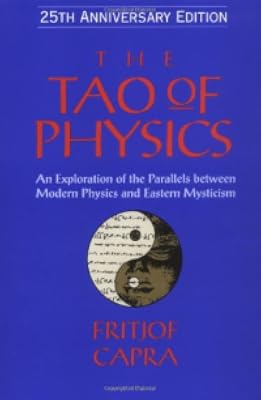
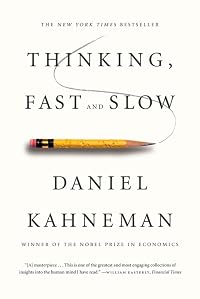


Member Reviews
In short: only read Synergetics after reading an 'interpretation' of Bucky's ideas by other writers.
Synergetics is a book that is impossible to rate with a star-rating. So I won't.
This is a an 800 page condensation of Buckminster Fuller's 50-year investigations into geometry, mathematics, physics, and metaphysics. It is formatted like a textbook, with every paragraph assigned a categorisation number ("524.101", "524.11", etc).
The fact that the book is almost exclusively about physics and metaphysics makes it harder for the layperson to understand than some of Bucky's other books. By contrast, his other books are about his more practical, everyday-life inventions and philosophies. Be warned!
Bucky does little to extend an olive branch to show more his readers. His text is heavy with his unusual jargon, as well as paragraph-length sentences. By his own account, Bucky preferred to be not understood than misunderstood. Therefore, he would rather you re-read a sentence out of sheer necessity, rather than skim through and misunderstand his points.
Despite reading horror stories of the book being utterly incomprehensible, I managed to get a good sense of what Bucky describes in Synergetics. I achieved this mostly by forcing myself to focus on the words, rather than relying on Bucky to pave an easy path. Having a reasonable understanding of high school Physics also helped.
The other reason why I was able to understand the book is because I had read a 'plain-English primer' of Bucky's ideas via the great biography Buckminster Fuller's Universe (1989), which remains the best book I have read about Bucky. This is the approach I recommend for other readers, in conjunction with the books A Fuller Explanation by Amy C. Edmondson and Bucky: a guided tour of Buckminster Fuller by Hugh Kenner.
Not being a mathematician, I am unable to verify the worthiness of the concepts described within this book. Bucky claims that it all fits within the parameters of conventional mathematics, though he emphasises a 60°, triangle-based coordinate system, rather than a 90°, square-based coordinate system. This flows into his philosophical conception of 'the geometry of thought', as described in the book.
By now you've already decided whether you want to read this book or not. For most people, reading books about Bucky will suffice. Others will be drawn to the magnetic allure of Synergetics through its reputation. As mentioned, I recommend reading only after being pre-primed by other writers' interpretations!
Side note: I was a little alarmed with how easily Bucky dismisses the concept of evolution. If he really disputes the Darwinian concept of simple organisms evolving into complex organisms, he really should have devoted more than a flimsy one-page dismissal to the topic. His arguments are easily demolished. I presume this oversight does not cloud the validity of the rest of his book... show less
Synergetics is a book that is impossible to rate with a star-rating. So I won't.
This is a an 800 page condensation of Buckminster Fuller's 50-year investigations into geometry, mathematics, physics, and metaphysics. It is formatted like a textbook, with every paragraph assigned a categorisation number ("524.101", "524.11", etc).
The fact that the book is almost exclusively about physics and metaphysics makes it harder for the layperson to understand than some of Bucky's other books. By contrast, his other books are about his more practical, everyday-life inventions and philosophies. Be warned!
Bucky does little to extend an olive branch to show more his readers. His text is heavy with his unusual jargon, as well as paragraph-length sentences. By his own account, Bucky preferred to be not understood than misunderstood. Therefore, he would rather you re-read a sentence out of sheer necessity, rather than skim through and misunderstand his points.
Despite reading horror stories of the book being utterly incomprehensible, I managed to get a good sense of what Bucky describes in Synergetics. I achieved this mostly by forcing myself to focus on the words, rather than relying on Bucky to pave an easy path. Having a reasonable understanding of high school Physics also helped.
The other reason why I was able to understand the book is because I had read a 'plain-English primer' of Bucky's ideas via the great biography Buckminster Fuller's Universe (1989), which remains the best book I have read about Bucky. This is the approach I recommend for other readers, in conjunction with the books A Fuller Explanation by Amy C. Edmondson and Bucky: a guided tour of Buckminster Fuller by Hugh Kenner.
Not being a mathematician, I am unable to verify the worthiness of the concepts described within this book. Bucky claims that it all fits within the parameters of conventional mathematics, though he emphasises a 60°, triangle-based coordinate system, rather than a 90°, square-based coordinate system. This flows into his philosophical conception of 'the geometry of thought', as described in the book.
By now you've already decided whether you want to read this book or not. For most people, reading books about Bucky will suffice. Others will be drawn to the magnetic allure of Synergetics through its reputation. As mentioned, I recommend reading only after being pre-primed by other writers' interpretations!
Side note: I was a little alarmed with how easily Bucky dismisses the concept of evolution. If he really disputes the Darwinian concept of simple organisms evolving into complex organisms, he really should have devoted more than a flimsy one-page dismissal to the topic. His arguments are easily demolished. I presume this oversight does not cloud the validity of the rest of his book... show less
Greatest companion math book every written.
I would not try to read this without the index, which is in Synergetics 2. Both can be read online:
http://www.rwgrayprojects.com/synergetics/toc/toc.html
http://www.rwgrayprojects.com/synergetics/toc/toc.html
Ratings
Members
- Recently Added By
Published Reviews
Would you care to index an 876 pp book prefaced by these words in the 'Moral of the Work'? Apparently no one would. Synergetics has no index, but this note on its last page:
'The attention of the reader is directed to the detailed Table of Contents for each chapter, which has been supplied by the author in lieu of an index, with each paragraph numbered.' There are twelve chapters, entitled: show more Synergy, Synergetics, Universe, System, Conceptuality, Structure, Tensegrity, Operational Mathematics, Medelability, Omnitopology, Triangular Geodesies Transformational Projection, Numerology. Each is divided into numbered sections; sections into numbered paragraphs. Thus, chapter 2, Synergetics, appears in the Contents List as: show less
'The attention of the reader is directed to the detailed Table of Contents for each chapter, which has been supplied by the author in lieu of an index, with each paragraph numbered.' There are twelve chapters, entitled: show more Synergy, Synergetics, Universe, System, Conceptuality, Structure, Tensegrity, Operational Mathematics, Medelability, Omnitopology, Triangular Geodesies Transformational Projection, Numerology. Each is divided into numbered sections; sections into numbered paragraphs. Thus, chapter 2, Synergetics, appears in the Contents List as: show less
added by KayCliff
Lists

Books We'd Want on a Desert Island
204 works; 133 members
Author Information

75+ Works 4,437 Members
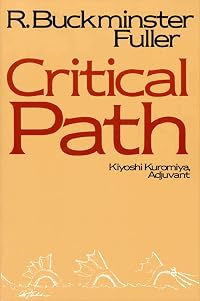
Richard Buckminster "Bucky" Fuller, the innovative thinker, engineer, and inventor, was born July 12, 1895 in Milton, Massachusetts. Despite early failures and tragedies, including his being expelled from Harvard University twice and the death of his four-year-old daughter, Fuller went on to achieve many successes. He is best known for inventing show more the geodesic dome; his design has been used in structures all over the world. Besides Harvard, Fuller also attended the U.S. Naval Academy, and was a professor at Southern Illinois University. He is the author of Synergetics: Explanations in the Geometry of Thinking, a book that discusses the utopic role technology will play in the future. Critical Path is the book Fuller felt was his most important. It outlined his plan to rejuvenate earth through the use of technology. His last book, Grunch of Giants, summarizes his most important ideas. Fuller was awarded 28 United States patents and many honorary doctorates. In 1968 he was elected into the National Academy of Design as an Associate member. In 1970 he received the Gold Medal award from the American Institute of Architects. He also received the Presidential Medal of Freedom presented to him on February 23, 1983 by President Ronald Reagan. (Bowker Author Biography) show less
7+ Works 552 Members
Work Relationships
Has as a supplement
Common Knowledge
- Canonical title
- Synergetics: Explorations in the Geometry of Thinking
- Dedication
- This work is dedicated to H.S.M. Coxeter Professor of Mathematics University of Toronto...I dedicate this work with particular esteem for him and in thanks to all the geometers of all time whose importance to humanity he epit... (show all)omizes.
- First words
- We are in an age that assumes the narrowing trends of specialization to be logical, natural and desirable.
- Quotations
- A complex of further discoverabilities is inherent in
eternally regenerative Universe and its omni-inter-accommodative
complex of unique and eternal generalized principles. It is inherently potential in the integrity
unity that god is the unknowable totality of generalized
principles which are only surprisingly unveiled, thereby
synergetically inaugurating entirely new, heretofore
unpredicted—because unpredictable—ages. - Last words
- (Click to show. Warning: May contain spoilers.)All the great metaphysical integrity of all the individuals, which is potential and inherent in the complex interactions of generalized principles, will always and only coexist eternally
Classifications
Statistics
- Members
- 304
- Popularity
- 105,883
- Reviews
- 3
- Rating
- (4.07)
- Languages
- English
- Media
- Paper
- ISBNs
- 2


