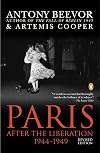
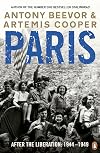
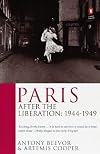
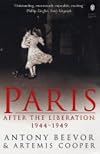
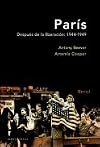
Paris After the Liberation: 1944-1949
by Antony Beevor (Author), Artemis Cooper (Author)
On This Page
Description
In this brilliant synthesis of social, political, and cultural history, Antony Beevor and Artemis Cooper present a vivid and compelling portrayal of the City of Lights after its liberation. Paris became the diplomatic battleground in the opening stages of the Cold War. Against this volatile political backdrop, every aspect of life is portrayed: scores were settled in a rough and uneven justice, black marketers grew rich on the misery of the population, and a growing number of intellectual show more luminaries and artists including Hemingway, Beckett, Camus, Sartre, de Beauvoir, Cocteau, and Picasso contributed new ideas and a renewed vitality to this extraordinary moment in time. show lessTags
Recommendations
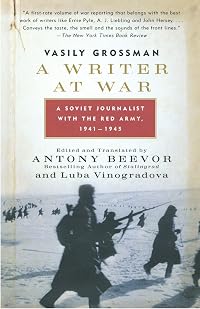
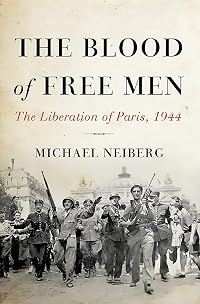
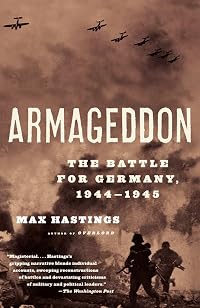
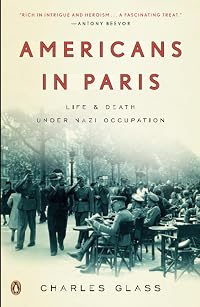















Member Recommendations
Member Reviews
The book in itself is absolutely enthralling. I’ve been a fan of Beevor’s nonfiction prose since I came across a paperback copy of his Berlin – a signed copy, no less! (Sadly a bit worn) – at my now-defunct Dutch auction haunt some years ago. So this one has been on my internal “must-read”-list for quite some time now.
Add to this the contributions of his wife, the always entertaining Artemis Cooper, and you have a very solid constellation.
Now, I’ve never fancied myself an expert on post-war France – not by any stretch – but I was somewhat aware that the years of the Cold War was also quite confusing and convoluted in many ways. This book proves that I wasn’t completely off. You are taken on an exhaustive – but not show more exhausting – tour of the frankly Byzantine chain of events, starting with a meeting between Marshal Petain, De Gaulle, and the rest of the French top brass in 1940.
It’s all there. All the stuff you might associate with France after the war. The intellectuals, the counterculture, the Communists. And yet, it never gets boring. Although I did find myself needing to look up certain names and events from time to time.
A central narrative role – for quite valid reasons – is performed by the power-couple Duff and Diana Cooper, later the 1st Viscount Norwich and Lady Diana Cooper, respectively (Lady Diana refused to be adressed as “Viscountess Norwich”, as she thought it sounded too much like “porridge”). Cooper was the UK ambassador to France from 1944-48 – and the paternal grandfather of Artemis Cooper.
In closing – as I don’t want to spoil too much of this great book – I flat-out loved it. No two ways about it. If you like 20th-Century history – and Beevor’s work in general – you’ll love this one.
5/5 show less
Add to this the contributions of his wife, the always entertaining Artemis Cooper, and you have a very solid constellation.
Now, I’ve never fancied myself an expert on post-war France – not by any stretch – but I was somewhat aware that the years of the Cold War was also quite confusing and convoluted in many ways. This book proves that I wasn’t completely off. You are taken on an exhaustive – but not show more exhausting – tour of the frankly Byzantine chain of events, starting with a meeting between Marshal Petain, De Gaulle, and the rest of the French top brass in 1940.
It’s all there. All the stuff you might associate with France after the war. The intellectuals, the counterculture, the Communists. And yet, it never gets boring. Although I did find myself needing to look up certain names and events from time to time.
A central narrative role – for quite valid reasons – is performed by the power-couple Duff and Diana Cooper, later the 1st Viscount Norwich and Lady Diana Cooper, respectively (Lady Diana refused to be adressed as “Viscountess Norwich”, as she thought it sounded too much like “porridge”). Cooper was the UK ambassador to France from 1944-48 – and the paternal grandfather of Artemis Cooper.
In closing – as I don’t want to spoil too much of this great book – I flat-out loved it. No two ways about it. If you like 20th-Century history – and Beevor’s work in general – you’ll love this one.
5/5 show less
This starts very well, and it is clear the authors have researched exhaustively, but after a while you do start to wish they would stop talking about Duff Cooper.
I enjoyed Antony Beevor's book on the Spanish Civil War so was eager to see what he made of post-Liberation Paris. Well-written and including the actions of some interesting figures (Hemingway, Orwell and a Rothschild or two), I found "Paris after the Liberation ..." more interesting than many of the others who have rated the book here.
Perhaps the most surprising figure in the book was that of Claus von Bulow, most famous for his alleged attempted murder of his wife, but interviewed here about his memories of post-Liberation Paris. He doesn't disclose anything too amazing or show more scandalous; he attended a party in an odd costume, but I felt the book was better for his inclusion. show less
I enjoyed Antony Beevor's book on the Spanish Civil War so was eager to see what he made of post-Liberation Paris. Well-written and including the actions of some interesting figures (Hemingway, Orwell and a Rothschild or two), I found "Paris after the Liberation ..." more interesting than many of the others who have rated the book here.
Perhaps the most surprising figure in the book was that of Claus von Bulow, most famous for his alleged attempted murder of his wife, but interviewed here about his memories of post-Liberation Paris. He doesn't disclose anything too amazing or show more scandalous; he attended a party in an odd costume, but I felt the book was better for his inclusion. show less
A marvellously absorbing history of Paris in the final year of the war after Liberation and the immediate post-war years, covering the whole range of issues - the desperate economic situation, political chaos, military tensions within the wartime alliance and the start of the Cold War, but also the intellectual life, and the worlds of fashion, art and literature, in many cases closely tied to political developments. Great stuff.
In a way this is two books in one, mirroring the diversity of its authors. I was wondering how Antony Beevor, obviously a respected war historian and author, came to write a book with Artemis Cooper, who clearly has written several books based on the access to her grand parents (Duff and Diana Cooper) and their friends. (this is not meant as a criticism to her writing, I have not read any of her books and am very interested in the lives of the people she has been writing about) Thanks to my friend the Wikipedia, I discovered that the authors are married, which explains a lot. I hope that their marriage in real life is more happy than the marriage of their styles in this book.
I appreciate the personal stories and observations of the show more elite in Paris at the time, whether it is Picasso, Sartre or the Duke of Windsor; and I am very interested in the facts and politics of the time. But, the way these two are intertwined makes for a surprisingly flowing, but also unsatisfying read, as the vignettes are often just briefly mentioned, without a conclusion and leave you wondering what happened next. In a way this book is not a fish and not a bird, which may frustrate the more purist readers. While I really like both genres and enjoy reading this book, also because of its variety, interesting facts and just the depth of information, I probably would have enjoyed reading two separate books more.
I would like the book to include a Who is who section, as there are many names to keep track of, and many destinies that are left hanging. I guess that this would make another book though:). show less
I appreciate the personal stories and observations of the show more elite in Paris at the time, whether it is Picasso, Sartre or the Duke of Windsor; and I am very interested in the facts and politics of the time. But, the way these two are intertwined makes for a surprisingly flowing, but also unsatisfying read, as the vignettes are often just briefly mentioned, without a conclusion and leave you wondering what happened next. In a way this book is not a fish and not a bird, which may frustrate the more purist readers. While I really like both genres and enjoy reading this book, also because of its variety, interesting facts and just the depth of information, I probably would have enjoyed reading two separate books more.
I would like the book to include a Who is who section, as there are many names to keep track of, and many destinies that are left hanging. I guess that this would make another book though:). show less
Somebody took an entertaining and informative history book and crossbred it with Hello magazine. More information and less gossip and this book would have rated higher.
Tras un breve preludio que incluye el colapso de la nación y la ocupación de París por los alemanes, el colaboracionismo y la resistencia, los autores nos describen las iluminosas jornadas de la liberación, el París, año cero de Simone de Beauvoir, de Sastre, de Camus y de Malraux, pero también de Hemingway, de Beckett, de Picasso y de García Marquéz, las purgas salvajes, el gobierno provisional, el regreso de los presos y exiliados, la guerra fría, la bulliciosa vida intelectual del barrio latino, los americanos en París o el papel desempeñado por el Partido Comunista francés en un libro excepcional escrito a partir de documentos oficiales, archivos privados, memorias personales e historias orales de los protagonistas de show more aquellos inolvidables años de optimismo y de esperanza. Tecnicamente se trata de un libro excepcional, pero además su lectura es pura delicia: apasionante, revelador, divertido y admirablemente tolerante y objetivo en sus opiniones. No se puede hacer mejor. show less
Jan 20, 2017Spanish
Un excellent ouvrage à quatre mains... Ce regard étranger apporte beaucoup (de fraicheur) sur cette époque parisienne si particulière. Un très bon ouvrage.
Mar 25, 2016French
Members
- Recently Added By
Author Information

British historian Antony Beevor was born on December 14, 1946. He was educated at Winchester College and Sandhurst and studied under the well-known World War Two historian, John Keegan. Beevor was an officer with the 11th Hussars for five years before becoming a writer. His works have received awards including the Runciman Prize, the Samuel show more Johnson Prize, the Wolfson Prize for History, and the Hawthornden Prize for Literature. The French government made him a Chevalier de l'Ordre des Arts et des Lettres in 1997, and in 2008 the president of Estonia awarded him the Order of the Cross of Terra Mariana. In 1999 Beevor was elected a Fellow of the Royal Society of Literature. He received the 2014 Pritzker Military Museum and Library Literature Award for Lifetime Achievement in Military Writing. In 2015 he made The New Zealand Best Seller List with his title Ardennes 1944: Hitler's Last Gamble. (Bowker Author Biography) show less

Some Editions
Work Relationships
Common Knowledge
- Canonical title
- Paris After the Liberation: 1944-1949
- Original title
- Paris After the Liberation: 1944-1949
- Alternate titles
- Paris After the Liberation 1944-1949
- Original publication date
- 1994 (1e édition originale anglaise, Hamish Hamilton, Londres) (1e é | dition originale anglaise, Hamish Hamilton, Londres); 2004 (Nouvelle édition anglaise révisée, Hamish Hamilton, Londres) (Nouvelle é | dition anglaise ré | visé | e, Hamish Hamilton, Londres); 2004-05-06 (1e traduction et édition française, Perrin) (1e traduction et é | dition franç | aise, Perrin); 2014-08-21 (Réédition française, Tempus, Perrin) (Ré | é | dition franç | aise, Tempus, Perrin); 2024-08-21 (Réédition française, Calmann-Lévy) (Ré | é | dition franç | aise, Calmann-Lé | vy)
- People/Characters
- Charles de Gaulle; Claus von Bülow
- Important places
- Paris, France; France
- Important events
- World War II (1939 | 1945)
- Dedication
- To our parents
- Blurbers
- Ziegler, Philip; Hamrick, S. J.; Todd, Olivier; Coward, David; Read, Piers Paul
- Original language*
- Anglais (Royaume-Uni) (Royaume-Uni)
*Some information comes from Common Knowledge in other languages. Click "Edit" for more information.
Classifications
- Genres
- History, Nonfiction, General Nonfiction
- DDC/MDS
- 944.361082 — History & geography History of Europe France and Monaco Champagne; Ile de France; Lorraine Île-de-France Paris
- LCC
- DC737 .B38 — History of Europe, Asia, Africa and Oceania France – Andorra – Monaco History of France Local history and description Paris
- BISAC
Statistics
- Members
- 662
- Popularity
- 43,630
- Reviews
- 7
- Rating
- (3.68)
- Languages
- 11 — Danish, Dutch, English, Finnish, French, Norwegian (Bokmål), Norwegian, Polish, Portuguese, Spanish, Swedish
- Media
- Paper, Audiobook, Ebook
- ISBNs
- 37
- ASINs
- 11