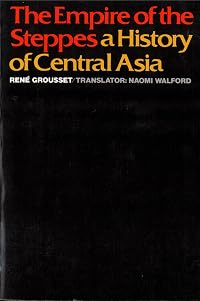
The Empire of the Steppes: A History of Central Asia
by René Grousset
On This Page
Description
.While the early history of the steppe nomad is shrouded in obscurity, The Empire of the Steppes brings both the general reader and the specialist the majestic sweep, grandeur and the overriding intellectual grasp of Grousset's original. Hailed as a masterpiece when first published in French in 1939, and in English in 1970, this great work of synthesis brings before us the people of the steppes, dominated by three mighty figures--Atilla, Genghiz Khan, and Tamberlain--as they marched through show more ten centuries of history, from the borders of China to the frontiers of the West. The book includes nineteen maps, a comprehensive index, notes, and bibliography. The late Rene Grousset was director of the Cernuschi Museum and curator of the Muse Guimet in Paris, a member of the French Academy and author of many works on Asia Minor and the Near East. show lessTags
Recommendations












Member Reviews
An engaging narrative synthesis from the earliest artifacts to the fall of the Mongols. I have no idea how much is speculation nor how much has been superseded since the book was published in 1939. Nevertheless, I had a much better understanding of the course of Central Asian history, the religious affiliations of the various khans, and why the empire disintegrated.
This is an opinionated book, the author doesn’t disguise his affinity for Genghis Khan, or his loathing of Tamerlane. He makes educated generalizations about the effect of nomadic life vs. sedentary civilization.
This is an opinionated book, the author doesn’t disguise his affinity for Genghis Khan, or his loathing of Tamerlane. He makes educated generalizations about the effect of nomadic life vs. sedentary civilization.
An impressive book, and remarkably, adequately mapped. The translation reads well, and though the text on occasion may dissolve into a confusing mass of the names of short-lived rulers and states, there is a lot to be retained. The index is useful, and I don't believe there is yet a better one volume work on this topic.
I'm sure this was a great work in its day, but, reading the introduction, I found it (or at least the English translation) to be dated. For instance it said some of the tribes in the northern Russian steppe "remained savage." Certainly not a word current historians or anthropologists would use. Since I just want an overview, I'm going to look elsewhere.
http://www.fireandsword.com/Reviews/empiresteppes.html
This masterful history by one of France’s most distinguished scholars piqued my youthful interest with its tales of wild tribes in remote places of Asia. I still keep The Empire of the Steppes on my shelf as a reference work and simply as an interesting read.
This masterful history by one of France’s most distinguished scholars piqued my youthful interest with its tales of wild tribes in remote places of Asia. I still keep The Empire of the Steppes on my shelf as a reference work and simply as an interesting read.
great, one of my favorite historys.
Ratings
Members
- Recently Added By
Lists

Books recommended in the history category on FiveBooks.com
329 works; 4 members
Author Information

84 Works 1,038 Members
Some Editions
Awards and Honors
Awards
Common Knowledge
- Canonical title*
- Histoire de l'empire mongol
- Original title
- L'Empire des steppes : Attila, Gengis-Khan, Tamerlan
- Original publication date
- 1939 ; 1970 (English Translation) (English Translation)
- People/Characters
- Attila the Hun
- Original language
- French
*Some information comes from Common Knowledge in other languages. Click "Edit" for more information.
Classifications
Statistics
- Members
- 402
- Popularity
- 77,712
- Reviews
- 5
- Rating
- (3.90)
- Languages
- 5 — Chinese, English, French, German, Spanish
- Media
- Paper
- ISBNs
- 14
- ASINs
- 1